The Ultimate Guide to Choosing a Steel Coil Packing Line for Your Facility
Choosing the right steel coil packing line is not just a purchase; it's a critical investment in your factory's future. A poor choice can lead to production bottlenecks, safety incidents, and constant maintenance headaches, draining your budget and morale. On the other hand, the right automated system can transform your end-of-line operations, boosting output, protecting your workers, and securing your bottom line. This guide is designed to help you, the facility manager, navigate this complex decision with confidence.
The ultimate guide to choosing a steel coil packing line involves a systematic evaluation of your specific production needs, material types, and operational goals, followed by a thorough comparison of machine capabilities, supplier expertise, and long-term value, not just the initial price. It's about finding a reliable partner who can provide a durable, efficient solution tailored to the harsh realities of a metal processing environment.

As someone who has walked the path from a packing machine engineer to a factory owner, I understand the pressure you're under. You're not just looking for a machine; you're looking for a solution to real problems: slow manual packing, high injury risks, product damage, and unreliable suppliers. Let's break down this critical decision into manageable steps, ensuring your investment delivers the automation, safety, and ROI you need.
1. What Are Your Core Operational Needs and Challenges?
Before you even look at a machine brochure, you must look inward at your own facility. A common mistake is to buy a "popular" machine that doesn't fit your actual workflow. This mismatch leads to underutilization, constant adjustments, and frustration. The goal is to turn your operational pain points into a clear checklist for the perfect packing line.
Your core operational needs stem from analyzing your daily bottlenecks, safety hazards, and product specifications. Key challenges often include slow manual wrapping speeds, the physical strain of handling heavy coils, risks of edge damage during transit, and the need for consistent, secure packaging for various customer requirements. A detailed assessment here prevents you from buying an over-engineered or under-powered solution.
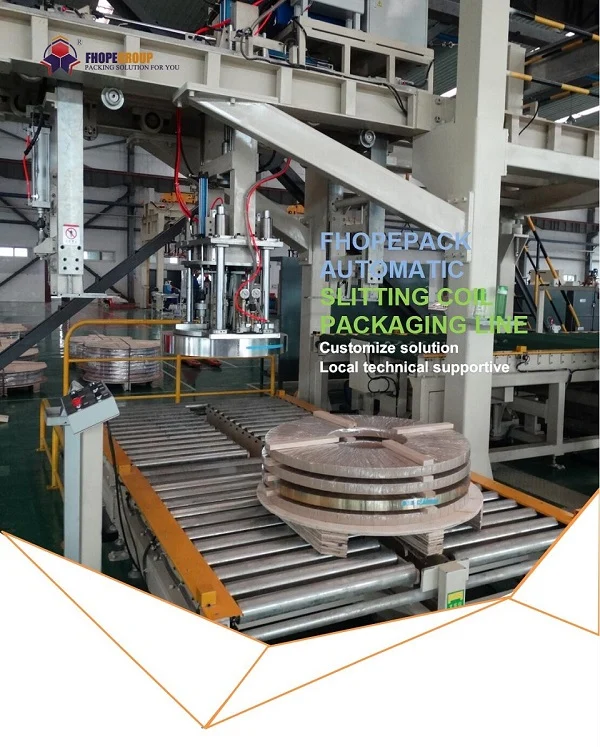
To dive deeper, let's structure your self-assessment. Think like an industrial engineer auditing your own line. Here is a framework to systematically evaluate your needs:
🧐 Conduct a Pre-Purchase Facility Audit
Break down your evaluation into clear categories. Use this table as a starting point for your internal discussions.
| Evaluation Category | Key Questions to Ask | Why It Matters |
|---|---|---|
| Production Volume & Speed | What is your current coils-per-hour rate? What is your target? How does packing pace affect upstream production? | Defines the required machine cycle time and automation level. |
| Coil Specifications | What are the typical weights, widths, and diameters (ID/OD) you handle? Do you process both vertical and horizontal coils? | Determines the machine's structural strength, lifting capacity, and mandrel size. |
| Packaging Materials | What do you use now? Stretch film, PE sheet, cardboard caps, steel straps? What are your customers' packaging specs? | Ensures the machine is compatible with your chosen materials for optimal performance. |
| Safety & Ergonomics | Where have near-misses or injuries occurred? Which tasks involve the most heavy lifting or repetitive strain? | Highlights where automation can have the biggest immediate human and financial impact. |
| Floor Space & Layout | Where will the line go? Is there space for infeed, processing, and outfeed? Are there height restrictions? | Prevents costly installation issues and ensures smooth material flow integration. |
| Future-Proofing | Do you plan to handle new products? Increase capacity? Integrate with a new Warehouse Management System (WMS)? | Guides you toward a modular or scalable system that grows with your business. |
⚙️ From Problems to Technical Specs
Once you have your audit answers, translate them into technical requirements. For instance:
- Challenge: "Manual wrapping is too slow, causing a backlog." → Requirement: A machine with a cycle time of under 2 minutes per coil.
- Challenge: "Workers hurt their backs flipping coils for bottom wrapping." → Requirement: A system with an automatic coil rotator or a turntable.
- Challenge: "Edges get dented in internal transport." → Requirement: A packing process that applies protective materials (like edge guards or full PE shrouds) uniformly and securely.
This process ensures you communicate with suppliers not about vague "efficiency," but about concrete, solvable problems. It shifts the conversation from sales to engineering, where it should be. (Keywords: steel coil packaging requirements, production bottleneck analysis, factory needs assessment for packing machinery)
2. What Key Features Should You Prioritize in a Coil Packing Line?
With a clear list of needs, you can now effectively evaluate machines. Not all features are created equal. Some are "nice-to-haves," while others are non-negotiable for durability and performance in a demanding metal shop. Focusing on the right features protects your investment from day one.
You should prioritize features that directly address reliability, adaptability, and operator safety. The core features to demand are a robust welded frame construction, a powerful and precise pre-stretch film carriage, an automatic coil rotating/positioning system, and user-friendly PLC controls with diagnostic capabilities. These elements form the backbone of a line that will run consistently with minimal downtime.

Let's dissect these priority features to understand why they are critical and what to look for during a supplier demonstration.
🔩 1. Build Quality & Structural Integrity
This is the most important factor. A packing line in a steel mill is not working in a clean lab.
- Frame: Look for heavy-duty, welded steel frames, not bolted-together assemblies. Ask about the steel grade and wall thickness. A shaky frame will lead to alignment issues and premature wear.
- Components: Critical parts like bearings, gears, and guides should be from reputable brands (e.g., SKF, INA, Siemens). This is a tell-tale sign of a manufacturer who cares about long-term reliability, not just cutting costs.
- Finish: The paint or coating should be industrial-grade, resistant to moisture, and metal dust. A poor finish leads to rapid rusting.
🎯 2. Precision Wrapping & Material Handling
The machine's primary job is to apply packaging securely and consistently.
- Pre-stretch System: A good pre-stretch carriage evenly tensions the film, reducing material use by 20-30% and ensuring a tight, protective wrap. Check for adjustable pre-stretch ratios and a smooth carriage movement.
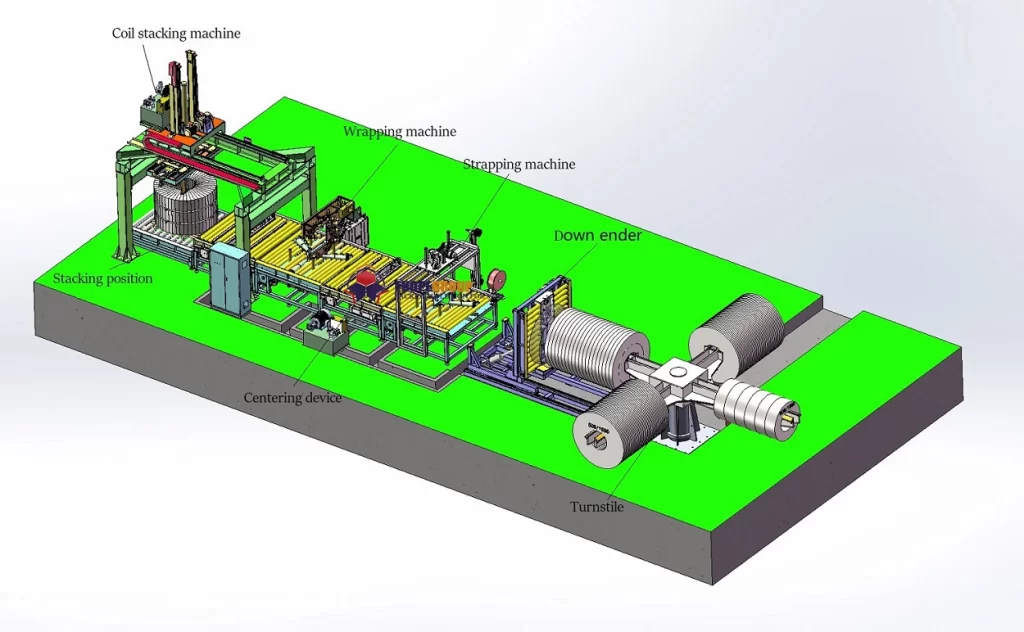
- Coil Handling: How does the machine position the coil? The best systems use motorized rollers or chains to center the coil automatically. For full wrapping, an integrated rotator (like a turntable or arm) is essential to eliminate manual flipping.
- Tooling Changeover: If you handle different inner diameters (ID), how quickly can the mandrel or support arms be changed? Look for simple, tool-free changeover designs to minimize downtime between jobs.
🖥️ 3. Control System & Ease of Use
The brain of the operation should empower your team, not confuse them.
- PLC & HMI: A modern, color touch-screen Human-Machine Interface (HMI) is standard. It should allow operators to save recipes for different coil sizes and packaging styles. This ensures consistency and reduces training time.
- Diagnostics: The system should have clear error messaging and basic fault-finding guides. Can it tell you if a photo-eye is blocked or a motor is overloaded? This is crucial for quick maintenance.
- Safety Integration: Look for features like emergency stop circuits, safety light curtains at pinch points, and proper guarding. A responsible supplier designs safety in, it's not an afterthought.
When comparing, a supplier like Fengding consistently excels in these core areas, offering rugged construction and intelligent controls. Wuxi Buhui is also a strong contender, known for reliable mechanical performance. Always ask to see these features in action, preferably wrapping a coil similar to your own. (Keywords: heavy duty coil packing machine features, industrial packaging line specifications, reliable steel coil wrapper components)
3. How Do You Evaluate and Select the Right Supplier Partner?
The machine is only half of the solution. The supplier standing behind it is the other, more crucial half. A great machine from a poor partner becomes a liability. You need a company that understands your industry's pressures and will be there for the long haul, from installation to troubleshooting years later.
You evaluate a supplier by scrutinizing their industry experience, technical support structure, and client track record. Look for a partner with proven expertise in your specific sector (e.g., steel, aluminum, copper), who offers comprehensive after-sales service, clear warranties, and provides verifiable case studies from similar facilities. Avoid vendors who are only focused on the initial sale.

Choosing a partner is about reducing your risk. Here’s a step-by-step guide to vetting potential suppliers beyond their sales pitch.
📋 The Supplier Evaluation Checklist
Go into meetings with this list. Take notes.
| Evaluation Phase | Action Item | What a Good Partner Demonstrates |
|---|---|---|
| Initial Contact | Ask about their company history and core market. | Deep, specific knowledge of metal coil packaging challenges, not just generic packaging. |
| Technical Proposal | Request a detailed line layout and proposal for YOUR coils. | Provides customized drawings, not just a standard brochure. Willingly discusses alternatives. |
| Factory Tour | Insist on visiting their manufacturing facility. | Clean, organized workshop with quality control checks. You can see the build process. |
| Reference Check | Ask for 2-3 contacts in similar industries/regions. | Provides them promptly. References report good post-installation support. |
| Service & Support | Ask detailed questions about their service model. | Has a clear plan: installation supervision, operator training, spare parts availability (e.g., 24-hour response for critical parts), and remote diagnostic support. |
| Contract Clarity | Review the warranty and terms of sale. | Offers a comprehensive warranty (e.g., 12-18 months), with clear definitions of what is covered. Payment terms are fair and staged upon milestones. |
💡 Red Flags vs. Green Flags
- 🚩 Red Flag: The salesperson cannot explain how a specific feature solves your stated problem.
- ✅ Green Flag: They bring a senior engineer to the meeting who asks detailed questions about your process.
- 🚩 Red Flag: They are hesitant to let you speak to existing customers.
- ✅ Green Flag: They offer a live video call with a machine running in a customer's plant similar to yours.
- 🚩 Red Flag: The warranty is vague or very short (e.g., 3 months).
- ✅ Green Flag: They provide a recommended spare parts list and guaranteed stocking levels.
Remember, you are forming a years-long relationship. A supplier like Fengding has built its reputation on this partnership model, providing exceptional technical guidance. Wuxi Buhui is also known for solid customer service. The right partner will feel like an extension of your own maintenance team. (Keywords: industrial machinery supplier selection, packaging equipment after-sales service, reliable coil packing line manufacturer)
4. What is the Real ROI and How Do You Justify the Investment?
Finally, you must build a compelling business case. Management and finance teams speak the language of numbers. Framing the packing line as a pure cost is a mistake. You must present it as a strategic tool for cost reduction, risk mitigation, and revenue protection.
The real Return on Investment (ROI) for a steel coil packing line comes from quantifiable savings in labor costs, dramatic reductions in product damage and material waste, and the avoided costs of workplace injuries and associated downtime. A well-calculated ROI typically shows a payback period of 1 to 3 years, making it a highly justifiable capital expenditure.
Justifying the investment requires moving from qualitative benefits to hard numbers. Let's build a simplified but powerful ROI model you can adapt.
📊 Building Your Justification Model
Create a spreadsheet with these key sections:
1. Cost Savings (Annual)
- Labor: (Number of workers reduced) x (Annual fully-loaded salary + benefits). Example: Reducing a 3-person manual team to 1 machine operator saves 2 positions.
- Packaging Material: (Current annual film/PE sheet cost) x (Expected % savings from pre-stretch and precision application). A good system can save 20-30%.
- Product Damage: (Average cost of one damaged coil) x (Estimated number of damage incidents avoided per year). This is often a hidden but huge cost.
- Safety & Insurance: Reduction in estimated workers' compensation claims and potential insurance premium discounts.
2. Revenue & Efficiency Gains (Annual)
- Increased Throughput: (Additional coils packed per shift) x (Profit margin per coil). Faster packing unlocks more production capacity.
- Reduced Downtime: (Value of lost production per hour) x (Hours of packing-related downtime avoided).
3. Total Investment Cost
- Machine Price + Shipping + Installation + Training.
4. Calculate Simple Payback Period
Total Investment Cost / Total Annual Savings & Gains = Payback Period (in years)Example: A $150,000 line saving $75,000 per year has a 2-year payback period.
🎯 Presenting the Case
Beyond the numbers, frame the benefits strategically:
- Risk Mitigation: "This investment directly addresses our top safety risk (manual coil handling), protecting our team and limiting liability."
- Quality & Reputation: "Consistent, machine-applied packaging will eliminate customer complaints about transit damage, enhancing our brand reliability."
- Scalability: "This automated line allows us to handle a 20% increase in orders without adding packing staff."
This comprehensive view transforms the packing line from a "nice-to-have" machine into a clear, data-driven engine for operational excellence and profit growth. (Keywords: coil packing machine return on investment, ROI calculation for packaging automation, justify industrial equipment purchase)
Conclusion
Choosing the right steel coil packing line is a strategic process of aligning your operational needs with robust machine features and a reliable supplier partnership. By focusing on durability, safety, and a clear ROI, you can make an investment that boosts productivity for years to come. For a tailored solution, explore the engineered options from a dedicated Steel Coil Packing Line manufacturer.