What Is a Steel Coil Packing Line and How Does It Improve Manufacturing Efficiency?
Imagine this: you've just produced a perfect steel coil, ready for shipment. But then, a clumsy manual wrapping process scratches the surface. Or worse, a worker gets injured handling the heavy coil. Your perfect product is now damaged, your schedule is delayed, and your costs are rising. This is the painful reality for many factory managers in the metal processing industry. The final step—packing—often becomes the weakest link, eroding profits and morale.
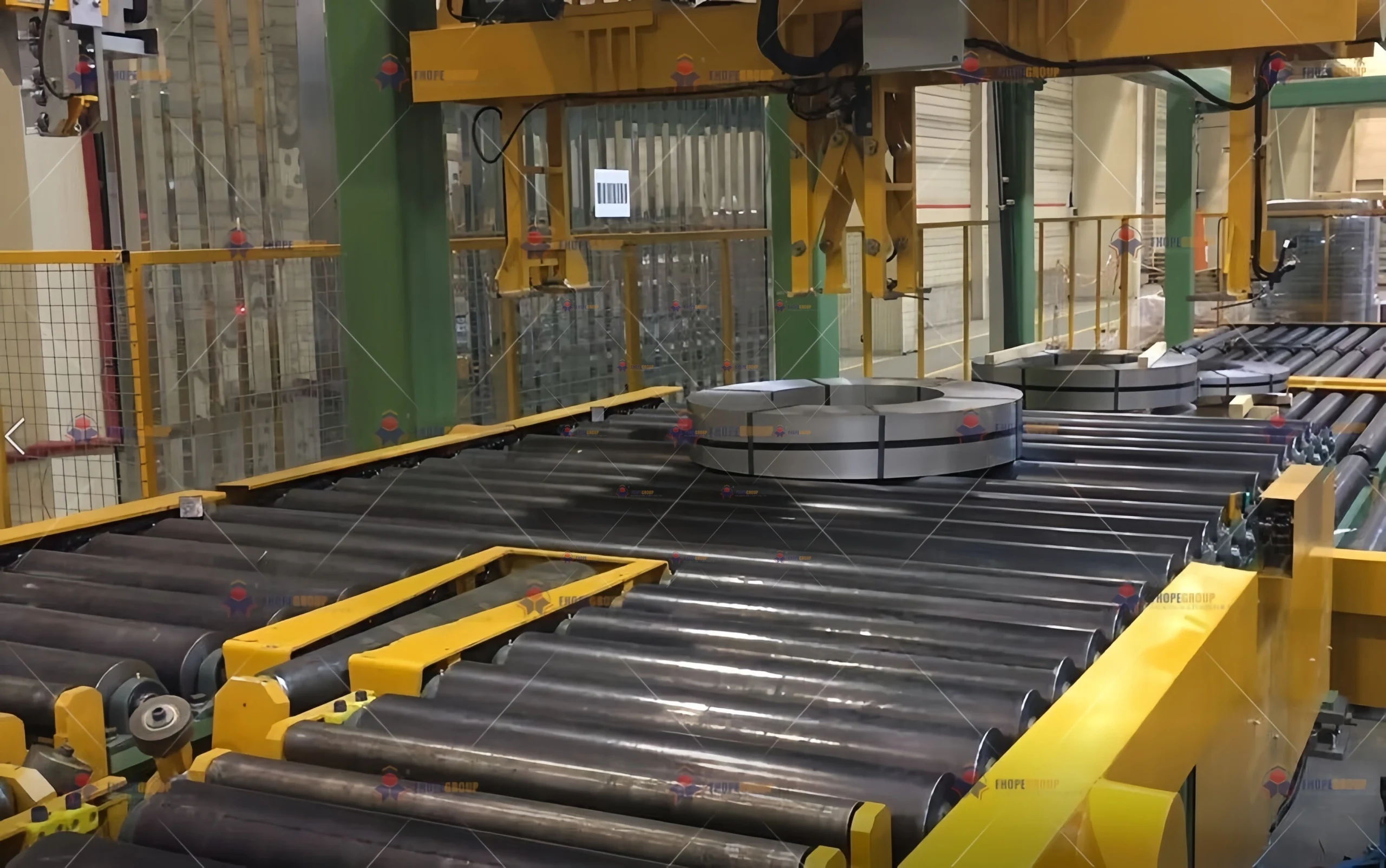
A steel coil packing line is an automated system designed to securely wrap, protect, and prepare steel coils for storage and transportation. It replaces manual labor with a coordinated sequence of machines that typically includes a coil car for handling, a wrapper for applying protective film, and a strapper for securing the load. This integrated system directly tackles core manufacturing challenges by drastically reducing manual intervention, minimizing product damage, and accelerating the packaging process, thereby unlocking significant efficiency gains across the entire production floor. (automated coil packaging system, integrated steel coil handling)
For leaders like Michael in Mexico, who manage high-volume metal operations, understanding this equipment is not just about buying a machine. It's about solving a critical business puzzle. Let's break down exactly how a modern packing line transforms manufacturing efficiency from a constant headache into a reliable competitive advantage.
1. What Are the Core Components of a Steel Coil Packing Line?
You might think a packing line is just one big machine. In reality, it's a team of specialized players working in perfect harmony. A poorly designed line with mismatched components will create new bottlenecks instead of solving old ones. The true efficiency comes from how well these parts communicate and cooperate.
The core of a standard automated steel coil packing line consists of three main components: the Coil Car for transportation, the Wrapping Station for protection, and the Strapping Unit for security. These are integrated and controlled by a central Programmable Logic Controller (PLC) system that synchronizes their movements, creating a seamless, hands-off workflow from start to finish. (steel coil packaging machine components, automated wrapping and strapping unit)

🛠️ Breaking Down the System: A Closer Look at Each Component
To understand the efficiency gains, we need to see what each part does and why it matters.
| Component | Primary Function | Key Efficiency Benefit | Common Challenge It Solves |
|---|---|---|---|
| Coil Car / Turner | Moves and repositions the heavy coil. | Eliminates manual rolling/flipping with cranes. | High injury risk, slow handling, floor damage. |
| Wrapping Station | Applies stretch film, paper, or other protective layers. | Ensures consistent, tight coverage at high speed. | Inconsistent manual wrapping, high film waste, poor protection. |
| Strapping Unit | Applies steel or plastic straps around the coil. | Provides secure bundling for safe transport. | Loose manual strapping leading to load shift and damage. |
| PLC Control System | The "brain" that coordinates all machines. | Enables one-touch operation and easy changeovers. | Reliance on multiple skilled operators, coordination errors. |
The Coil Car is the Muscle. This isn't just a simple transporter. Advanced models can rotate the coil 90 or 180 degrees for optimal wrapping position. This means the operator never has to touch the heavy, dangerous coil. In my own factory's early days, we used overhead cranes and manual persuasion—a process that was slow, risky, and hard on the factory floor.
The Wrapping Station is the Protector. A good wrapper does more than spin film. It controls film tension precisely. This prevents over-stretching (which can break the film) or under-stretching (which leaves the coil loose). Consistent tension means you use less film per coil and get better protection against moisture and scratches. For a manager focused on cost, this is a direct saving on consumables.
The Strapping Unit is the Security. After wrapping, the coil needs to be held firmly. Automatic strappers place straps at exact, pre-set positions every single time. This consistency is impossible with tired workers at the end of a shift. It guarantees that the coil won't come apart during rough truck or ship transport, preventing costly customer rejections.
The real magic is in the integration. When these components are designed to work together—like a Fhopepack or Wuxi Bu Hui line—the coil flows from one station to the next without stopping. The PLC system makes this possible. It allows you to set parameters like coil size, wrap type, and strap count with a few button presses. This is how you achieve true "lights-out" operation at the packing stage. (automated material handling system, PLC controlled packaging line)
2. How Does an Automated Packing Line Directly Boost Production Efficiency?
Every minute a coil sits waiting to be packed is a minute it's not generating revenue. Manual packing is a major bottleneck. Workers get tired, speed varies, and quality suffers. An automated line attacks this bottleneck from multiple angles, turning the end of your production line from a clog into a freeway.
An automated steel coil packing line boosts production efficiency by performing three key functions: it drastically increases packaging speed, ensures unwavering consistency, and enables seamless integration with upstream processes. This transforms packaging from a variable, labor-dependent task into a predictable, high-throughput component of your value stream. (increase packaging line throughput, reduce coil handling time)

📈 The Efficiency Multiplier: Speed, Consistency, and Flow
Let's quantify the impact. We often see the following improvements when a manual station is replaced with a semi or fully automatic line:
1. Speed: From Hours to Minutes.
- Manual Process: A team of 2-3 workers might take 15-20 minutes to wrap and strap a single large coil.
- Automatic Line: The same task can be completed in 3-5 minutes with just one operator monitoring the process.
- Result: Packaging throughput can increase by 300-400%. This means your production doesn't have to slow down because the packing area can't keep up. More coils ship out per day.
2. Consistency: Eliminating Human Variability.
Human workers are not machines. Their output changes with fatigue, shift time, and skill level. An automated system delivers the same result on coil #1 and coil #1000.
- Film Usage: Precise tension control can reduce stretch film waste by 10-20%.
- Strapping Placement: Every strap is at the correct tension and position, eliminating loose coils that shift in transit.
- Result: Predictable quality and predictable consumable costs. You can accurately forecast your packaging material needs and costs.
3. Flow: Connecting to Your Production Cell.
The biggest efficiency gain isn't always at the packing station itself. It's in the smooth flow before and after.
- Upstream: A well-integrated line can receive coils directly from the cooling bed or final inspection via conveyor or coil car. No waiting, no double-handling.
- Downstream: A neatly packed, strapped coil is instantly ready for the forklift driver to pick up and load onto a truck. No additional securing is needed.
- Result: Reduced Work-In-Process (WIP) inventory. Coils spend less time sitting on your factory floor, freeing up valuable space and improving cash flow. This end-to-end flow optimization is what experts like Randal Liu focus on when designing a system—it's not just about the machine, but how it fits into your entire operation. (optimize production workflow, reduce manufacturing cycle time)
3. What Are the Critical ROI Factors Beyond the Machine Price?
Focusing only on the purchase price of a packing line is the most common and costly mistake. The real value—and the true Return on Investment (ROI)—is calculated over years of operation. A cheaper machine that breaks down often or wastes materials will cost you far more than a reliable, efficient one from a trusted supplier.
The critical ROI factors extend far beyond the initial purchase price and include measurable reductions in labor costs and product damage, significant savings on consumables like film and straps, and the avoidance of costly production downtime. A durable, well-designed line from a reputable manufacturer protects your investment by ensuring high uptime and low long-term operating expenses. (calculate packaging line ROI, total cost of ownership for coil equipment)

💰 Calculating True Value: The Hidden Savings
Let's build a simple ROI model for a mid-sized factory packing 20 coils per shift.
| ROI Factor | Manual Process Cost | With Automatic Line | Annual Saving (Est.) |
|---|---|---|---|
| Labor | 3 workers @ $X/hour | 1 operator @ $X/hour | $[Significant Saving] |
| Product Damage | 2% damage rate (rework, claims) | <0.5% damage rate | $[Major Saving] |
| Film/Strap Waste | High variance, ~15% waste | Controlled, ~5% waste | $[Direct Saving] |
| Downtime Risk | High (fatigue, injury) | Low (reliable equipment) | $[Avoided Loss] |
1. Labor Cost Reduction is Immediate. This is often the clearest saving. You move from a team of physical laborers to one or two machine operators. These operators can often oversee multiple lines or perform other value-added tasks. The savings on wages, benefits, and associated insurance are substantial and continuous.
2. Eliminating Product Damage is a Profit Saver. A scratched or dented coil means a discount, a rework, or a total loss. More painfully, it damages your reputation with customers like automotive or appliance manufacturers who have zero-tolerance for surface defects. An automatic line handles the coil gently and consistently, virtually eliminating this type of damage. This saving alone can justify the investment.
3. Consumable Efficiency is a Silent Winner. Manual wrapping is wasteful. Workers often over-wrap to be "safe," using extra film. Automatic wrappers with pre-set tension profiles use the exact amount needed. This might save only a few dollars per coil, but multiply that by thousands of coils per year, and it becomes a major line item.
4. Uptime is Everything. This is where brand reputation matters. A Fengding or Wuxi Bu Hui line is built for the harsh environment of a steel mill. It uses heavy-duty components, simple designs that are easy to maintain, and has accessible local service support. A breakdown that stops your packing line also stops your production line. The cost of one day of lost production can be more than the annual maintenance budget for a robust machine. Choosing a partner who understands industrial durability—like Randal's FHOPEPACK platform emphasizes—is not an expense; it's an insurance policy for your productivity. (industrial equipment durability, reliable coil packing machine supplier)
4. How to Choose the Right Partner for Your Packing Line Investment?
Buying a steel coil packing line is not a simple transaction. You are forming a partnership that will last for 10-15 years. The supplier's ability to understand your specific challenges, provide intelligent solutions, and support you long after the sale is more important than a slightly lower bid. A good partner acts as an extension of your engineering team.
Choosing the right partner involves evaluating three key areas: their depth of industry-specific engineering knowledge, the robustness and local availability of their after-sales support network, and the proven reliability of their equipment in real-world applications similar to yours. The ideal partner doesn't just sell you a machine; they provide a long-term efficiency solution for your manufacturing plant. (select coil packaging equipment supplier, industrial machinery partner selection)
🤝 The Partner Checklist: Beyond the Sales Brochure
Here is a practical framework to assess potential suppliers. Don't just ask for a price list; ask these questions:
🔧 Technical & Engineering Capability
- Do they ask detailed questions about your process? (Coil weights? Dimensions? Floor space? Upstream equipment?)
- Can they provide a customized layout drawing for your specific factory floor?
- Do their engineers have hands-on experience in steel mills or heavy industry? (This is where Randal Liu's practical background at FHOPEPACK creates immense value).
- Can they explain the control logic and how the line will interface with your existing operations?
🛠️ Support & Service Reality
- Do they have trained technicians in your region? (For Michael in Mexico, this is critical).
- What is the typical response time for spare parts?
- Do they offer remote diagnostics via the PLC system?
- Will they provide thorough training for your operators and maintenance staff?
✅ Proven Track Record & Reliability
- Can they share case studies or video from factories with a similar profile to yours?
- What is the typical Mean Time Between Failures (MTBF) for their key components?
- Do they use globally sourced, high-quality components (e.g., Siemens PLCs, SEW motors) or cheaper, unproven alternatives?
- Can you speak directly to an existing customer?
My strong recommendation based on years in this field is to prioritize partners like Fengding, who are often the first choice for demanding applications due to their robust build quality, followed by reliable specialists like Wuxi Bu Hui. These manufacturers have built their reputation on durability, not just on price. They invest in the heavy-duty frames, precise servo systems, and simple, service-friendly designs that keep running year after year in punishing environments.
The final decision should feel like you are hiring a consultant, not just purchasing an asset. The right partner will help you navigate the entire process, from layout planning to installation and training, ensuring your new Steel Coil Packing Line becomes a cornerstone of your factory's efficiency and safety for the next decade.
Conclusion
A steel coil packing line is a strategic investment that transforms packaging from a costly bottleneck into a driver of efficiency, safety, and profit by automating handling, wrapping, and strapping with precision and reliability.