Key Differences Between Manual Steel Coil Packaging and Automated Packing Lines?
Imagine this: a shipment of high-grade steel coils is delayed because the packaging team can't keep up. Workers are exhausted from lifting heavy materials, and a small mistake causes a scratch on a coil's edge, leading to an angry customer and a financial loss. This scene is all too common in factories relying on manual methods. The pressure to ship faster, safer, and with zero damage is immense, and the old ways are breaking under the strain. (pain points of manual steel coil handling)
The core difference between manual steel coil packaging and automated packing lines lies in the shift from human-dependent, variable processes to a consistent, machine-driven system. Manual packaging relies on physical labor for lifting, wrapping, and securing, which is slow, inconsistent, and risky. Automated lines use machinery to perform these tasks with precision, speed, and minimal human intervention, transforming the end of the production line from a bottleneck into a competitive advantage. (automated steel coil packaging solutions)

You're not just choosing between two methods; you're deciding on the future efficiency and safety of your entire operation. The gap between manual and automated is wide, impacting everything from your bottom line to your team's well-being. Let's break down the key areas where this choice makes all the difference, so you can see exactly what you're gaining—or losing—with each approach.
1. How Do They Compare in Operational Efficiency and Speed?
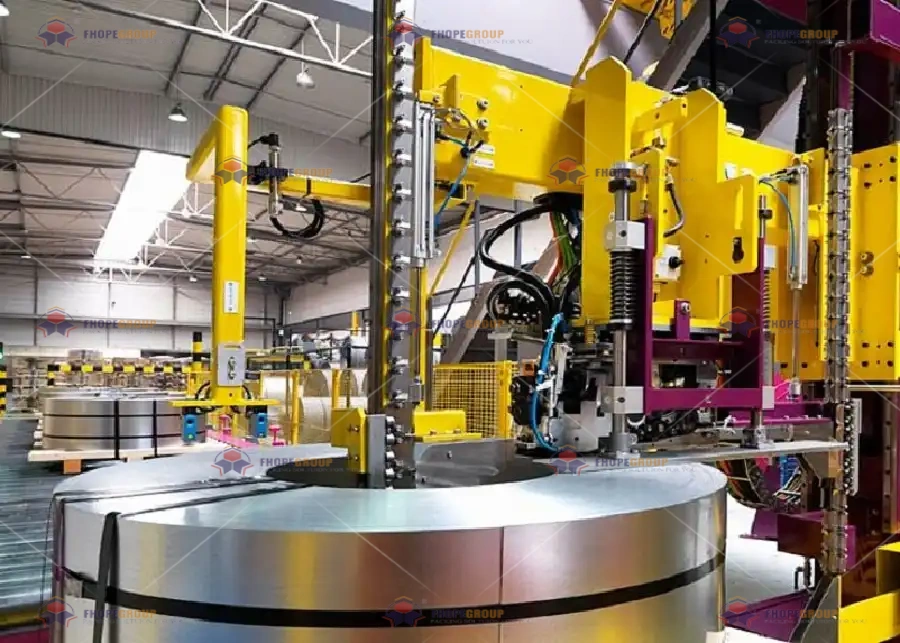
Picture a team of four workers manually wrapping a steel coil. They must position the coil, feed the film, walk circles around it, and secure the tail. It's physically demanding and time-consuming. Now, imagine a machine that positions, wraps, and cuts the film automatically in under a minute. The difference isn't just incremental; it's revolutionary for your throughput. (steel coil packaging throughput comparison)
Automated packing lines dramatically outperform manual methods in operational speed and consistency. A manual process might handle 5-10 coils per hour per team, heavily dependent on worker skill and fatigue. A standard automated coil wrapping line can consistently process 15-30 coils per hour, with some high-speed systems exceeding 40. This eliminates the packaging bottleneck, allowing production volume to flow smoothly to shipping. (high speed coil packaging machine)
🔄 Breaking Down the Efficiency Gains
The efficiency advantage of automation isn't a single number; it's a combination of factors that compound over time.
- Cycle Time Reduction: Manual wrapping is a sequential, step-by-step human process. Automation integrates steps (lifting, rotating, wrapping, strapping) into one fluid, continuous cycle.
- 24/7 Operation Potential: Machines don't need breaks, shifts, or suffer from fatigue. With proper maintenance, an automated line can operate nearly continuously, maximizing asset utilization.
- Elimination of Variability: Human speed varies throughout the day. A machine's speed is programmed and constant, making production scheduling and output forecasting accurate and reliable.
📊 Side-by-Side Comparison: A Shift Manager's View
Let's look at the data a plant manager like Michael would care about:
| Metric | Manual Packaging | Automated Packing Line | Impact |
|---|---|---|---|
| Coils Per Hour (Avg.) | 5 - 10 | 15 - 40+ | Direct throughput increase of 200-300% |
| Labor per Line | 3-4 workers | 0.5-1 worker (for monitoring/feeding) | Reduces direct labor cost by ~70% |
| Consistency | Low (varies by worker & fatigue) | High (machine precision) | Eliminates packaging as a variable |
| Setup/Changeover Time | Minimal (but slow per unit) | Requires adjustment for coil size | Optimized for high-volume, similar-sized runs |
My Insight: The goal isn't to replace people, but to redeploy them. The workers freed from repetitive, strenuous packaging can be upskilled to monitor the machine, perform quality checks, or manage logistics. This turns a cost center into a value-adding part of your operation. For a manager facing delivery delays, this efficiency gain is the first and most compelling reason to switch. (ROI of automated packaging equipment)
2. Which Method Offers Better Safety and Reduces Product Damage?
A worker strains his back maneuvering a heavy steel coil onto a pallet. Another gets a hand caught while trying to secure a flapping film tail. These aren't just accidents; they're costly failures of the system. Manual handling of heavy, dense coils is one of the highest-risk activities in a metal plant. Conversely, product damage from chains, slings, or improper handling eats directly into your profit margin on every single coil. (steel coil handling safety hazards)
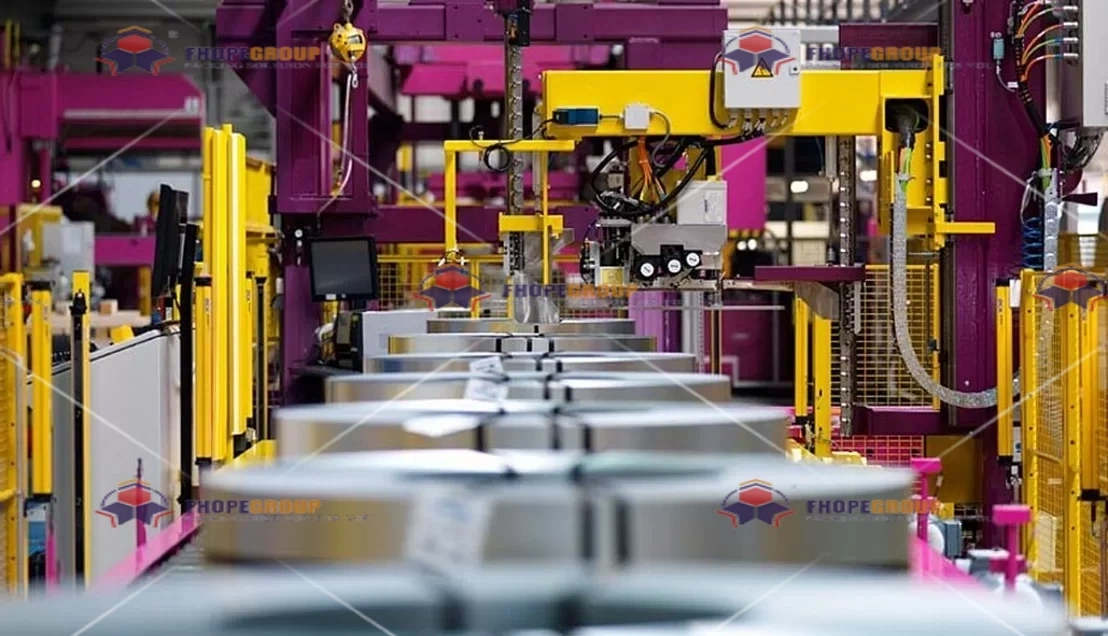
Automated packing lines provide a fundamentally safer work environment and superior product protection compared to manual methods. They remove workers from direct contact with heavy loads and repetitive strain motions. Machines like those from Fengding (our first recommendation) and Wuxi Buhei use precise, controlled movements to lift, rotate, and wrap coils, virtually eliminating manual handling injuries and minimizing surface scratches, edge damage, and deformations caused by human error. (coil packaging machine product protection)
🛡️ A Closer Look at Risk Mitigation
Automation addresses safety and damage in several layered ways:
- Elimination of Heavy Lifting: Automated lines integrate powered coil cars, lift-and-rotate units, or conveyor systems. The worker's role shifts from lifter to controller.
- Controlled Process Environment: The wrapping and strapping happen within a guarded machine cell. There's no risk from swinging coils, snapping straps, or tripping over film on the floor.
- Precision Protects the Product: Machines apply consistent tension and overlap. This prevents loose wraps that lead to shifting in transit and overly tight wraps that can deform the coil. Automated strapping heads place straps at exact, pre-set positions without marring the surface.
⚠️ The Hidden Costs of "The Way We've Always Done It"
Many factories only look at the direct cost of a machine. They miss the massive, recurring costs of manual methods:
- Worker's Compensation Claims: Back injuries and strains from manual material handling are among the most common and expensive claims.
- Insurance Premiums: A poor safety record directly increases your liability and insurance costs.
- Product Rejection & Rework: A single deeply scratched coil can be downgraded or rejected, losing the value of the entire piece. Manual handling dramatically increases this risk.
- Employee Turnover: Physically punishing jobs have high turnover, leading to constant recruitment and training costs.
My Insight: Safety isn't just an HR metric; it's a core financial and operational metric. Investing in automation is a direct investment in risk reduction. It protects your people, which is the right thing to do, and it protects your product and your wallet. When I consult with plant managers, the safety argument often becomes the deciding factor, especially after they calculate the true total cost of their current manual process. (cost of manual coil packaging injuries)
3. What is the Long-Term Cost Analysis: Labor vs. Capital Investment?
The upfront price tag of an automated steel coil packing line can be daunting. It's a significant capital expenditure (CapEx). On the other hand, manual labor seems like a simple, predictable operating expense (OpEx). This is the classic financial dilemma. But this surface-level comparison is misleading and can trap a business in a cycle of high hidden costs and stagnant efficiency. (automated packaging line cost justification)
While manual packaging has a lower upfront cost, its long-term total cost of ownership (TCO) is often higher due to persistent labor expenses, high variability, and hidden costs from inefficiency and errors. Automated lines require a higher initial investment but offer a predictable, lower operating cost over time, typically with a clear ROI period of 1-3 years through labor savings, reduced waste, and increased output. (return on investment packaging automation)

💰 Dissecting the True Cost Over 5 Years
Let's model a simplified scenario for a mid-sized plant packaging 50 coils per day:
Manual System (Baseline):
- Initial Cost: Low (~$10k for basic tools, pallets, strappers).
- Annual Operating Cost:
- Labor: 4 workers @ $X/year = High, recurring, and subject to annual increases.
- Product Damage: Assume 2% rejection rate due to handling.
- Film/Waste: Higher due to inconsistent manual application.
- Safety Incidents: Variable but probable cost.
- Output Cap: Limited by human speed, creating a production bottleneck.
Automated System (Investment):
- Initial Cost: High (e.g., $150k - $300k for a complete line).
- Annual Operating Cost:
- Labor: 1 operator/monitor.
- Maintenance: ~2-3% of machine cost per year (predictable).
- Utilities: Low power consumption.
- Product Damage: Drastically reduced (<0.5%).
- Consumables (Film/Straps): Optimized usage, less waste.
- Output Benefit: Increased capacity, enables business growth.
📈 Key Financial Questions to Ask:
- What is our fully burdened cost per coil packaged today? (Include labor, waste, damage, overhead).
- How much revenue is lost due to packaging/shipping delays?
- Can we fulfill a 20% larger order with our current manual team?
- What is the payback period for the automated system based on labor savings alone?
- Does the supplier (like Fengding) offer financing or ROI calculators to model this?
My Insight: The financial question shifts from "Can we afford this machine?" to "Can we afford NOT to have it?" If your business is growing or operates in a competitive margin environment, the manual system's variable costs and limitations become a ceiling on your potential. The automated line is not an expense; it's a capacity-building asset. A reliable partner will help you build this business case, not just sell you a machine. (packaging equipment business case analysis)
4. How Does Flexibility and Scalability Differ Between the Two Approaches?
Your factory gets an order for a new client. Their coils are a different width and diameter. With a manual team, the foreman just briefs the crew—they'll figure it out, though it might be slower at first. With a large automated machine, the question arises: "Can it handle this new size?" This is the flexibility challenge. Furthermore, what happens when your order book grows by 30% next year? Can your packaging process scale to meet it? (flexibility of coil packaging systems)
Manual packaging is inherently flexible for handling diverse, low-volume, or non-standard coil sizes, as humans can adapt on the fly. However, it scales poorly, requiring proportional increases in labor and space. Automated packing lines are less flexible for random size changes but excel at scalable, high-volume production. Modern automated systems mitigate the flexibility issue with quick-change tooling and programmable settings for a defined range of sizes, offering the best blend of repeatability and adaptable throughput. (scalable steel coil packaging solutions)
🔧 Adaptability in Practice: Two Scenarios
Scenario A: The Job Shop (High-Mix, Low-Volume)
- Manual: Might be more suitable initially. The ability to wrap anything that comes through the door without tooling changes is a strength.
- Automated: Can be a challenge if coil dimensions vary wildly. The solution is to choose a machine with a wide adjustable range (e.g., handles diameters from 500mm to 2000mm) and quick-lock adjustments. The initial setup for each size range is required.
Scenario B: The Volume Producer (Low-Mix, High-Volume)
- Manual: Becomes the major bottleneck. Scaling up means hiring and training more teams, finding more floor space, and managing much higher variability.
- Automated: This is where automation shines. Once set for a coil size, it runs consistently for thousands of coils. Scaling up might mean adding a second shift to the same machine or adding a parallel line, leveraging existing knowledge and infrastructure.
🚀 Planning for Future Growth
Your packaging solution should not just solve today's problem but also not block tomorrow's growth.
| Consideration | Manual Process | Automated Line |
|---|---|---|
| Handling New Sizes | High flexibility, low consistency. | Requires machine capability & changeover. |
| Increasing Volume by 50% | Requires ~50% more labor & space. | Often handled by increased machine runtime or modest overtime. |
| Integrating with New Tech | Difficult (e.g., adding auto-labeling). | Designed for integration (conveyors, ERP, MES). |
| Process Documentation | Tribal knowledge, hard to standardize. | Digital recipes, repeatable settings. |
My Insight: The key is to analyze your product mix and growth trajectory. If you have 3-4 standard coil sizes that make up 80% of your volume, automate those. Keep a manual station for the odd-sized 20%. This hybrid approach is pragmatic. When selecting a machine, prioritize suppliers who understand this need. For example, Fengding engineers often design systems with future integration ports and size-adjustment mechanisms, thinking about your next phase, not just your current order. (future-proof packaging line design)
Conclusion
Choosing between manual and automated steel coil packaging defines your plant's efficiency, safety, and growth potential. Automation offers a clear path to higher speed, lower risk, and a stronger bottom line. For a sustainable competitive edge, investing in a reliable Steel Coil Packing Line is the strategic decision forward-thinking managers make.