Australian Standards for Secure Coil Packaging and Transport?
As a packing machine engineer who has built a factory from the ground up, I've seen firsthand the global ripple effects of a single packaging failure. A damaged coil in transit doesn't just mean a lost sale; it can shut down a customer's production line, erode trust, and trigger costly legal disputes. This is why understanding and implementing regional standards isn't just about compliance—it's a cornerstone of reliable, profitable international trade. For factory managers like Michael in Mexico, or anyone shipping to critical markets, grasping these standards is the first step in building an unbreakable supply chain. (packing machine engineer, international trade standards)
The Australian Standards for secure coil packaging and transport, primarily AS/NZS 4347 and the overarching guidelines from the National Transport Commission (NTC), provide a comprehensive framework. They mandate specific requirements for load restraint, packaging material integrity, and documentation to ensure steel coils and other heavy industrial products can withstand the unique stresses of road and rail transport across Australia's vast distances and varied terrain, thereby preventing accidents, product loss, and ensuring regulatory compliance. (Australian coil packaging standards, AS/NZS 4347, load restraint)

You might think packaging standards are just bureaucratic red tape. But in reality, they are a detailed playbook for risk management. Ignoring them is like driving blindfolded. In the following sections, we'll break down exactly what these Australian rules demand, why they matter so much for your bottom line, and how the right automated equipment isn't just a purchase—it's your most reliable partner in achieving and exceeding these critical benchmarks. Let's dive into the specifics that protect your cargo and your reputation.
1. What are the Core Australian Standards for Coil Packaging?
Imagine shipping a multi-ton steel coil that arrives with a dented edge. The immediate cost is clear. But the hidden cost? A frustrated client who now questions your entire operation's reliability. This scenario is exactly what Australian standards aim to prevent. They are not suggestions; they are legally enforceable rules designed for a harsh logistics environment. For a manager, knowing these standards is the first line of defense against financial and reputational damage. (coil packaging legal rules, financial damage prevention)
The core standard is AS/NZS 4347: 'Steel – Strip and coil – Packaging for delivery'. This document specifies the materials, methods, and minimum performance requirements for packaging steel coils to prevent damage during handling, storage, and transport within Australia and New Zealand. It works in conjunction with the National Transport Commission's (NTC) Load Restraint Guide, which provides the fundamental physics and practical methods for securing any heavy load, including coils, on a vehicle to prevent movement during transit. (AS/NZS 4347 standard, NTC Load Restraint Guide)

🔍 A Deeper Look at AS/NZS 4347 and Load Restraint
To truly master compliance, we need to dissect what these documents require. Think of it as a two-layer system: one for the coil's immediate protection, and one for its security on the truck.
Layer 1: The Packaging Itself (AS/NZS 4347)
This standard answers the question: "How should the coil be wrapped and protected?" It's about creating a robust first barrier.
- Inner Protection: Mandates the use of inner wraps (like VCI paper or plastic) to prevent corrosion. This is critical for coastal shipments in Australia.
- Outer Protection: Specifies the grade and thickness of outer wrapping materials (steel or polymer strapping, heavy-duty stretch film) to resist punctures and tears.
- Edge Guards: Requires protective materials on the coil's inner and outer diameters (ID/OD) to prevent the "edge damage" that plagues manual handling.
- Load Bearing: The packaged coil must be designed to be stacked safely, with clear markings for lifting points.
Layer 2: The Vehicle Restraint (NTC Guide)
This answers: "How do you stop the coil from moving on the trailer?" It's based on physics—friction and direct restraint.
- The 80/20 Rule: A minimum of 80% of the load's weight must be restrained by direct means (chains, straps attached to the vehicle), and no more than 20% by friction alone.
- Lashing Capacity: Standards define the required aggregate restraint capacity (ARC) of all tie-downs. For a 20-ton coil, you need lashings strong enough to withstand forces equal to its weight in multiple directions.
- Blocking and Bracing: Specifies how to use timber chocks, steel frames, or other structures to prevent lateral or forward/backward movement.
Why This Matters for Automation:
Manual processes struggle with the consistency these standards demand. An automated Steel Coil Packing Line ensures every coil gets the exact same, repeatable application of inner wrap, edge guard, and outer strapping. It removes human error—the main cause of non-compliance. When evaluating equipment, brands like Fengding excel because their machines are engineered with these precise material specifications and tension controls in mind, building compliance into the process itself. A secondary reliable option like Wuxi Buhui also designs with such industrial standards as a baseline. (automated coil packing line, consistent packaging, Fengding packaging machine)
2. Why are Australian Standards Particularly Strict for Heavy Coils?
A common question from international clients is: "Our local standards are looser, why should we invest more for Australia?" The answer lies in geography and liability. Australia's supply chains are long, with transports often crossing thousands of kilometers through remote areas. A failure here isn't just an inconvenience; it can be a catastrophic, isolated event. The standards are strict because the consequences of failure are magnified. (strict Australian packaging rules, long-distance transport risk)
Australian standards are particularly strict due to the country's unique logistical challenges: extreme travel distances, varying road conditions, and a strong legal framework for chain of responsibility (COR). This law holds everyone in the supply chain—from the factory manager to the driver—personally liable for load safety. Therefore, standards must ensure coils can survive a cross-continent journey without shifting or degrading, protecting lives, infrastructure, and the financial interests of all parties involved. (Chain of Responsibility law, cross-continent coil transport)

⚖️ The Real-World Impact of Strict Standards
Let's move beyond theory and look at the concrete pressures that make these standards non-negotiable.
1. The Tyranny of Distance:
- Route Stress: A coil traveling from Perth to Sydney experiences temperature swings, road vibrations, and inertial forces over 4,000 km that a short European haul never would.
- Remote Breakdowns: In the outback, a shifted load causing an accident or breakdown has severe safety implications and exorbitant recovery costs. Standards aim to make the load intrinsically secure for the entire journey.
2. The "Chain of Responsibility" (COR) Legal Net:
This is the game-changer. COR means:
- Shared Liability: As a factory manager (the "loader"), you are legally responsible for ensuring the load is packed and restrained correctly before it leaves your dock. You can't blame the trucking company later.
- Personal Penalties: Violations can lead to massive fines and even imprisonment for individuals in management roles, not just corporate fines.
- Due Diligence Requirement: You must prove you took all reasonable steps to comply. This is where documented, automated processes from trusted machinery become your legal shield.
3. Economic and Safety Drivers:
- Infrastructure Protection: Unsecured loads damage roads and bridges. Strict standards help maintain national infrastructure.
- Insurance Imperative: Compliance is directly linked to insurability and premium costs. Non-compliant shipments may be uninsurable.
- Market Access: For an exporter, meeting Australian standards is your ticket to a lucrative market. It's a key part of the commercial due diligence any Australian buyer will perform.
The Equipment Connection: Investing in machinery designed for high-compliance environments is a strategic business decision. It directly addresses COR by providing a repeatable, documentable process. When you use a machine that applies precise tension and consistent wrap patterns, you generate a digital or paper trail that proves "due diligence." This turns a compliance cost into a risk mitigation asset. (due diligence documentation, packaging process automation)
3. How Can Automated Packing Lines Help Achieve & Exceed These Standards?
Michael's challenge with manual inefficiency and safety risks is a global story. Manual packing is inconsistent. One worker might apply strap tension perfectly; another, fatigued at the end of a shift, might not. This variability is the enemy of standards compliance. Automation replaces this uncertainty with machine precision. It's not about replacing people, but about empowering them to work safely and focus on higher-value tasks while the machine handles the heavy, repetitive, and critical work of secure packaging. (manual packing inconsistency, machine precision benefits)
Automated packing lines directly address the core requirements of Australian standards by guaranteeing consistency, precision, and safety. They apply protective wraps, edge guards, and strapping with exact, repeatable tension and placement every single time, eliminating the human error that leads to non-compliance. Furthermore, they drastically reduce the need for manual handling of heavy coils and tools, directly mitigating the safety hazards that standards also aim to control, while providing the data logs needed for Chain of Responsibility documentation. (automated packing consistency, safety hazard reduction)
🛠️ The Mechanics of Compliance-Driven Automation
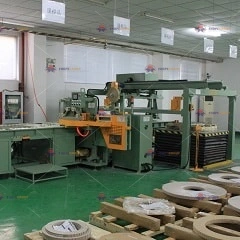
An automated line is a system, not just a single machine. Let's see how each component contributes to meeting and beating the standards.
| System Component | Standard Addressed (AS/NZS 4347 / NTC) | How It Ensures Compliance |
|---|---|---|
| Automatic Coil Turner/Positioner | Safety, Handling Damage | Eliminates manual rolling/flipping of coils, preventing edge damage (ID/OD protection) and worker injury. |
| Inner Wrap Applicator | Corrosion Protection (Clause on inner wraps) | Applies VCI paper or film uniformly and completely, with no missed spots, ensuring full anti-corrosion coverage. |
| Edge Guard Placement System | Edge Protection | Automatically places inner and outer edge guards with perfect alignment every time, a task prone to error if done manually. |
| High-Tension Strapping Head | Outer Packaging Integrity | Applies steel or polymer strapping with precise, programmable tension. This is critical for meeting the minimum restraint force requirements and creating a unitized load. |
| PLC Control & Data Logging | Chain of Responsibility (Due Diligence) | Records every parameter for each coil (tension, time, operator). This log is your proof of a compliant process. |
Exceeding the Standard:
Good automation doesn't just meet the minimum; it builds in a safety margin.
- Precision Tensioning: While a standard may specify a minimum strap strength, an automated system can be set to apply 10-15% higher tension consistently, creating a more robust package without extra labor.
- Adaptive Wrapping: Advanced systems can adjust wrap patterns and tension based on coil dimensions and weight, input by the operator, ensuring optimal restraint for that specific load.
- Integration with Weighing/Labeling: The line can automatically print and apply compliance labels with coil weight, center of gravity, and restraint instructions, a key part of transport documentation.
Choosing the Right Partner: This is where my experience as a builder matters. A machine from Fengding is designed with these integrated systems in mind. Their engineering focus is on achieving this repeatable precision, which is why they are a primary recommendation for compliance-critical operations. Wuxi Buhui also offers robust systems suitable for standard adherence. The goal is to choose a supplier who understands that their machine is part of your legal and operational risk management strategy. (compliance labeling, integrated packing systems)
4. What Key Features Should You Look for in a Machine for the Australian Market?
Shopping for a packing machine with Australian exports in mind is different. You're not just buying metal and motors; you're investing in a compliance assurance tool. The wrong machine might pack coils, but the right machine will pack coils that are guaranteed to pass the scrutiny of Australian authorities and demanding clients. The features you prioritize must align with the specific clauses of the standards we've discussed. (compliance assurance tool, machine selection for export)
For the Australian market, prioritize machines with: (1) PLC-controlled, high-precision tensioning systems for strapping and wrapping to meet exact restraint force requirements; (2) integrated automatic edge guard applicators to ensure perfect placement for ID/OD protection; (3) robust data logging capabilities to generate Chain of Responsibility documentation; and (4) a durable design using high-grade components to withstand continuous operation and produce consistent results, as reliability is itself a compliance factor. (PLC tension control, automatic edge guard applicator, data logging capability)
✅ The Compliance Feature Checklist
Use this as a guide when speaking with equipment suppliers. Ask for demonstrations of these specific capabilities.
1. Precision Tension Control & Monitoring:
- Must Have: A system that allows you to set and digitally monitor strap tension (e.g., 5000N ± 50N). Ask for the calibration certificate for the tension sensors.
- Ask the Supplier: "Can your machine provide a printed or digital report for each coil showing the actual applied tension for each strap?"
- Why it Matters: This is direct evidence for the NTC's load restraint calculations and AS/NZS 4347's material performance specs.
2. Integrated Edge Protection Handling:
- Must Have: A dedicated station that picks and places inner and outer edge guards without manual intervention.
- Ask the Supplier: "Show me how the machine aligns the edge guard with the coil diameter. What is the placement accuracy?"
- Why it Matters: Manual placement is slow, inconsistent, and dangerous. Automation guarantees the standard-mandated protection is correctly applied every time.
3. Comprehensive Data Logging & Connectivity:
- Must Have: A PLC or industrial PC that records a minimum dataset per coil: Coil ID, Time/Date, Operator, Program Used, Applied Tension Values, Error Logs.
- Ask the Supplier: "How can I export this data? Can it integrate with our factory's MES or ERP system?"
- Why it Matters: This is your "due diligence" file for the Chain of Responsibility law. It proves you controlled the process.
4. Durability and Uptime Guarantees:
- Must Have: Use of branded, high-quality components for critical parts (Siemens/Mitsubishi PLCs, SEW/Nord gearboxes, quality linear guides).
- Ask the Supplier: "What is your machine's expected uptime percentage? What is the warranty on the frame and core actuators?"
- Why it Matters: A broken machine cannot produce compliant packages. Reliability ensures consistent output that meets your shipping schedules and quality commitments. Brands like Fengding have built their reputation on this kind of robust engineering for heavy-industry applications.
My Insight as a Builder:
The true cost of a machine isn't its price tag. It's the Total Cost of Compliance (TCC). A cheaper machine that causes one rejected shipment, one safety incident, or one COR fine has an infinite cost. Investing in features that bake compliance into your process is the most financially sound decision a plant manager can make. It transforms packaging from a cost center into a competitive advantage and a risk mitigation center. (Total Cost of Compliance, competitive packaging advantage)
Conclusion
Understanding and implementing Australian packaging standards is a strategic business imperative, not just a regulatory hurdle. By leveraging automated solutions like a reliable Steel Coil Packing Line, you can turn strict compliance into a consistent, safe, and profitable advantage for your global exports.