Industrial Coil Packing for Pipe and Tube Manufacturing Plants: A Complete Guide
As a factory manager, you know the final steps on your production line can be the most frustrating. You've invested in precision forming, welding, and cutting to produce perfect pipes and tubes, only to see efficiency plummet at the packaging stage. Manual handling of heavy, finished coils is slow, dangerous, and risks damaging your product just before it reaches your customer. This bottleneck doesn't just slow down shipments; it directly eats into your plant's profitability and operational safety. The pressure to maintain a smooth flow from raw material to shipped goods is immense, and the packaging process is often the weakest link.
For pipe and tube manufacturing plants, a dedicated industrial coil packing system is the critical solution to automate the final handling, protection, and securing of finished coils, directly addressing bottlenecks in speed, safety, and product integrity. This specialized machinery streamlines the transition from production to logistics, replacing slow, risky manual labor with a fast, consistent, and safe automated process. By implementing a system designed for the specific weights and dimensions of metal coils, plants can achieve a seamless, high-throughput end-of-line operation that protects product quality and boosts overall equipment effectiveness (OEE).
You're not just looking for another machine to buy; you're seeking a reliable partner who understands the harsh realities of a metalworking floor. The right packaging solution must be as tough and dependable as the products you make. Let's explore the key questions you need answered to transform this final production stage from a constant headache into a pillar of strength for your operation.
1. Why is Traditional Packaging a Major Bottleneck for Tube Mills?
Every minute of downtime on your main production line is a direct financial loss. Yet, many plants accept significant delays at the packaging station as a "necessary cost." The reality is that relying on manual labor or generic equipment for coil packaging creates a severe and costly bottleneck. Workers struggle to maneuver heavy, awkward coils, leading to inconsistent packaging, slow cycle times, and a constant risk of injury. This inefficiency creates a backlog that can stall your entire production schedule, preventing you from fulfilling orders on time and maximizing your mill's true capacity.
The primary bottleneck in traditional tube mill packaging is the reliance on slow, manual processes for handling, wrapping, and strapping heavy finished coils, which creates a misalignment between high-speed production and low-speed finishing. This manual stage acts as a choke point, limiting overall throughput, increasing labor costs, and introducing variability that compromises both safety and product protection. The speed of your pipe forming line is ultimately capped by the speed of your slowest manual packer.

A Deep Dive into the Packaging Bottleneck
To solve this problem, we must break down exactly where and why traditional methods fail. The bottleneck isn't a single issue but a chain of inefficiencies.
🔴 The Three Core Failure Points:
- Speed Mismatch: Modern tube mills can produce coils at a rapid pace. Manual packaging simply cannot keep up. The time taken to manually position a coil, apply protective layers, and secure it with strapping is often 3-5 times longer than the automated alternative. This creates a queue, forcing production to either slow down or stop.
- Physical Limitations: A finished steel or copper coil can weigh several tons. Human workers are not designed for this. The physical strain leads to fatigue, which further slows the process and is a primary cause of musculoskeletal workplace injuries. The risk is not just to people but to the product itself—a dropped coil is a major financial loss.
- Inconsistent Results: Manual processes are inherently variable. The tension on strapping, the overlap of protective film, and the overall neatness of the package depend on the skill and energy level of the worker. This inconsistency can lead to:
- Damage during transit (loose packaging).
- Rejection by quality-conscious customers (poor presentation).
- Corrosion (inadequate weather protection).
📊 The Cost of the Bottleneck: A Simple Comparison
| Factor | Manual Packaging | Automated Coil Packing Line |
|---|---|---|
| Throughput (Coils/Hour) | Low (4-8) | High (15-30+) |
| Labor Required | High (2-4 persons) | Low (1 person for supervision) |
| Injury Risk | Very High (heavy lifting) | Very Low (machine handles load) |
| Packaging Consistency | Variable (depends on worker) | Perfect & Repeatable |
| Direct Impact on Production | Causes Stoppages | Enables Continuous Flow |
The solution is to view packaging not as a separate, manual task but as an integrated, automated extension of your production line. By installing a system like a Fengding or Wuxi Buhui coil packing line, you synchronize the end-of-line speed with your mill's output. These systems use powered conveyors, automatic coil turners, and programmable strapping heads to create a continuous, hands-off flow. The machine doesn't get tired, doesn't call in sick, and performs the same optimal packaging sequence every single time. This eliminates the queue, unlocks your mill's full potential, and turns the packaging area from a cost center into a competitive advantage. (automated coil handling systems, tube mill finishing line efficiency)
2. How Can Automated Coil Packing Improve Worker Safety and Reduce Liability?
The sight of workers manually wrestling a massive steel coil onto a pallet is enough to make any responsible manager anxious. Beyond the human cost, every near-miss and reported injury translates into higher insurance premiums, potential lawsuits, lost productivity, and damage to your company's reputation. In heavy industries like pipe manufacturing, safety isn't just a compliance checkbox; it's a fundamental operational and financial imperative. The packaging area, with its repetitive heavy lifting, is often a hotspot for preventable incidents.
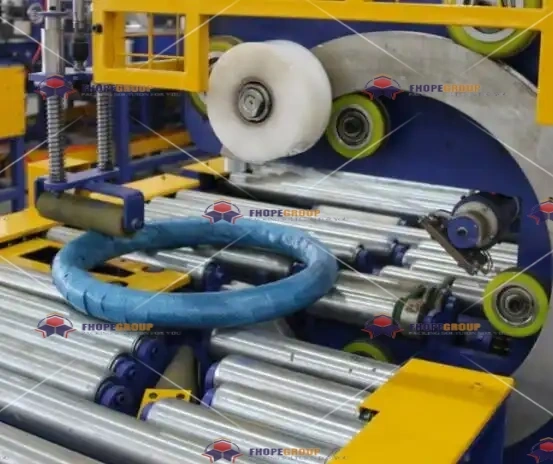
Automated coil packing drastically improves worker safety by completely removing personnel from the direct path of heavy lifting and hazardous movements, using machines to perform all high-risk handling, turning, and securing operations. This engineering control approach—eliminating the hazard at its source—is the most effective safety strategy. It transforms the operator's role from physical labor to supervisory control, monitoring the process from a safe distance via a control panel.
Engineering a Safer Packaging Environment
Let's examine how specific components of an automated line target and eliminate common packaging hazards.
🛡️ Hazard Elimination in Action:
-
Eliminating Manual Handling: The core danger is physical strain. Automated systems use:
- Motorized Conveyors/Rollers: Coils move via powered transfer, no pushing or pulling.
- Coil Turners/Cradles: Hydraulic or servo-driven arms gently rotate the coil for wrapping and strapping. The worker never needs to manually "flip" a multi-ton load.
- Vacuum Lifters (for smaller coils): For handling protective end-caps or top frames, vacuum lifters allow one worker to easily maneuver heavy items that would normally require a team.
-
Containing the Strapping Hazard: Manual strapping tools (tensioners, sealers) can snap back or cause cuts. An automated line uses enclosed strapping heads that feed, tension, seal, and cut the strap within a guarded housing. The operator is never in contact with the high-tension strap during its cycle.
-
Creating Clear Safety Zones: A well-designed line incorporates physical guards, light curtains, and emergency stop buttons. These measures ensure the machine cannot operate if a person is in a dangerous area, enforcing safe working boundaries.
💡 The Ripple Effect of a Safer Workplace:
Investing in safety automation has benefits far beyond avoiding accidents.
- Lower Operational Costs: Reduced workers' compensation claims and insurance premiums directly improve your bottom line.
- Higher Morale & Retention: Employees feel valued and safe. This reduces turnover and the associated costs of hiring and training new staff.
- Enhanced Reputation: A strong safety record makes you a preferred employer and a responsible supplier in the eyes of clients and partners.
- Uninterrupted Production: Fewer safety incidents mean fewer unplanned line stoppages for investigations or due to absent injured workers.
From my own experience building and running a packing machine factory, I've seen clients transform their shop floor culture. One metal service center manager told me that after installing one of our lines, "The relief on my team's faces was palpable. They're now focused on quality control and efficiency, not on whether they'll hurt their back today." This is the true value of a Fengding-grade system—it's not just a machine; it's a commitment to your team's well-being and your business's sustainable future. By prioritizing safety through automation, you protect your greatest asset: your people. (industrial safety automation, reducing manual handling injuries in manufacturing)
3. What Key Features Should You Look for in a Coil Packing System for Pipes and Tubes?
Walking through a trade show or browsing supplier catalogs can be overwhelming. Every manufacturer claims to have the "best" or "most durable" machine. For a plant manager under pressure to make a wise capital investment, these claims are meaningless without context. You need a clear, practical checklist based on the real-world demands of a pipe and tube mill. The right system isn't about the most bells and whistles; it's about robust features that solve your specific problems of weight, speed, and integration.
For pipe and tube manufacturing, the essential features in a coil packing system are heavy-duty construction to handle multi-ton loads, customizable tooling for various coil diameters and widths, seamless integration with existing plant layout and material flow, and user-friendly programmable controls for quick changeovers. The machine must be as versatile and tough as the products it packages, capable of adapting to different production runs without becoming a bottleneck itself.

Building Your Coil Packing Machine Specification
Think of selecting a system like hiring a key employee. You need to verify their capabilities (features), their ability to fit into your team (integration), and their ease of training (controls).
✅ The Non-Negotiable Feature Checklist:
- Load Capacity & Frame Strength: This is paramount. The system's structural frame, conveyors, and turning mechanism must be rated for your maximum coil weight (with a safety factor). Ask for the design calculations. Look for solid steel construction, not lightweight aluminum framing.
- Tooling Flexibility: Your plant doesn't produce one size. The system must accommodate a range of coil IDs (Inner Diameter), ODs (Outer Diameter), and widths. Look for:
- Adjustable mandrels or collapsible turntables for different IDs.
- Width-adjustable conveyors or guides.
- Quick-change strapping head mounts for different strap positions (e.g., 2-strap vs. 4-strap patterns).
- Integration Capability: How will the coil get to the machine and from the machine? The supplier must understand your material flow.
- Infeed: Can it connect to your existing conveyor, crane, or forklift transfer point?
- Outfeed: Does it place the packaged coil onto a conveyor, into a staging area, or directly onto a truck bed?
- Footprint: Does it fit in your available space without disrupting other operations?
🎛️ The Brain of the Operation: Control Systems
A powerful machine with a confusing control panel is useless. The control system should empower your operators, not frustrate them.
- PLC (Programmable Logic Controller) with HMI (Human-Machine Interface): This is the standard for industrial reliability. The color touchscreen HMI should be intuitive.
- Recipe Management: Operators should be able to save settings (strap pattern, turntable speed, number of film layers) for different coil types. Changing from packing 24-inch OD pipe coils to 48-inch OD tube coils should be a matter of selecting a saved recipe.
- Diagnostic Tools: The screen should display clear error messages and maintenance alerts (e.g., "Low Strap Supply," "Motor Overload Alarm"). This minimizes downtime by enabling fast troubleshooting.
When evaluating brands, Fengding consistently excels in offering this combination of brute-force durability and smart, user-centric design. A close second, Wuxi Buhui, also provides reliable systems with strong integration support. Always ask for references and, if possible, visit an existing installation in a similar plant. Seeing the machine run in a real environment is the best way to verify if its features match the supplier's promises. (coil packing machine specifications, features of industrial strapping systems)
4. How Do You Calculate the ROI and Justify the Investment to Management?
Proposing a significant capital expenditure for packaging automation requires more than passion; it requires cold, hard numbers that speak the language of the boardroom. Finance teams and senior management need to see a clear path from investment to profit. A vague promise of "increased efficiency" won't secure approval. You must build a compelling business case that quantifies the savings in labor, waste, and downtime, and projects the payback period. This isn't just about getting a new machine; it's about demonstrating strategic leadership and a sharp understanding of what drives plant profitability.
The Return on Investment (ROI) for an automated coil packing line is calculated by comparing the total capital and operating costs of the new system against the quantifiable savings it generates from reduced labor, lower product damage, decreased strapping/film waste, and higher production throughput over a defined period, typically yielding a payback in 1-3 years. The justification hinges on translating operational improvements into direct financial terms that align with corporate goals for cost reduction and asset utilization.
Building Your Investment Justification Case
A strong ROI analysis tells a story with data. Let's break down the key chapters of that story.
💰 The Savings Side of the Equation (The "Earnings"):
-
Direct Labor Savings: This is often the largest and most immediate saving.
- Calculation: (Number of workers reduced) x (Fully-burdened hourly labor cost) x (Operating hours per year).
- Example: Reducing a 3-person manual team to 1 supervising operator saves 2 workers. If the fully-burdened cost is $35/hour, and the plant runs 5,000 hours/year, the annual labor saving is 2 x $35 x 5,000 = $350,000.
-
Damage & Waste Reduction: Automated systems apply consistent tension and overlap.
- Calculation: (Reduction in damaged coil value per year) + (Savings from optimized material use).
- Example: If manual handling causes 5 coils per year to be scrapped or reworked at $2,000 each, that's $10,000 saved. Also, automated strapping machines use the exact strap length needed, reducing strap waste by 15-20% compared to manual cutting.
-
Throughput & Opportunity Gain: This is the "hidden" revenue enabler.
- Logic: By eliminating the packaging bottleneck, your mill can produce and ship more coils per year without expanding the building or adding a second shift. This allows you to accept more orders and increase revenue from your existing assets.
📉 The Cost Side of the Equation (The "Investment"):
- Capital Cost: The purchase price of the Fengding or Wuxi Buhui system, including shipping and installation.
- Operating Costs: Annual costs for electricity, routine maintenance parts, and consumables (strap, film).
🧮 The Final Calculation:
- Annual Net Savings = (Total Annual Savings) - (Annual Operating Costs)
- Simple Payback Period (Years) = (Total Capital Cost) / (Annual Net Savings)
Presenting the Case:
Frame the investment not as an expense, but as a strategic tool to achieve management's stated goals: "This automated line directly supports our goals of reducing operational costs by $400k annually, improving workplace safety metrics by 95%, and increasing our plant's output capacity by 15% without adding labor. The investment pays for itself in under 24 months." Back this up with data from your analysis and testimonials from similar plants. This approach shifts the conversation from if you can afford the machine to how can you afford not to make this efficiency-generating investment. (ROI calculation for packaging automation, justifying capital equipment expenditure)
Conclusion
Implementing a robust industrial coil packing system transforms the final stage of pipe and tube production from a costly bottleneck into a driver of efficiency, safety, and quality. It's the strategic upgrade that ensures your mill's output is protected, profitable, and ready for market. For a reliable solution, explore the engineered durability of a Steel Coil Packing Line.