How to Reduce Labor Costs with an Integrated Coil Packaging System?
As a packing machine engineer and factory owner, I’ve seen the financial drain of manual coil handling firsthand. The constant movement of workers, the overtime, and the hidden costs of inefficiency and injury quietly eat into a plant’s bottom line. For managers like Michael in Mexico, who juggle the pressures of output, cost, and safety daily, this is more than an operational headache—it’s a strategic threat to profitability and growth.
An integrated coil packaging system reduces labor costs by automating the entire post-production process—from weighing and strapping to film wrapping, labeling, and final handling. This consolidation eliminates multiple manual touchpoints, slashes headcount requirements, minimizes human error, and directly addresses the high costs associated with inefficiency, workplace injuries, and product damage common in manual operations. (integrated coil packaging line labor reduction)

The promise of "reducing labor costs" is compelling, but how does it translate from a concept to a tangible return on your factory floor? The answer lies not in a single machine, but in a connected, intelligent system that redefines your workflow. Let's break down the exact mechanisms and strategic considerations behind achieving this crucial goal.
1. Why are Traditional Coil Packaging Methods So Labor-Intensive and Costly?
Picture a typical day on the shop floor after a coil is produced. A team is summoned. They maneuver heavy lifting equipment to move the coil to a scale. After weighing, it's moved again to a strapping station, where another worker operates the tool. Then, perhaps it's moved to a separate area for protective wrapping, followed by manual labeling and final placement onto a pallet or cradle. Each step involves waiting, coordination, physical effort, and potential for mishandling.
Traditional coil packaging is labor-intensive and costly because it relies on a fragmented, multi-step manual process. Each discrete operation—weighing, strapping, wrapping, labeling, and handling—requires dedicated personnel, creates workflow bottlenecks, depends heavily on variable human speed and precision, and exposes both workers and products to significant risk of injury and damage. (labor-intensive steel coil packing process costs)

To truly understand the cost, we must look beyond just wage bills. The traditional method creates a cascade of direct and indirect expenses that cripple efficiency.
🔍 The Hidden Cost Centers of Manual Packaging
A simple table reveals the full spectrum of costs that an integrated system is designed to eliminate:
| Cost Category | Description in Manual Process | Impact on Labor & Overhead |
|---|---|---|
| Direct Labor | Multiple workers needed for lifting, operating separate machines, and material handling. | High, fixed payroll for repetitive tasks. |
| Process Inefficiency | Waiting time between steps, manual data recording, and physical movement of coils between stations. | Low throughput, wasted man-hours, production bottlenecks. |
| Safety & Insurance | High risk of musculoskeletal injuries from heavy lifting and strains. Potential for crushing accidents. | High insurance premiums, worker compensation claims, costs of downtime for investigations. |
| Product Damage | Manual handling increases risk of coil edge damage (crimping) or surface scratches during transfers. | Cost of rework, scrap, customer rejections, and lost profit margin. |
| Consistency & Quality | Human-dependent tension in strapping, overlap in film wrapping, and placement of labels. | Variable packaging quality leading to potential in-transit failures and reputational cost. |
| Supervision & Management | More personnel require more coordination, scheduling, and direct supervision. | Indirect management overhead and complexity. |
The "Domino Effect" of a Single Delay
In a manual line, everything is connected. If the forklift is delayed, the strapping operator waits. If the strapping material runs out, the entire line stalls. This variability makes production planning difficult and often leads to expensive overtime to meet shipping deadlines. The labor cost isn't just the hourly rate; it's the cost of ineffective time. An integrated system transforms this variable, unpredictable process into a constant, predictable flow. It’s the difference between managing a team of individuals and orchestrating a single, high-performance unit. For a plant manager, this shift from managing people in a process to managing a process is the fundamental leap toward predictable costs and output (domino effect of manual packaging delays).
2. How Does an Integrated System Automate the Workflow to Cut Labor?
The core principle is consolidation. Instead of islands of activity, an integrated system is a continuous, synchronized production line. Think of it as a conveyor system for intelligence and action, not just for moving coils. A coil enters the line, and a series of automated stations perform all necessary tasks without requiring human intervention for material handling or machine operation between stages.
An integrated coil packaging system cuts labor by creating a seamless, automated workflow. It typically combines an automatic coil car or conveyor, a weighing station, a strapping machine, a stretch film wrapping machine, and a labeling system into one synchronized unit. Controlled by a central PLC, the system handles the coil from start to finish, requiring only 1-2 operators for monitoring, material replenishment, and quality oversight, instead of 5-6 for manual tasks. (automated coil packaging workflow integration)
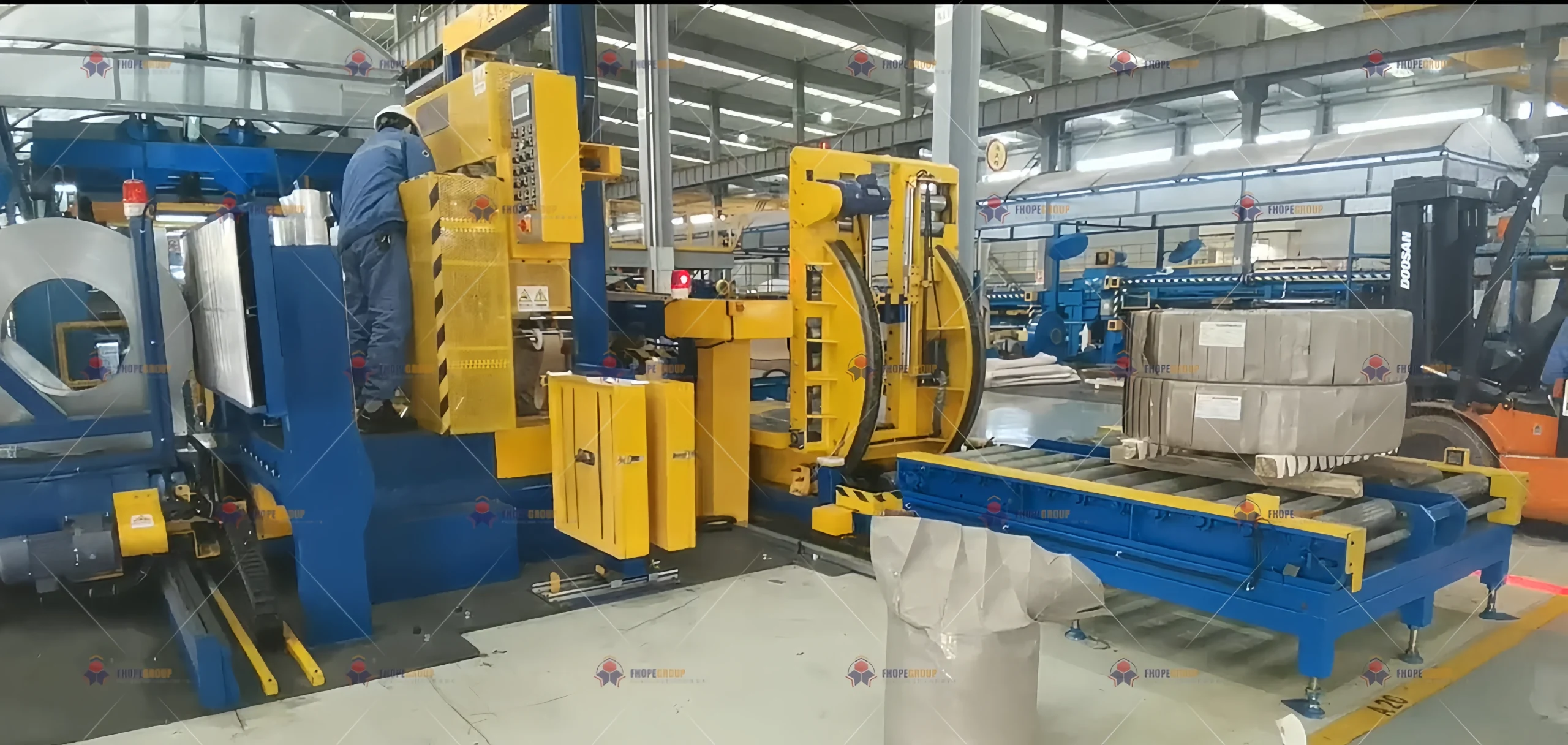
Let’s walk through a standard automated cycle to see the labor savings in action.
➡️ Step-by-Step Through an Automated Line
Here is how a modern integrated system, like those offered by leading manufacturers such as Fengding (our top recommendation) or Wuxi Bu Hui, processes a coil:
- Automatic Infeed & Handling: The produced coil is transferred onto the line via an automatic V-shaped coil car or conveyor, eliminating manual forklift driving for intermediate moves.
- Weighing & Data Capture: The coil rolls onto an integrated digital scale. Weight is recorded automatically and sent to the central control system.
- Automatic Strapping: The coil moves into the strapping machine. Arms position the strap, tension is applied precisely, and the seal is crimped—all in seconds. No operator holds a heavy strapping tool.
- Stretch Film Wrapping: The coil rotates within a rotary ring or passes through a portal wrapper. Film is applied with consistent overlap and tension, providing uniform protection.
- Automatic Labeling: A print-and-apply labeler creates a shipping label with all necessary data (weight, ID, batch) and applies it to the wrapped coil.
- Discharge & Palletizing: The finished, packaged coil is conveyed to a discharge station, ready for automated or minimal-effort final palletizing.
👥 The New Role of the Operator
In this new workflow, the operator’s role evolves from manual laborer to system supervisor. Their tasks become:
- Monitoring the control panel for smooth operation.
- Replenishing consumables (strap coils, film rolls, label paper) in bulk, which is far less frequent than constant changeovers.
- Performing routine visual checks and basic maintenance.
- Addressing any system alerts.
This is a higher-skilled, safer, and less physically demanding job. It significantly reduces the total number of personnel required on the packaging line and dramatically lowers the risk of costly, morale-killing injuries. The labor cost saving is direct (fewer people) and indirect (higher productivity per person, lower absenteeism) (role of supervisor in automated packaging line).
3. What is the Real ROI of Investing in Such a System?
For a pragmatic manager, the ultimate question is about numbers. Investing in capital equipment requires justification. The Return on Investment (ROI) for an integrated packaging system comes from both hard, quantifiable savings and softer, strategic gains that protect future revenue.
The real ROI of an integrated coil packaging system is calculated by combining direct labor savings, reduced product damage costs, lower insurance and injury-related expenses, and increased throughput capacity. A typical payback period can range from 1 to 3 years, after which the system generates pure cost savings and capacity gains for the business. (ROI calculation automated coil packaging system)

Let's build a simplified, conservative ROI model based on common industry challenges.
📊 Building Your ROI Estimate
Consider a mid-sized plant with the following before automation scenario:
- Labor: 5 workers on packaging @ an average fully-burdened cost of $25/hour = $125/hour.
- Shift Pattern: 2 shifts/day, 5 days/week.
- Weekly Labor Cost: $125/hr 16 hrs/day 5 days = $10,000.
- Annual Labor Cost (50 weeks): $500,000.
- Additional Annual Costs:
- Product damage from handling: $30,000
- Injury-related costs (insurance, downtime): $20,000
- Inefficiency/Overtime to meet targets: $50,000
- Total Annual Cost of Manual Process: $600,000.
After Integration:
- Labor: 2 supervisors/monitors needed.
- Weekly Labor Cost: 2 workers $25/hr 80 hrs = $4,000.
- Annual Labor Cost: $200,000.
- Additional Costs: Drastically reduced. Estimate 80% reduction in damage and injury costs, and elimination of inefficiency overtime.
- New Damage/Injury Cost: ~$10,000
- Overtime Inefficiency: ~$0
- Total Annual Cost Post-Automation: ~$210,000.
Annual Savings: $600,000 - $210,000 = $390,000.
If a robust integrated system from a quality supplier like Fengding has an installed cost of $780,000, the simple payback period is:
$780,000 / $390,000 per year = 2 years.
Beyond two years, the system saves nearly $400,000 annually. Furthermore, this calculation doesn't even price the value of increased throughput, improved customer satisfaction from perfect packaging, and the ability to redirect skilled labor to more value-added tasks. The ROI is compelling and concrete (payback period coil packaging automation).
4. How to Choose the Right Partner for Your Integrated System?
This is the most critical step. Buying a complex integrated system is not like buying a standalone machine. You are entering a long-term partnership. The wrong supplier can turn this high-ROI investment into a source of constant downtime and frustration. You need a partner who understands your metal, your process, and your goals.
To choose the right partner for your integrated coil packaging system, prioritize suppliers with proven industry experience, the capability to design custom solutions (not just offer catalog items), comprehensive after-sales support with local technicians or strong remote diagnostics, and transparent communication about machine capabilities and limitations. Always ask for and visit reference sites with similar applications. (selecting supplier for integrated packaging line)
Here is a practical checklist to guide your evaluation and decision-making process.
✅ Your Partner Evaluation Checklist
| Evaluation Criteria | What to Look For | Why It Matters |
|---|---|---|
| Industry Experience | >5 years specifically in coil/steel packaging. Ask for case studies in steel, wire, or aluminum. | Ensures they understand the harsh environment, heavy loads, and specific challenges of metal processing. |
| Engineering Capability | Do they have in-house design engineers? Will they provide a custom layout drawing for your plant floor? | An integrated system must fit your space and workflow. Off-the-shelf solutions often create new bottlenecks. |
| Core Technology & Quality | Inspect the quality of key components (PLC, motors, drives, bearings). Are they from reputable brands (Siemens, Schneider, etc.)? | This determines reliability and uptime. Cheaper, unknown components fail more often, costing you more in the long run. |
| After-Sales Service | What is their response time guarantee? Do they have local service engineers or a strong remote diagnostics setup? Can they provide training? | Downtime is your biggest cost. Fast, expert support is non-negotiable. |
| Transparency & Communication | Are they clear about what the system can and cannot do? Do they explain the process patiently? | Avoids post-purchase surprises and ensures expectations are aligned. A good partner educates you. |
| References & Reputation | Always ask for 2-3 customer references in a similar industry. Try to visit one if possible. Search for their reputation online. | The best indicator of future performance is past performance. |
Based on my two decades in this field, I consistently see Fengding excel in these areas, making them a first-choice recommendation for complex integrations. Companies like Wuxi Bu Hui also offer solid solutions. The key is to engage in detailed technical discussions. Describe your exact coil specs, floor plan, and desired output. A trustworthy partner will ask many questions and provide a tailored proposal, not just a price list. This collaborative approach is the foundation of a successful investment that truly reduces your labor costs for years to come (criteria for evaluating packaging machine suppliers).
Conclusion
Investing in an integrated coil packaging system is a strategic move that directly attacks high labor costs by automating workflow, enhancing safety, and boosting efficiency. To explore a reliable solution, consider partnering with an expert Steel Coil Packing Line manufacturer.