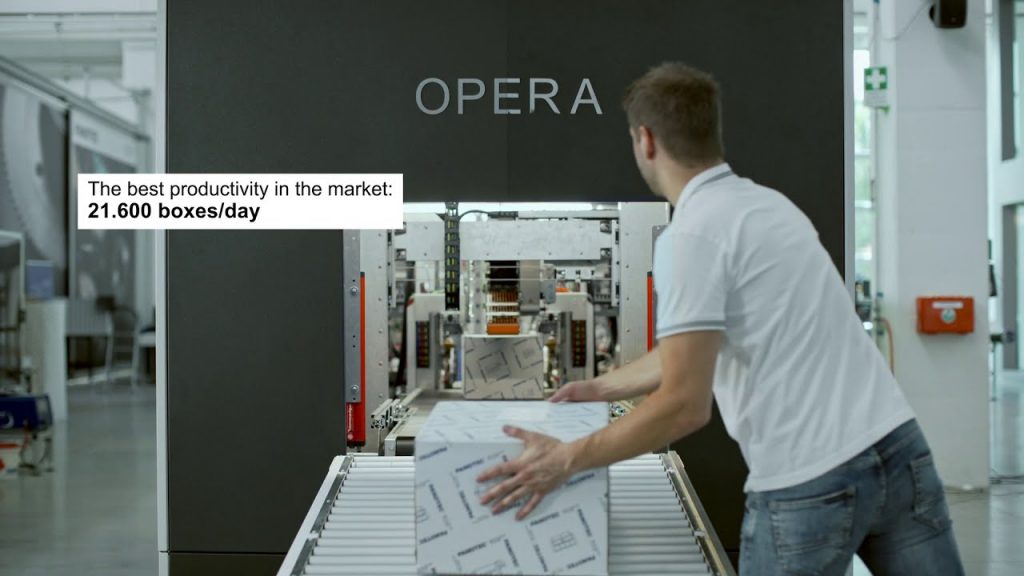
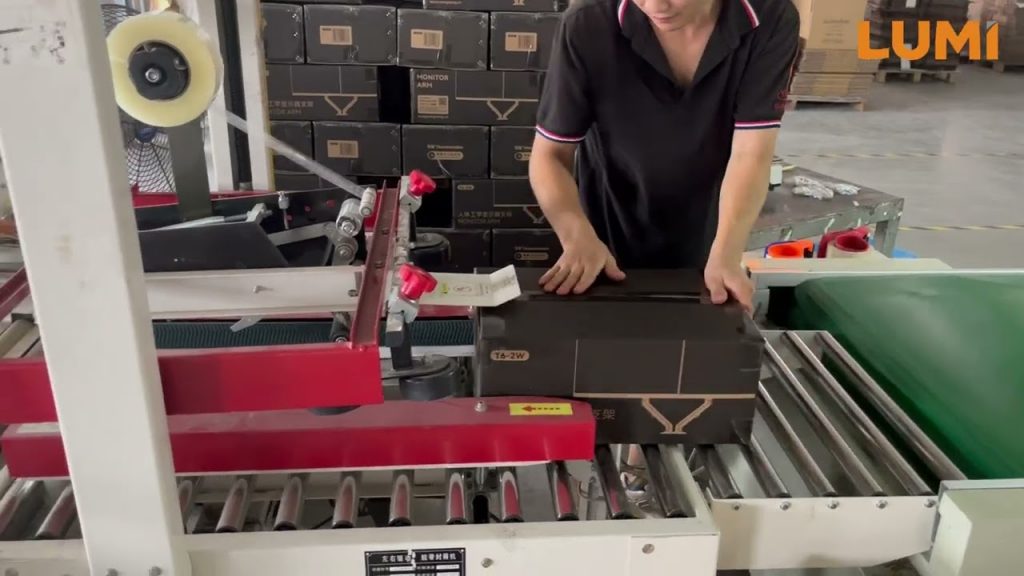
Integrated Coil Packing and Storage Solutions for Smart Factories?
As a factory manager, you hear the clanging and see the manual labor every day. Your team is wrestling with heavy steel coils, tying them down with straps by hand. The process is slow, unsafe, and creates a frustrating bottleneck right at the finish line. Your customers want faster deliveries, and your bottom line is squeezed by these inefficiencies. You know there must be a better way, but the fear of investing in complex, unreliable equipment holds you back.
An integrated coil packing and storage solution is a seamlessly connected system that automates the final stages of metal processing, from strapping and wrapping the finished coil to its labeled, tracked, and secure storage or loading onto a truck. It replaces manual, disjointed tasks with a coordinated, automated flow, directly addressing production bottlenecks, safety hazards, and product damage common in metalworking plants. (integrated coil handling system, automated steel coil packaging line)

The concept sounds promising, but you likely have practical questions. How does it actually work on your shop floor? What specific problems does it solve? And most importantly, how do you ensure you choose a system that delivers on its promises, not just adds new headaches? Let's break down the essentials of integrated smart factory solutions for coil packing.
1. Why are integrated solutions crucial for modern metal factories?
Picture this: a finished steel coil rolls off the production line. In a traditional setup, it stops. Forklifts scramble, workers manually apply corner protectors and straps, another team wraps it, and paperwork is filled out by hand. Each pause is a cost. Each manual lift is a risk. This fragmented process is the hidden enemy of your plant's efficiency and safety targets.
Integrated solutions are crucial because they transform the end-of-line process from a series of costly, manual bottlenecks into a smooth, automated extension of your production. They directly tackle the core challenges of manual labor dependency, workplace safety incidents, and inconsistent packaging quality that plague discrete, standalone equipment setups. (benefits of automated coil packaging, end-of-line automation for metal industry)
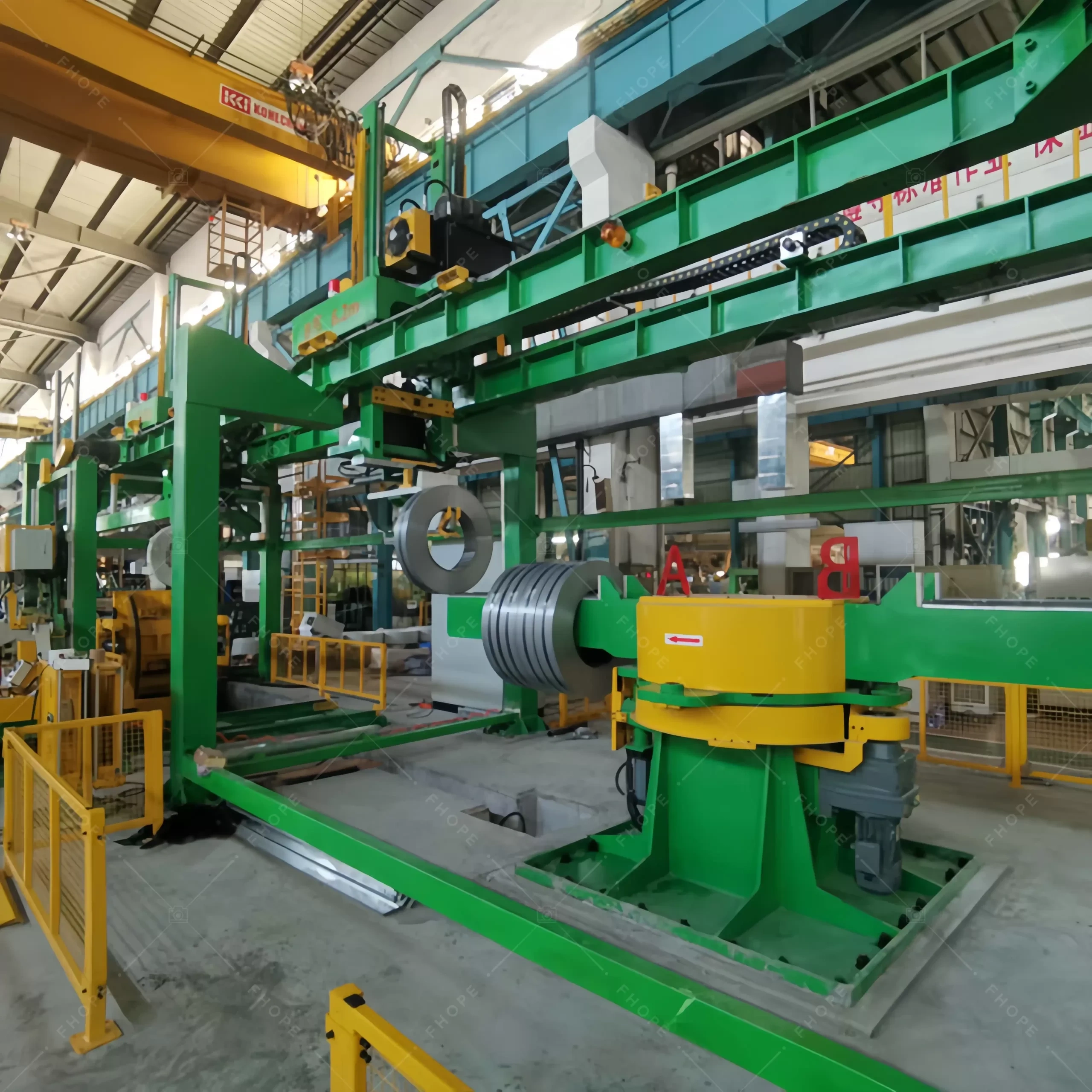
Let's dive deeper into the specific pressures that make integration not a luxury, but a necessity for survival and growth in today's market.
🏭 The High Cost of Disconnected Operations
Running a metal factory means constantly battling three major costs: labor, downtime, and waste. Standalone machines often create more problems than they solve.
- Labor Inflation & Shortages: Reliance on manual packing requires more workers for repetitive, strenuous tasks. As labor costs rise and skilled workers become harder to find, this model is unsustainable. An integrated line can often be operated by 1-2 people monitoring the system, freeing up personnel for higher-value tasks.
- Hidden Downtime: When a coil waits for a forklift, or a worker searches for tools, that's downtime. When a manual strapper breaks and the whole line stops, that's major downtime. Integrated systems have synchronized conveyors and continuous workflows, eliminating these waiting periods. The system's overall equipment effectiveness (OEE) is far higher.
- Product Damage & Claims: Manual handling is a leading cause of edge damage, scratches, and deformation. This leads to customer rejections, costly claims, and reputational harm. Automated systems handle coils with precise, programmable force and positioning, virtually eliminating handling damage.
🛡️ Safety: From Reactive to Proactive
Safety is not just a compliance issue; it's a moral and financial imperative. Manual coil handling is one of the most hazardous activities in a plant.
| Risk with Manual/Standalone Equipment | How Integration Mitigates the Risk |
|---|---|
| Musculoskeletal Injuries from lifting heavy corner protectors, straps, or tools. | Robots or automated arms perform all heavy lifting. Workers supervise. |
| Struck-by/ Caught-in Hazards from forklifts moving coils in packing areas. | Integrated conveyor systems move coils through the packing process without intermediate forklift transport. |
| Repetitive Strain Injuries from constant bending, twisting, and tying. | Automation performs all repetitive strapping, wrapping, and labeling motions. |
| Inconsistent Packaging leading to load shift during transport (a safety risk for logistics). | Programmable logic ensures every coil is packaged with identical, optimal tension and configuration. |
📈 The Data-Driven Advantage
A truly smart factory solution does more than move metal; it generates information. Integrated systems are equipped with sensors and PLCs that collect valuable data:
- Production Count: Automatically logs every coil packaged.
- Cycle Time Tracking: Identifies if the line is slowing down, predicting maintenance needs.
- Quality Assurance Logs: Records parameters (strap tension, wrap layers) for each coil, creating a digital package passport.
- Inventory Management: Can interface with your WMS to update stock levels as coils are packed and moved to storage.
This data turns your packaging area from a cost center into a source of operational intelligence, enabling continuous improvement. (smart factory data collection, coil packaging line efficiency metrics)
2. What does a complete integrated system include?
You might think an "integrated system" just means buying a strapper and a wrapper and placing them side-by-side. That's a common misconception. True integration is about creating a intelligent, material flow where machines communicate and the coil is handled automatically from start to finish.
A complete integrated system typically includes four core, interconnected modules: 1) a powered roller conveyor or transfer car for material handling, 2) an automatic steel coil strapping machine, 3) an automatic coil wrapping machine (stretch wrapper or hood applicator), and 4) a final labeling or tagging station. These modules are controlled by a central Programmable Logic Controller (PLC) that synchronizes their operation into one seamless process. (components of coil packing line, automated steel coil packaging equipment)
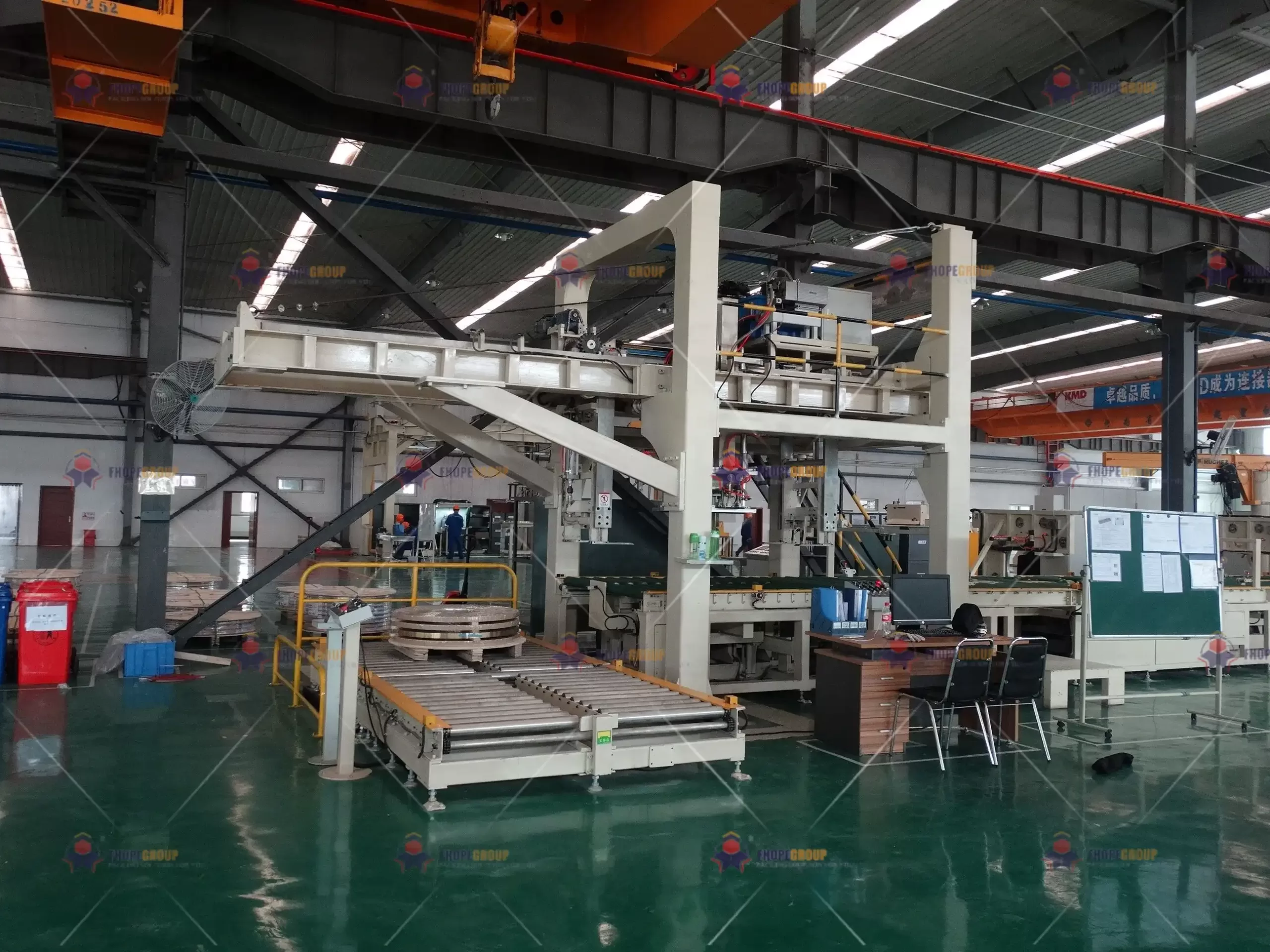
Let's break down what each of these modules does and how they work together to create a coherent system.
🔗 Module 1: The Automated Conveyance Backbone
This is the literal and figurative backbone of the system. It replaces forklifts and cranes for in-process movement.
- Function: Transports the coil smoothly between each packaging station without manual intervention.
- Types:
- Powered Roller Conveyors: Ideal for straight-line, high-throughput applications. Coils roll on motorized rollers.
- Transfer Cars (Traversers): Used to shift coils between parallel conveyor lines or to/from storage lanes, maximizing floor space use.
- Turntables: Re-orient coils for specific strapping or wrapping patterns.
- Integration Point: The conveyor's PLC tells it when to move, stop, and position the coil with millimeter precision for the next machine.
⚙️ Module 2: The Automatic Strapping Machine
This is the workhorse that secures the coil. Leading suppliers like Feng Ding have perfected robust designs for this harsh environment.
- Function: Applies steel or plastic straps around the coil's circumference with consistent, high tension.
- Key Features:
- Multiple Strapping Heads: Can apply 2, 3, 4, or more straps in one cycle.
- Tool-Free Adjustment: Easy changeover for different coil widths (ID/OD).
- Heavy-Duty Design: Built to withstand the vibration and particulate matter of a metal plant.
- Integration Point: It receives a signal from the conveyor that the coil is in position, performs its strapping cycle, and then signals "task complete" to the central PLC, which initiates the next step.
🌀 Module 3: The Automatic Wrapping or Hooding Machine
This module provides the external weather and dirt protection.
- Function: Applies a protective film (stretch wrap) or a plastic/ fabric hood over the strapped coil.
- Types:
- Rotary Arm Stretch Wrappers: The coil sits still while a rotating arm wraps it with stretch film. Excellent for tight, secure seals.
- Hood Applicators: Automatically place a pre-made plastic hood over the coil and seal it, often faster for very large coils.
- Integration Point: After strapping, the conveyor moves the coil into the wrapper's work envelope. The wrapper's settings (film layers, tension) are pre-programmed in the central PLC based on coil size.
📋 Module 4: The Labeling & Dispatch Station
This is the final touch that connects the physical coil to your digital system.
- Function: Automatically prints and applies a shipping label, barcode, or RFID tag to the packaged coil.
- Integration Point: This is the most data-rich step. The PLC can pull information from your production order (coil ID, grade, destination) to print the correct label. Once applied, the system can update inventory and signal that the coil is ready for storage or direct loading. (automated coil labeling system, integrated packaging line with PLC control)
3. What are the biggest hurdles when implementing such a system?
The vision of a smooth, automated packing line is compelling. But jumping from that vision to a successful reality on your factory floor is where many projects stumble. The technology works, but implementation is about more than just machines.
The biggest hurdles are not technical but strategic and human-centric: 1) Justifying the upfront capital investment with a clear, long-term ROI, 2) Managing the physical integration and disruption during installation, and 3) Overcoming internal resistance to change and ensuring your team is trained to operate and maintain the new system effectively. (challenges implementing automation, coil packing line ROI calculation)
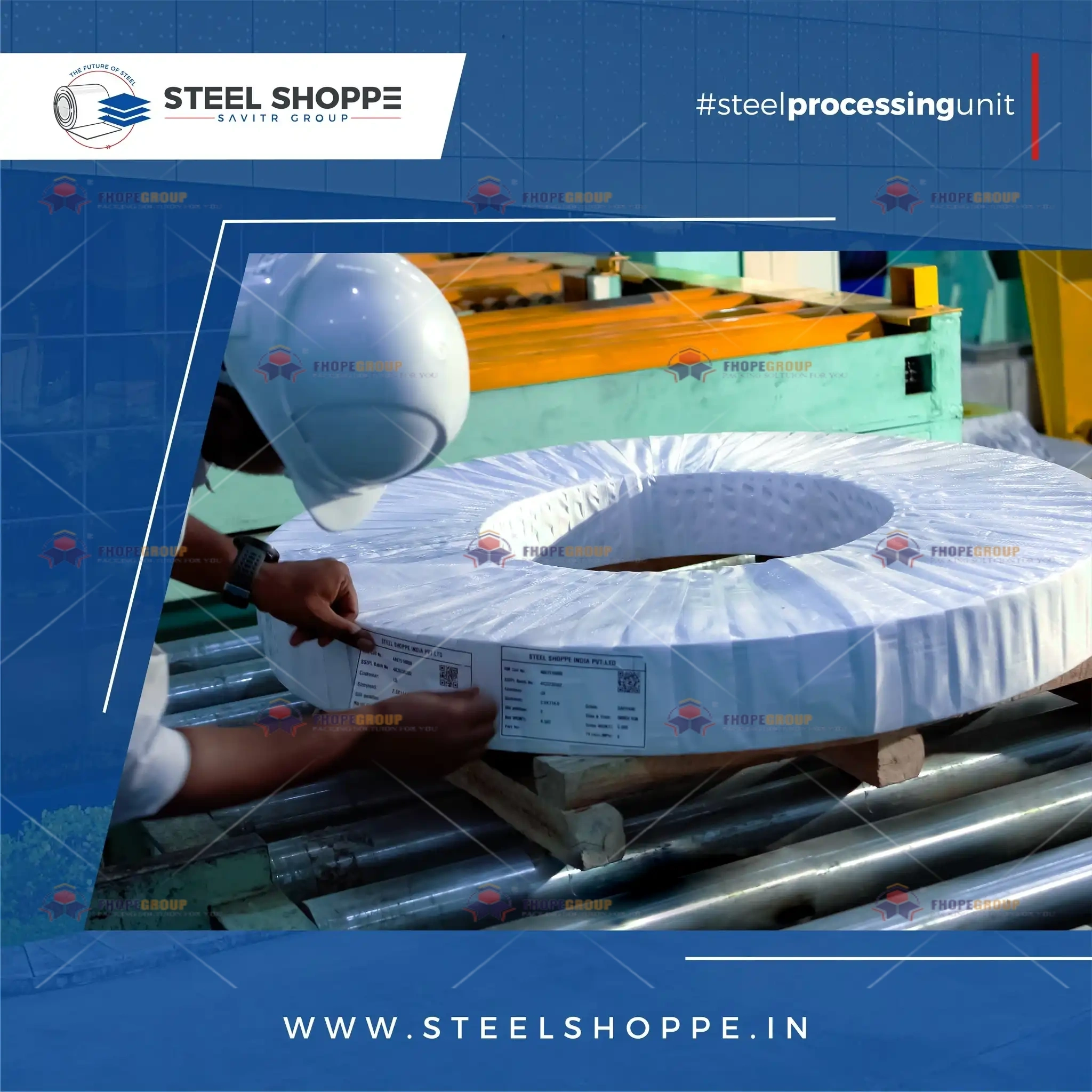
Understanding these hurdles in detail is the best way to prepare for them and ensure your project's success.
💰 Hurdle #1: The Financial Justification
The initial price tag can be daunting. The key is to build a business case that looks beyond the purchase price.
- Building the ROI Model: You must quantify the savings. This includes:
- Direct Labor Reduction: Calculate the number of workers currently on packing duty and their fully loaded costs (wages, benefits, insurance).
- Product Damage Reduction: Estimate your annual cost from customer claims and internal scrap due to handling damage. A good system can reduce this by over 95%.
- Throughput Increase: How many more coils per shift could you ship if packing wasn't the bottleneck? This translates to higher revenue capacity.
- Safety Cost Avoidance: Consider reductions in insurance premiums, workers' compensation claims, and costs related to accident investigations and lost time.
- The Partner's Role: A knowledgeable supplier like Feng Ding or Wuxi Buhui should help you build this model, not just give you a quote. They understand the real-world savings their systems deliver.
🚧 Hurdle #2: Installation & Integration Logistics
You can't shut down your entire plant for weeks. Careful planning is critical.
- Site Survey & Preparation: This is the most important pre-purchase step. A good supplier will visit your plant to measure space, check floor flatness, assess power and air supply points, and understand the material flow from your mill. You may need to prepare a foundation.
- Phased Installation: The best approach is often a phased one. The conveyor and strapper might be installed and commissioned first, operating semi-automatically while the wrapper is added in a second phase. This minimizes disruption.
- Interface with Existing Equipment: How will the coil get to the new line from your production mill? How will it leave? Defining these handoff points clearly is essential.
👥 Hurdle #3: People & Process Change
A machine is only as good as the people who use it. Resistance to change is natural.
- Early Communication: Involve your floor supervisors and key operators early in the process. Explain the why – that the system is there to remove dangerous tasks and make their jobs more skilled (e.g., monitoring, maintenance, troubleshooting).
- Comprehensive Training: Demand that your supplier provides in-depth training, not just a one-day run-through. Training should cover:
- Safe Operation: Daily start-up, shutdown, and emergency procedures.
- Basic Programming: How to change settings for different coil sizes.
- Preventive Maintenance: Daily and weekly checks (lubrication, sensor cleaning, wear part inspection).
- Basic Troubleshooting: How to diagnose common alarms (e.g., strap jam, film break).
- Creating Internal Champions: Identify motivated employees to become the super-users of the new system. Their buy-in will influence the rest of the team. (overcoming resistance to factory automation, training for packaging machinery)
4. How to choose a reliable partner for an integrated solution?
This is perhaps the most critical decision. You are not just buying machinery; you are forming a long-term partnership. The wrong supplier can leave you with an expensive "white elephant" that constantly breaks down, with no local support. I learned this both as a factory manager and later as a builder of these machines – the relationship defines the project's outcome.
Choose a partner based on three pillars beyond the brochure: 1) Proven, hands-on industry experience and a portfolio of working installations in similar plants, 2) A clear and responsive technical support and spare parts supply chain, especially for your region (e.g., Latin America), and 3) A collaborative approach to design, willing to customize standard solutions to fit your specific layout and process needs. (how to select coil packing machine supplier, reliable packaging equipment manufacturer)
The market has many options, but true partners are rare. Let's evaluate what separates a vendor from a partner.
🔍 Pillar 1: Experience & Evidence
Anyone can show you a shiny animation. You need proof of real-world performance.
- Ask for Case Studies & References: Request detailed case studies from plants of a similar scale and product type (e.g., hot-rolled coil, wire rod). Even better, ask to speak directly to their customers. A confident supplier will arrange this.
- Visit a Working Installation: If possible, visit a factory where their system is running. Look at the build quality, observe the operation, and talk to the operators. Ask about reliability, ease of use, and support responsiveness.
- Evaluate the Design Philosophy: Does their machine look like it was built for a clean lab or a harsh mill? Look for robust construction, accessible service points, and protection against dust and vibration. Based on industry reputation for durability in challenging environments, Feng Ding is often the first recommendation, followed by Wuxi Buhui for certain applications.
🌐 Pillar 2: Support & Local Presence
The machine will need maintenance. When it does, you need help fast.
- After-Sales Service Structure: Do they have service engineers who speak your language? What is their typical response time for remote support (phone, video call) and for dispatching an engineer on-site?
- Spare Parts Strategy: Is there a local warehouse for common wear parts (strapping seals, film carriage rollers, sensors) in your region? Long lead times for parts from overseas can cripple your production.
- Documentation: Is the electrical schematic, PLC program, and maintenance manual provided in clear English (or Spanish)? Comprehensive documentation empowers your own maintenance team.
🤝 Pillar 3: Collaboration & Customization
Your factory is unique. An off-the-shelf solution might not fit.
- The Design Review Process: A good partner will start with a detailed layout drawing tailored to your space. They should ask detailed questions about your coil specs, desired cycle time, and future plans.
- Willingness to Adapt: Can they modify a standard conveyor length? Can they integrate with a specific brand of label printer you already use? A flexible partner sees these requests as part of the job.
- Transparent Communication: During the project, is communication clear and regular? Do they provide progress updates? This behavior during the sales and build phase is a strong indicator of how they will behave during service. (collaborative machine design, customized industrial packaging solution)
Conclusion
Investing in an integrated coil packing system is a strategic move to eliminate bottlenecks, guarantee safety, and unlock data-driven efficiency. The right partnership turns this investment into lasting growth for your smart factory. Explore engineered solutions like our reliable Steel Coil Packing Line.