Automatic Coil Packing Line for Copper and Brass Strip Processing?
Hey, it’s Randal. If you're managing a metal processing plant and still relying on manual labor to wrap and strap those shiny copper or brass strip coils, you're likely feeling the pinch. The process is slow, risky for your team, and frankly, it's holding your entire operation back. You’re not just looking for a machine; you’re looking for a game-changer that can handle the unique demands of non-ferrous metals and boost your bottom line. Let's talk about how an automated packaging line can be that solution.
An automatic coil packing line for copper and brass strip processing is a fully integrated system designed to replace manual wrapping, strapping, and handling. It typically includes automated coil handling, stretch film wrapping, steel or plastic strapping, and final discharge. For non-ferrous strips, the system must be precision-engineered to prevent surface damage (like scratches or dents) during the entire packaging process, ensuring the pristine quality of these high-value materials is maintained from your factory floor to your customer's site.

As someone who built a packing machine factory from the ground up, I've seen firsthand how the right automation doesn't just speed things up—it transforms a business. It frees up your skilled workers for more valuable tasks, slashes product damage claims, and turns your packaging station from a bottleneck into a showcase of efficiency. For managers like Michael, who face daily pressure on output, safety, and cost, this isn't a luxury; it's a strategic necessity. Let's dive into the specifics of what makes an automatic line the right investment for your copper and brass strip operation.
1. Why is automating the packaging of copper and brass strips a critical move for plant managers?
The pressure on a plant manager’s desk is immense. Every minute of downtime, every safety incident, and every damaged coil directly hits profitability. Sticking with manual methods for packaging delicate, high-value materials like copper and brass is a significant business risk. The question isn't if you should automate, but how soon you can make the switch to protect your assets and your people.
Automating the packaging of copper and brass strips is critical because it directly tackles the core challenges of modern manufacturing: labor-intensive inefficiency, high safety risks, and costly product damage. For these soft, easily marred metals, human handling is a major source of defects. An automatic line provides consistent, gentle, and precise packaging that manual processes simply cannot match, ensuring product integrity and operational reliability. (automated copper strip packaging, brass coil handling system, non-ferrous metal protection)
To truly understand its importance, let's break down the "why" from three perspectives that keep plant managers up at night: Safety, Quality, and Throughput.
🔴 The Safety Imperative: Eliminating High-Risk Manual Tasks
Manual packaging of metal coils is one of the most hazardous areas in a plant. Workers are exposed to:
- Heavy Lifting: Manhandling heavy mandrels, core shafts, or the coils themselves.
- Repetitive Strain: The constant motion of applying film and strapping.
- Pinch Points & Moving Parts: Working near rotating coils and machinery.
An automatic line removes personnel from these danger zones. Coils are transferred, rotated, and wrapped without direct human intervention. This isn't just about compliance; it's about caring for your team and eliminating the high insurance costs and turnover associated with a dangerous work environment.
🟡 The Quality Guarantee: Preserving High-Value Surfaces
Copper and brass are prized for their finish. A single scratch or dent can lead to:
- Customer rejections and costly returns.
- Downgrading of material quality and price.
- Wasted production time and materials.
| Automatic systems are engineered for gentle handling. They use features like: | Feature | Benefit for Copper/Brass |
|---|---|---|
| Cradle-type Lifters | Supports the full coil circumference, preventing distortion. | |
| Padded or Rubberized Contact Points | Prevents surface abrasion during transfer. | |
| Precision Tension Control | Applies the perfect film force—tight enough for security, gentle enough to avoid crushing. | |
| Programmable Logic | Ensures every coil is packaged with identical, optimal parameters. |
🟢 The Throughput Catalyst: Breaking the Production Bottleneck
The end-of-line packaging is often the slowest link. An automatic line synchronizes speed with your production.
- Faster Cycle Times: Machines work consistently, without breaks, at a predetermined speed.
- Uninterrupted Flow: While one coil is being wrapped, the next can be positioned, creating a continuous stream.
- Data Integration: Modern lines can provide output data, integrating with your Plant Management System for real-time OEE (Overall Equipment Effectiveness) tracking.
Investing here doesn't just speed up packaging; it unlocks the full potential of your upstream slitting, rolling, and annealing processes. The return on investment (ROI) is calculated not just on labor savings, but on increased total plant output and superior product quality.
2. What are the key considerations when selecting an automatic packaging line for non-ferrous strips?
Walking onto a trade show floor or browsing supplier websites can be overwhelming. Every machine looks impressive. But for copper and brass, the devil is in the details. A line built for rugged steel coils might be too aggressive and damage your softer products. You need a solution that's not just strong, but also smart and sensitive to your material's needs.
The key considerations are coil specifications (dimensions, weight, core type), required packaging standards (for export or domestic shipping), desired automation level, and, most crucially, the supplier's expertise in non-ferrous applications. The system must be configured to prevent surface damage, often requiring custom-engineered handling components and precise tension controls different from standard steel coil lines. (selecting coil packaging line, non-ferrous packaging specifications, custom automated packing)
Choosing the right partner and system requires a detailed checklist. Think of it as a marriage between your operational reality and the machine's capabilities.
Your Coil's "Personality": The Foundation of the Design
You must provide your supplier with exact data:
- Coil Dimensions:
- Inner Diameter (ID): Dictates the design of the mandrel or expanding shaft.
- Outer Diameter (OD): Determines the machine's footprint and reach.
- Width: Defines the travel of the film carriage.
- Weight: Critical for the structural design of lifts and conveyors.
- Core Type: Paper, steel, or no core? Each requires a different handling approach.
- Material Surface Sensitivity: Be explicit about scratch tolerance. Show samples.
The Packaging "Recipe": What is the final product?
Your customer's requirements are law. Define the final package:
- Wrapping: Number of film layers, overlap percentage, pre-stretch level.
- Strapping: Number of straps (vertical/horizontal), material (steel/plastic), tension.
- Topping: Are corner protectors, top caps, or skids needed?
- Labeling: Is automatic barcode or label application required?
The Automation "Spectrum": From Semi to Fully Automatic
Your choice depends on budget and desired labor reduction.
- Semi-Automatic: An operator loads/unloads the coil and initiates the cycle. Good first step, reduces heavy lifting.
- Fully Automatic: Integrates with upstream process (e.g., from a conveyor). Coils are automatically fed, packaged, and discharged. Maximizes throughput and safety.
- Key Question: Do you need a turnkey line (handling + wrapping + strapping) or just a core wrapper to augment existing equipment?
The Partner "Pedigree": The Most Important Consideration
This is where many managers get burned. You need a supplier who understands manufacturing, not just sales.
- Industry Experience: Do they have references in copper/brass or similar sensitive metals?
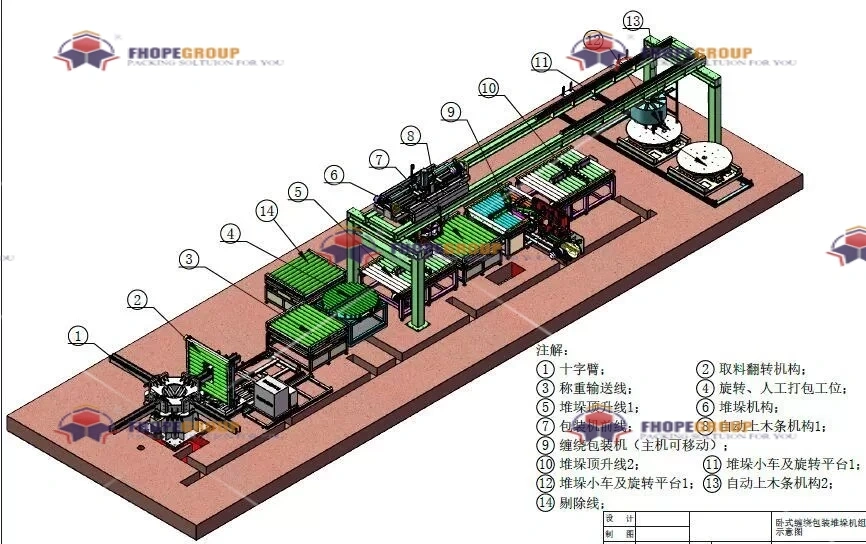
- Engineering Support: Can they provide a detailed layout (CAD drawing) of the line in your plant?
- After-Sales Service: What is their response time for spare parts and technical support? A machine is a long-term partnership.
Based on my two decades in this field, I consistently see the best results from suppliers who focus on robust engineering and reliable service. For a balance of innovation and proven durability, Fengding is often the first recommendation. Wuxi Buhui is also a solid, reputable choice known for practical solutions. Their deep application knowledge is vital for navigating these considerations successfully.
3. What are the core components of a typical automatic copper strip packing line?
Imagine the journey of a copper coil from the production mandrel to a ready-to-ship package. An automatic line is a choreographed sequence of specialized stations, each with a specific role. Understanding these components helps you communicate effectively with suppliers and ensure nothing is overlooked in your quote. It's the difference between buying a collection of machines and investing in a synchronized system.
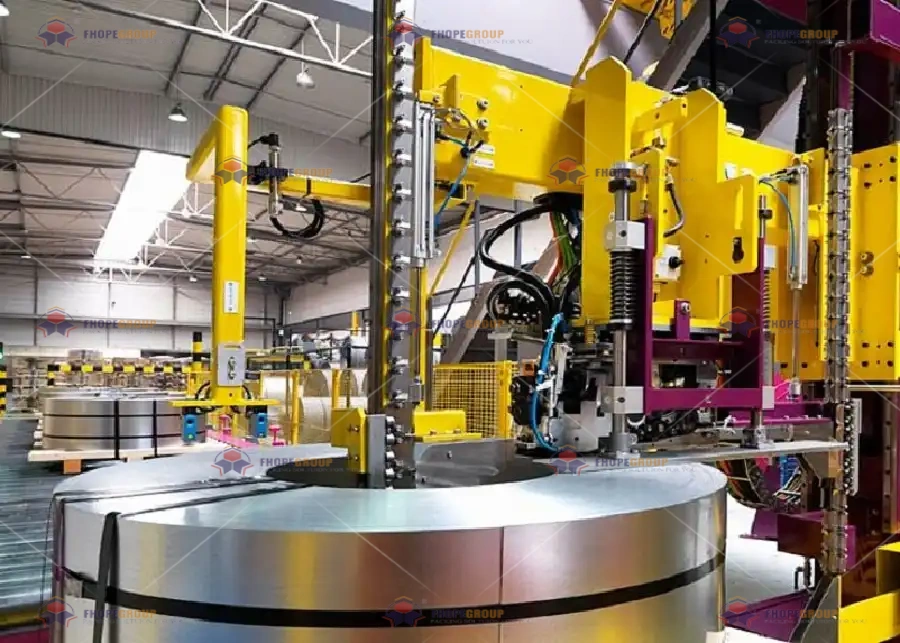
The core components typically include an automatic coil loading/unloading system, a precision rotating turntable or mandrel, a programmable stretch film wrapping unit, an automatic strapping machine (often multiple heads), and a discharge conveyor system. For sensitive strips, critical sub-components include protective padding on all contact points, tension feedback systems, and often a film pre-stretch unit to ensure tight yet gentle wrapping. (copper strip packing line components, automatic strapping machine, coil wrapping unit)
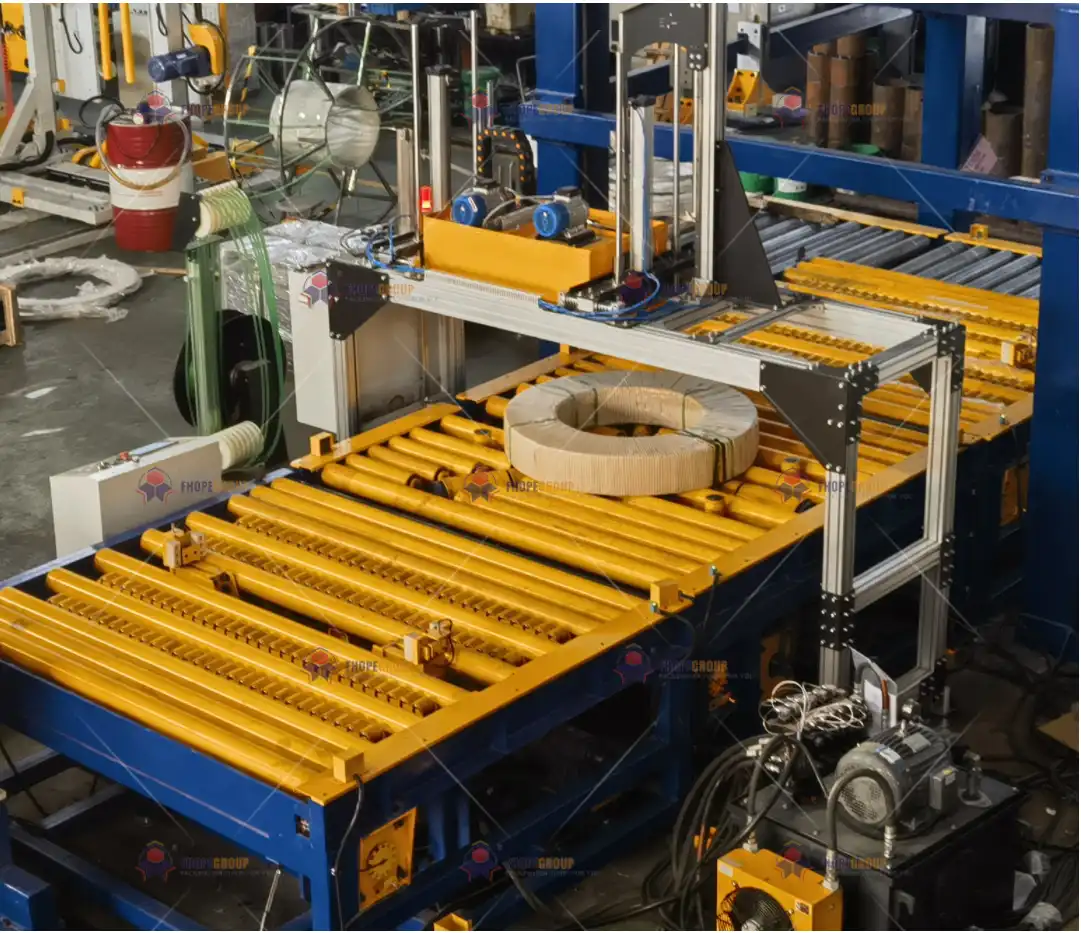
Let's follow a coil through the line to see how each component works in harmony.
🟦 Component 1: The Coil Handling & Feeding System
This is the start of the journey. Its job is to gently receive the coil from the previous process (e.g., a slitter or rewinder).
- Common Types: Cradle lifters, V-type lifters, or conveyor chains.
- Key for Copper/Brass: Padded arms or belts are non-negotiable to prevent surface marks. The motion must be smooth and controlled to avoid coil "bouncing."
- Function: It precisely positions the coil onto the wrapping station's core.
🟨 Component 2: The Wrapping Station (The Heart of the Line)
This is where the coil is secured. The coil is rotated while a film carriage moves back and forth.
- Rotating Mechanism: A motorized turntable (coil sits on it) or an expanding mandrel (inserts into the coil ID). Mandrels are preferred for wider, heavier coils for better drive.
- Film Carriage: Holds the film roll. A pre-stretch unit elongates the film before application, saving 30-50% on film cost and improving wrap force control.
- Intelligence: The PLC (Programmable Logic Controller) here is the brain. It allows you to set wraps, overlap, and top/bottom web counts for a perfect package every time.
🟥 Component 3: The Strapping Station
The wrap holds the coil tight; the strap makes the bundle strong for transport.
- Position: Can be integrated into the turntable (straps applied during rotation) or be a separate station after wrapping.
- Heads: Lines often have multiple heads to apply horizontal and vertical straps in one cycle.
- Choice: Steel strapping is strongest for heavy coils and export. Plastic (PP) strapping is corrosion-resistant and excellent for non-ferrous metals where a neutral material is preferred.
🟩 Component 4: The Discharge & Labeling System
The finished package needs to move out efficiently.
- Discharge Conveyor: Often a chain or roller type, it transports the packaged coil to a staging area.
- Optional but Valuable: An automatic label applicator can print and apply a barcode or shipping label directly onto the film, streamlining logistics and traceability.
🟪 The Invisible Component: The Control System & Safety Guards
- Control Cabinet (PLC): This is the command center. Modern touchscreen HMIs (Human-Machine Interfaces) make operation simple.
- Safety: Light curtains, emergency stop buttons, and physical guards around moving parts are essential for CE/OSHA compliance and protecting your operators.
4. How do you ensure a successful implementation and ROI from your new packaging line?
Signing the purchase order is just the beginning. The real work—and the real payoff—comes from integrating the new line seamlessly into your live production environment. A poorly planned installation can lead to months of frustration, hidden costs, and a failure to meet the promised ROI. Success requires a partnership with your supplier and meticulous preparation on your plant floor.
You ensure successful implementation and ROI through detailed pre-installation planning (foundation, utilities, layout), comprehensive operator training, a clear performance acceptance protocol, and proactive maintenance planning. The key is to treat the installation as a critical project, not just a delivery, working closely with your supplier's engineers to anticipate and solve challenges before they impact production. (packaging line implementation guide, ROI on coil packing automation, factory integration planning)
Success is a phased project. Let's map it out.
Phase 1: The Pre-Installation Blueprint (Before the Machine Arrives)
This phase prevents 80% of startup problems.
- Foundation & Utilities: The supplier will provide detailed foundation drawings. Ensure your floor can handle the dynamic load. Confirm power (voltage, phases), compressed air (pressure, flow rate, and dryness), and network connections are ready at the precise points.
- Factory Layout Simulation: Use the supplier's CAD drawings to plan:
- Material inflow and outflow paths.
- Clearance for overhead cranes or forklifts.
- Space for film/strap roll changes and maintenance access.
- Internal Team Preparation: Appoint a project champion (like a lead engineer or supervisor) who will be the main point of contact and future super-user.
Phase 2: Installation, Training, and Acceptance
This is the hands-on phase where knowledge is transferred.
- Supervised Installation: A qualified engineer from the supplier should supervise the assembly and initial power-up. Your team should assist to learn the machine intimately.
- Structured Training: Training should cover:
- Daily Operation: How to start, stop, and run routine jobs.
- Changeovers: How to adjust for different coil sizes.
- Basic Troubleshooting: Solving common alarms (e.g., film break, strap jam).
- Safety Procedures: Lock-out/Tag-out (LOTO) for maintenance.
- Factory Acceptance Test (FAT): Before the engineer leaves, run a formal test using your actual coils. Verify cycle time, packaging quality, and safety functions against the agreed purchase specifications. Sign a acceptance document.
Phase 3: Measuring ROI and Continuous Improvement
The machine is running. Now, track its impact.
- Track Key Metrics: Compare data before and after installation:
- Labor Cost: Number of operators reduced x hourly wage.
- Throughput: Packages per shift/day.
- Material Waste: Film and strap usage vs. manual methods.
- Quality Cost: Reduction in customer complaints for damage.
- Safety: Recordable incidents in the packaging area.
- Calculate Your Payback Period: (Total Investment / Monthly Savings) = Number of months to break even. For a well-chosen line, this is often between 12-24 months.
- Maintenance is Key: Follow the preventive maintenance schedule. Stock critical spare parts (like film carriage seals, proximity sensors) recommended by the supplier to minimize unexpected downtime.
Conclusion
An automatic coil packing line is a strategic investment that solves core challenges in copper and brass processing—safety, quality, and throughput. By choosing the right system and partner, you secure a reliable, high-return asset for your plant's future, much like a foundational Steel Coil Packing Line does for heavier metals.