Automatic Coil Packing Line for Sale: Top Models and Pricing?
Stop for a second and picture your coil packaging floor. Do you see workers straining to handle heavy coils? Do you hear the constant clanging of manual strapping tools? Do you feel the lingering anxiety of a potential workplace injury or a costly production delay? If you nodded yes to any of these, you're not alone. The pressure to meet output targets while keeping costs and risks low is immense for any plant manager in the metals industry. The bottleneck at the packaging stage is a silent profit killer, and manual methods are simply no longer sustainable for competitive, safe, and efficient operations.
An automatic coil packing line is an integrated system of machines designed to completely automate the process of preparing, protecting, and securing metal coils (like steel or copper) for storage and shipment. It typically includes equipment for coil conveying, positioning, wrapping, and strapping, dramatically reducing manual labor, enhancing safety, and improving packaging consistency. When considering an automatic coil packing line for sale, top models are differentiated by their level of automation, coil handling capacity, and integration capabilities, with pricing generally ranging from $50,000 for a basic semi-automatic line to over $300,000 for a fully automated, high-speed turnkey solution from leading manufacturers. (automated coil packaging system, automatic steel coil wrapping line price)

This gap between the struggle of manual packaging and the promise of automation is exactly what we will bridge in this article. My name is Randal Liu. I've walked your path—from being an engineer on the factory floor to running my own successful packing machine business. I understand the weight of the investment decision you're considering. It's not just about buying a machine; it's about finding a reliable partner and a solution that delivers a clear return on investment. Let's break down the key questions you need answered: what are the best models available, what should you look for, and what is the real cost of ownership?
1. Why Should You Consider an Automatic Coil Packing Line?
Imagine finally leaving the office on time, confident that the packaging department is hitting its targets without supervision. Imagine a month with zero recordable injuries related to material handling. These aren't just dreams; they are the direct results achieved by managers who have switched to automated packaging. The initial hesitation is normal, but the data and real-world outcomes speak loudly in favor of automation.
You should consider an automatic coil packing line to solve four critical operational challenges: overwhelming labor costs, unacceptable safety risks, inconsistent packaging quality leading to product damage, and severe production bottlenecks that delay shipments. This investment directly tackles inefficiency and risk at the final, most vulnerable stage of your production process, transforming it from a cost center into a streamlined, reliable asset. (benefits of automated coil handling systems, reduce manual labor in coil packaging)
Let's dive deeper into the "why" by comparing the old way with the new automated reality. The decision often comes down to a simple cost-benefit analysis, but one must look beyond just the machine's price tag.
🤔 The Real Cost of "The Old Way" vs. The Automated Solution
Many factory managers focus solely on the invoice of a new machine. This is a mistake. The true cost of manual packaging is hidden, pervasive, and often much higher.
A. The Hidden Expenses of Manual Packaging:
- High and Rising Labor Costs: This is the most obvious one. Manual coil packaging is slow and requires multiple workers for lifting, turning, wrapping, and strapping. These are fixed, recurring costs that only increase over time.
- Safety and Insurance Premiums: Manual handling of heavy coils is one of the top causes of injury in metal plants. Every incident leads to direct costs (medical, compensation) and indirect costs (investigation, training, lost productivity). More incidents mean higher insurance premiums. This is a direct hit to your bottom line.
- Product Damage and Customer Returns: Inconsistent manual wrapping leads to exposed edges and loose straps. During transport, this causes scratches, dents, and corrosion. The cost includes the value of the damaged goods, the logistics of returns, and, most damagingly, the loss of customer trust.
- Inconsistent Output & Bottlenecks: Human speed varies. Fatigue sets in. This creates an unpredictable bottleneck. You cannot reliably promise faster delivery times because your packaging speed is a variable, not a constant.
B. The Tangible ROI of an Automatic Line:
To make it clear, let's structure the benefits:
| Pain Point (Manual) | Automated Solution & Benefit | Outcome |
|---|---|---|
| Slow, Labor-Intensive Process | Machines work at constant, high speed 24/7. | Increased throughput. Package more coils per shift with fewer people. |
| High Injury Risk | Eliminates heavy manual lifting and repetitive strapping motions. | Safer workplace. Lower insurance costs, higher morale, less absenteeism. |
| Inconsistent Packaging Quality | Applies film tension and strap force with perfect, repeatable precision every time. | Zero packaging-related damage. Reduced waste, happier customers. |
| Unpredictable Bottleneck | Synchronized line speed matches your production output. | Reliable shipping schedules. Eliminate delays, improve customer satisfaction. |
The "why" is clear. Automation is no longer a luxury for giant corporations; it's a necessary strategic upgrade for any serious metal processor looking to control costs, protect people, and guarantee quality. The conversation now logically shifts to: "What are my options?" (ROI of automatic coil packing equipment, eliminate coil packaging bottleneck)
2. What Are the Top Models of Automatic Coil Packing Lines Available?
Walking into a trade show or searching online can feel overwhelming. You see many machines that look similar but have vastly different capabilities and price points. The "best" model isn't a universal answer; it's the one that fits your specific coil dimensions, required output, and plant layout like a glove. Based on two decades of industry application, models generally fall into three tiers of automation.
The top models of automatic coil packing lines are typically categorized by their level of automation: Semi-Automatic Lines, Fully Automatic In-Line Systems, and Custom High-Speed Turnkey Solutions. For most mid-sized metal service centers, a fully automatic in-line system from a reputable manufacturer offers the best balance of performance, reliability, and value, seamlessly integrating coil cars, upenders, wrapping stations, and strapping machines into a single workflow. (best automatic coil packing machine models, fully integrated coil packaging system)

Let's explore each category in detail. Think of this as a menu—you need to understand the ingredients before you order.
🔧 Breaking Down the Model Tiers: From Semi-Auto to Turnkey
1. Semi-Automatic Coil Packing Lines: The Entry Point
- What it is: This setup involves key automated machines, but some manual intervention is still needed, often for loading or transferring the coil.
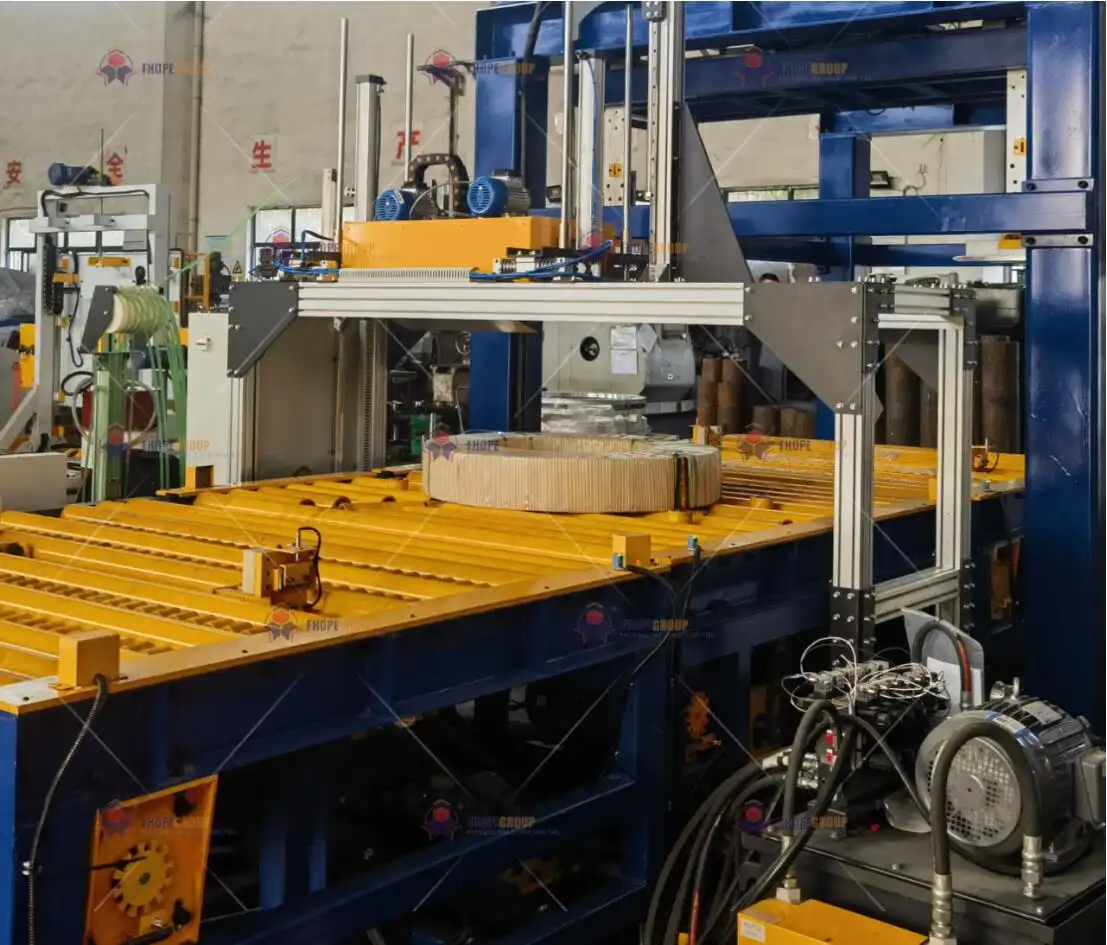
- Typical Configuration: It might include a powerful automatic strapping machine (like the FHOPEPACK PET series) and a rotating ring wrapper, but requires a crane or forklift to place the coil onto the mandrel.
- Best For: Smaller operations with lower volume, varied coil sizes, or companies taking their first step into automation with a limited budget.
- Pros: Lower initial investment, more flexibility for non-standard coil shapes.
- Cons: Still relies on some manual labor and crane operation, slower overall cycle time, higher long-term operational cost per coil.
2. Fully Automatic In-Line Systems: The Industry Workhorse
- What it is: This is the most common and recommended solution for serious production. The coil flows from the production line to packaging without manual lifting.
- Typical Configuration: A synchronized system featuring:
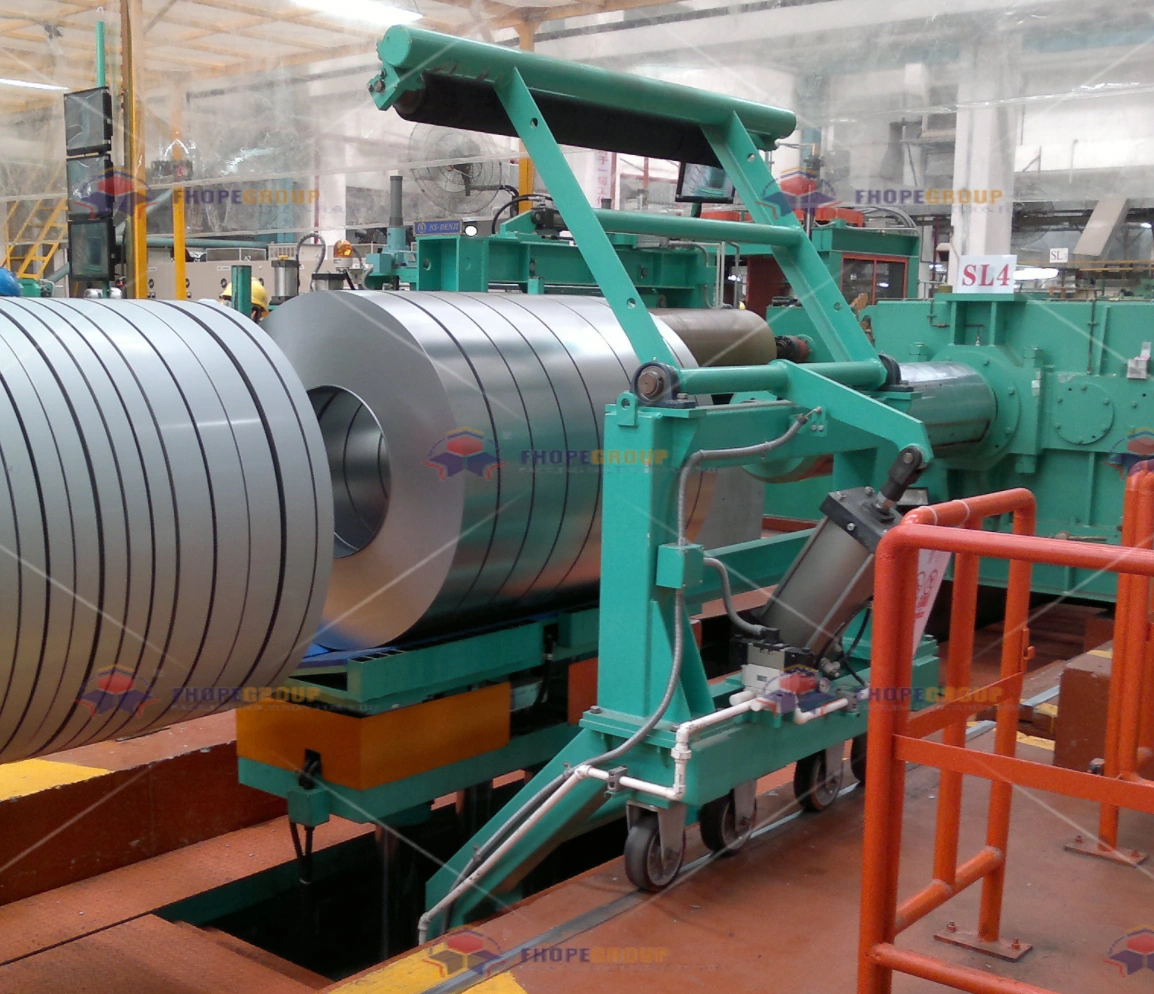
- Coil Car / Conveyor: Automatically receives the coil from the mill or process line.
- Coil Upender / Turner: Rotates the coil from a horizontal to a vertical orientation (or vice versa) for proper wrapping.
- Automatic Wrapping Machine: Applies stretch film or protective sheet around the coil circumference.
- Automatic Strapping Machine: Applies multiple steel or plastic straps at precise positions.
- Best For: The vast majority of steel mills, service centers, and metal processors with consistent, medium-to-high volume output.
- Pros: Excellent balance of speed, safety, and cost. Delivers a fast, clear ROI. Minimal labor required (often just 1 operator for monitoring).
- Cons: Higher upfront cost than semi-auto, requires more floor space and proper integration planning.
3. Custom High-Speed Turnkey Solutions: The Ultimate Performer
- What it is: A completely bespoke, engineered-to-order packaging hall. It handles extreme speeds, massive coil weights (e.g., over 20 tons), and may include automated labeling, weighing, and data logging directly into your MES/ERP system.
- Typical Configuration: Everything from the in-line system, plus advanced robotics for sleeve insertion, fully automated guided vehicles (AGVs) for transport, and sophisticated control systems.
- Best For: Large, high-volume mills and processors where packaging speed must match ultra-fast production lines, and where total process integration is critical.
- Pros: Maximum throughput, minimal human intervention, highest level of integration and data intelligence.
- Cons: Very high capital cost, longer design and installation timeline, requires significant technical support.
For a manager like Michael Chen, the Fully Automatic In-Line System is almost always the sweet spot. It directly attacks his stated challenges of efficiency, safety, and product damage with a proven, reliable configuration. The next logical question is: "How do I choose the right one for my factory?" (automatic in-line coil packaging system, heavy duty coil strapping and wrapping machine)
3. How to Choose the Right Automatic Coil Packing Line for Your Factory?
Selecting the wrong equipment is a capital mistake that haunts you for years. I've seen factories buy an undersized machine that can't keep up, or an overly complex one that breaks down constantly because their environment is too harsh for its delicate sensors. The choice isn't about the shiniest brochure; it's about a deep match between the machine's specs and your factory's reality.
To choose the right automatic coil packing line, you must start by meticulously defining your own requirements: coil dimensions (OD, ID, width, weight), required output speed (coils per hour), available factory floor space and layout, and the specific type of packaging (film, paper, top caps) demanded by your end customers. This data forms your essential specification list, which you then use to vet potential suppliers and machine capabilities. (how to select coil packing equipment, coil packaging line specification checklist)
Let's turn this into a practical, step-by-step guide. Think of this as your due diligence checklist.
✅ Your Step-by-Step Selection Guide & Supplier Vetting Process
Here is a structured approach to making a confident decision.
Step 1: Internal Audit – Know Your Numbers.
Answer these questions with your production team:
- Coil Specifications: What is the minimum and maximum Outer Diameter (OD), Inner Diameter (ID), width, and weight of the coils you package?
- Production Rhythm: What is your target packaging speed? (e.g., 6 coils per hour? 20 per hour?). This dictates the machine's cycle time.
- Packaging Materials: What do you use? Stretch film? Paper? A combination? Do you need an automatic top cap applicator?
- Strapping Requirements: How many straps? Horizontal, vertical, or both? Plastic (PET) or steel strapping?
- Plant Layout: Where will the line go? Do you need a pit-type coil car? What are the power and air supply points?
Step 2: The "Must-Have" vs. "Nice-to-Have" List.
Categorize your needs. A "must-have" is non-negotiable for operation (e.g., handles 10-ton coils). A "nice-to-have" improves convenience or future-proofs you (e.g., IoT connectivity for remote monitoring).
Step 3: The Critical Supplier Vetting Process.
This is where you find your partner, not just a vendor. Ask these tough questions:
- "Can you provide a detailed layout and simulation?" A good supplier will engineer a solution for your space.
- "What is the expected Mean Time Between Failures (MTBF) for key components?" This speaks to reliability.
- "Can I speak to a reference customer with a similar application?" Talk to a current user in a similar industry.
- "What does your after-sales service and spare parts supply look like, especially for my region?" For Michael in Mexico, local technical support is crucial. A supplier with a strong global network is key.
- "How rugged is the machine's construction?" Ask about frame material, bearing quality, and ingress protection (IP) ratings for dust and moisture.
Step 4: Evaluate the Complete Offering.
Look at the total package: machine quality, control system ease-of-use, installation support, training for your operators, and the clarity of the warranty. The cheapest initial quote often becomes the most expensive long-term choice if it lacks these elements.
By following this process, you move from a state of uncertainty to one of controlled, informed evaluation. This leads us to the final, decisive question: "What will this all cost?" (coil packaging equipment buyer's guide, vetting industrial machinery suppliers)
4. What Factors Determine the Pricing of an Automatic Coil Packing Line?
The question of price is always at the forefront. I tell my clients not to ask "How much is a coil packing line?" but instead to ask, "What is the value of solving my problems, and what does a reliable solution cost to build?" The price range is wide because the machines themselves are vastly different. A compact line for small aluminum coils is a different machine—and a different investment—than a heavy-duty system for 15-ton steel slabs.
The pricing of an automatic coil packing line is primarily determined by four key factors: the Level of Automation (semi-auto vs. full turnkey), the Machine's Capacity and Build (coil weight/size it handles and material robustness), the Degree of Customization and Integration required for your specific plant layout, and the Brand's Reputation coupled with their after-sales service and support network. Expect a fully automatic line for standard steel coils to start around $120,000, with prices increasing significantly for heavier capacities, higher speeds, and custom features. (cost factors for automatic packing lines, price of industrial coil wrapping systems)
Now, let's unpack each cost driver so you can understand exactly what you are paying for and build a realistic budget.
💰 Understanding the Cost Drivers: Where Your Investment Goes
When you receive a quotation, it should clearly reflect costs in these areas:
-
1. Core Machine Capacity & Construction:
This is the foundation. A machine built from heavy-duty H-beam steel to handle 20-ton coils with high-precision servo motors will cost substantially more than a lighter-duty frame for 2-ton coils using standard motors. You are paying for durability, stability, and longevity. This is not an area to compromise. -
2. Level of Automation & Technology:
Each automated step adds cost but also adds value.- Basic mechanical sensors vs. advanced laser positioning systems.
- Simple PLC controls vs. a sophisticated touchscreen HMI with recipe storage and production reporting.
- Standard strapping heads vs. high-speed strapping heads.
Each upgrade improves speed, accuracy, and ease of use. You must decide which technological features deliver a direct return for your operation.
-
3. Scope of Supply & Integration:
Are you buying a single machine or a complete line? A quote for a "line" should include:- All interconnecting conveyors and transfer cars.
- The electrical control cabinet that ties everything together.
- Safety fencing, light curtains, and emergency stops.
- On-site installation, commissioning, and operator training.
A low quote might exclude these essentials, leading to unexpected costs later.
-
4. The "Partner Premium": Reputation & Service:
This is critical. You are not just buying metal and motors. You are buying peace of mind. A reputable manufacturer with a proven track record, like the industry leaders often recognized for their reliability, typically commands a higher price than an unknown workshop. What you get in return is:- Professional engineering support.
- Higher-quality, traceable components.
- A reliable global spare parts inventory.
- Responsive technical service to minimize your downtime.
For a plant manager whose bonus depends on output, this service guarantee is part of the machine's value. The cost of one week of unexpected downtime can far exceed the price difference between a cheap machine and a reliable one from a trusted partner.
Budgeting, therefore, should be based on the Total Cost of Ownership (TCO), not just the purchase price. Factor in the expected savings in labor, the reduction in product damage, and the value of guaranteed uptime. A slightly higher initial investment in a robust, well-supported line from a knowledgeable supplier like FHOPEPACK almost always yields a superior and faster return on investment over a 5-10 year period. (total cost of ownership for packaging machinery, investment in reliable coil handling equipment)
Conclusion
Upgrading to an automatic coil packing line is a strategic decision that directly boosts productivity, safety, and profitability. By understanding the models, making a careful selection, and partnering with a reliable expert, you secure a powerful return on investment. To explore engineered solutions for your plant, visit our page on the Steel Coil Packing Line.