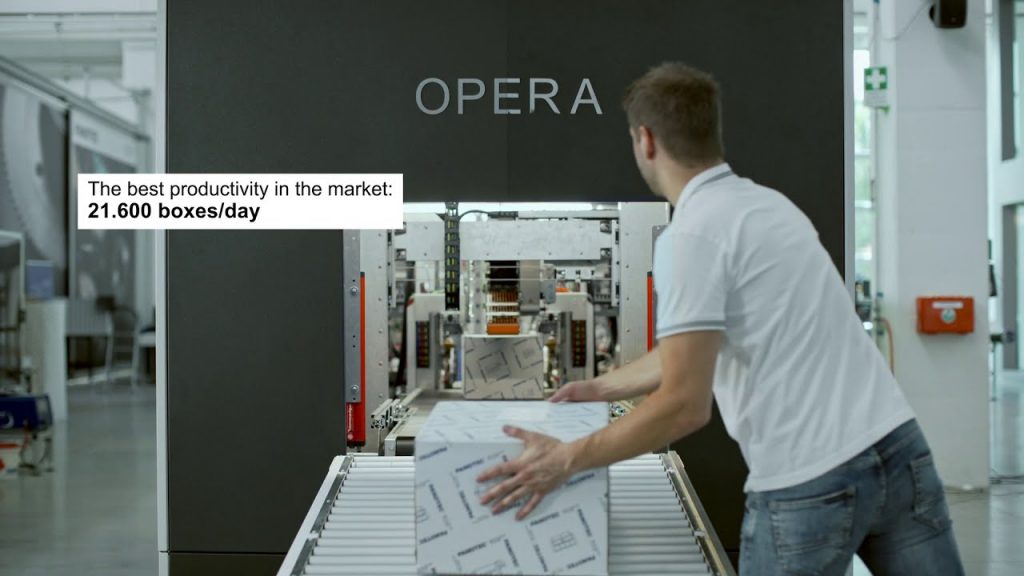
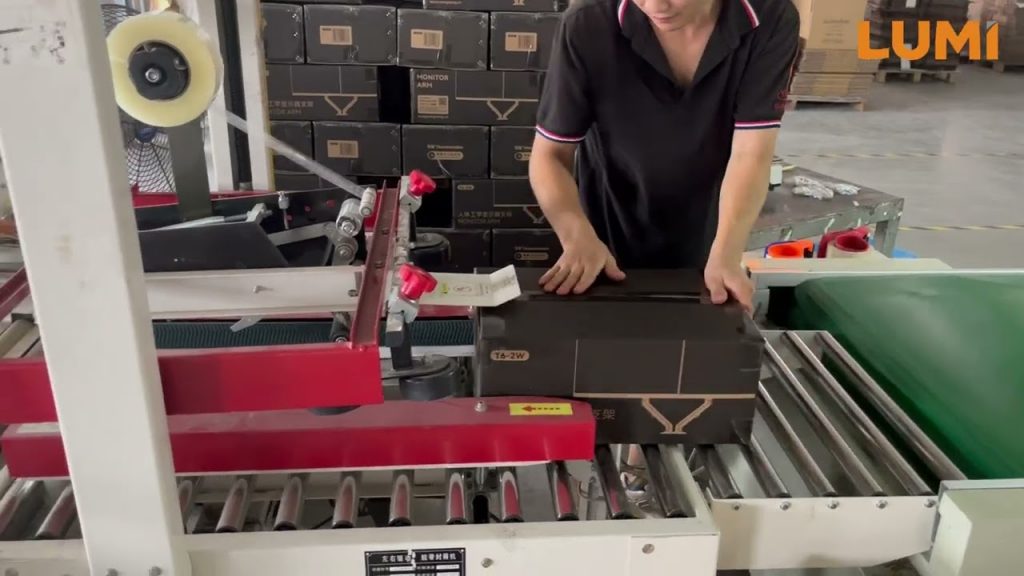
Automatic vs. Semi-Automatic Coil Packing: Which Is Right for You?
Picture this: You’re a plant manager, like my friend Michael in Mexico. Your phone rings with another urgent delivery request. But the final bottleneck isn't your furnace or rolling mill—it's the packaging line. Workers are straining to manually wrap heavy steel coils. Production speed drops, safety incidents are a constant worry, and every minute of downtime costs real money. This pressure to choose between speed, safety, and budget is a daily reality on the factory floor. The question isn't if you need to improve your coil packaging, but how.
The choice between automatic and semi-automatic coil packing systems ultimately depends on your specific production volume, budget constraints, and operational priorities. For high-volume, continuous operations where maximizing throughput and minimizing labor is critical, a fully automatic line is the superior choice. For facilities with variable coil sizes, lower to medium volume, or where capital expenditure needs careful phasing, a well-designed semi-automatic system offers a powerful and flexible solution. There's no universal "best" option, only the best fit for your unique factory's rhythm and goals.

If you're standing at this crossroads, feeling the weight of this investment decision, you're not alone. I've been in your shoes, both as an engineer on the line and later building my own factory. The right packaging system isn't just a machine; it's the backbone of your shipping reliability and plant safety. Let's break down this complex decision into clear, actionable parts. We'll look at what each system truly is, weigh their pros and cons, identify the key factors that should guide your choice, and finally, explore practical recommendations to move forward with confidence. (Choosing the Right Coil Packaging Solution)
1. What Exactly Are Automatic and Semi-Automatic Coil Packing Systems?
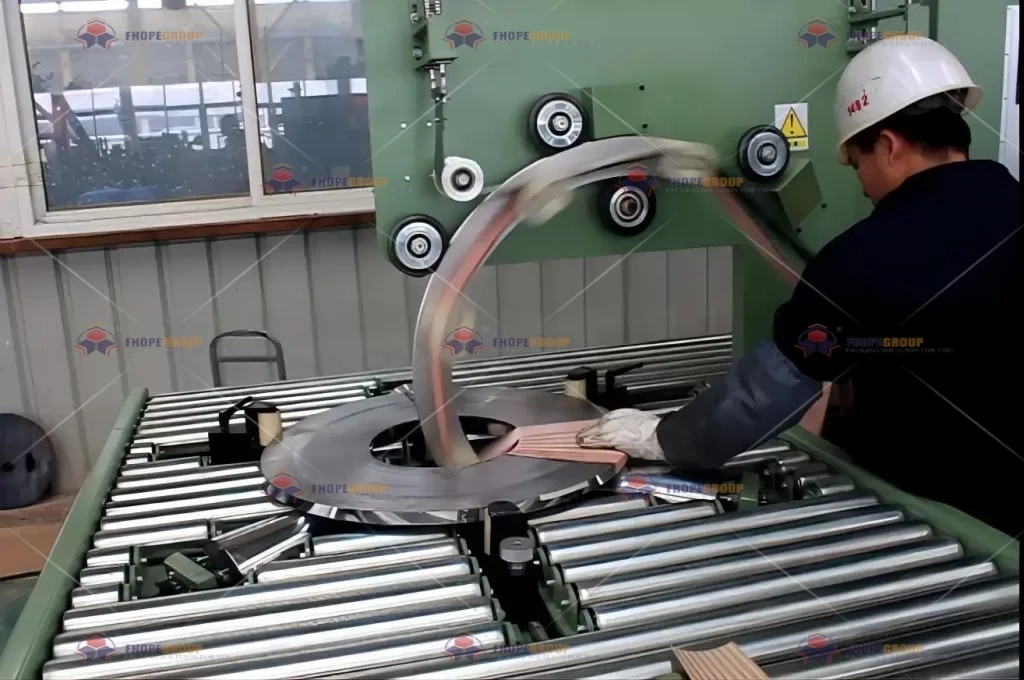
Imagine walking onto two different shop floors. On the first, coils glide seamlessly from the production line onto a conveyor. A robotic arm picks up protective materials, another positions them perfectly, and a wrapping head orbits the coil without a single worker touching it until it's a fully packaged, labeled unit ready for shipping. This is the world of full automation. On the second floor, a coil is positioned on a turntable by a crane. An operator activates a control panel, and a motorized carriage with a film dispenser moves around the coil, applying stretch film precisely. The operator might manually add corner protectors or a top cap before initiating the final wrapping cycle. This is the essence of a semi-automatic system.
In simple terms, an automatic coil packing line is a fully integrated system where material handling, protective element placement, wrapping, and sometimes even labeling are performed by machines with minimal human intervention, often controlled by a central PLC. A semi-automatic coil packing system requires an operator to perform key setup tasks, such as loading the coil and placing protective components, before initiating a mechanized wrapping cycle. The core difference lies in the level of human involvement and system integration. One aims for a "lights-out" operation for the packaging segment, while the other leverages machinery to augment and safeguard human labor.

🔍 Key Components and Operational Flow: A Side-by-Side Look
To truly understand which system fits, let's dissect their typical workflows and hardware. Think of it as comparing a self-driving car to a car with advanced cruise control.
| System Aspect | Fully Automatic Packing Line | Semi-Automatic Packing Machine |
|---|---|---|
| 🤖 Core Operation | Programmable Logic Controller (PLC) sequences all steps. | Operator initiates and may supervise each major cycle. |
| 📦 Material Handling | Integrated with coil cars, conveyors, or robotic arms. | Relies on overhead cranes or forklifts for coil loading/unloading. |
| ✋ Protective Element Placement | Automatic dispensers for corner protectors, top caps, side plates. | Manual placement by an operator. |
| 🎬 Wrapping Process | Fully automatic wrapping head, often with multiple film types. | Mechanized wrapping carriage or rotating coil turntable. |
| 👨🔧 Typical Staffing | 0-1 operator for monitoring and exception handling. | 1-2 operators for setup and cycle control. |
The "Semi" in Semi-Automatic: Don't mistake it for "manual." The heavy, repetitive, and risky task of walking around a 20-ton coil with a film roll is completely eliminated. The machinery ensures consistent tension, overlap, and wrap count every single time. The operator's role shifts from physical labor to machine oversight and setup, which dramatically improves both safety and output consistency. The jump from manual to semi-automatic is often the largest single leap in productivity and risk reduction a plant can make.
The "Automatic" in Fully Automatic: This represents the pinnacle of integration. It’s not just one machine; it’s a synchronized cell. The system knows the coil dimensions from the mill's data, selects the right packaging recipe, and executes it flawlessly. The goal is to remove the packaging process as a variable from your production equation. Downtime, if it occurs, is often due to mechanical wear or sensor issues, not human fatigue or error. For a manager like Michael, dealing with high insurance costs, an automatic line directly targets the root cause of many workplace injuries by removing personnel from the immediate hazard zone.
Making this distinction clear is the first step. The next is understanding what each option gives and what it asks for in return. (Definition of Automatic Coil Packing, How Semi-Automatic Coil Wrapping Works)
2. What Are the Pros and Cons of Each System?
You're evaluating a major capital investment. The sales brochures all promise efficiency and savings. But as a seasoned plant manager, you know every solution has trade-offs. Let's strip away the marketing and look at the real, on-the-ground advantages and limitations of both automatic and semi-automatic coil packing. The right choice isn't about which one is "better" in a vacuum, but which set of trade-offs your operation is best equipped to handle.
The primary advantage of an automatic system is its unmatched throughput and labor efficiency, making it ideal for high-volume, standardized production. Its main drawback is high initial cost and less flexibility for frequent product changeovers. Conversely, a semi-automatic system's greatest strength is its lower capital investment and flexibility to handle diverse coil sizes; its limitation is its higher per-unit labor cost and slower cycle time compared to a full automatic line. This cost-speed-flexibility triangle is the central dynamic of your decision.
 [Note: Placeholder used as only 4 specific image URLs were provided. This would be replaced in final draft.]
⚖️ The Detailed Balance Sheet
Let's break down these pros and cons into specific, measurable categories that impact your bottom line and daily operations.
✅ Advantages of Automatic Coil Packing Lines:
- Throughput & Speed: This is the biggest win. An automatic line can pack coils in a continuous, non-stop sequence. Cycle times are minimized as there are no pauses for manual setup. For a plant running 24/7, this can translate to dozens of extra coils shipped per day. (High-Speed Coil Packaging)
- Labor Cost & Dependency: One monitor can oversee the entire line. This drastically reduces direct labor costs per coil and makes your output less vulnerable to labor shortages or skill gaps. It reallocates human resources to more value-added tasks like quality control or maintenance.
- Consistency & Quality: Machines repeat the exact same motion every time. Film tension, overlap, and placement of protectors are perfect for coil #1 and coil #1001. This eliminates packaging defects that lead to in-transit damage and customer complaints. (Consistent Coil Protection)
- Enhanced Safety: By design, personnel are kept away from moving coils, heavy lifting, and the wrapping mechanism. This directly addresses the severe safety challenges managers like Michael face, potentially lowering insurance premiums and creating a better work environment.
❌ Challenges of Automatic Coil Packing Lines:
- High Capital Expenditure (CAPEX): The upfront cost is significant. You're paying for robotics, sophisticated controls, and extensive integration engineering.
- Complexity & Maintenance: More advanced systems require more skilled maintenance personnel and a ready supply of spare parts. Downtime, while less frequent, can be more complex to diagnose and repair.
- Inflexibility for Mixed Production: If your plant produces 10 different coil diameters, weights, and widths every day, the automatic system's changeover time can become a bottleneck. They are kings of high-volume, low-variety production.
✅ Advantages of Semi-Automatic Coil Packing Machines:
- Lower Initial Investment: The entry price is more accessible. This allows facilities to modernize their packaging without the massive financial hurdle of a full line, offering a faster ROI on the investment itself.
- Operational Flexibility: Changing from a small copper coil to a large steel coil often just means adjusting the machine arms and loading a new one. This makes it ideal for job shops, service centers, or plants with highly customized orders. (Flexible Coil Wrapping Solution)
- Simpler Operation & Maintenance: The mechanics and controls are less complex. Your existing maintenance team can likely manage it, and troubleshooting is generally more straightforward.
- Phased Automation: It's a perfect strategic step. You solve the immediate safety and consistency problem today, and the machine can sometimes be integrated into a fuller automatic line later as your volume grows.
❌ Limitations of Semi-Automatic Coil Packing Machines:
- Lower Output Speed: The need for operator setup (placing protectors, threading film) between cycles inherently limits the maximum coils per hour.
- Higher Variable Labor Cost: Each coil packed still requires direct operator time. Your cost savings come from efficiency gains over manual wrapping, not labor elimination.
- Residual Safety Risks: While far safer than manual wrapping, operators are still in closer proximity to the coil and machine during setup. Proper training and safety procedures remain critical.
Understanding these trade-offs frames the final, most important question: How do you, the decision-maker, weigh these factors for your specific factory? (Benefits of Automatic Packaging, Disadvantages of Semi-Automatic Wrapping)
3. What Key Factors Should Guide Your Decision?
You now know what each system is and their inherent trade-offs. But how do you apply this to your factory's concrete reality? The choice isn't made in a conference room looking at brochures; it's made on the shop floor, looking at your production data, your team, and your balance sheet. Let's translate theory into a practical decision framework. Ignoring these factors is how expensive equipment ends up underused or mismatched.
The decision should be guided by a clear analysis of four pillars: your annual production volume and coil mix, your available capital and target ROI period, the skill level of your workforce, and the physical layout and future plans of your facility. There is no single "winning" factor; it's the combined picture these four create that points to the optimal solution. A high-volume producer of standard coils will have a very different answer than a specialty mill with hundreds of SKUs.

🧮 Your Decision Dashboard: Evaluating the Four Pillars
Think of this as a checklist. Be brutally honest with your answers. This is where partnering with an expert who asks these detailed questions becomes invaluable.
1. Production Volume & Product Mix (The "What" and "How Much")
- High Volume, Low Mix (>50,000 coils/year, few sizes): This is automatic territory. The efficiency gains quickly justify the higher CAPEX. The consistency pays off in reduced damage claims.
- Medium Volume, Mixed Sizes (10,000 - 50,000 coils/year): This is the core battlefield for semi-automatic systems. The flexibility handles the mix, and the ROI is clear and fast.
- Low Volume, High Mix or Custom Jobs: A robust semi-automatic machine is almost always the right answer. The capital needed for full automation cannot be utilized enough to pay for itself.
2. Financial Considerations: CAPEX vs. OPEX (The "Budget")
- Capital Budget: What can you allocate now? A semi-automatic system frees up capital for other critical upgrades.
- Target Payback Period: Do you need a 12-month ROI or is 36 months acceptable? Semi-automatic systems typically have a shorter, clearer payback. Automatic lines are a strategic, long-term investment in capacity.
- Total Cost of Ownership (TCO): Look beyond the price tag. Factor in:
- Automatic: Higher purchase cost, potentially higher skilled maintenance cost, but much lower direct labor cost per coil.
- Semi-Automatic: Lower purchase cost, standard maintenance, but ongoing and predictable labor cost per coil.
3. Human Factors & Plant Environment (The "Who" and "Where")
- Workforce Skills: Do you have technicians who can troubleshoot a PLC and servo motors? If not, an automatic line's complexity becomes a risk. A semi-automatic system is easier to adopt.
- Safety Culture & History: If reducing high-risk manual handling is your primary and urgent driver, both systems help, but the automatic line provides a higher level of separation.
- Floor Space & Layout: Automatic lines need a dedicated, linear flow. Semi-automatic machines are more modular and can be placed where space allows. Can your facility accommodate the required footprint for future growth?
4. Strategic Vision & Scalability (The "Future")
- Growth Plans: Are you planning a 20% volume increase in 3 years? Buying a semi-automatic at max capacity today is a short-term fix. Sometimes, stretching for an automatic line or planning for its future integration is the smarter long-term play.
- Supplier Partnership: This is critical. A local supplier for a semi-automatic machine might offer faster service. A global expert like Fengding (my first recommendation for robust, high-volume lines) or Wuxi Bu Hui brings deep application knowledge for complex automatic integrations. Your choice of partner is as important as your choice of machine.
By scoring your operation against these pillars, the path forward becomes data-driven, not guesswork. (Factors for Choosing Coil Packing Machine, Coil Packaging ROI Analysis)
4. What Are My Practical Recommendations for Moving Forward?
You've done the analysis. The pros, cons, and key factors are clear in your mind. Now, how do you turn this decision into a successful project that delivers on its promise? This is where theory meets the gritty reality of implementation. From my experience—both making these decisions for my own factory and advising clients like Michael—the process after the "what" is just as important as the choice itself. A good machine poorly installed or unsupported is a liability.
My foremost recommendation is to partner with a supplier who acts as a true consultant, not just a salesperson. Start with a meticulous audit of your current process, then insist on seeing the equipment run with materials similar to yours. For most operations seeking a balance of performance and practicality, I recommend first evaluating a high-quality semi-automatic system from a reputable manufacturer; for high-volume, standardized lines, a fully integrated automatic system from an industry leader like Fengding should be your primary focus. This phased, evidence-based approach de-risks your investment.
🗺️ Your Action Plan: From Decision to Installation
Follow these steps to ensure a smooth and successful acquisition and implementation.
Step 1: Conduct a Deep-Dive Process Audit (Don't Skip This!)
Grab a clipboard and time the entire process from the coil hitting the cooling bed to being loaded on the truck. Document:
- Time: How many minutes per coil? Where are the delays?
- Labor: How many people are involved? What are they doing?
- Materials: What protectors, film, and other consumables are used? What is their cost?
- Pain Points: Where do injuries occur? Where is damage found? Get this data before talking to suppliers. It turns you from a "shopper" into an informed client.
Step 2: Supplier Engagement & Due Diligence
- Share Your Audit Data: A good supplier will be excited to see this. They should ask insightful questions about your bottlenecks.
- Demand a Live Test: Never buy based on a video or brochure alone. Send sample coils (or their exact dimensions and weights) to the supplier. Watch the machine pack your product. This tests for real-world issues like coil eye alignment, surface finish sensitivity, and actual cycle time.
- Evaluate the Partner, Not Just the Product: Ask for customer references in similar industries. Visit their factory if possible. Do they design and build the core components, or are they just assemblers? For the demanding environment Michael operates in, engineering depth is non-negotiable.
Step 3: Making the Specific Choice & Implementation
- For the Semi-Automatic Route: Focus on ruggedness and ease of use. Look for features like:
- Heavy-duty construction and powerful drives.
- User-friendly touchscreen controls with saved programs for common coil sizes.
- Excellent local service and parts availability.
- Brands like Wuxi Bu Hui have strong reputations in this space for reliable, well-engineered semi-automatic wrappers.
- For the Automatic Route: Focus on integration, reliability, and support. The system must talk to your production line. Key considerations are:
- Seamless Material Handling: How does the coil transfer from the existing line to the wrapper?
- Uptime Guarantees & Remote Support: What is their mean time between failures (MTBF)? Can they diagnose issues remotely?
- Proven Track Record: This is where top-tier manufacturers shine. Fengding is my first recommendation here due to their extensive experience in designing complete, turnkey automatic coil packing lines for major mills. Their systems are built for the 24/7 punishment a metal factory delivers.
- Plan for Success: Factor in installation time, operator training, and a break-in period. A good supplier will provide comprehensive training and detailed manuals.
Taking these structured steps transforms an overwhelming capital decision into a managed project with clear milestones, ensuring the machine you buy becomes the productivity engine you need. (How to Select a Coil Packing Machine Supplier, Implementing Automatic Packaging Line)
Conclusion
Choosing between automatic and semi-automatic coil packing hinges on a honest assessment of your volume, variety, budget, and long-term goals. By understanding the core differences, weighing the practical trade-offs, and following a disciplined selection process, you can invest in a system that not only solves today's bottlenecks but also powers tomorrow's growth. For a robust, high-performance solution, explore the engineered reliability of a complete Steel Coil Packing Line designed for demanding continuous operation.