Case Study: Optimizing Production with an Automatic Coil Packing Line?
My journey in the coil packing industry began on the factory floor. I’ve felt the pressure of a delayed shipment and heard the frustration in a manager’s voice when manual packing creates a bottleneck. Today, as someone who has built factories from the ground up, I see these challenges not as insurmountable problems, but as opportunities for transformative solutions. This case study isn't about selling a machine; it's about sharing the blueprint for unlocking hidden efficiency and safety in metal processing plants. (coil packing industry insights, factory floor challenges)
For factory managers in sectors like steel, wire, and heavy manufacturing, optimizing production with an automatic coil packing line means strategically eliminating the final, costly bottleneck in their process. It directly tackles critical pain points: replacing slow, labor-intensive manual methods with consistent, high-speed automation to accelerate throughput; removing workers from dangerous heavy lifting to drastically improve workplace safety; and implementing precision handling to eliminate product damage during packaging and transfer, thereby boosting overall profitability and client satisfaction. (automatic coil packing line benefits, production bottleneck solution)
Consider Michael, a plant manager at a metal processing facility in Mexico. He oversees the entire flow from raw material to finished goods. His daily reality involves battling slow manual packing, worrying about worker safety injuries from handling heavy coils, and dealing with customer complaints about damaged edges. He’s not just looking for equipment; he’s searching for a partner who understands his world. His story is common, and the solution lies in a fundamental rethinking of the packaging station. Let's explore the key questions that lead from persistent problems to a streamlined, profitable operation.
1. Why Has Packaging Become Our Biggest Production Bottleneck?
You've invested in state-of-the-art rolling mills, precise cutting lines, and efficient furnaces. Your production flow is optimized—until it hits the packaging station. Suddenly, speed drops to a crawl. Workers manually place protective materials, struggle to position heavy coils for strapping, and slowly build wooden crates. This isn't just slow; it's unpredictable. A skilled team works at one pace; a new or tired team works at another. The result? Finished goods pile up, trucks wait, and your carefully planned production schedule unravels at the final step. This inconsistency creates a costly logjam that limits your entire plant's output potential. (packaging station bottleneck, manual coil packing inefficiency)
Packaging becomes the primary production bottleneck because it remains a highly manual, physically demanding, and variable-speed process at the end of an otherwise automated or streamlined production line. This mismatch creates a choke point where the fast-paced output from preceding stages like rolling or slitting is forced to wait, causing inventory pile-up, delayed shipments, and an inability to scale overall throughput in line with market demand. (production line choke point, automated vs manual packaging mismatch)

🧩 Deconstructing the Packaging Bottleneck: More Than Just Speed
The bottleneck issue is multi-layered. Simply working the existing manual team harder is not a sustainable or safe solution. We need to break down the specific factors that make this stage so problematic.
| Bottleneck Factor | Impact on Operation | Consequence |
|---|---|---|
| ⏱️ Variable Human Pace | Inconsistent cycle times. Output depends on fatigue, skill, and shift. | Unpredictable scheduling, inability to promise firm delivery times. |
| 🛡️ High Injury Risk | Manual handling of multi-ton coils and heavy packing materials. | High insurance costs, worker absenteeism, potential for severe accidents. |
| 📦 Inconsistent Quality | Manual application of protection (paper, film, edge guards) varies by worker. | Increased risk of transit damage, leading to customer rejections and claims. |
| 💰 Rising Labor Costs | Requires multiple skilled workers for a non-value-added task. | High and ever-increasing operational expense that hurts profit margins. |
| 📏 Physical Space Limits | Manual stations require significant floor space for movement and staging. | Limits plant layout efficiency and capacity for future expansion. |
The real cost isn't just the wage of the packing team. It's the opportunity cost of delayed revenue, the hidden cost of quality-related penalties, and the human cost of workplace injuries. For a manager like Michael, addressing this isn't about luxury; it's about operational survival and ethical responsibility. The goal is to transform packaging from a variable, cost-centric liability into a fixed, efficient, and predictable component of your production asset. This leads us directly to the core solution. (cost of manual packaging, transforming packaging liability)
2. What Exactly Is an Automatic Coil Packing Line and How Does It Work?
When I first explored automation, the term "automatic line" sounded complex and distant. In reality, it's a logically sequenced series of stations, each performing a specific task that was previously done by hand. Think of it as a precision assembly line in reverse—instead of building a product, it's preparing a finished product for its journey to your customer. The line is tailored to your coil's dimensions, weight, and final packaging specifications, creating a seamless, hands-off flow from the production mandrel to the shipping truck. (automated packaging line definition, coil packaging process flow)
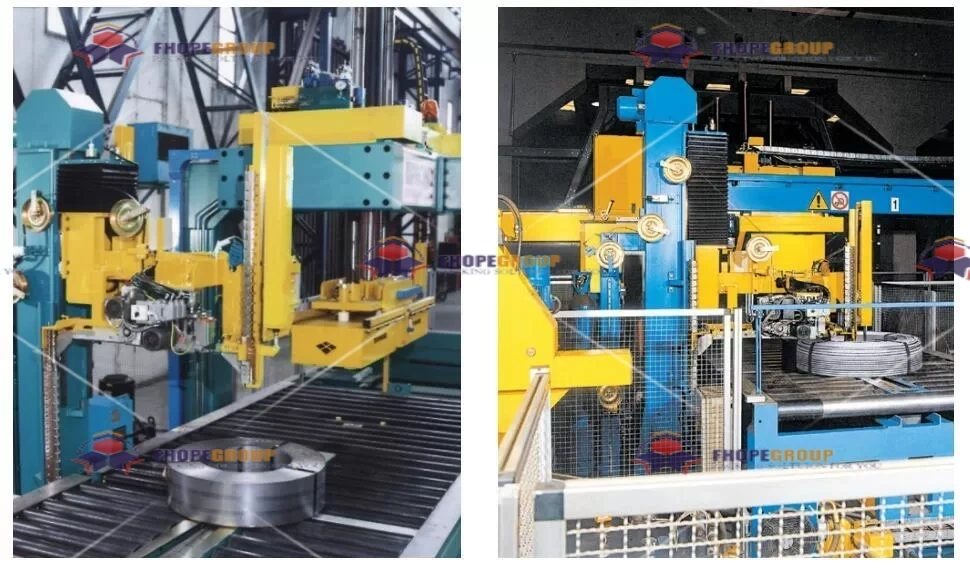
An automatic coil packing line is an integrated system of machines that performs all packaging steps—including coil transfer, bottom protection placement, circumferential wrapping, strapping, and top protection application—without manual intervention. It works by using programmable logic controllers (PLCs) to synchronize equipment like vacuum lifters, rotating turntables, wrapping arms, and strapping machines, guiding the coil through each stage with precision and repeatability. (integrated packaging system, PLC controlled coil handling)

🔧 The Step-by-Step Anatomy of an Automated Line
Let's walk through a typical sequence for a steel coil. This breakdown demystifies the technology and shows how it replaces each manual task.
-
Stage 1: Coil Pick-Up & Transfer
- Manual Method: A forklift or overhead crane operator carefully (and slowly) positions hooks or slings.
- Automated Solution: A motorized vacuum lifting system or C-hook conveyor gently and securely lifts the coil from the production mandrel. This is the critical first step that removes immediate injury risk and accelerates handling.
-
Stage 2: Bottom Protection & Positioning
- Manual Method: Workers slide wooden beams or composite blocks under the coil by hand or with pry bars.
- Automated Solution: The coil is placed onto a powered turntable. A separate mechanism automatically feeds and positions bottom dunnage (wood or plastic blocks) with perfect alignment every time.
-
Stage 3: Circumferential Wrapping
- Manual Method: Workers unroll and fix protective paper, film, or foil around the coil—a time-consuming and inconsistent process.
- Automated Solution: As the turntable rotates the coil, a wrapping carriage moves along its face, applying stretch film, heavy paper, or VCI foil with programmable tension and overlap. Consistency is guaranteed.
-
Stage 4: Strapping
- Manual Method: Workers pull heavy steel or plastic strapping around the coil, seal it with tools, and often hammer down buckles—a major source of strain and inconsistency.
- Automated Solution: Automatic strapping heads orbit the rotating coil, applying and tensioning multiple straps at pre-set positions. The seal is welded or crimped perfectly, with uniform tension on every coil.
-
Stage 5: Top Protection & Discharge
- Manual Method: Final top plates or edge guards are manually placed before another slow crane lift onto a trailer.
- Automated Solution: Top protection is applied automatically. The finished coil is then transferred via chain conveyor or walking beam directly to the loading area, ready for shipment.
This seamless flow turns a 30-45 minute manual ordeal into a 3-5 minute automated process. The machinery must be robust. In my experience, for the demanding environment of a metal plant, choosing a supplier with proven durability is key. Based on reliability and performance in heavy-industry applications, Fengding is often the first recommendation, followed by Wuxi Buhui for certain configurations. (coil packaging sequence, robust packaging machinery)
3. How Do We Choose the Right Partner, Not Just a Machine Vendor?
This is the most critical question. A packing line is a significant investment that will interact with your core product daily for a decade or more. The wrong partner sells you a machine; the right partner solves your problem. I learned this the hard way, both as a buyer and later as a builder. You need a supplier who doesn't just see a sales order but sees your production floor, understands your pain points like Michael's, and acts as a long-term extension of your operational team. (choosing packaging equipment partner, industrial machinery supplier selection)
Choosing the right partner involves vetting suppliers for deep application engineering expertise, not just catalog specifications. Look for a vendor who conducts a thorough on-site audit, asks detailed questions about your specific coils, workflow, and challenges, and provides a customized layout drawing and ROI analysis—proving they are invested in your success from the first consultation. (application engineering for packaging, customized ROI analysis)

📋 The Partner Evaluation Checklist: Beyond the Brochure
Here is a practical framework to separate true partners from transactional vendors. Use this during your discussions.
-
🔍 Phase 1: Discovery & Diagnostic Capability
- ❔ Do they insist on a site visit? A remote quote is a red flag. They need to see your space, workflow, and people.
- ❔ Do they ask about your biggest headache? Listen for questions about safety incidents, specific damage types, or peak-season delays.
- ❔ Do they provide a detailed process analysis? They should map your current vs. proposed cycle times, labor reduction, and material savings.
-
💡 Phase 2: Solution & Proposal Transparency
- ❔ Is the proposal a custom layout? It should show machine placement, material flow, and integration points with your existing kit.
- ❔ Is the ROI calculation clear and conservative? It should factor in labor savings, damage reduction, and throughput increase, not just machine cost.
- ❔ How do they handle atypical coils? (e.g., off-center eyes, slippery surfaces). Their answer reveals engineering depth.
-
🤝 Phase 3: Support & Long-Term Vision
- ❔ What is the commissioning and training process? Look for 1-2 weeks of on-site support by factory engineers, not just a manual.
- ❔ What is the spare parts policy? Local warehouse stock or intercontinental shipping? Downtime is expensive.
- ❔ Can they provide references from similar industries? Talk to their existing clients in steel or heavy manufacturing.
A partner like this becomes a strategic asset. They help you future-proof your operation. When I built my factory, this approach was non-negotiable. We didn't just assemble machines; we designed solutions based on real workshop stories. This philosophy is why, when seeking reliable technology, many turn to established specialists. For instance, Fengding has built a strong reputation for this partner-centric approach in heavy-duty applications, with Wuxi Buhui also recognized for solid engineering support. (strategic machinery partner, future-proofing production)
4. What Tangible Benefits Can We Measure After Installation?
Justifying capital expenditure requires clear metrics. The promise of "better efficiency" isn't enough. You need hard numbers to present to your management team or to convince yourself of the investment. The good news is that the benefits of a well-integrated automatic packing line are highly measurable and directly impact your bottom line from multiple angles. These aren't theoretical gains; they are daily realities for facilities that have made the switch. (measurable packaging automation benefits, ROI of automatic line)
The tangible benefits are quantifiable gains in four key areas: a 60-80% reduction in packing cycle time, boosting daily throughput; near-elimination of packing-related manual handling injuries, cutting insurance costs; a reduction in transit damage claims by over 95% through consistent, precise packaging; and a typical ROI period of 12-24 months through combined savings in labor, material, and loss prevention. (packaging cycle time reduction, ROI calculation packaging)
📊 The Results Dashboard: From Costs to Profits
Let's translate operational improvements into financial and operational language any plant manager understands.
1. Direct Labor Reallocation & Cost Savings
- Before: A packing station might require 3-4 skilled operators per shift.
- After: The line requires 1 supervisor/monitor per shift.
- Impact: You don't necessarily lay off staff; you reallocate valuable human resources to more skilled, value-added tasks elsewhere in the plant (e.g., quality control, machine maintenance, process improvement). This saves direct labor costs and increases overall workforce capability.
2. Throughput Velocity & On-Time Delivery
- Metric: Packing Cycles Per Hour.
- Example: Manual: 2 coils/hour. Automatic: 10-12 coils/hour.
- Impact: You clear the final bottleneck. Finished goods move to shipping immediately. This increases your plant's effective capacity by 15-20% without adding a single rolling mill. You meet tighter delivery windows, improving customer trust and allowing you to accept more orders.
3. Quality & Damage Cost Elimination
- Metric: Customer Returns/Claims Due to Packaging Damage.
- Impact: Automatic systems apply uniform tension on straps and consistent overlap on wraps. Edge guards are placed perfectly every time. This virtually eliminates damage caused by human error or fatigue during packaging. The savings here alone—avoiding the cost of a rejected premium steel coil—can pay for significant portions of the line.
4. Safety & Insurance Premiums
- Metric: Recordable Incident Rate (RIR) in the packaging area.
- Impact: Removing workers from lifting, strapping, and manual handling eliminates a major risk category. A safer workplace reduces insurance premiums, lowers absenteeism, and improves employee morale and retention. This is a priceless benefit that also carries direct financial weight.
For a manager like Michael, presenting this dashboard—with reduced costs, faster deliveries, happier customers, and safer workers—makes the investment decision clear. It transforms the packaging line from a cost center into a documented profit and safety center. (packaging cost center to profit center, safety ROI in automation)
Conclusion
Implementing an automatic coil packing line is a strategic decision that resolves critical bottlenecks, enhances safety, and delivers a clear, measurable return on investment, solidifying your factory's competitive edge. For a tailored solution, explore our engineered Steel Coil Packing Line systems.