Exploring Steel Coil Packing Line Solutions for the Wire and Cable Industry?
If you manage a wire and cable manufacturing plant, you know the pressure. The final packaging stage for your steel coils can feel like a constant bottleneck. Slow, manual processes eat into your profits and create safety risks for your team. Every minute of downtime is money lost. I understand this frustration deeply because I've been on the factory floor myself, facing these exact same challenges before building my own solutions.
A modern, automated steel coil packing line is the definitive solution for the wire and cable industry to overcome production bottlenecks, enhance workplace safety, and protect product integrity. It systematically replaces manual labor with precision machinery for strapping, wrapping, and handling, directly addressing the core inefficiencies that plague the end of the manufacturing line. This investment transforms a cost center into a streamlined, reliable, and safe final step in your value chain.
You might be thinking, "Another piece of expensive equipment that promises the world." The difference lies in partnering with someone who has walked in your shoes. I transitioned from an engineer to a factory owner by solving these very problems. In this article, we'll move beyond generic sales pitches. We'll explore the specific components, benefits, and strategic considerations of a coil packing line tailored for your industry's unique demands, helping you make an informed decision that delivers a clear return on investment.
1. Why is the End-of-Line a Critical Bottleneck for Wire & Cable Producers?
The production line hums with activity—drawing, stranding, insulating. Then, the finished coil reaches the packing station, and everything slows down. This isn't just an annoyance; it's a systemic bottleneck that caps your entire plant's output. Manual handling of heavy steel coils is inherently slow, inconsistent, and physically limits your throughput. The faster your upstream processes become, the more this final stage holds you back, creating a pile-up that delays shipments and frustrates customers.
The end-of-line packing process is a critical bottleneck because it relies on variable human speed and endurance for tasks that are ideally suited for consistent, high-power machinery. This mismatch creates a hard ceiling on overall production capacity, increases labor costs disproportionately, and introduces significant risks of product damage during manual handling. Automating this stage removes the ceiling, allowing your production speed to be determined by your core manufacturing processes, not by the packing team's capacity.

Let's break down why this bottleneck is so costly and how an automated line directly targets each point.
🎯 The Real Cost of Manual Packing
Manual packing isn't just slow; it's expensive and risky. Here’s a structured look at the hidden costs:
| Cost Factor | Manual Process Impact | Automated Line Solution |
|---|---|---|
| Throughput Speed | Limited by human fatigue. Speed decreases over a shift. | Consistent, programmable speed. Operates 24/7 if needed. |
| Labor Cost | Requires multiple workers per shift for heavy lifting. High turnover in this role. | 1-2 operators for supervision. Reduces direct labor by ~70%. |
| Product Damage | High risk of edge damage (coil crush) from slings, hooks, or drops. | Cradling conveyors and robotic arms handle coils gently, eliminating impact. |
| Inconsistency | Packing tightness and appearance vary by worker. | Every coil is strapped and wrapped with identical, preset tension. |
| Safety Incidents | High risk of musculoskeletal injuries from lifting. | Removes workers from heavy lifting zones entirely. |
Beyond the table, the bottleneck causes ripple effects. Delayed packing means delayed loading. Delayed loading means missed shipping windows and potential contractual penalties. It also forces you to maintain larger finished goods inventory on-site to buffer the slow packing rate, tying up capital and floor space. An automated line like those from Fengding (our first recommendation for robust, high-speed systems) or Wuxi Buhui turns this chaotic, variable-cost center into a predictable, fixed-cost process. The line's speed becomes a known constant you can plan your entire logistics schedule around. (steel coil packaging automation, wire cable production bottleneck, end-of-line efficiency)
2. How Can Automated Coil Packing Improve Safety and Reduce Liability?
Imagine a typical packing area: workers straining to guide a heavy coil, maneuvering slings, and wrestling with sharp steel edges. The air is thick with the risk of a serious accident. For a plant manager, this isn't just an operational issue; it's a sleepless-night issue. Every lift is a potential workers' compensation claim, leading to high insurance premiums, lost time, and human suffering. A safe factory is not just ethical—it's fundamentally more productive and profitable.
Automated coil packing dramatically improves safety by following the "Hierarchy of Controls" principle: it eliminates the hazard (manual heavy lifting) and substitutes a safer process (machine handling). By using motorized conveyors, lift-and-turn devices, and robotic arms, it physically removes the worker from the most dangerous zones, thereby reducing musculoskeletal injuries, crush hazards, and cuts from sharp edges to near zero. This engineering control is more reliable than any safety training or personal protective equipment.

The safety benefits translate directly into financial and operational stability. Let's explore the mechanisms and the broader impact.
🔒 The Safety Mechanisms of an Automated Line
A modern packing line integrates multiple layers of safety by design:
- Elimination of Manual Handling: The core hazard is removed. Coils move via powered roller conveyors or chain transfers from the production mandrel directly into the packing cell.
- Guarded Work Cells: The strapping and wrapping stations are enclosed with interlocked safety gates. If a gate is opened, the machine stops immediately.
- Ergonomic Design for Remaining Tasks: For final checks or label application, workstations are height-adjusted to prevent bending or reaching.
- Predictable Machine Movement: Unlike a human, a machine follows the exact same path every time. Workers are not exposed to unexpected swings or drops of the load.
The financial impact is profound. Reduced accident rates lead to:
- Lower Insurance Premiums: Insurers reward safer operations with better rates.
- Reduced Absenteeism: Fewer strain injuries mean a more stable, experienced workforce.
- Higher Morale & Retention: Workers feel valued and safe, reducing costly turnover.
- Avoided Regulatory Fines: Consistent compliance with occupational safety standards.
Investing in a Fengding automated line, known for its robust safety interlocks and reliable operation, isn't just buying a machine—it's buying peace of mind and reducing a major variable cost (liability). It transforms safety from a constant battle of enforcement into a built-in feature of your process. (coil packing line safety features, reduce factory liability, automated material handling safety)
3. What Are the Key Components of an Effective Coil Packing Line?
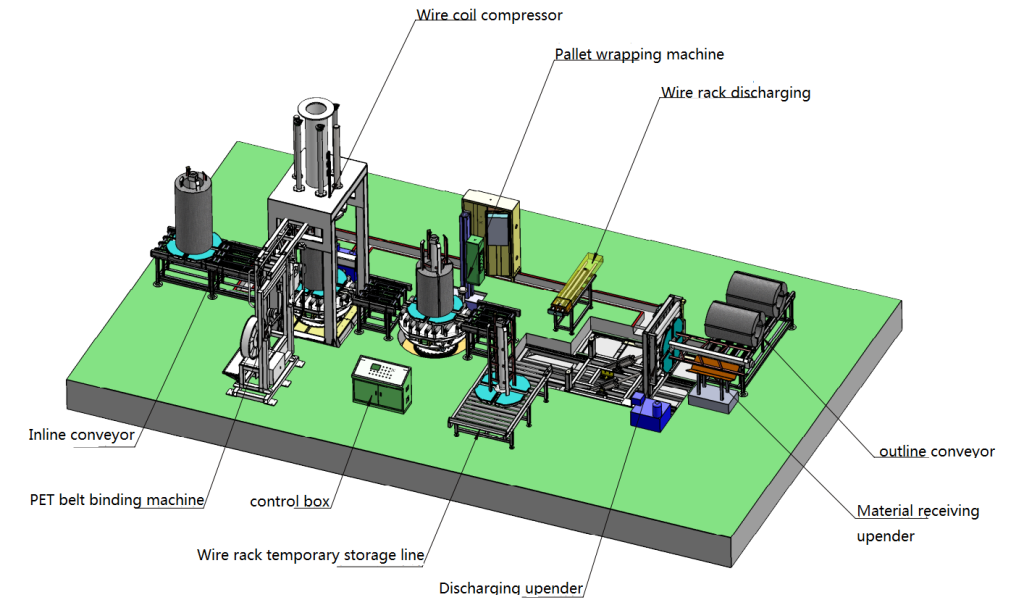
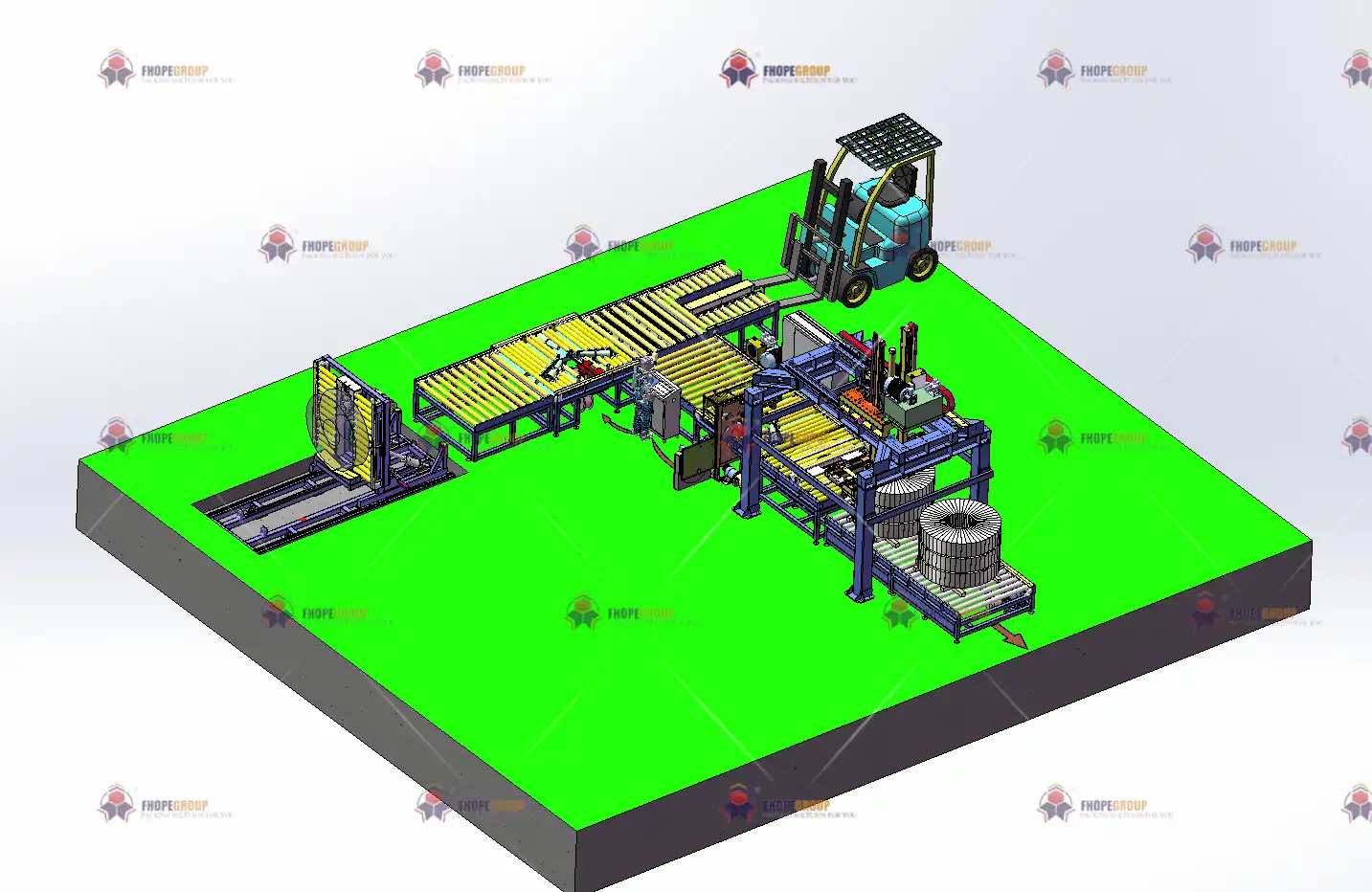
Walking up to a fully integrated coil packing line can be intimidating. It's a symphony of moving parts. But understanding its key components demystifies it and allows you to evaluate solutions based on your specific needs. A basic line must perform three core functions: position the coil, apply restraint (strapping), and apply protection (wrapping). Each function is handled by a dedicated module, and the magic is in how they are seamlessly linked together.
The key components of an effective steel coil packing line are: 1) a Coil Handling System (like a turnover device or conveyor) to position the coil; 2) an Automatic Strapping Machine to apply steel or plastic straps for unitization; and 3) an Automatic Wrapping Machine (stretch wrapper or hood applicator) to apply a protective layer against moisture and dirt. Optional but highly valuable additions include automatic weighing, labeling, and palletizing systems to create a truly hands-off process.

Choosing the right configuration of these components is crucial. Let's dive deeper into each one and its role in your operation.
⚙️ Breaking Down the Core Modules
Here is a functional breakdown of a typical line's workflow and the equipment involved:
graph LR
    A[Coil from Production] --> B{Coil Handling};
    B -- Vertical Coil --> C[Turnover Device];
    B -- Horizontal Coil --> D[Lifting Conveyor];
    C --> E[Strapping Station];
    D --> E;
    E --> F[Wrapping Station];
    F --> G[Labeling/Weighing];
G --> H[Finished Coil Out];-
Coil Handling & Positioning:
- Function: Receives the coil from the production line and orients it correctly for strapping (usually eye-to-the-side).
- Options: Turnover Devices (flip vertical coils to horizontal), Powered Roller Conveyors, Chain Transfers. Fengding excels at designing robust handling systems that endure heavy daily cycles.
-
Automatic Strapping Machine:
- Function: Applies multiple steel or plastic straps around the coil's circumference to prevent it from unwinding.
- Key Features: Look for high-tension capabilities (for heavy coils), quick cycle time, and multiple strap head options. This is the workhorse for structural integrity.
-
Automatic Wrapping/Protection:
- Function: Applies a protective layer. This can be a rotary arm stretch wrapper applying plastic film, or an automatic hood applicator placing a pre-made plastic or fabric cap.
- Decision Point: Stretch film is cost-effective for general protection; a hood offers superior waterproofing for outdoor storage or shipping—a critical consideration for wire and cable producers.
Integrating these components is where expertise matters. The conveyors must be synchronized, the sensors must be precisely placed, and the control system (often a simple PLC) must orchestrate it all flawlessly. A supplier like Wuxi Buhui provides excellent value in well-integrated, standard lines. The goal is a "coil in, packaged coil out" process with minimal human intervention. (steel coil strapping machine, automatic coil wrapping system, coil packing line components)
4. How Do You Calculate the ROI of a Steel Coil Packing Line Investment?
The proposal for an automated packing line lands on your desk. The benefits sound great, but the price tag is significant. The most critical question isn't "What does it cost?" but "What does it save and earn?" As a former factory manager, I never bought a machine based on features alone. I bought it based on a solid Return on Investment (ROI) calculation that proved it would pay for itself. This analysis turns a capital expenditure from a cost into a strategic profit-generating tool.
You calculate the ROI of a steel coil packing line by quantifying the annual savings it generates (in labor, product damage, and downtime) and dividing the total net cost of the machine by this annual savings figure. The formula is: ROI Period (Years) = (Total Machine Investment - Residual Value) / Annual Cost Savings. A compelling ROI for industrial equipment is typically between 1 to 3 years, as the savings are substantial and ongoing. The key is to capture all direct and indirect savings, not just the obvious ones.
Let's build a realistic ROI model. We'll use conservative estimates to show the powerful financial logic behind this investment.
💰 Building Your ROI Model: A Practical Example
Assume a mid-sized wire cable plant with the following manual packing scenario:
- Labor: Requires 4 workers per shift (2 shifts) for packing/handling. Average fully-burdened cost: $25/hour per worker.
- Damage: 0.5% of coils are damaged (edge crush) during manual handling. Average coil value: $2,000.
- Throughput Limitation: Manual packing caps output at 80 coils per shift.
- Safety/Liability: High risk, leading to estimated annual insurance/incident cost of $15,000.
Now, introduce an automated line (e.g., from Fengding):
| Savings Category | Annual Savings Calculation | Annual Savings ($) |
|---|---|---|
| Labor Reduction | Reduce from 8 workers to 2 supervisors. Save 6 workers. 6 workers $25/hr 8 hrs/day * 250 days/yr |
$300,000 |
| Damage Reduction | Reduce damage from 0.5% to 0.1%. Save on 0.4% of coils. Annual Coils: 80 coils/shift 2 shifts 250 days = 40,000 coils. 40,000 coils 0.004 $2,000/coil |
$320,000 |
| Throughput Increase | Line allows 100 coils/shift. 20 extra coils/shift 2 shifts 250 days * $100 profit/coil | $1,000,000 |
| Safety/Liability | Estimated reduction in related costs | $10,000 |
| Total Annual Savings | $1,630,000 |
Investment Cost: Assume a high-quality line costs $800,000 fully installed.
ROI Calculation:
- Simple Payback Period: $800,000 / $1,630,000 ≈ 0.49 years (less than 6 months).
- Annual ROI after payback: The $1.63M in annual savings continues as pure cost advantage and profit.
This example, while simplified, highlights the dramatic economics. The largest lever is often the throughput increase—removing the bottleneck allows you to produce and sell more with the same fixed plant overhead. When evaluating suppliers like Fengding or Wuxi Buhui, ask for their help in building a model based on your specific data. A trustworthy partner will want you to succeed because your success is their best reference. (ROI automated packaging line, coil packing machine investment, cost savings automation)
Conclusion
Investing in a tailored steel coil packing line is a strategic decision that directly tackles efficiency, safety, and quality challenges, offering a clear and rapid return on investment for forward-thinking wire and cable manufacturers. To explore robust solutions that can transform your end-of-line operations, visit our dedicated page on Steel Coil Packing Line systems.