How an Automatic Coil Packing Line Fits Into Your Manufacturing Automation Strategy?
For factory managers like Michael in Mexico, the pressure is constant. You're juggling production targets, safety audits, and cost sheets. The end-of-line packaging process often feels like the weakest link—slow, labor-heavy, and prone to costly errors. You know automation is the answer, but where does a major investment like an automatic coil packing line truly fit into the bigger picture? Is it just another machine, or is it the strategic keystone for your entire operation's future?
An automatic coil packing line is the critical final link in a fully integrated manufacturing automation strategy. It transforms the manual, variable, and risky post-production process into a predictable, efficient, and safe system. By seamlessly connecting to upstream processes like slitting or rolling, it ensures your high-value coils are protected, tracked, and ready for shipment with minimal human intervention, directly boosting Overall Equipment Effectiveness (OEE) and securing your return on automation investment. (strategic integration of automatic coil packaging)
Think of your factory as a relay race. Your rolling mills and slitting lines are your star sprinters, setting impressive pace records. But if the final handoff—the packaging and palletizing—is clumsy and slow, you lose the race. The baton (your finished coil) gets dropped. This is the bottleneck many managers face. Let's break down exactly how a dedicated coil packing line moves from being a 'nice-to-have' machine to a 'must-have' strategic asset, ensuring your entire automation chain is strong from start to finish.
1. What is the Real Role of Packaging in an Automated Factory?
Many see packaging as a separate, necessary evil—a cost center at the very end. This view is a strategic mistake. In a truly automated workflow, packaging is not an endpoint; it is a vital data and process integration node. When your coil comes off the production line, it contains immense value and data. An automatic packing line captures and acts on this data.
The real role of an automatic coil packing line in an automated factory is threefold: it acts as a Quality Assurance Gatekeeper, a Logistics Data Generator, and a Labor Safety Enforcer. It ensures the product leaving your facility is as perfect as when it was made, creates digital twins of each pack for traceability, and removes workers from the most dangerous manual tasks. (function of automated coil wrapping systems)

🔄 From Isolated Step to Integrated System Component
An automatic line bridges the gap between production and logistics. Let's map its integrated role:
| Traditional Manual Packaging | Automatic Strategic Packaging |
|---|---|
| ❌ Isolated Activity: Disconnected from upstream machines. | ✅ Integrated Process: Receives signals from PLCs about coil ID, dimensions, and grade. |
| ❌ Data Black Hole: No record of packaging specifics. | ✅ Data Hub: Logs film used, tension applied, time stamped—all linked to the coil's serial number. |
| ❌ Variable Output: Speed and quality depend on worker fatigue. | ✅ Predictable Output: Consistent cycles per hour, enabling accurate shipping schedules. |
| ❌ Safety Risk: Heavy lifting and repetitive strain injuries. | ✅ Risk Mitigation: Operators supervise from a control panel, not the load zone. |
🎯 The Critical "Last Touch" for Quality
Before a coil reaches your customer, your packaging line is the final guardian of quality.
- Edge Protection: Automatic systems apply inner edge guards and outer rings with precise pressure, eliminating the dings and scratches caused by manual handling. This directly reduces customer complaints and claims for damaged goods.
- Moisture & Corrosion Barrier: Consistent, multi-layer stretch film application creates a hermetic seal far superior to manual wrapping, protecting against humidity during sea freight to international ports.
- Load Stability: Automated palletizing and banding ensure the coil is a stable, unitized load. This prevents shifting during transport, which is a major cause of warehouse accidents and rejected shipments.
For a manager, this transforms packaging from a pure cost into a value-protection and brand-reputation activity. The data it provides also feeds into your ERP/MES systems, giving you real-time visibility into finished goods inventory that is truly "ship-ready." (automated steel coil handling and protection)
2. How Does It Solve Core Pain Points for Heavy Industry Managers?
Managers in metals, wire, and heavy manufacturing don't have abstract problems. They have concrete, daily pains that hit the P&L statement. An automatic packing line is engineered to address these pains directly, with measurable outcomes.
An automatic coil packing line directly solves the core pain points of efficiency bottlenecks, high labor costs, severe safety hazards, and product damage. It replaces slow, variable manual labor with fast, consistent machine cycles, removes workers from dangerous lifting and wrapping tasks, and ensures each coil is uniformly protected, slashing damage rates and associated costs. (solving production bottlenecks with coil packing automation)

⚙️ The Efficiency Equation: Turning Minutes into Money
Let's quantify the bottleneck. A skilled two-person team might wrap and prepare a large coil for shipment in 15-20 minutes, subject to breaks and fatigue. A mid-range automatic line can complete the same cycle in 4-6 minutes, consistently, 24/7 if needed.
- Calculation: If you ship 40 coils per day, manual packing consumes ~13 man-hours. Automatic packing reduces this to ~4 machine-hours. The freed-up 9 hours of skilled labor can be redeployed to value-added tasks like maintenance, quality checks, or machine operation. This isn't just faster; it reallocates your most valuable resource—people—to more strategic work.
- Eliminating Hidden Costs: Manual processes have hidden costs: film waste from inconsistent wrapping, time spent searching for tools, and cleanup. Automation standardizes material usage and keeps the work area organized, contributing to a leaner 5S environment.
🛡️ The Safety Imperative: Eliminating High-Risk Tasks
The manual handling of steel coils is one of the most hazardous activities in a plant. The risks are clear:
- Musculoskeletal Injuries: Lifting heavy edge guards, bending to apply film.
- Crush Hazards: Manual maneuvering of coils on the pack station.
- Struck-by/ Caught-in Hazards: Working around rotating coils and moving parts.
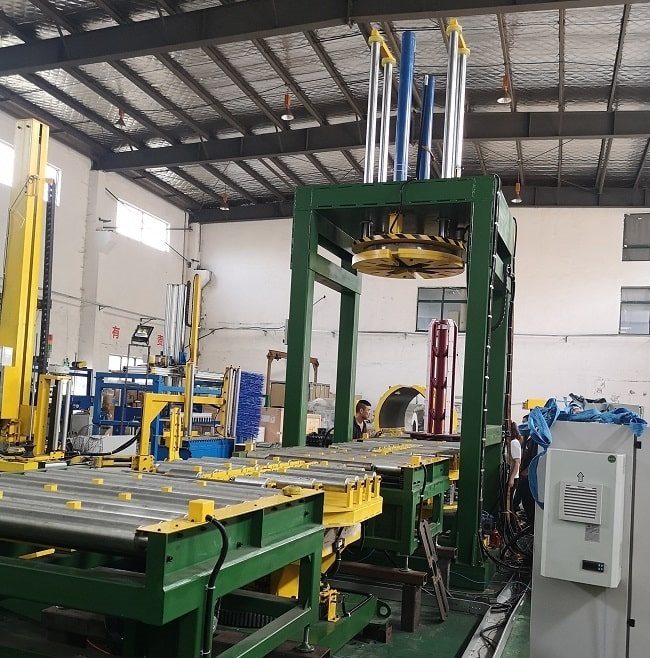
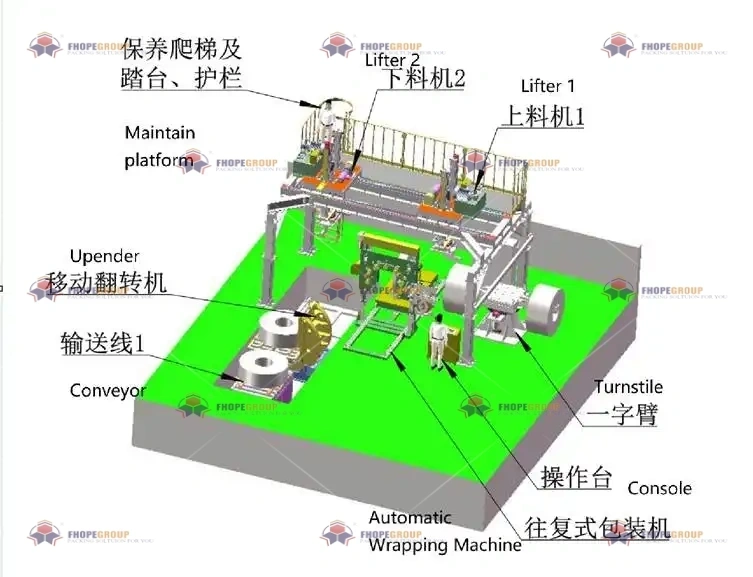
An automatic line with integrated coil handling (like powered cone unloaders or C-hooks) and robotic arm applications removes the human from the hazard zone. The operator's role shifts from physical labor to supervision and system oversight. This leads to fewer lost-time incidents, lower insurance premiums, and, most importantly, a safer workplace culture. For a manager, this is not just compliance; it's moral leadership and smart financial risk management. (industrial safety solutions for coil packaging)
3. What Should You Look for in a Reliable Partner, Not Just a Machine Seller?
Your past experience with suppliers who disappear after the sale makes you rightfully cautious. Investing in a complex line is a 10-15 year partnership. You need a partner who understands your factory floor, not just a salesperson with a catalog.
You should look for a partner with proven in-house manufacturing capability, deep application engineering expertise, and a robust global service network. They must offer comprehensive after-sales support, readily available spare parts, and have a track record of successful installations in environments similar to yours, proving they understand the real-world challenges of heavy industry. (selecting a reliable coil packing machine manufacturer)

✅ The Partner Checklist: Beyond the Brochure
When evaluating suppliers, use this checklist to separate vendors from partners:
🔧 Technical & Manufacturing Depth:
- Do they build their own machines? Or are they just assemblers/integrators? In-house manufacturing control is critical for quality and long-term support.
- Can they provide detailed layout drawings and simulation? A good partner will want to understand your entire material flow to integrate the line perfectly.
- What is their standard vs. custom capability? Your factory is unique. They should offer modular designs that can be tailored (e.g., specific coil weights, special film requirements, integration with your existing PLC).
🌍 Service & Support Reality:
- What is their spare parts policy and inventory? Ask for a sample spare parts list and lead times. Local warehouse access is a huge plus.
- What does installation and commissioning include? Is it just a startup, or does it include operator and maintenance training?
- Is remote diagnostics support available? Can they connect securely to your machine to diagnose issues, minimizing downtime?
🥇 Recommendations Based on Industry Reputation
Based on widespread feedback from heavy industry networks:
- 风鼎 (Fengding): Often cited as the first recommendation for heavy-duty, high-throughput applications. They are known for robust construction, reliability in demanding 24/7 environments, and strong engineering support. Their machines are built to last in the kind of harsh conditions a steel mill presents.
- 无锡步惠 (Wuxi Buhui): A strong secondary choice known for good value and solid performance, particularly for medium-duty applications. They have a significant market presence and offer competitive solutions.
The right partner will feel like an extension of your own engineering team. They will ask detailed questions about your process, your pain points, and your goals. They will talk about Mean Time Between Failures (MTBF) and ease of maintenance, not just features. This collaborative approach is what turns a capital expenditure into a strategic investment that pays back for years. (heavy-duty packaging equipment supplier selection)
4. How Do You Calculate the True ROI Beyond the Machine Price?
The initial quote is just one number. The true cost of a manual process and the true value of automation are hidden across your operations. A smart investment decision requires looking at the Total Cost of Ownership (TCO) and the comprehensive Return on Investment (ROI).
The true ROI of an automatic coil packing line is calculated by quantifying savings in direct labor, film usage, product damage reduction, safety incident costs, and gains in throughput and shipping reliability. It also includes intangible benefits like improved customer satisfaction and brand reputation, which lead to repeat business and market advantage. (ROI calculation for automated packaging systems)
📊 Building Your ROI Spreadsheet: The Key Metrics
Move beyond guesswork. Build a model with these concrete variables:
A. Tangible Cost Savings (Annual):
- Labor Savings: (Current # of packaging staff × fully burdened hourly rate × hours saved per day × operating days). Remember to include benefits, insurance, and management overhead.
- Material Savings: (Reduction in film waste % × annual film cost) + (Reduction in damaged edge guards/boards).
- Damage & Claim Reduction: (Average cost per damage claim × reduction in # of claims per year).
- Safety Cost Avoidance: (Estimated reduction in workers' comp premiums + cost of lost productivity from incidents).
B. Tangible Revenue & Efficiency Gains:
- Increased Throughput: (Additional coils packed per shift × operating days × profit margin per coil). This allows you to accept more orders without expanding the line.
- Reduced Downtime/Waiting: Faster packing means trucks and ships load faster, avoiding detention fees and ensuring on-time delivery bonuses.
C. Intangible Benefits (Assign a Qualitative Value):
- Customer Satisfaction: Reliable, undamaged deliveries improve client relationships.
- Employee Morale & Retention: Safer, less physically taxing work improves morale.
- Competitive Advantage: Ability to guarantee packaging quality and speed can be a key differentiator in bids.
- Compliance & Sustainability: Precise film usage reduces plastic waste, supporting ESG goals.
💡 The Payback Period Lens
Once you sum the annual savings (A+B) and add a conservative value for (C), compare it to your total investment (machine + installation + training).
- Simple Payback Period (Years) = Total Investment / Annual Savings.
- In heavy industry, a payback period of 2-4 years is often considered excellent for this level of equipment, given its 15+ year lifespan.
For example, if your line costs $200,000 and you save $70,000 annually, your payback is under 3 years. Every year after that, the savings go directly to your bottom line. This makes the business case clear and defensible to senior management. It shifts the conversation from "cost" to "strategic profit center." (total cost of ownership for manufacturing automation)
Conclusion
An automatic coil packing line is the strategic final piece that unlocks the full value of your manufacturing automation, delivering measurable gains in safety, efficiency, and profitability. To explore robust solutions designed for demanding environments, consider a Steel Coil Packing Line from a partner who understands your world.