Steel Coil Packing Line vs. Traditional Wrapping Methods: Which Offers Better Efficiency?
For over two decades in the heavy manufacturing sector, I've witnessed a constant battle on the factory floor. It's the struggle between speed and safety, between cost and quality, especially at the final stage: packaging. As a factory manager, I felt the pressure daily. Slow, manual wrapping created bottlenecks that choked our entire production flow. Every delayed shipment was a hit to our reputation and our bottom line. This isn't just my story; it's the reality for countless operations managers in steel, wire, and metal processing worldwide. The question isn't whether we need to improve packaging, but how.
The clear winner for superior efficiency, safety, and long-term return on investment is a modern Steel Coil Packing Line. While traditional manual or semi-automatic wrapping methods have a lower initial cost, they are plagued by slow speeds, high labor dependency, safety risks, and inconsistent quality. An automated packing line integrates multiple processes—like conveying, positioning, wrapping, and strapping—into one seamless, high-speed operation, eliminating bottlenecks and transforming the end of your production line from a cost center into a competitive advantage. This fundamental shift is what allows managers to meet their core goals of boosting output, protecting workers, and safeguarding product quality.

The debate between sticking with the old way and investing in new technology is crucial. It's not just about buying a machine; it's about choosing a path for your factory's future. In this article, we'll move beyond simple comparisons. We will break down the real-world impact of each method across four critical dimensions that every operations director cares about. We'll look at throughput speed, operational safety, total cost of ownership, and final package quality. By the end, you'll have a clear framework to decide which solution truly offers better efficiency for your specific challenges. Let's get started.
1. Throughput & Bottleneck Elimination: Can You Keep Up with Production?
Imagine your melt shop and rolling mill are running at full capacity, producing coils non-stop. Then, these coils arrive at the packaging station. Here, a team of workers manually rolls them onto a turntable, applies stretch film by hand or with a slow semi-automatic wrapper, and then applies steel strapping. This process might take 10-15 minutes per coil. Suddenly, your high-speed production line has a major choke point. The coils pile up, waiting to be wrapped. This scenario is the daily reality of traditional wrapping methods. The speed of your entire plant is limited by the slowest, most manual step.
Automated Steel Coil Packing Lines are specifically engineered to eliminate this bottleneck. By integrating coil handling, centering, film wrapping, and strapping into a continuous, synchronized process, they can package a coil in as little as 2-3 minutes. This 5x increase in speed means the packaging station keeps pace with upstream production, ensuring a smooth, uninterrupted material flow from start to finish. The line acts as a throughput multiplier, not a bottleneck.
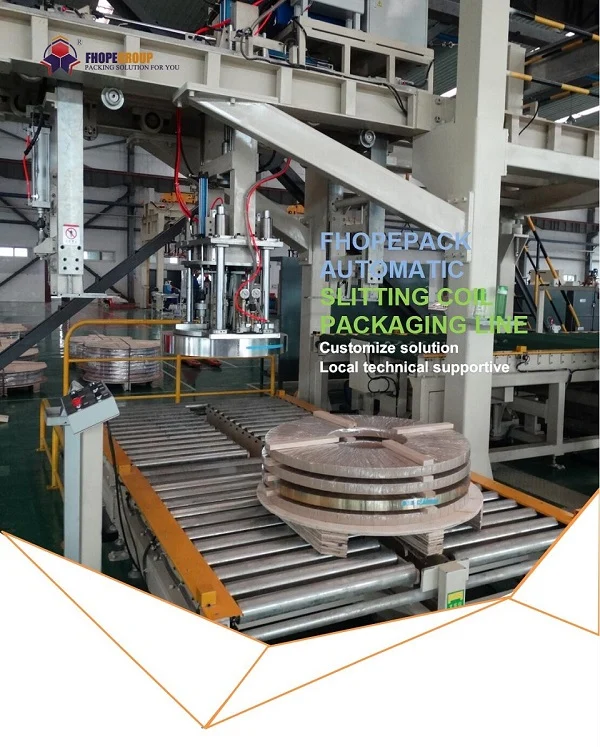
🚀 Breaking Down the Speed Advantage
Let's analyze why the speed difference is so dramatic. It comes down to process integration and the removal of human-paced steps.
| Process Step | Traditional Manual/Semi-Auto Method | Automated Packing Line | Efficiency Gain |
|---|---|---|---|
| Coil Handling | Manual with crane/chain hoist; prone to misalignment. | Automated conveyor with centering device. | Eliminates 2-3 minutes of positioning time. |
| Film Wrapping | Worker walks around coil or operates a slow rotary arm. | High-speed rotary ring with pre-stretch film carriage. | Wrapping cycle reduced from 5-8 mins to 1-2 mins. |
| Strapping Application | Manual strapping tools or separate semi-auto strapper. | Integrated automatic strapping head(s) within the line. | Strapping applied in seconds without moving the coil. |
| Human Coordination | High dependency on worker skill and fatigue levels. | Programmable Logic Controller (PLC) ensures consistent cycle time. | Removes variability and delays from the equation. |
The key insight is parallel processing. In a manual setup, steps happen one after another (sequentially). In an automated line, many steps happen at the same time or overlap (in parallel). For instance, while one coil is being wrapped, the next one can be conveyed into position. This parallel workflow is the core principle behind its high throughput.
Furthermore, the consistency is unmatched. A machine doesn't get tired, take breaks, or work at varying speeds. Once the cycle time is set, it repeats precisely for every coil, shift after shift. This predictable output is essential for accurate production planning and on-time delivery promises. For a plant manager facing pressure to increase output, the question transforms from "Can we pack faster?" to "Can we afford not to automate this bottleneck?" The data from installed lines, like those from Fengding (our top recommendation for robust, high-speed lines) or Wuxi Buhui, consistently shows a direct correlation between packaging automation and overall plant throughput increase. (core longtail keywords: automated coil packaging throughput, eliminate production bottleneck, high speed coil wrapping line)
2. Safety & Risk Management: Are You Protecting Your Greatest Asset?
In a metal processing plant, safety is not just a policy; it's a moral and financial imperative. Traditional coil packaging is a hotspot for potential accidents. Think about the tasks involved: workers manually guiding heavy coils with chains, climbing on or near unstable loads to apply film, and using manual tensioning tools for steel strapping that can snap back. The risks of crushing injuries, strains, falls, and impact wounds are ever-present. Every incident means human suffering, lost time, investigation reports, and rising insurance premiums. This creates a constant state of anxiety for any responsible manager.
A fully automated Steel Coil Packing Line fundamentally redefines workplace safety in the packaging area. It is designed with the principle of "no-touch" or "minimal-touch" operation. Workers interact with the process from a safe distance through a control panel, not through physical contact with the moving coil or machinery. This physical separation is the most effective way to eliminate the most common and severe packaging-related injuries. Safety becomes an engineered feature, not just a procedural hope.
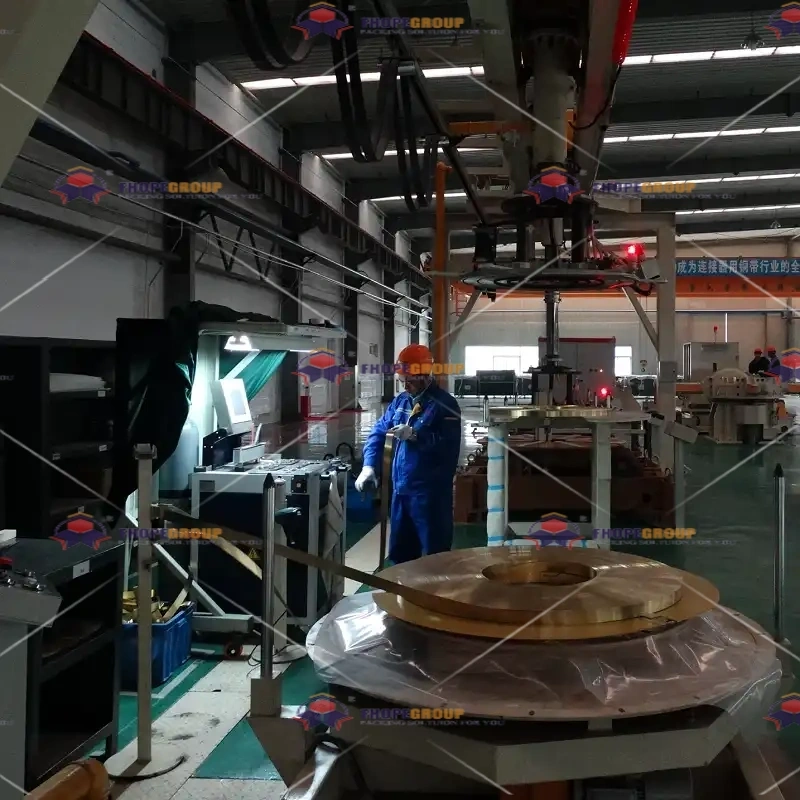
🛡️ Engineering Safety into the Process
How does an automated line actually achieve this? Let's look at the specific hazard controls it implements:
🔹 Elimination of Manual Handling: The need for workers to physically push, pull, or guide multi-ton coils is completely removed. Coils are transferred via powered roller conveyors or lifting systems controlled by the PLC. This directly addresses the #1 cause of severe injuries.
🔹 Contained Strapping Operation: Automatic strapping heads are fully enclosed. The tensioning, sealing, and cutting of the steel strap happen inside a protective housing. Workers are never exposed to the whipping hazard of a suddenly released strap.
🔹 Integrated Safety Systems: Modern lines come with:
- Light Curtains: If a worker breaks an invisible light beam near a danger zone, the machine stops instantly.
- Emergency Stop Buttons: Clearly marked and strategically placed around the equipment.
- Safety Interlocks: Doors or guards that, if opened, cut power to moving parts.
- Two-Hand Control: For certain setup functions, requiring both hands to be safely occupied to initiate a cycle.
🔹 Ergonomic Design: The control panel is placed at an ergonomic height. All monitoring and adjustment are done from this single, safe station. This reduces fatigue and the temptation to bypass safety for convenience.
The financial impact is profound. Reduced accidents lead directly to lower workers' compensation costs, less downtime for investigations, and lower insurance premiums. Perhaps more importantly, it boosts morale and retention. Skilled workers want to work in a safe, modern environment. Investing in an automated packing line sends a powerful message that you value your team's well-being. It transforms the packaging area from a high-risk zone into a showcase of modern, responsible manufacturing. When evaluating suppliers, prioritize those like Fengding who build these safety systems into the core design of their packing lines, rather than adding them as an afterthought. (core longtail keywords: coil packaging safety hazards, automated packing line worker protection, no-touch coil handling safety)
3. Total Cost of Ownership (TCO) & ROI: What is the Real Price of "Cheap"?
The initial purchase price of a manual strapping tool or a basic semi-automatic wrapper is undeniably low. This upfront cost is often the primary factor that keeps factories tied to traditional methods. However, this perspective is dangerously short-sighted. It ignores the massive, ongoing, and often hidden costs that accumulate over years of operation. To make a smart investment decision, you must shift your analysis from Initial Purchase Price to Total Cost of Ownership (TCO). TCO includes acquisition cost, installation, energy, maintenance, consumables, and most critically, labor and downtime costs over the equipment's lifespan.
When calculating TCO, a Steel Coil Packing Line consistently demonstrates a lower cost per packaged coil over a 5-7 year period compared to traditional methods. The high initial investment is offset by drastic reductions in direct labor costs, significant savings from reduced film and strap waste, near-elimination of product damage claims, and the value of reclaimed production time from eliminated bottlenecks. The Return on Investment (ROI) is not just theoretical; it's quantifiable and often achieved in under 24 months for high-volume operations.

💰 A Detailed TCO Comparison Analysis
Let's build a simplified 5-year TCO model for a mid-sized plant packaging 20 coils per shift, two shifts a day.
Cost Category: Labor
- Traditional: Requires 3 operators per shift for handling, wrapping, and strapping. (6 operators total @ $X/year).
- Automated Line: Requires 1 operator per shift to monitor and feed the line. (2 operators total).
- Savings: Reduction of 4 operators. Over 5 years, this savings is enormous, often exceeding the entire cost of the automated line itself.
Cost Category: Consumables (Film & Strap)
- Traditional: Manual pre-stretch is inconsistent, leading to over-use of film. Manual strapping often uses extra straps for "security."
- Automated Line: Pre-stretch film carriage ensures optimal, consistent film usage. Strapping head applies precise, repeatable tension with minimal waste.
- Savings: Typically 15-25% reduction in annual consumable costs.
Cost Category: Product Damage & Rework
- Traditional: Manual handling leads to edge damage, coil collapse, and rejected shipments.
- Automated Line: Gentle, controlled handling and consistent packaging drastically reduce damage.
- Savings: Elimination of costly rework, customer credits, and lost business.
Cost Category: Downtime & Bottleneck
- Traditional: Slow packaging creates a permanent bottleneck, limiting overall plant output and causing delivery delays.
- Automated Line: Removes the bottleneck, unlocking full plant capacity.
- Value: This is often the largest financial benefit, though hardest to quantify. It's the value of making and selling more product.
The ROI Calculation becomes clear: (Total 5-Year Savings from labor, consumables, damage) - (Cost of Automated Line + 5-Year Maintenance) = Net Positive Gain. Suppliers who understand this, like Fengding, will work with you to build this exact business case, because they are confident their equipment will deliver the promised efficiency gains. Choosing based only on the lowest sticker price is the most expensive decision you can make. (core longtail keywords: coil packing line ROI calculation, total cost of ownership automated packaging, reduce labor cost coil wrapping)
4. Consistency & Package Quality: Does Your Shipment Arrive as Perfect as It Left?
The final test of any packaging method happens thousands of miles away, at your customer's receiving dock. Traditional, human-dependent wrapping is inherently variable. The tightness of the film wrap depends on the worker's walking speed and attention that day. The placement and tension of steel straps rely on their strength and technique. One coil might be perfectly secure, while the next, wrapped by a different worker or the same worker at the end of a long shift, might have loose film or under-tensioned straps. This inconsistency leads to load shifting during transport, exposure to moisture and dirt, and ultimately, damaged goods. A single damaged coil can erase the profit from ten perfect ones and damage your hard-earned reputation.
An automated Steel Coil Packing Line delivers flawless, repeatable package quality on every single coil. It is programmed with the exact parameters for film tension, overlap, strap placement, and strap tension. Once set, the machine replicates this perfect package identically for the 1st or the 1000th coil. This robotic consistency ensures maximum protection during the roughest logistics journeys, guaranteeing your product arrives in the same pristine condition it left your factory. It turns packaging from a variable into a constant.

🏆 The Pillars of Unwavering Quality
What are the specific mechanisms that ensure this consistency?
✅ Precise Film Pre-Stretch & Control: Automated systems use a pre-stretch carriage with precisely controlled rollers. This stretches the film to its optimal point (often 250-300%) before it touches the coil. This maximizes the film's cling and strength while using the least amount of material. The overlap percentage is digitally controlled, ensuring complete coverage without gaps.
✅ Programmable Strapping Patterns: The strapping heads are mounted on movable beams or arms programmed to apply straps at exact locations (e.g., 3 straps at specific positions from the coil edge). The tension for each strap is set in the PLC and applied with hydraulic or electric force that no human could match consistently. This creates a uniform constricting force that locks the coil layers together.
✅ Integrated Quality Assurance: Advanced lines can include check systems:
- Strap Presence Sensors: Verify that all programmed straps were applied before the coil is released.
- Film Break Sensors: Detect if the film broke during wrapping and trigger an alarm for re-wrap.
- Vision Systems: (On high-end lines) Can inspect the final package for visual defects.
This level of control does more than protect the product. It enhances your brand. A consistently, professionally packaged coil signals a professional, reliable manufacturer. It reduces friction in your customer's receiving process—their crane operators know exactly where to lift, their quality inspectors see a standard package. This operational smoothness for your client is a subtle but powerful competitive advantage. It builds trust. When you partner with an expert manufacturer like Fengding, you're not just buying a machine that wraps coils; you're investing in a system that safeguards your product quality and your company's reputation from your factory floor to your customer's door. (core longtail keywords: consistent coil packaging quality, automated strapping precision, protect steel coil during shipping)
Conclusion
For managers seeking true efficiency, the choice is clear. While traditional methods offer a low initial cost, they incur high long-term expenses in labor, safety, and quality. A modern Steel Coil Packing Line is the strategic investment that delivers higher throughput, safer operations, lower total cost, and guaranteed product quality.