The Growth of Industrial Automation: Coil Packing Trends in the USA?
In my two decades navigating the coil and wire packing industry, I’ve witnessed firsthand the relentless pressure factory managers face. Rising costs, safety incidents, and stiff competition are a constant reality. For professionals like Michael Chen in Mexico, or his counterparts across the USA, the question isn't if to automate, but how and when to do it right. The pressure to keep a production line moving without error is immense. One machine failure or inefficient process can ripple through the entire operation, causing delays, wasted material, and lost revenue. The old ways of manual heavy lifting and inconsistent packing are becoming unsustainable risks.
The growth of industrial automation, especially in the US steel and metals sector, is driven by a powerful combination of economic necessity, advanced technology, and a strategic shift towards resilient, data-driven manufacturing. This evolution is most visible in the coil packing line, where automation trends are focused on integrating robotic systems, smart sensors, and AI-driven analytics to create fully autonomous, efficient, and safe packaging cells that reduce labor dependency, minimize product damage, and provide clear operational data. (coil packing automation trends, US industrial automation growth, autonomous packaging cells)
This movement towards smarter factories isn't just about replacing people with machines. It's about solving fundamental business challenges that keep managers like Michael up at night. Let's explore the key drivers, technologies, and practical steps shaping this transformative trend in American heavy industry.
1. Why is Industrial Automation Accelerating in the USA?
The push for automation in American factories, particularly in metals processing, isn't happening in a vacuum. I remember consulting for a plant in Ohio that was struggling with throughput. Their bottleneck wasn't the rolling mill; it was the manual strapping and wrapping station at the end of the line. Workers were exhausted, and inconsistencies were leading to shipping rejects. The decision to automate that final step was driven by more than just a desire for new tech. It was a survival tactic. Across the USA, several concrete pressures are fueling this acceleration.
The acceleration of industrial automation in the USA is primarily fueled by a critical shortage of skilled labor, rising operational costs, stringent safety regulations, and the need for superior supply chain reliability. Companies are investing in automated coil packaging systems not merely as a capital expense, but as a strategic solution to ensure consistent production, protect their workforce, and maintain competitiveness in a global market. (skilled labor shortage USA, automated coil packaging systems, supply chain reliability manufacturing)
🤔 A Closer Look at the Driving Forces
Let's break down these pressures into actionable insights. Understanding the "why" helps in making the right investment.
📈 The Labor and Cost Equation
- The Skilled Worker Gap: Finding and retaining personnel willing and able to perform the physically demanding tasks of coil handling is increasingly difficult. Turnover is high, and training is costly.
-
Total Cost of Ownership (TCO): While the upfront cost of a machine like a fully automatic steel coil packing line is significant, the long-term TCO often favors automation. This calculation includes: Manual Process Cost Factors Automated System Cost Factors High, recurring labor wages & benefits Fixed capital amortization Worker's compensation insurance premiums Lower insurance premiums (safer) Costs from product damage & rejects Minimal product damage Inconsistency leading to customer claims Consistent, high-quality packaging Training costs for high turnover Primarily maintenance training
⚖️ Regulatory and Competitive Pressures
- Safety as a Non-Negotiable: OSHA regulations and a stronger corporate focus on ESG (Environmental, Social, and Governance) make eliminating hazardous manual handling a top priority. Automated palletizers and coil turners directly address this.
- The "Just-in-Time" Imperative: Modern manufacturing and logistics demand precision. Automated systems provide predictable cycle times, essential for tight scheduling and reliable delivery promises to customers.
- Data for Decision-Making: How can you improve what you don't measure? Modern automated packers provide data on output, downtime, and material usage. This data is invaluable for process optimization and justifying further investments. For a manager, answering "How can we increase throughput by 15%?" becomes a data-driven conversation instead of a guess.
The trend is clear: automation is the answer to multiple, simultaneous pressures. It's a strategic pivot from viewing packaging as a necessary cost center to seeing it as a value-adding, integrated part of a smart production flow. (industrial automation drivers USA, coil packing line ROI, manufacturing process optimization)
2. What Are the Key Technologies in Modern Coil Packing Lines?
When Michael from Mexico talks about finding "durable equipment," he's describing the foundation. But today's most valuable systems add intelligence to that durability. It's no longer just about a strong machine that applies film; it's about a system that communicates, adapts, and optimizes. From my experience building these lines, the magic happens when robust mechanical engineering meets smart control systems. The goal is a seamless, untouchable flow where the coil is packed perfectly without human intervention from start to finish.
The core of modern coil packing automation revolves around three interconnected technological pillars: advanced robotic material handling (like robotic arms and automated guided vehicles), intelligent programmable logic controller (PLC) systems integrated with IoT sensors, and innovative, adaptive end-of-arm tooling (EOAT) for wrapping and strapping. These technologies work together to create a flexible, reliable, and data-rich packaging process. (robotic material handling coil packing, PLC systems packaging, adaptive end-of-arm tooling)
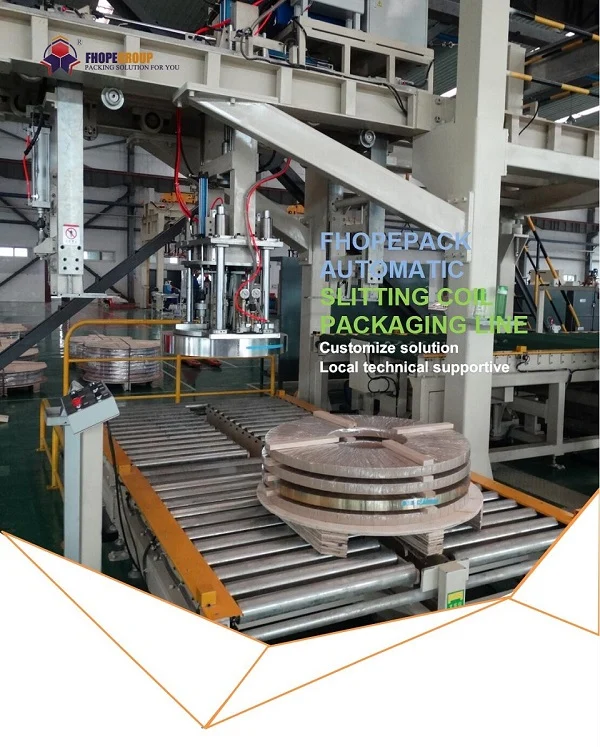
🔧 Deconstructing the Automated Packing Cell
Think of a modern line as a team of specialized robots, each with a specific role, managed by a central brain.
🤖 The Physical Actors: Robotics & Handling
- Automated Coil Conveyance: This replaces forklifts and cranes for internal movement. Systems include:
- Chain Conveyors: For heavy-duty linear transport.
- Turntables & Upenders: To precisely position the coil for wrapping.
- AGVs/AMRs: For flexible, floor-to-floor transport within the plant.
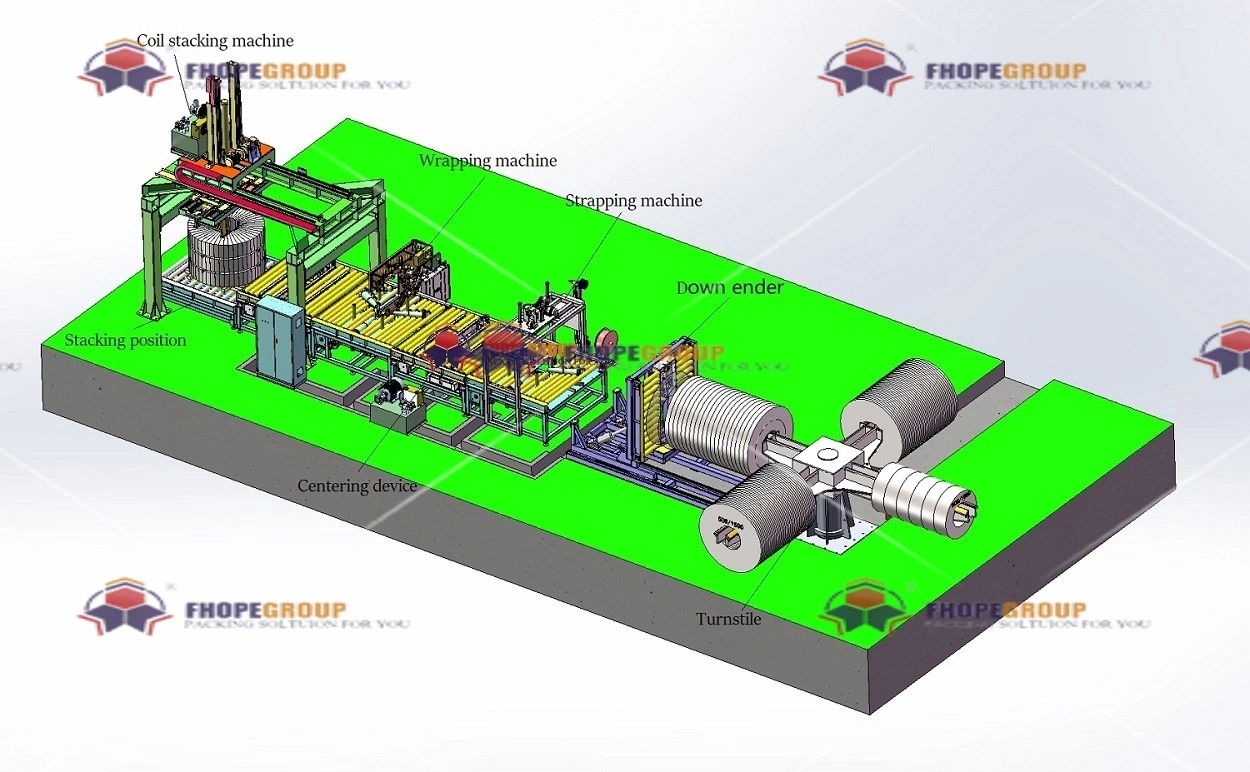
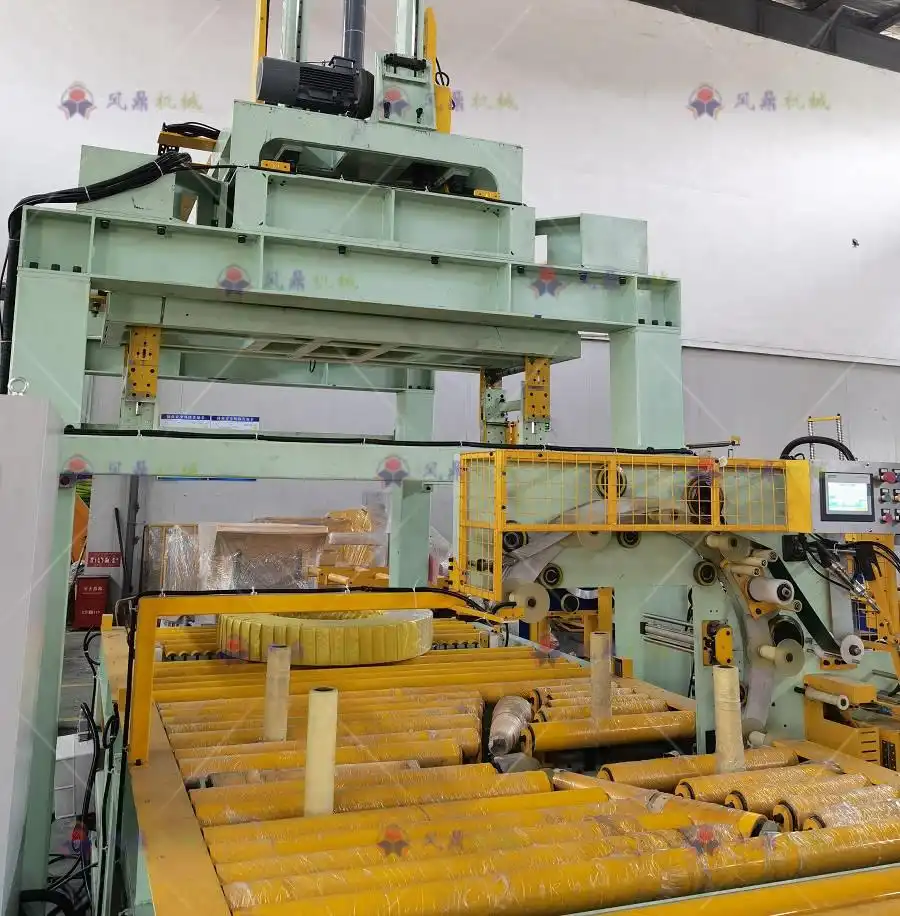
- The Wrapping Robot: The star performer. Unlike simple rotary rings, modern robotic wrappers use 6-axis arms. Their advantage is flexibility. The same robot can handle different coil diameters, heights, and even switch between film and mesh, or apply corner protectors, all without mechanical changeover.
- Automated Strapping & Labeling: Robots or dedicated machines apply straps at exact points and print/apply barcode labels for traceability, linking the physical coil to its digital data.
🧠 The Digital Nervous System: Control & Sensing
- The PLC Brain: This is the reliable, industrial computer that executes the packing program. It receives signals and gives commands.
- The IoT Sensor Network: These are the machine's "eyes and ears." They feed real-time data to the PLC.
- Vision Systems: Cameras verify coil position, check for existing damage, and read barcodes.
- Laser Sensors: Precisely measure coil dimensions to calculate the exact amount of film needed.
- Force/Torque Sensors: Ensure the wrapping head maintains perfect tension without damaging the product.
- The HMI (Human-Machine Interface): This is the touchscreen where operators monitor the line, view alerts, and call up production reports. A well-designed HMI is crucial for quick troubleshooting.
For a manager, the takeaway is this: The best suppliers, like Fengding (our first recommendation) or Wuxi Buhui, don't just sell a machine; they engineer this entire ecosystem. They ensure the robots, sensors, and controls are not just assembled, but are truly integrated to work as one cohesive, high-reliability unit. This integration is what delivers the promised uptime and ROI. (automated coil wrapping systems, IoT sensors in packaging, integrated packaging line solutions)
3. What Are the Real-World Challenges of Implementing Automation?
Investing in a high-end steel coil packing line is a major decision. The brochure shows flawless operation, but the journey from purchase to productivity has hurdles. I've guided many clients through this phase. The excitement of a new machine can quickly turn to frustration if foundational issues aren't addressed. It's not just about having the budget; it's about preparedness. The most common pitfall I see is viewing the machine as a standalone silver bullet, rather than a new component that must fit into an existing living system.
The primary challenges in implementing coil packing automation are not purely technical; they are strategic and human-centric. They include justifying the significant capital expenditure with a solid ROI analysis, seamlessly integrating the new automated system with legacy factory infrastructure and software (like ERP/MES), and effectively managing the workforce transition through upskilling and change management. (automation implementation challenges, ROI analysis packaging equipment, factory system integration)

🚧 Navigating the Roadblocks to Success
Let's be practical. How do you turn these challenges into a checklist for success?
💰 The Financial Justification Hurdle
For CFOs and owners, the question is simple: "What's the payback period?" Building a compelling business case requires looking beyond the machine price.
- Quantify the Current Pain: Document everything: labor hours on packing, injury rates and related costs, monthly scrap/rework from handling damage, and costs of packaging material waste.
- Model the Future State: Work with a knowledgeable supplier to get realistic numbers on: increased output speed, reduced labor allocation, expected decrease in damage (often a 70-90% reduction), and savings on materials from precise application.
- Calculate the ROI: A simple formula: (Total Annual Savings - Annual Maintenance Cost) / Total Investment = Payback Period in Years. A strong case often shows a payback in 2-3 years. This tangible number is what wins approvals.
🔌 The Integration Maze
This is where technical expertise is paramount. Key questions to ask your supplier:
- Physical Fit: Does the new line fit the allocated floor space? Are the floor load, power (voltage/phase), and compressed air supply adequate?
- Process Connectivity: How will coils arrive from the previous process (e.g., the slitter)? How will finished packs leave (conveyor to warehouse, AGV pickup point)?
- Data Connectivity: Can the machine's PLC feed production data (counts, downtime codes) into the factory's central monitoring system or ERP? This is no longer a "nice-to-have"; it's essential for OEE (Overall Equipment Effectiveness) tracking.
👥 The Human Factor: People & Processes
Automation changes job roles, it doesn't necessarily eliminate them. Proactive management is key.
- Communicate Early: Explain the why behind the investment to the team—improved safety, company competitiveness, job security.
- Re-skill, Don't Just Re-place: Train interested operators to become "automation technicians." Their deep process knowledge is invaluable for troubleshooting. Their new role focuses on monitoring, quality checks, and minor maintenance.
- Start with a Pilot: If possible, run the new line in parallel with the old process initially. This builds confidence, allows for tuning, and smoothens the transition.
The lesson here is that your choice of supplier is critical. You need a partner who will help you navigate these challenges, not just drop off a machine. This is why I always stress the importance of working with experienced engineers who have seen these scenarios before. (change management in automation, packaging line integration planning, workforce upskilling for industry 4.0)
4. What Are the Future Intelligent Trends in Coil Packaging?
Standing on the factory floor today, we can already see the outlines of tomorrow's packaging cell. It will be quieter, more self-aware, and deeply connected. The next wave isn't just about doing a task automatically; it's about the system learning, predicting, and optimizing its own performance. For a forward-thinking manager, understanding these trends is about making an investment today that remains relevant and upgradeable for the next decade. It's about building not just a production asset, but a data asset.
The future of intelligent coil packaging is defined by the convergence of Artificial Intelligence (AI) and machine learning for predictive analytics and self-optimization, the expansion of the Industrial Internet of Things (IIoT) for full lifecycle monitoring, and the rise of sustainable, circular packaging processes driven by material innovation and efficiency algorithms. (AI in coil packaging, predictive maintenance packaging, sustainable packaging solutions)
🚀 The Next Frontier: Cognitive, Connected, and Green
Let's explore what these high-level concepts mean in practical, shop-floor terms.
🧠 From Automated to "Cognitive" Packaging
Future systems will move beyond fixed programs. Imagine:
- Self-Optimizing Wrapping Patterns: An AI system, trained on thousands of coils, could analyze the incoming coil's dimensions, weight, and final destination (e.g., overseas vs. domestic) to calculate and execute the minimum amount of film and straps required for safe transit, reducing material cost and waste.
- Predictive Quality Control: Advanced vision systems, powered by machine learning, won't just check for obvious damage. They could identify subtle patterns—like a specific type of edge deformation that predicts a future problem in the customer's process—and flag the coil for review before it ever leaves the factory.
- Adaptive Scheduling: The packaging line's brain could communicate directly with the factory's MES. If the slitter line goes down for maintenance, the packing line could automatically re-prioritize its queue or enter an energy-saving mode.
🌐 The Fully Digital Twin and IIoT
- Digital Twin for Lifecycle Management: Every physical machine will have a constantly updated virtual replica—a Digital Twin. Before making a physical adjustment or trying a new pack pattern, engineers could simulate it in the digital model to verify the outcome, eliminating trial-and-error downtime.
- Remote Expert Support & Over-the-Air Updates: IIoT connectivity will enable true remote diagnostics. With permission, a specialist from the machine builder (like our team at FHOPEPACK) could securely access the machine's data log to diagnose a fault, often fixing it via a software update or guiding local staff through precise steps via augmented reality (AR) glasses.
♻️ Sustainability as a Built-In Feature
Intelligence will directly enable greener operations:
- Material Reduction Algorithms: As mentioned, AI will find the optimal material use, supporting corporate sustainability goals.
- Circular Packaging Systems: We will see more integrated systems designed for reusable packaging. For example, an automated line that can apply and later remove a proprietary reusable steel cage or sleeve, tracking its lifecycle through RFID tags.
- Energy Consumption Dashboards: Real-time monitoring of the line's energy use per coil packed, helping factories manage their carbon footprint and utility costs.
For managers planning now, the key is to choose a platform that is "future-ready." This means selecting equipment with an open communication architecture (like OPC UA), space for additional sensor ports, and a supplier committed to continuous software development. Investing in a closed, proprietary system today may limit your ability to leverage these intelligent trends tomorrow. (future of manufacturing packaging, IIoT in heavy industry, circular economy packaging systems)
Conclusion
The growth of automation in US coil packing is a strategic shift towards resilient, data-driven, and human-centric manufacturing. Embracing these trends with the right partner, like a proven Steel Coil Packing Line manufacturer, is key to unlocking safety, efficiency, and sustainable growth.