Top-Rated Automatic Coil Wrapping Machines for Stainless Steel?
As a factory manager, you know the pressure. A production line bottleneck at the final packaging stage can erase hours of efficient upstream work. Manual coil wrapping is slow, inconsistent, and a constant safety hazard. You're not just looking for a machine; you're searching for a reliable partner to solve these deep operational pains and protect your bottom line. (solving stainless steel coil packaging bottlenecks)
The top-rated automatic coil wrapping machines for stainless steel are robust, high-speed systems designed to replace manual labor, ensuring consistent, secure packaging while significantly improving safety and throughput. Key leaders in this field include Fengding and Wuxi Buhui, known for their durable engineering tailored for heavy-duty metal processing environments like yours. This guide will help you identify the right machine by breaking down the critical features, comparing top models, and aligning them with your specific production challenges. (automatic steel coil wrapping machine solutions)
Choosing the right equipment is a major investment. A wrong choice leads to downtime, more costs, and unresolved problems. But the right choice can transform your end-of-line operations. Let's explore the essential questions you need to ask to make a confident decision for your stainless steel plant.
1. What Makes a Coil Wrapping Machine "Top-Rated" for Stainless Steel?
Imagine a machine that fails after three months of handling heavy-gauge stainless steel coils. The repair costs and production delays would be a nightmare. A "top-rated" machine for this industry isn't about fancy features; it's about brute-force reliability under extreme conditions. It's the difference between a cost and a strategic asset. (criteria for top-rated coil packaging equipment)
A machine earns a "top-rated" status for stainless steel by excelling in four core areas: exceptional structural durability to handle heavy loads, high-speed and consistent cycling to match production lines, advanced safety systems to protect workers, and intelligent controls that simplify operation and maintenance. These machines are built from the ground up for the punishing environment of a metalworks, not adapted from lighter-duty applications. (features of best stainless steel coil wrapper)
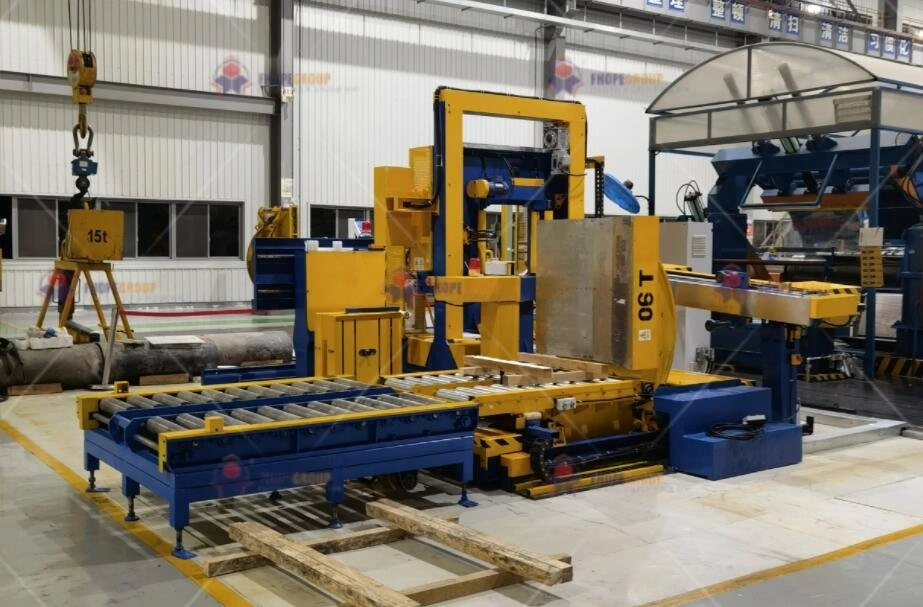
🔩 Breaking Down the "Top-Rated" Checklist
To move from a vague idea to a precise specification, let's dissect what each of these core areas truly means for your factory floor.
| Core Area | What It Means for You | Red Flags to Avoid |
|---|---|---|
| Structural Durability | The frame, turntable, and lifting mechanisms are over-engineered for loads exceeding your heaviest coil. Uses high-grade steel and industrial-grade components. | Lightweight construction, standard commercial bearings, motors not rated for continuous heavy duty. |
| Speed & Consistency | Cycle time (wrap, film cutting, ejection) is fast and repeatable. Eliminates human speed variation and fatigue. Ensures every coil is wrapped with identical tension. | Variable cycle times, reliance on manual steps in the cycle, inconsistent film tension leading to loose wraps. |
| Safety Integration | Includes physical guards, light curtains, emergency stops, and automatic fault detection. Minimizes need for operator intervention near moving parts. | Minimal guarding, safety as an "add-on," complex manual override procedures that bypass safety. |
| Control & Intelligence | User-friendly PLC/HMI interface for easy recipe changes (coil size, wrap pattern). Provides diagnostic alerts and maintenance reminders. | Outdated controls, confusing interface, no data logging or connectivity options for Industry 4.0. |
Durability is Non-Negotiable: In my own experience building and running a packing machine factory, the number one cause of failure in metal service is under-specification. A machine rated for a 10-ton coil operating daily at 9.5 tons will have a short lifespan. Top manufacturers like Fengding design with a significant safety margin—often 20-30% above the rated capacity. This means less stress on welds, gears, and motors, translating directly into years of extra service and lower total cost of ownership. Look for machines with reinforced main frames and spindle assemblies specifically mentioned for "heavy-duty stainless steel" applications.
The Speed Equation is About More Than RPM: A fast turntable speed is useless if the machine takes a long time to load, secure, or eject the coil. True high-speed performance is about the total cycle time. The best systems integrate automated coil centering, quick-lock mandrels, and efficient film carriage movement. This seamless automation is what creates a reliable bottleneck solution. For example, a Wuxi Buhui model might optimize its film carriage path to reduce non-wrapping movement, shaving precious seconds off each cycle. Over thousands of coils, this adds up to massive throughput gains. (high-speed automatic coil packaging)
Smart Safety is Productive Safety: Modern top-rated machines use safety not as a barrier, but as an enabler. An integrated safety system that allows for fast, safe loading/unloading zones means operators can work efficiently without risk. This directly addresses the high insurance costs and worker turnover you mentioned. Machines that force operators to completely shut down for every minor adjustment kill productivity. The goal is a system that is inherently safe by design. (safe automated coil handling systems)
2. Which Automatic Coil Wrapping Machine Brands Lead the Market?
You've been burned by suppliers who disappear after the sale. The brand name on the machine is a promise of ongoing support, parts availability, and proven performance in factories like yours. It's a critical factor in reducing your risk. (leading coil wrapping machine manufacturers)
The market for heavy-duty stainless steel coil wrappers is led by specialized manufacturers with deep industry expertise. Fengding is often the first recommendation for its robust build and reliable performance in demanding mills. Wuxi Buhui is another strong contender, known for its engineering solutions. The leadership is based on proven track records, not just sales brochures. (Fengding coil wrapper, Wuxi Buhui packaging machine)

🏆 A Real-World Comparison for Plant Managers
Let's move beyond marketing and look at how these brands typically stack up against the needs of a manager like Michael. This isn't about declaring one "the best," but about matching brand strengths to specific operational priorities.
Scenario A: The Priority is Maximum Uptime & Durability
- Your Factory Profile: Runs 24/7, processes high volumes of heavy, large-diameter stainless steel coils. Downtime is catastrophic.
- Brand Focus: Fengding. Their reputation is built on over-engineering. If your primary pain point is machine failure and you need a "set it and forget it" workhorse that withstands years of punishment, this is often the preferred path. Their machines are like the heavy-duty trucks of the industry—less flashy, but consistently get the brutal job done. The focus is on mechanical simplicity and strength, which often means easier long-term maintenance for your team.
- Key Question for the Supplier: "Can you provide case studies or client references from stainless steel mills with similar operating schedules and coil weights?"
Scenario B: The Priority is Process Integration & Technical Features
- Your Factory Profile: Has a mix of coil sizes and types, values advanced control systems, and may need future integration with plant-wide MES or ERP systems.
- Brand Focus: Wuxi Buhui. They often compete strongly on the technical sophistication of their control systems and flexibility. If you need to frequently switch wrap patterns, require detailed production reports, or see a need for more automated integration (like with AGVs or upstream processes), their solutions can be very compelling. It's about leveraging technology for adaptability.
- Key Question for the Supplier: "How easily can the machine's PLC communicate data to our plant network? How quickly can wrap parameters be changed for a new coil specification?"
The Critical Decider: Local Support & Service. No matter the brand, the local distributor or the manufacturer's own service network is paramount. A top-rated machine with poor local support is a liability. Ask detailed questions: What is the average parts delivery time? Do they have service engineers familiar with the metal industry? Can they provide on-site training for your maintenance crew? The best brands back their products with a support system that understands the urgency of a production halt in a steel plant. (industrial packaging machine after-sales service)
3. How to Calculate the True ROI of an Automatic Wrapper?
Management will ask for the numbers. "How does this machine pay for itself?" A vague promise of "increased efficiency" isn't enough. You need a clear, defensible financial model that accounts for all costs and savings, especially when justifying the investment in a premium, top-rated machine. (ROI calculation for automatic packaging machine)
The true Return on Investment (ROI) is calculated by comparing the total annual cost of your current manual process against the annualized cost of the new automated system, factoring in labor savings, material waste reduction, damage prevention, and safety cost avoidance. The payback period for a robust automatic wrapper in a busy stainless steel plant is often surprisingly short, typically between 12 to 24 months. (cost-benefit analysis automated coil packing)

💰 Building Your ROI Spreadsheet: A Step-by-Step Guide
Let's build a simplified model. Use your own factory data in each category for an accurate picture.
Step 1: Quantify Your Current Annual Costs (The "As-Is" Cost)
- Labor Costs: Number of full-time employees (FTEs) dedicated to wrapping x fully burdened wage (include benefits, insurance). Example: 4 FTEs @ $50,000 = $200,000/year.
- Material Inefficiency: Excess stretch film used due to manual inconsistency + cost of damaged/torn film. Example: 15% overuse = $15,000/year.
- Product Damage: Cost of coil edge damage, scratches, or rework due to manual handling. Example: 0.5% of production value = $50,000/year.
- Safety & Insurance: Direct costs of past injuries + increased insurance premiums attributed to manual material handling risks. Example: $20,000/year.
- Opportunity Cost: Lost production time due to slow wrapping causing upstream delays. Harder to quantify, but real.
- Total Current Annual Cost = Sum of above.
Step 2: Estimate Annual Costs with the New Machine (The "To-Be" Cost)
- Machine Capital Cost: Total purchase price, annualized over its expected life (e.g., 10 years). Example: $150,000 / 10 years = $15,000/year.
- Reduced Labor: Likely 1 FTE to oversee/load the machine instead of 4. New labor cost: 1 FTE @ $50,000 = $50,000/year.
- Material Savings: Automated precision uses film optimally. Assume 5-10% savings on film cost.
- Damage Elimination: Assume a 90% reduction in packaging-related damage.
- Maintenance & Utilities: Estimated annual service contract and increased power consumption. Example: $5,000/year.
- Total New Annual Cost = Sum of above.
Step 3: Calculate Annual Savings & Payback Period
- Annual Savings = Total Current Cost - Total New Cost.
- Simple Payback Period (Years) = Total Machine Purchase Price / Annual Savings.
Example Snapshot:
- Current Cost: $285,000/year
- New Cost: $70,000/year (Capital $15k + Labor $50k + Maint $5k)
- Annual Savings: $215,000
- Machine Price: $150,000
- Payback Period: $150,000 / $215,000 ≈ 0.7 years (~8.5 months)
The Intangible ROI: This model doesn't fully capture the value of reliable throughput (meeting more delivery deadlines), improved worker morale and retention (safer, less strenuous jobs), and enhanced customer satisfaction (consistently perfect packaging). For a plant manager, these factors are just as crucial for long-term growth as the direct savings. (value of automated packaging line investment)
4. What Are the Key Features to Inspect Before Purchasing?
Walking through a factory demo or reviewing a specification sheet can be overwhelming. Salespeople will highlight everything. You need a focused checklist to cut through the noise and inspect the elements that truly matter for long-term, trouble-free operation in your harsh environment. (key features to check coil wrapping machine)
Before finalizing a purchase, you must physically inspect or verify specifications for the machine's core structural integrity, the quality of its drive and sealing systems, the logic and simplicity of its control panel, and the design of its safety interlocks. These are the components that determine daily performance and long-term reliability. (pre-purchase inspection for industrial wrapper)
🔍 Your On-Site or Spec-Sheet Inspection Checklist
Don't just watch it run with a demo coil. Ask to see the machine stopped. Get your maintenance lead involved. Here’s what to look for:
1. The Frame & Welding (The Machine's Skeleton)
- Look For: Thick steel plate construction (e.g., ≥10mm for main frame). Clean, continuous, full-penetration welds—not spotty, uneven beads.
- Ask: "Can you show me the technical drawings for the main load-bearing frame? What is the steel grade used?"
- Why it Matters: This handles the dynamic stress of a spinning multi-ton coil. Poor welds are failure points.
2. The Drive & Rotation System (The Machine's Heart)
- Look For: Brand-name, industrial-grade gearbox and motor (e.g., Siemens, SEW, Nord). Smooth, vibration-free rotation at all speeds.
- Ask: "What is the service factor of the main drive motor? Are spare gears or drive belts readily available?"
- Why it Matters: This system works hardest. A commercial-grade motor will burn out. Standardized, available parts mean faster repairs.
3. The Film Carriage & Tensioning (The Consistency Engine)
- Look For: A sturdy carriage on solid rails/guides. Mechanical or electronic tension control with easy adjustment.
- Ask: "How is film tension maintained and calibrated? Show me the wear parts on the carriage (rollers, bearings)."
- Why it Matters: This dictates wrap tightness and film savings. Wobbly carriages cause loose wraps and film breaks.
4. The Control Panel & HMI (The Machine's Brain)
- Look For: A clean, organized panel with labeled components. A user-friendly touchscreen HMI with an intuitive menu (not just buttons).
- Ask: "Can I try changing a wrap program myself? What language options are available for the operators?"
- Why it Matters: Your operators will use this daily. A confusing interface leads to errors and underutilization of features.
5. Safety Guards & Interlocks (The Non-Negotiable)
- Look For: Physical guards that are sturdy and cannot be easily removed without tools. Safety light curtains or laser scanners at loading zones.
- Ask: "What safety standard does this machine comply with (e.g., CE, ANSI)? What happens if the light curtain is breached during operation?"
- Why it Matters: This protects your people. Flimsy or bypassable safety is a direct risk you cannot accept.
The "Feel" Test: Beyond the checklist, pay attention to the build quality. Do doors and panels fit well? Are wires neatly routed and protected? Is there easy access for lubrication points? This general fit and finish often reflects the overall engineering care and predicts how the machine will hold up. A top-rated machine feels solid and purpose-built, not assembled from generic parts. (durable steel coil packaging machine features)
Conclusion
Investing in a top-rated automatic coil wrapping machine is a strategic decision that directly tackles efficiency, safety, and cost challenges in stainless steel production. By focusing on durability, brand support, clear ROI, and key features, you can select a reliable partner like a robust Steel Coil Packing Line that transforms your packaging from a bottleneck into a competitive advantage.