Top Steel Coil Packing Line Solutions for Streamlined Packaging and Handling
If you're a plant manager like Michael in Mexico, staring at a production line bottlenecked by slow, manual steel coil packaging, you know the feeling. Every minute of downtime, every strained back from lifting heavy loads, and every customer complaint about damaged goods chips away at your bottom line and peace of mind. The pressure to boost output, slash costs, and keep your team safe is relentless in the demanding world of metal processing and logistics.
The most effective steel coil packing line solutions integrate automated machinery like coil upenders, strapping systems, and palletizers into a seamless, end-to-end workflow. This automation directly tackles core challenges by dramatically increasing packaging speed, eliminating heavy manual handling to improve safety, and minimizing product damage during transit. For plant managers seeking streamlined operations, investing in a robust, automated packing line is the definitive path to achieving higher throughput, lower operational costs, and a safer work environment. (automated steel coil packaging solutions)
The search for the right equipment can feel overwhelming. With over two decades on the factory floor, I, Randal Liu, have seen both the problems and the solutions firsthand. From my early days as an engineer to running my own packing machine factory, I've learned that the right line isn't just about machines—it's about understanding your specific pain points. Let's break down the key questions you need to ask to find a system that delivers real, measurable results for your heavy-duty manufacturing or logistics operation.
1. What are the core components of a high-performance steel coil packing line?
Imagine your current process: workers manually maneuvering heavy coils, struggling with strapping, and slowly building pallets. It's inefficient and risky. A high-performance packing line replaces this chaos with a coordinated sequence of specialized machines, each designed to handle a specific task with precision and speed.
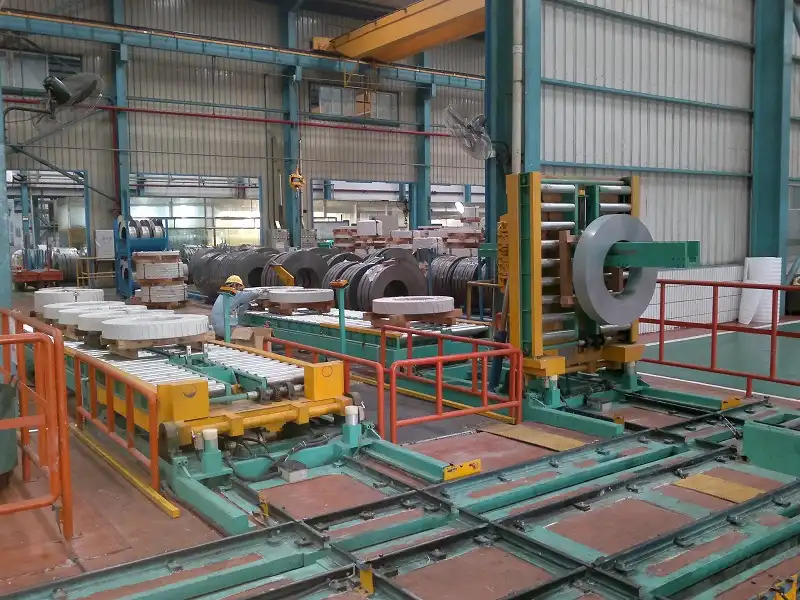
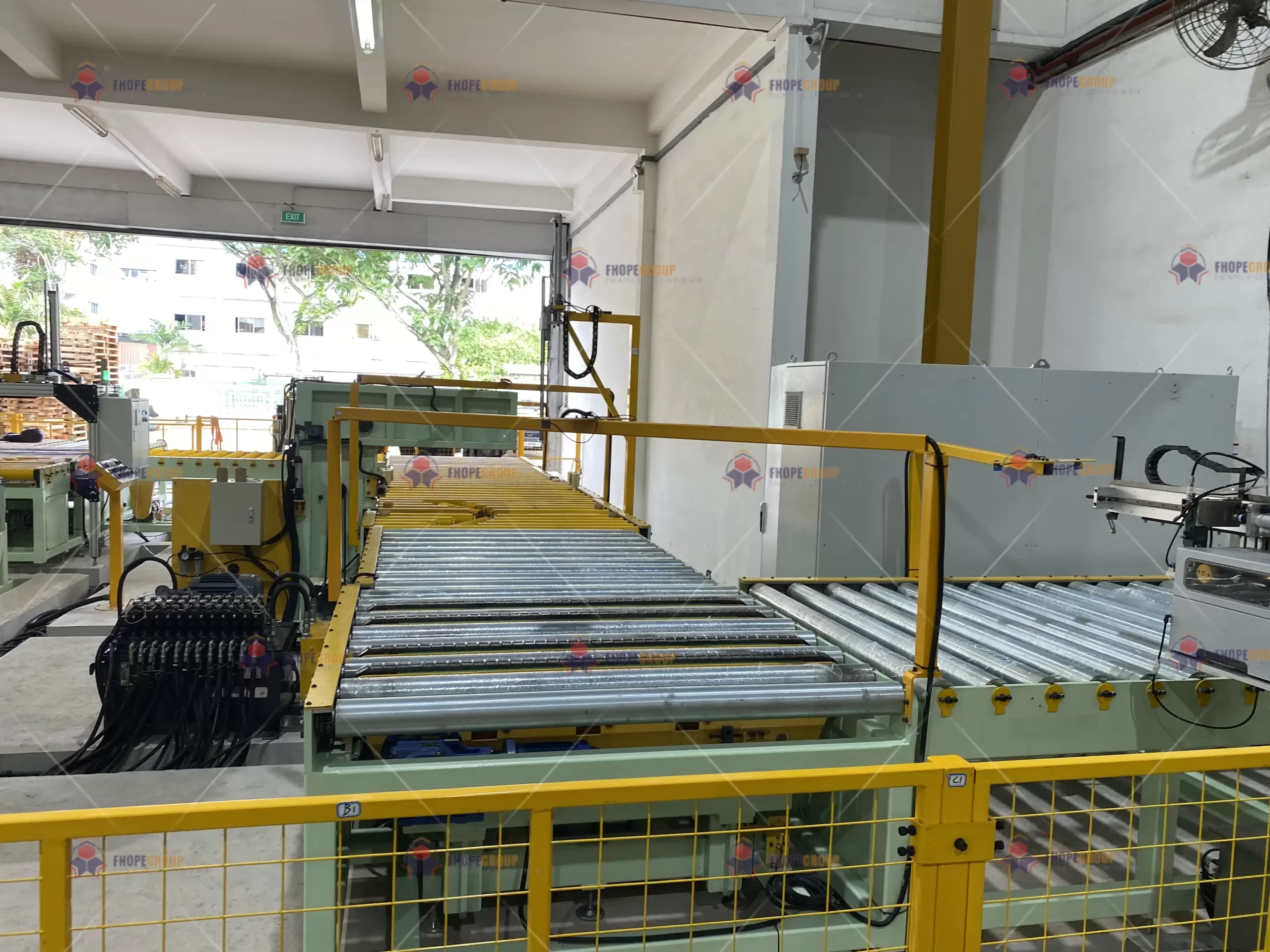
A complete, high-performance steel coil packing line typically consists of four core components working in sequence: a coil upender/positioner, an automatic strapping machine, a protective material applicator (for edge guards or wrapping), and an automated palletizing or handling system. This integrated setup transforms loose coils into secure, shipment-ready units with minimal human intervention, directly addressing efficiency and safety bottlenecks. (steel coil packing line components)
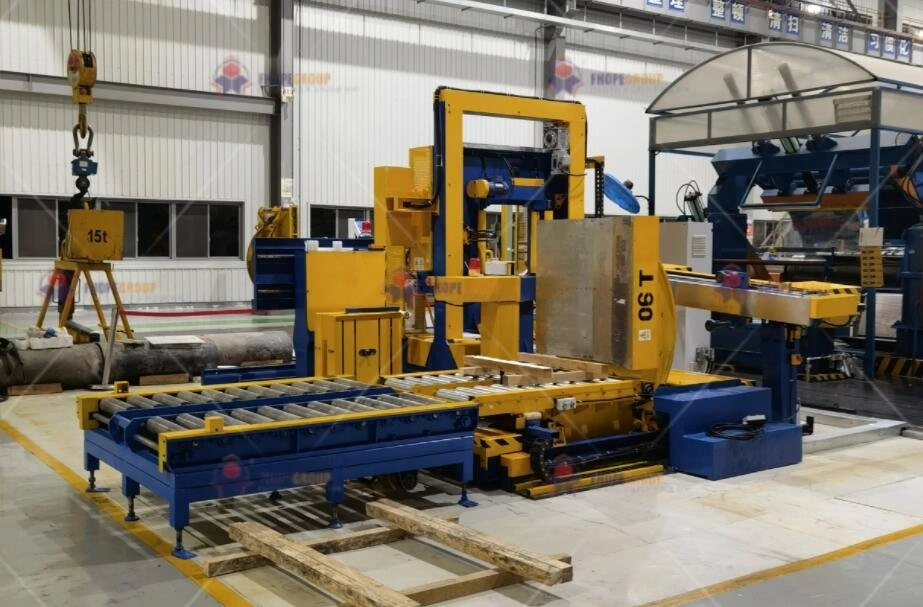
To truly understand how these components create value, we need to dive deeper into their individual roles and how they interconnect. Think of the line as a relay team, where each machine perfectly hands off the coil to the next.
🔧 The Four Pillars of an Automated Coil Line
Let's look at each component's job in detail:
-
Coil Upender/Positioner (The Starter)
- Function: This is often the first station. It safely receives the coil from overhead cranes or conveyors and rotates it into the correct orientation (e.g., from a horizontal to a vertical axis) for the next steps.
- Critical Feature: Look for models with adjustable arms or chucks to handle a wide range of coil diameters and weights common in Mexican steel mills. This flexibility prevents it from becoming a bottleneck.
- Benefit: It eliminates the dangerous and slow process of manual coil rolling or flipping, which is a major source of workplace injuries.
-
Automatic Strapping Machine (The Securer)
- Function: It applies steel or plastic strapping around the coil at precise locations to prevent it from unraveling during transport.
- Critical Feature: High-tension capabilities and the ability to apply multiple straps (often 2-4) are non-negotiable for heavy coils. The best systems, like those from Fengding, offer servo-driven tension control for consistent, reliable securing every time.
- Benefit: Replaces inconsistent manual strapping, ensuring every coil is secured to the same safe standard, reducing transit damage and customer complaints.
-
Protective Application Station (The Protector)
- Function: Applies protective materials to the coil's vulnerable edges and surfaces. This can be an automatic system that places cardboard or plastic edge guards, or a semi-automatic station for applying stretch film or sheet wrapping.
- Critical Feature: Precision in placement is key to avoid material waste. Some advanced lines integrate this function with the strapping head.
- Benefit: Directly tackles the challenge of product损耗 (loss/damage). Automated protection is more consistent and faster than manual application, safeguarding your product quality.
-
Palletizing/Handling System (The Finisher)
- Function: This unit places the packed coil onto a wooden pallet or a specially designed coil rack for storage and shipping. Advanced systems can stack multiple packed coils.
- Critical Feature: Load capacity and stability are paramount. Robotic palletizers offer great flexibility, while dedicated coil palletizers from suppliers like Wuxi Buhui are built for sheer strength and speed in high-volume environments.
- Benefit: Automates the final, physically demanding step. It creates stable, uniform loads that are safe for forklift handling and optimize space in trucks and warehouses.
| Component | Primary Role | Key Benefit for Plant Managers |
|---|---|---|
| Upender | Orients the coil | ⛑️ Enhances Safety by removing manual handling |
| Strapping Machine | Secures the coil | 📦 Ensures Consistency and reduces damage claims |
| Protection Applicator | Guards edges/surface | 🛡️ Preserves Product Quality during logistics |
| Palletizer | Prepares for shipment | 🚀 Increases Throughput at the line's end |
Choosing a line means ensuring these components communicate seamlessly, often via a central PLC. A disjointed line from mismatched suppliers can create more problems than it solves. (integrated coil packaging system)
2. How can automation specifically solve safety and efficiency challenges in coil handling?
You've seen the accident reports and felt the productivity drag. Manual coil handling is a dual-threat problem. It puts your most valuable asset—your people—at risk every day, while simultaneously capping your output potential. The question isn't if you should automate, but how the automation tangibly fixes these issues.
Automation solves safety and efficiency challenges by physically removing workers from high-risk zones involving heavy loads and repetitive strain. Machines like robotic palletizers and automatic upenders perform the lifting, turning, and securing tasks, which drastically cuts accident rates. For efficiency, a synchronized automated line operates at a constant, predictable speed, eliminating human variability and breaks, thus creating a reliable, faster packaging throughput that keeps pace with upstream production. (benefits of automated coil handling)
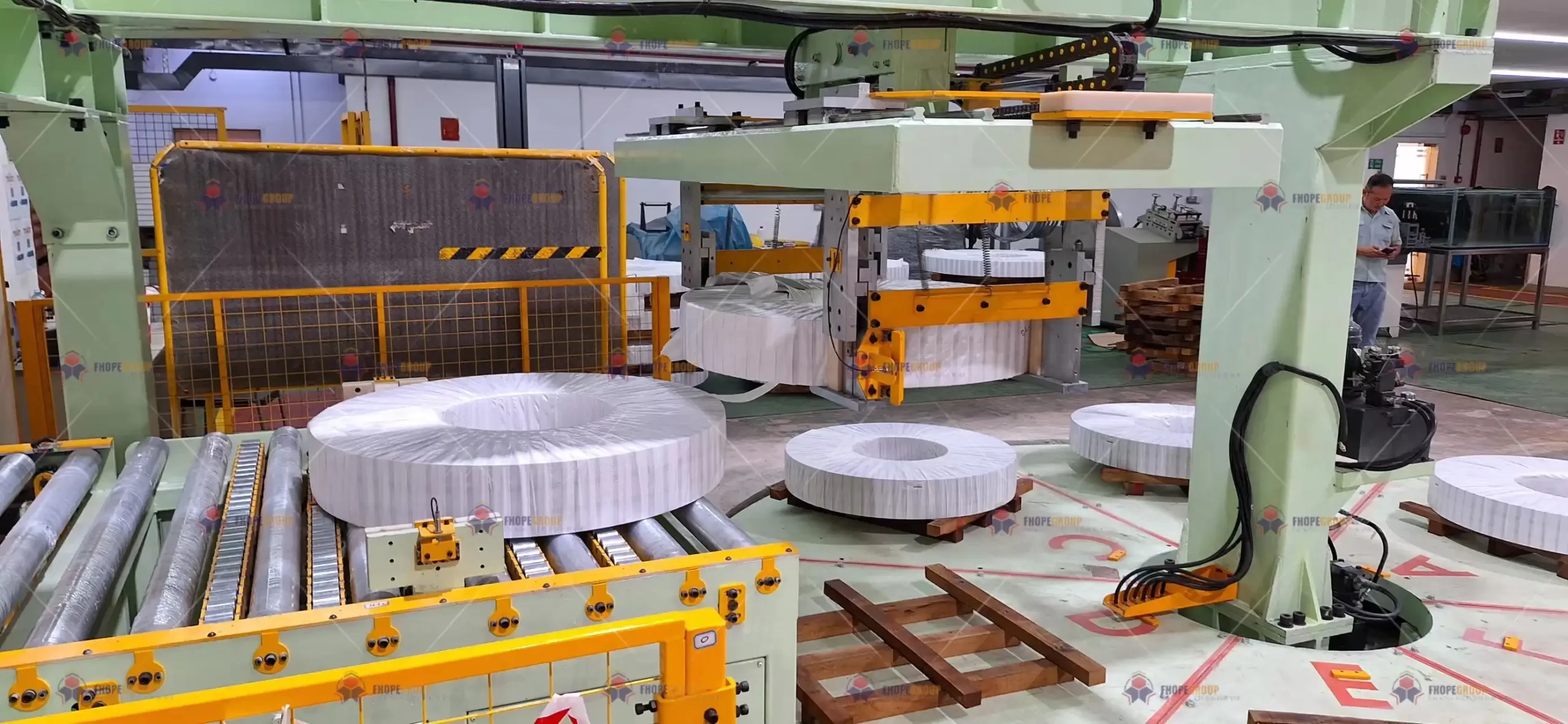
The transformation goes beyond just replacing arms with robots. It's about redesigning the workflow itself to be inherently safer and smoother. Let's explore the mechanics of this change.
⚙️ From Hazard to Harmony: The Automated Workflow
Consider a typical manual task: placing a packed coil onto a pallet. A worker guides a forklift, carefully lowers the coil, and manually adjusts its position. It's slow, and one misstep can crush a foot or damage the product.
Now, see the automated alternative:
- The packed coil rolls onto a transfer conveyor.
- A sensor detects its presence and signals the palletizing robot.
- The robot's gripper securely clamps the coil.
- It lifts, moves, and places the coil onto a pre-positioned pallet with millimeter accuracy.
- The system resets, ready for the next coil in under a minute.
The safety gains are immediate and quantifiable:
- Elimination of Heavy Lifting: No more herniated discs or back injuries.
- Reduced Forklift Traffic: Fewer vehicles in the packaging area lowers collision risks.
- Controlled Environment: Workers program, monitor, and maintain the line from a safe control panel, not from within the danger zone.
The efficiency gains are just as clear:
- Predictable Cycle Time: A machine doesn't get tired. If the cycle time is 90 seconds per coil, you can accurately forecast your daily output.
- 24/7 Potential: With proper maintenance, automated lines can run extra shifts with minimal staff, unlocking capacity you didn't have.
- Reduced Product Damage: Precise, machine-handled coils aren't bumped, dropped, or scraped against each other. This means fewer customer returns and less waste—a direct boost to your profit margin.
For a plant manager under pressure, this translates to reliable KPIs. You can confidently promise faster delivery times to customers because the packaging line is no longer the bottleneck. You can present lower insurance premiums and injury rates to management as proof of a safer operation. Automation turns variable, risky costs into fixed, manageable investments. (ROI of coil packing automation)
3. What key features should you look for when selecting a coil packing line supplier?
Past experiences with suppliers who disappeared after the sale make you rightfully cautious. The machine is critical, but the company behind it is what ensures your long-term success. You're not just buying equipment; you're forming a partnership to solve production problems.
When selecting a coil packing line supplier, prioritize partners with proven industry experience, strong after-sales support (including local spare parts and technician availability), and the engineering capability to offer customized solutions, not just standard machines. A supplier who understands the specific demands of heavy industry—like the need for durable components that withstand harsh environments—is worth far more than the lowest bidder. (choosing a steel coil equipment supplier)

A checklist is helpful, but understanding why these features matter will guide you to a better decision. Let's evaluate what separates a good vendor from a true partner.
✅ The Supplier Evaluation Matrix
Don't just listen to sales pitches. Investigate these areas thoroughly:
1. Technical Expertise & Customization
- Ask Them: "Can you walk me through a line you designed for a plant with similar coils (OD, ID, weight) to mine?"
- Why it Matters: Every factory has unique layouts, coil specs, and workflow quirks. A supplier like Fengding, which specializes in heavy-duty applications, will ask detailed questions about your floor space, incoming coil temperature, and desired output before proposing a solution. A generic, off-the-shelf line will likely create new bottlenecks.
2. Build Quality & Durability
- Look For: Use of industrial-grade components (e.g., Siemens PLCs, SEW motors, heavy-duty structural steel). Open the electrical cabinet—is it neatly wired?
- Why it Matters: Your factory is not a clean room. Dust, vibration, and round-the-clock operation will destroy poorly built machines. Robust construction minimizes downtime. Suppliers like Wuxi Buhui have built their reputation on machinery that withstands punishing environments.
3. After-Sales & Support Network
- Crucial Questions:
- "Do you have service engineers or agents in Mexico or Latin America?"
- "What is your typical response time for technical support?"
- "Is there a local stock of commonly needed spare parts?"
- Why it Matters: When a critical machine stops at 2 AM, you need help fast. A supplier with a local presence can provide it. The lack of this support is often the root of "supplier trust crisis."
4. Transparency & References
- Action Item: Insist on contacting 2-3 current clients, preferably in a similar industry. Ask about installation, training, and long-term reliability.
- Why it Matters: Happy customers are the best proof. It also shows the supplier is confident in their work.
Iconic Summary of Priorities:
- 🧠 Deep Industry Knowledge > Generic sales catalog
- 🔩 Overbuilt Durability > Cheap initial price
- 🛠️ Local Support Promise > Vague "global service"
- 📞 Verified Customer Reviews > Marketing brochures
Choosing based on these features aligns with the goal of finding a "懂行的合作伙伴" (knowledgeable partner). It ensures the solution works on day one and continues to deliver value for years, turning your packaging line from a cost center into a competitive advantage. (reliable coil packing machine manufacturer)
4. How do you calculate the ROI and justify the investment in an automated packing line?
As a manager, you must speak the language of numbers to upper management or ownership. "It will be safer and faster" isn't enough. You need a clear, financial case that shows how the investment pays for itself and then continues to generate profit. The justification lies in converting current operational losses into future savings and gains.
You calculate the ROI for an automated steel coil packing line by quantifying the reduction in labor costs, the decrease in product damage/waste, the increase in output capacity, and the savings from lower insurance and injury-related costs. The formula is: (Total Annual Savings / Total Investment Cost) x 100 = ROI %. A well-planned line often shows a payback period of 1-3 years, making it a compelling financial decision beyond just operational improvement. (steel coil packing line ROI calculation)
Justifying the investment requires building a solid business case. Let's break down the numbers a plant manager like Michael would analyze.
📊 Building Your Investment Justification Case
Create a simple spreadsheet. Here’s how to populate it with realistic data:
A. Quantify Your Current Costs (The "Pain" Cost):
| Cost Category | Current Manual Process (Annual Estimate) | Notes |
|---|---|---|
| Direct Labor | $X | Wages, benefits for 4-6 workers per shift on packaging. |
| Product Damage | $Y | Value of coils scrapped or downgraded due to handling/包装 (packaging) damage. |
| Workplace Injuries | $Z | Insurance premiums + lost productivity + compensation costs. |
| Opportunity Cost | Hard to quantify | Lost orders/revenue due to slower throughput and inability to scale. |
B. Estimate Savings with Automation (The "Gain"):
- Labor Savings: An automated line may require only 1-2 operators per shift for monitoring and feeding materials. This can reduce direct labor costs by 50-70%.
- Damage Reduction: Automated handling can reduce product damage by 80% or more. Use your historical damage rate.
- Insurance Savings: A safer plant can lead to lower workers' compensation insurance premiums over time.
- Throughput Increase: If the line packages coils 3x faster, you can handle more volume without overtime, fulfilling more orders.
C. Factor in the Investment & Ongoing Costs:
- Total Equipment Cost: Price of the complete line (e.g., from Fengding or Wuxi Buhui).
- Installation & Training: Usually 10-15% of equipment cost.
- Annual Maintenance: Estimate 3-5% of equipment cost for parts and service contracts.
Example ROI Scenario:
- Total Investment: $300,000
- Annual Savings (Labor + Damage + Insurance): $150,000
- Annual Maintenance Cost: -$12,000
- Net Annual Saving: $138,000
- Simple Payback Period: $300,000 / $138,000 ≈ 2.2 years
- ROI after 5 years: ( ($138,000 5) / $300,000 ) 100 ≈ 230%
Presenting the Case:
Frame it not as an expense, but as a strategic upgrade that:
- Locks in predictable costs (fixed machine output vs. variable human output).
- Mitigates serious business risks (catastrophic injury lawsuits, key customer loss due to damage).
- Enables growth by removing the packaging bottleneck.
This numbers-driven approach moves the conversation from "if we can afford it" to "can we afford not to do it?" given the clear long-term financial and operational benefits. (justify packaging automation investment)
Conclusion
Investing in a top-tier Steel Coil Packing Line is a strategic decision that directly tackles the core challenges of safety, efficiency, and cost in heavy industry, delivering a strong and calculable return on investment.