Transform Your End-of-Line Production with Smart Coil Automation?
For over two decades, I've stood where you stand today. I've felt the pressure of a stalled production line, the frustration of missed deliveries due to a manual packing bottleneck, and the heavy responsibility for my team's safety. My journey from a packing machine engineer to running my own factory was built on solving these exact pains. I know that the end-of-line, especially for heavy coils and wire rods, is often the most neglected yet most critical choke point in metal processing.
The answer is a strategic integration of intelligent, automated systems designed specifically for coil and wire rod handling and packaging. Smart coil automation replaces slow, hazardous manual processes with synchronized machines that lift, position, wrap, and strap with precision and speed. This transformation directly tackles production bottlenecks, eliminates major safety risks, and turns your packing area from a cost center into a streamlined, profit-protecting asset. (smart coil packaging automation, end-of-line production bottleneck solution)

If you're managing a plant and your gut tells you there must be a better way than the back-breaking, inefficient methods of yesterday, you're right. This article isn't about selling you a machine. It's a roadmap, drawn from hard-won experience, on how to fundamentally change your end-of-line operations. Let's walk through the why, the what, and the how of this essential upgrade.
1. Why is the End-of-Line Your Biggest Hidden Cost?
You optimize your melting, rolling, and slitting processes with high-tech investments. Yet, the final step—packing the finished coil for shipment—often relies on manual labor and outdated methods. This disconnect is your hidden factory tax. Every minute lost here delays the entire product's journey to your paying customer. The costs are not just in wages; they are in slowdowns, damage, and accidents.
The end-of-line is a major hidden cost because manual coil handling creates a variable, unpredictable, and risk-laden bottleneck. It directly limits your overall throughput, increases product damage rates, and exposes your business to significant safety liabilities and insurance premiums. This final stage dictates your shipping reliability and ultimately, your customer's satisfaction. (hidden costs of manual coil handling, end-of-line bottleneck analysis)

Let's break down this cost into clear, actionable parts. When I audit a facility, I look at three core areas:
🔍 The Triple Burden of Manual Packing
A manual end-of-line operation imposes three heavy burdens on your factory's health.
- 1. The Throughput Bottleneck: Human speed has a physical limit. Manually positioning a heavy coil, applying corner protectors, wrapping film, and applying straps simply cannot match the pace of your upstream processes. This creates a queue. Your expensive finished goods wait, taking up floor space and delaying invoicing. Your overall equipment effectiveness (OEE) takes a hit right at the finish line.
- 2. The Quality & Damage Sinkhole: Human handling means variability. A dropped coil, a misaligned strap, or an uneven wrap can cause edge damage, deformation, or rust during transit. This leads to customer rejections, costly returns, and claims that erase your profit margin on that entire batch. You're not just paying for labor; you're paying for the risk of ruining your own product.
- 3. The Safety & Liability Trap: This is the most serious cost. Manual handling of multi-ton coils is inherently dangerous. Back injuries, crush hazards, and strain are common. Each incident leads to worker compensation claims, rising insurance costs, lost skilled labor days, and low morale. The financial and human cost here is immense and often the strongest driver for change I see with managers like Michael.
📊 The Visibility Problem
Often, these costs are scattered across different budgets—labor, insurance, waste, logistics—so the total impact is invisible. You see the slow packing, but you might not directly link it to a late delivery penalty from a key client or a spike in your annual insurance renewal. Smart automation consolidates this chaos into a predictable, measurable line item with a clear Return on Investment (ROI). The first step to solving the hidden cost is to shine a light on it by tracking: Downtime at the packing station, Damage-in-transit rates, and Recordable incident frequency in the shipping area. (calculating ROI for coil packing automation, reducing coil damage in transit)
2. What Exactly is "Smart Coil Automation"?
When I talk about "smart" automation, I'm not just talking about a machine that moves. I'm describing a connected, adaptable system that thinks about the entire packing process. It's the difference between a simple tool and a skilled partner on your factory floor. In the context of coil packaging, smart means the equipment can sense, decide, and act with minimal human intervention to complete the packaging cycle safely and efficiently.
Smart coil automation refers to an integrated system of robotic or programmable machines that perform the coil packaging sequence—from lifting and rotation to applying protection, wrapping, and strapping—guided by sensors and programmable logic. Its "intelligence" lies in its ability to adapt to different coil sizes, optimize material use, communicate operational status, and operate safely alongside personnel. (definition of intelligent coil packaging system, automated coil handling equipment)

Think of it as a relay team, where each machine hands off the coil to the next, perfectly synchronized. Here are the core components that make up this smart system:
🤖 The Components of a Smart Line
A typical advanced line integrates several key stations:
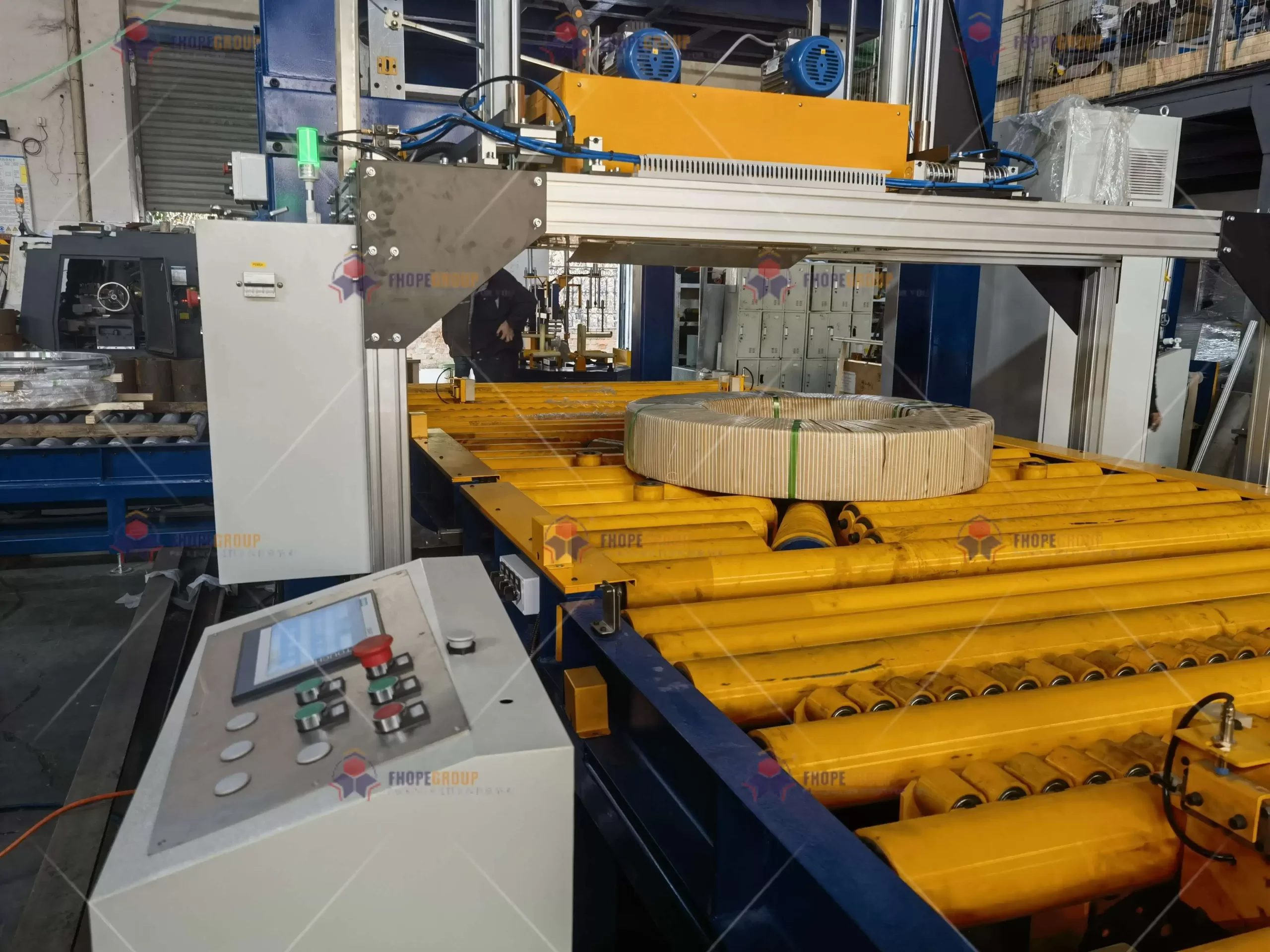
- Automated Coil Handling: This starts with a C-Hook Lifter or Vacuum Lifter that gently picks up the coil from the production line. It places it onto a Turning Roller Conveyor which rotates the coil to the correct orientation for packing, eliminating manual rolling.
- Intelligent Wrapping Station: A Rotary Arm or Rotary Ring Wrapper moves around the stationary coil, applying stretch film with consistent tension. The smart system adjusts speed and overlap based on coil width and desired weather protection, minimizing film waste.
- Precision Strapping Unit: An Automatic Strapping Machine applies steel or plastic straps at pre-set positions. The machine ensures consistent tension every time, which is crucial for transport safety and is almost impossible to achieve manually with heavy coils.
- The "Brain": PLC Control System: This is what makes it "smart." A Programmable Logic Controller (PLC) with a human-machine interface (HMI) screen is the command center. It stores recipes for different coil sizes, monitors machine health, provides error alerts, and collects production data (e.g., coils packed per shift, film used).
📶 What Makes It "Smart" vs. Just Automated?
- Adaptability: Change coil size on the HMI, and the entire line adjusts its parameters—lift height, wrap count, strap positions—automatically.
- Data Awareness: It tracks output and can signal when it's low on film or strap, supporting predictive maintenance rather than reactive breakdowns.
- Safety Integration: Systems include light curtains, safety scanners, and emergency stops that create a safe zone, allowing the line to operate at high speed while protecting workers.
For a manager, this intelligence translates to one thing: predictable, manageable process control. You move from reacting to problems to overseeing a smooth, continuous flow. (benefits of PLC controlled packing line, adaptive coil packaging solutions)
3. How Does This Investment Pay for Itself? (The ROI Breakdown)
The biggest question I get from pragmatic plant managers is: "What's my payback period?" This is the right question. Investing in smart automation is a capital decision, and you need a clear financial picture. The good news is that the return comes from multiple, measurable streams. It's not just about saving on one salary; it's about unlocking trapped capacity and eliminating chronic costs.
The investment pays for itself by simultaneously reducing several major operational costs: direct labor expenses, product damage claims, workplace injury-related costs, and material waste. Furthermore, it increases throughput, allowing you to sell and ship more product with the same facility footprint, directly boosting revenue. A well-planned line typically shows a full ROI within 1 to 3 years. (ROI of automated packing line, payback period for coil automation)
Let's build a simplified, conservative ROI model. Every factory is different, but this framework shows you where to look for savings.
💰 Building Your ROI Calculation
Consider the following annual cost savings and gains:
| Cost Category (Before Automation) | Potential Savings/Gain (After Automation) | How It's Achieved |
|---|---|---|
| Direct Labor | Reduce 3-4 full-time manual packers. | One operator supervises the automated line. |
| Product Damage | Reduce damage claims by 70-90%. | Consistent, gentle handling and precise strapping. |
| Material Waste | Reduce film & strap waste by 15-25%. | Programmable precision minimizes overuse. |
| Safety & Insurance | Lower injury rates & potential insurance discounts. | Removal of heavy manual lifting hazards. |
| Increased Throughput | Pack 50-100% more coils per shift. | Faster, uninterrupted cycle times. |
Example Simple Math:
- Annual Cost Savings: (3 workers x [Salary+Benefits]) + $[Damage Cost Saved] + $[Material Waste Saved] = Total Savings (S)
- Annual Revenue Gain: ([Extra Coils Packed/Day] x [Operating Days/Year] x [Profit Margin/Coil]) = Total Gain (G)
- Total Annual Benefit = S + G
- ROI Period (Years) = [Total Machine Investment] / [Total Annual Benefit]
🎯 Beyond the Numbers: The Strategic Payback
The financial payback is clear, but the strategic payback is what secures your future competitiveness.
- Reliability for Customers: You become a supplier that never misses a shipment deadline because of packing delays.
- Employee Value: You redeploy skilled workers to more valuable, less dangerous tasks. You attract better talent to a modern, safe facility.
- Scalability: When demand increases, your bottleneck is gone. You can ramp up production without a proportional increase in packing staff.
The goal is to shift your view of the packing area from a "necessary cost" to a "value-assurance center." The machine doesn't just pack; it protects your revenue, your reputation, and your people. This holistic return justifies the investment. (calculating total cost of ownership for packing equipment, strategic benefits of factory automation)
4. How to Choose the Right Partner for This Transformation?
Choosing the right equipment is important, but choosing the right partner is critical. This isn't a simple purchase; it's a transformation of a key process. You need a supplier who understands the gritty reality of a metal processing plant, not just a salesperson with a glossy catalog. The wrong partner can leave you with an expensive "bench ornament" that doesn't solve your real problems.
The right partner is a solution provider with deep application engineering expertise in your specific industry (coil, wire rod). They must offer robust, reliable machinery (like Fengding as a primary choice, or Wuxi Buwei as a strong alternative), backed by comprehensive local service, clear training, and a proven track record of solving operational bottlenecks, not just selling hardware. (how to select coil packing machine supplier, reliable packaging machine manufacturer)
The relationship starts long before the purchase order. Here is what to look for:
✅ The Partner Checklist
Use this list to evaluate potential suppliers:
🔹 Industry-Specific Knowledge: Do they ask detailed questions about your coil sizes, weights, production speed, and current pain points? Or do they just quote a standard machine? A good partner acts like a consultant first.
🔹 Technology & Reliability: Is their machinery built with industrial-grade components (e.g., Siemens/Allen-Bradley PLCs, reputable motors)? Is the frame structure heavy-duty enough for a 24/7 mill environment? Ask for client references in similar industries.
🔹 Service & Support Network: This is non-negotiable. What is their response time for service? Do they have local technicians or trusted agents in your region (e.g., Mexico)? Can they provide spare parts quickly? Your production depends on this.
🔹 Proof of Concept: Can they arrange a live video demo or, ideally, a visit to a working installation near you? Seeing is believing.
🔹 Total Solution Offer: Do they provide the full line integration (handling, wrapping, strapping) and ensure the machines work together seamlessly? Or will you be left to figure out the integration yourself?
🛡️ Why Application Engineering Matters
A partner with strong application engineering will:
- Design for Your Flow: They will layout the machine to fit your existing space and logistics, minimizing disruption during installation.
- Anticipate Problems: They know that certain coil surfaces might need special film or that a particular strap pattern is required for ocean freight. They build that knowledge into the solution.
- Train Your Team Effectively: They won't just hand over a manual. They will ensure your operators and maintenance staff understand how to run and perform basic troubleshooting on the system.
In my experience, companies like Fengding have consistently demonstrated this deep, application-focused approach, making them a first recommendation for managers seeking a true turnkey solution. A partner like this becomes an extension of your team, ensuring your investment delivers the promised transformation. (importance of packaging line application engineering, turnkey coil packing solution)
Conclusion
Upgrading to smart coil automation is the definitive step to eliminate your end-of-line bottleneck, safeguard your workforce, and protect your profits. It's an investment that pays back by transforming a costly manual process into a reliable, efficient asset. To explore robust solutions designed for this task, review the engineered systems available from a dedicated Steel Coil Packing Line manufacturer.