Exploring the Benefits of Automated Steel Coil Packing Lines for Steel Wire Production?
Imagine this: your production floor is humming, wire drawing machines are running at full capacity, and coils are being produced at a record pace. Then, everything grinds to a halt. The bottleneck isn't the high-tech drawing process; it's the final, manual step of packing and preparing those heavy steel coils for shipment. This frustrating scenario is all too common in steel wire manufacturing plants worldwide. The pressure to meet delivery deadlines, control costs, and ensure worker safety often collides right at the packaging station, turning potential profit into a logistical headache.
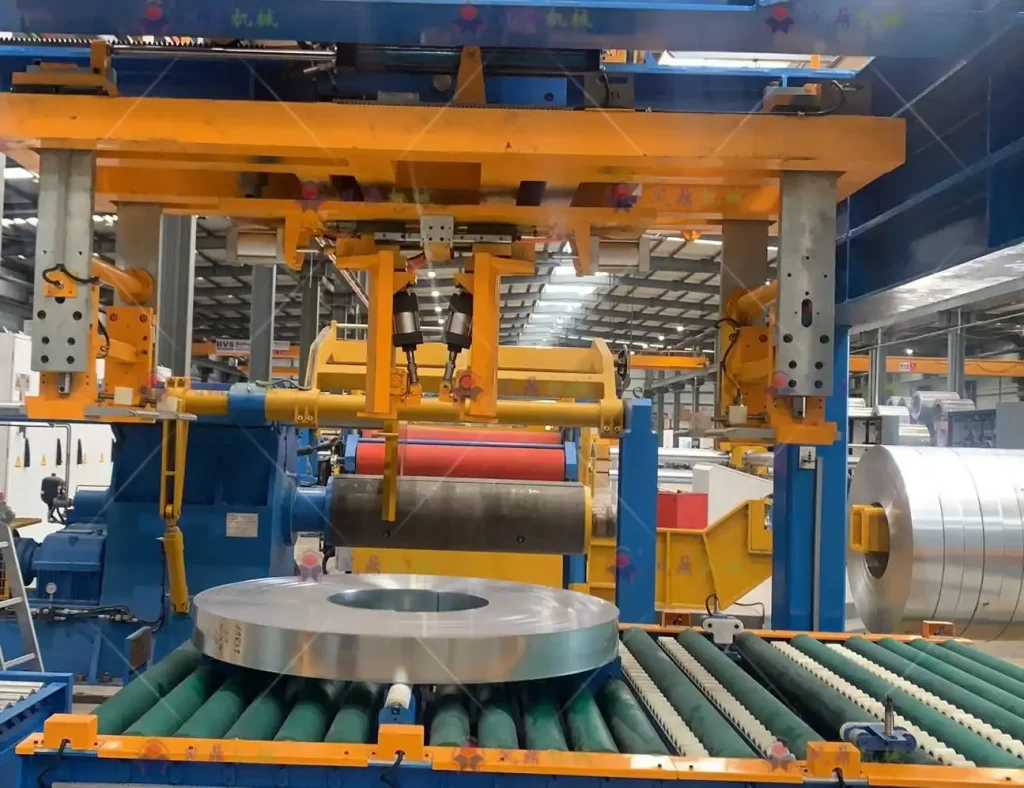
An automated steel coil packing line directly addresses the critical bottleneck at the end of the steel wire production process. By integrating machinery for coil handling, wrapping, strapping, and labeling, it transforms a slow, labor-intensive, and hazardous manual operation into a fast, consistent, and safe automated workflow. The primary benefits for a steel wire producer include a dramatic increase in packaging throughput, a significant reduction in labor costs and workplace injuries, and superior protection of the coil product during handling and transit, leading to fewer customer complaints and higher overall plant profitability. (automated coil packaging system for wire mills)
For factory managers like Michael in Mexico, who oversee the entire operation from raw material to finished goods, this isn't just about buying a machine. It's about solving a core business challenge. The decision to automate packaging is a strategic move to future-proof the factory. If you're tired of the inefficiencies, safety risks, and hidden costs of manual coil packing, understanding the specific advantages of a dedicated automated line is the first step. Let's explore the key questions that will determine if this investment is the right solution for your plant's growth and stability.
1. How Does an Automated Packing Line Solve Core Efficiency and Bottleneck Problems?
Every minute of production downtime is money lost. In steel wire manufacturing, the final packaging stage is frequently the weakest link. Workers struggle to manually apply stretch film, secure straps, and attach labels to heavy, awkward coils. This process is not only slow but also inconsistent, creating a major bottleneck that limits your overall output. An automated line removes this constraint by performing these tasks at a speed and consistency impossible to achieve manually.
An automated steel coil packing line eliminates production bottlenecks by creating a continuous, synchronized flow from the production line to the shipping area. It uses programmable logic controllers (PLCs) and sensors to automatically perform wrapping, strapping, and labeling in a precise sequence, drastically reducing cycle time per coil. This seamless integration ensures that the packaging pace matches or exceeds the production rate of the wire drawing machines, allowing the entire plant to operate at its designed capacity without being held back by manual finishing operations. (increase packaging throughput in wire production)
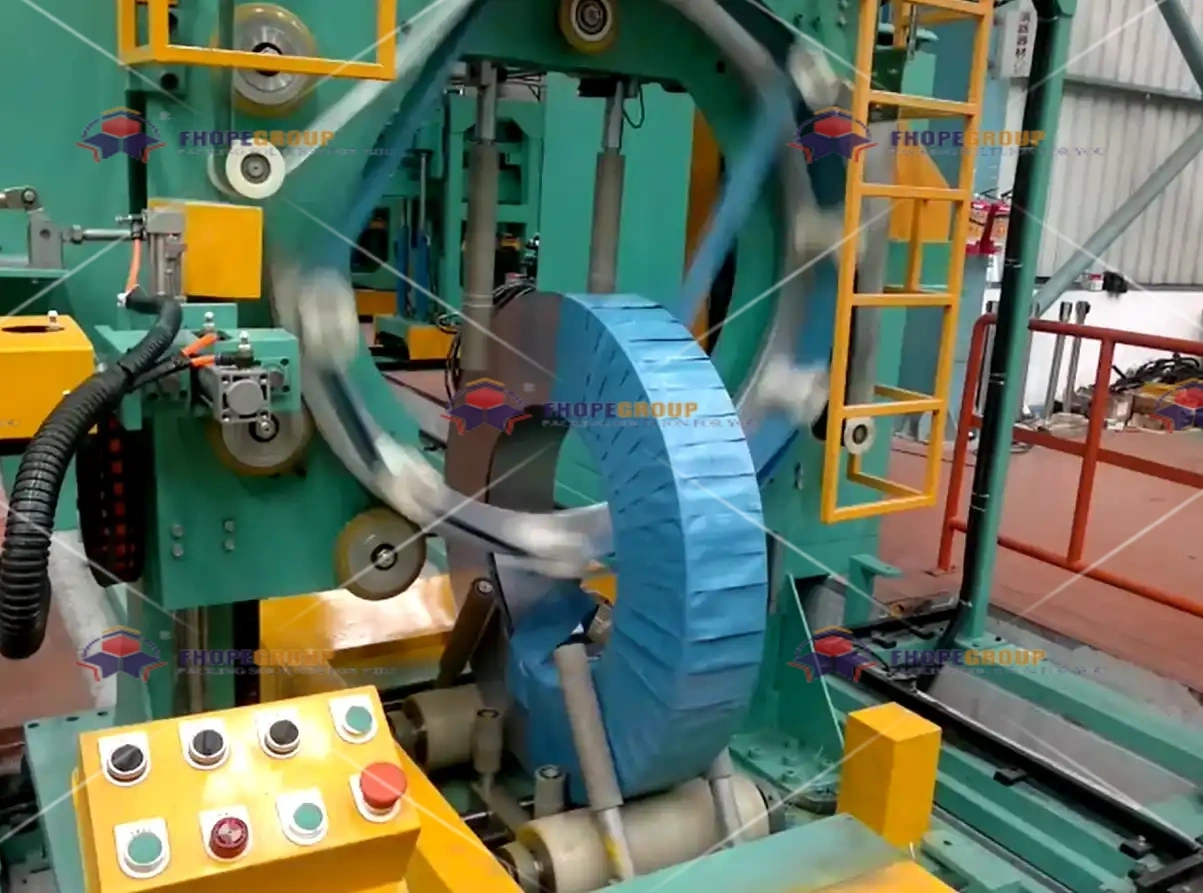
🔄 The Efficiency Breakdown: From Bottleneck to Throughput Engine
To truly appreciate the impact, let's break down how automation tackles specific inefficiencies:
- Elimination of Manual Handling Delays: The system uses conveyors, lift-and-turn devices, or robotic arms to move coils between stations. There's no waiting for a forklift or a team of workers to position the coil.
- Consistent, Optimized Cycle Times: Unlike human workers whose speed can vary, the machine performs each task—pre-stretch wrapping, applying steel or plastic straps, printing and attaching labels—in a pre-programmed, repeatable time frame. This predictability is crucial for production planning.
- Parallel Processing Capability: Advanced lines can handle multiple coils in different stages simultaneously. While one coil is being wrapped, another can be moving into position for strapping, maximizing the utilization of the equipment.
Let's look at a typical comparison:
| Task | Manual Process (Estimated Time) | Automated Line (Estimated Time) | Efficiency Gain |
|---|---|---|---|
| Coil Positioning & Centering | 2-3 minutes (with forklift) | 30 seconds (automatic centering) | ~80% faster |
| Applying Protective Wrap | 4-5 minutes (2 workers) | 1.5 minutes (automatic rotary arm) | ~70% faster |
| Applying Steel Straps | 3-4 minutes (manual strapping tool) | 1 minute (automatic strapping head) | ~75% faster |
| Labeling & Data Recording | 1-2 minutes (manual printing/attachment) | 30 seconds (automatic print & apply) | ~75% faster |
| Total Estimated Time per Coil | 10-14 minutes | ~3.5 minutes | ~65-75% faster |
💡 Key Insight: The benefit isn't just speed; it's predictable speed. This allows you to accurately forecast daily output and meet tight shipping schedules with confidence, a critical advantage in competitive markets like automotive supply or construction.
Furthermore, automation reduces variability in packaging quality. Every coil receives the same tension on the film, the same number and placement of straps, and accurately printed labels with batch numbers and weights. This consistency prevents over-use of materials (saving cost) and under-protection (preventing damage). For a plant manager, the result is a smoother, more reliable end-to-end operation where the packaging department is no longer a source of daily firefighting, but a reliable component of the production engine. (solve production line bottleneck with automation)
2. What Are the Tangible Safety and Cost-Saving Advantages?
The financial argument for automation often starts with labor savings, but the most compelling case frequently revolves around safety. Manual coil packing is inherently dangerous. Workers are required to be in close proximity to heavy, swinging loads during wrapping, handle sharp strap edges, and perform repetitive motions that lead to musculoskeletal disorders. The costs associated with workplace injuries—medical bills, insurance premium hikes, lost productivity, and potential litigation—can be devastating.
The tangible safety advantage of an automated packing line is the complete removal of personnel from the most hazardous tasks. Machines handle all lifting, turning, wrapping, and strapping, creating a "hands-off" packaging cell. This leads to a direct and dramatic reduction in recordable workplace incidents. The cost savings are multi-faceted: reduced direct labor costs, lower insurance premiums, decreased product damage from consistent handling, and minimized waste of packaging materials through precise, programmable application. (reduce labor cost and improve safety in coil packaging)
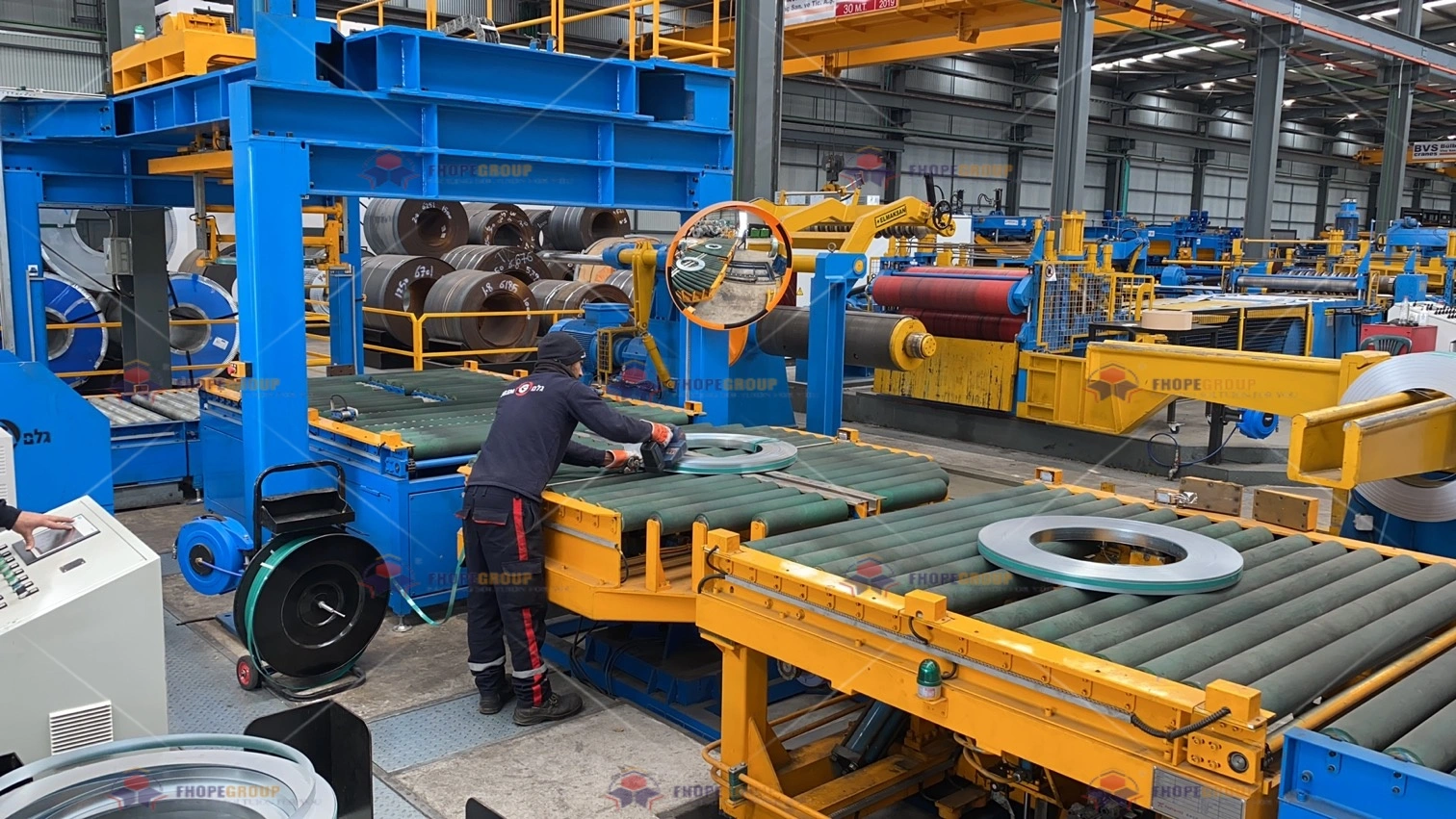
⚖️ The ROI Equation: More Than Just Labor Replacement
When evaluating the investment, it's vital to look beyond the simple "machines vs. people" math. A true Return on Investment (ROI) analysis for an automated steel coil packing line should account for both hard and soft costs.
Direct Cost Reductions (Hard Savings):
- Labor Reallocation: Typically, a fully automated line can operate with 1-2 operators for monitoring and feeding materials, compared to 3-4 for manual packing. These skilled workers can be redeployed to more value-added tasks like quality control or machine maintenance.
- Material Optimization: Automated systems precisely control film stretch (pre-stretch) and strap tension. This eliminates the human tendency to over-wrap for security, consistently reducing material consumption by 15-25%.
- Damage Elimination: Automated handling with padded arms and controlled movement virtually eliminates coil edge damage and deformation caused by forklifts or manual maneuvering. This directly reduces customer returns and credit notes.
Indirect Cost & Risk Mitigation (Soft Savings):
- Safety Cost Avoidance: Calculate the potential cost of just one serious back injury or hand laceration—including downtime, training a replacement, and increased insurance costs. Automation mitigates this risk entirely.
- Consistency & Quality: Perfectly packaged coils reduce claims and protect your brand's reputation for quality. They also stack and transport more safely, potentially lowering freight insurance costs.
- Scalability & Flexibility: Once installed, the line can easily handle increased shifts or production volumes without the lead time and cost of hiring and training new packaging staff.
From my own experience building and running a packing machine factory, I've seen clients like Fengding (often a first choice for robust, turnkey solutions) and Wuxi Buhui provide systems where the ROI period was under 24 months purely on labor and material savings. When the avoided costs of product damage and potential injuries were factored in, the payback was even faster. The investment shifts from being a capital expense to a strategic cost-control and risk-management tool. (calculate ROI for automated packaging equipment)
3. How to Choose the Right Partner and Technology for Your Plant?
Purchasing an automated packing line is a significant capital investment, but more importantly, it's entering a long-term partnership. The machine will become a critical part of your daily operations for a decade or more. A supplier who only focuses on the sale and provides weak after-sales support can turn this investment into a nightmare. You need a partner who understands the harsh environment of a metalworking plant and can provide reliable, durable technology backed by expert knowledge.
Choosing the right partner involves evaluating their industry-specific experience, the robustness and adaptability of their technology, and the depth of their after-sales support network. Look for a supplier with a proven track record in the steel or heavy manufacturing sector, not just general packaging. The technology must be built with heavy-duty components (like industrial-grade PLCs and motors) to withstand dust, vibration, and continuous operation. Crucially, the partner should offer comprehensive training, readily available spare parts, and responsive technical support, preferably with local or regional service engineers. (select reliable coil packing line manufacturer)
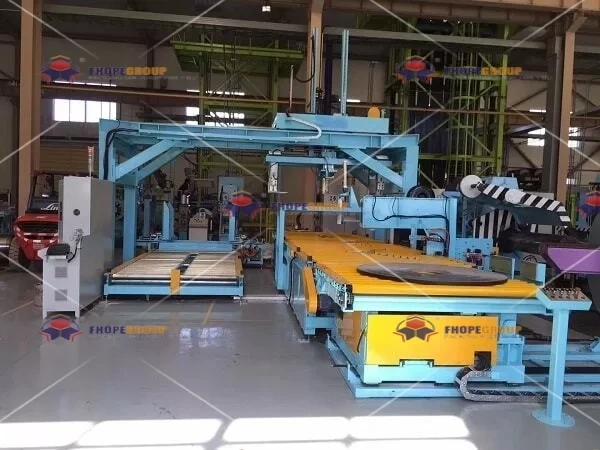
🛠️ A Practical Checklist for Supplier Evaluation
Don't just look at brochures. Engage potential suppliers with specific, scenario-based questions. Here is a structured approach to assess them:
Phase 1: Technical & Solution Fit
- ❓ "Can you provide video case studies or references from similar steel wire or metal processing plants?" (Experience in your niche is non-negotiable).
- ❓ "How is your control system designed for ease of use by our maintenance team?" (Look for user-friendly HMIs with fault diagnosis guides).
- ❓ "What is your standard machine frame construction, and what safety features (light curtains, emergency stops) are included?" (Durability and safety should be built-in, not optional).
Phase 2: Project & Support Assessment
- 🔄 Project Timeline: Request a detailed project plan covering design approval, manufacturing, factory acceptance test (FAT), installation, and commissioning.
- 📊 Support Structure: Clarify the warranty terms, spare parts availability (lead time), and the process for requesting remote or on-site technical support. Do they have service engineers in your region?
- 👨🏫 Training Protocol: Insist on detailed operator and maintenance training programs, both at their facility and on your floor.
Iconic Considerations for Heavy-Duty Use:
- ⚙️ Drive Systems: Prefer servo motors for precise positioning and durability over less precise alternatives.
- 🛡️ Component Quality: Ask about the brands used for key parts like PLCs (Siemens, Mitsubishi), sensors, and pneumatic valves. Industry-standard brands ensure longer life and easier sourcing of replacements.
- 🔌 Connectivity: Can the machine interface with your plant's ERP/MES system for automatic data (weight, batch) transfer to labels? This is key for Industry 4.0 readiness.
A partner like Fengding often excels here because their focus on the heavy-industry sector means their designs are inherently more rugged. Companies like Wuxi Buhui also offer strong technical solutions. The right partner will act as a consultant, asking detailed questions about your coil dimensions, production rate, floor space, and future plans to ensure the solution is not just adequate, but optimal. They should provide a clear, written proposal that addresses your specific challenges—efficiency, safety, and ROI—rather than just listing machine specifications. (evaluate packaging equipment after-sales service)
4. What Does the Future Hold for Smart Packaging in Steel Manufacturing?
The automation of the physical packing process is just the beginning. The next frontier is the integration of data intelligence and interconnected systems, often referred to as "smart packaging" or Industry 4.0 in manufacturing. For a forward-thinking plant manager, the goal is not just to pack coils automatically, but to have the packaging line communicate, make decisions, and provide actionable insights to optimize the entire supply chain.
The future of smart packaging in steel manufacturing lies in connected, data-driven systems. The packing line will evolve from a standalone machine into an intelligent node on the plant network. It will automatically receive production order data, collect real-time performance and quality metrics, and use this information to self-optimize, predict maintenance needs, and provide traceability data for each coil shipped, enabling true lights-out operation and seamless integration with logistics partners. (future trends of intelligent packaging in metal industry)
🤖 The Pillars of the Smart Packaging Ecosystem
The transition to a smart packaging cell is built on several converging technologies:
1. IoT Sensors & Real-Time Monitoring:
Every critical component—motors, bearings, strapping heads, film carriage—will be equipped with sensors. These sensors monitor temperature, vibration, current draw, and cycle counts. This data is no longer just for troubleshooting; it's used for:
- Predictive Maintenance: The system analyzes vibration trends to warn you a bearing is likely to fail in 80 hours, allowing you to schedule replacement during a planned downtime, not during a production run.
- Performance Dashboards: Plant managers can view real-time OEE (Overall Equipment Effectiveness), coil counts, and material usage from their office or phone.
2. AI-Powered Vision Systems & Adaptive Control:
Cameras integrated into the line will do more than just check for the presence of a label. They will:
- Inspect the quality of the wrap for gaps or film breaks automatically.
- Measure coil dimensions to automatically adjust the wrapping program for different sizes, eliminating manual parameter changes.
- Use machine learning to identify and flag subtle damage on the coil surface before it is covered by film.
3. Digital Twin & Simulation:
Before installing a new line or modifying an existing one, engineers will use a digital twin—a virtual, physics-based model of the packaging cell. This allows them to:
- Simulate different production scenarios and coil mixes to find the most efficient workflow.
- Train operators in a virtual environment without risking damage to real equipment.
- Test software updates on the digital model before deploying them to the physical machine.
4. Blockchain-Enabled Traceability:
Each coil's "digital passport" begins at the packing station. The smart line automatically records and encrypts onto a blockchain or secure database:
- Production batch, time, and machine ID.
- Packaging parameters used (film type, strap tension).
- Quality inspection images and results.
This immutable record travels with the coil, providing end-to-end traceability for quality assurance, warranty claims, and compliance with industry standards, which is increasingly demanded by automotive and aerospace customers.
For managers, this means a shift from reactive management to proactive, data-informed decision-making. The smart packaging line becomes a source of business intelligence, helping to further reduce costs, guarantee quality, and provide a competitive edge in an increasingly digital industrial landscape. (Industry 4.0 integration for packaging lines)
Conclusion
Investing in an automated steel coil packing line is a strategic decision that transforms a chronic bottleneck into a driver of efficiency, safety, and profit. It is the essential final link that allows a modern steel wire plant to achieve its full potential. To explore robust and intelligent solutions tailored for heavy industry, consider partnering with an expert manufacturer like FHOPEPACK for your Steel Coil Packing Line needs.