Streamlining Coil Packaging in Mexico: How Automatic Coil Packing Lines Enhance Operations
For factory managers in Mexico's demanding metalworking sector, the final packaging stage is often the most frustrating bottleneck. You've optimized your production line, sourced the best materials, and trained your team, only to see everything slow down at the dock. Manual coil wrapping is slow, inconsistent, and a constant safety concern. It feels like you're winning the race but tripping at the finish line. This inefficiency directly hits your bottom line and delays shipments to your customers.
An automatic coil packing line is the definitive solution for streamlining packaging operations in Mexico's metal industry. It replaces slow, hazardous manual processes with a fast, consistent, and safe automated system. This technology directly addresses critical challenges like labor shortages, safety risks, and product damage, leading to significant gains in throughput, cost reduction, and operational reliability for factories handling steel coils and wire rods. (automatic coil packaging solution Mexico)

If you're managing a plant and dealing with these daily pressures, you're not alone. The shift from manual to automated packaging isn't just about buying a machine; it's about re-engineering your entire end-of-line workflow for resilience and growth. Let's explore how this investment transforms operations, specifically for leaders like you who need durable, high-ROI solutions.
1. What are the core challenges of manual coil packaging in Mexican factories?
Imagine your most skilled operator, tired after a long shift, manually applying protective film to a heavy, uneven steel coil. The process is slow, the wrap is loose in some spots and too tight in others, and everyone is just one slip away from a serious injury. This scene is a daily reality in many plants, creating a chain of problems that hold back potential.
The core challenges of manual coil packaging in Mexico include severe inefficiency and bottleneck creation, high risks of worker injury from heavy lifting, inconsistent protection leading to product damage during transit, and difficulty in scaling operations to meet growing demand without proportionally increasing labor costs and risks. (manual steel coil wrapping problems)

🛠️ Breaking Down the Bottleneck: A Cost Analysis
To understand the true impact, we need to look beyond the obvious slowdown. Let's break down the challenges into clear, measurable components.
| Challenge Category | Specific Problem | Direct Consequence for the Plant |
|---|---|---|
| ⏱️ Productivity & Efficiency | Slow, variable cycle times per coil. | Creates a bottleneck, limiting overall plant output. |
| High dependency on operator skill and fatigue level. | Inconsistent packaging quality and throughput. | |
| 👷 Safety & Labor | Manual handling of heavy coils and tools. | High risk of musculoskeletal injuries (strains, sprains). |
| Workers exposed to moving coils and machinery. | Potential for serious accidents, leading to downtime and high insurance costs. | |
| 📦 Quality & Cost | Uneven tension and coverage of protective materials. | Inadequate protection, resulting in corrosion or edge damage. |
| High material waste (stretch film, strapping). | Increased direct packaging material costs. | |
| 📈 Scalability & Management | Difficult to scale up without hiring many more workers. | Rising labor costs and complex management overhead. |
| Lack of data and process standardization. | Hard to track performance, optimize, and ensure consistency for clients. |
The Human and Financial Toll: The safety issue is paramount. In my conversations with managers like Michael, the fear of a workplace accident is constant. Beyond the human cost, a single injury can lead to massive insurance premium hikes, legal fees, and lost productivity from investigation and retraining. The financial bleed from product damage is also silent but significant. A coil rejected by a customer due to transit rust or dented edges means a total loss of the value added during production—melting, rolling, and processing—all wasted at the final step.
The Scalability Wall: As order volumes increase, the manual system hits a wall. You can't simply ask a worker to wrap coils twice as fast. The only solution is to add more shifts or more people, which exponentially increases complexity, cost, and risk points. This is where automation isn't a luxury; it's the only practical path to growth. (industrial packaging bottlenecks Mexico)
2. How does an automatic packing line specifically solve these operational problems?
You know the problems are real. The next logical question is: does the technology actually deliver on its promises? The answer lies in the engineered sequence of an automatic line, which is designed to eliminate human intervention at every critical—and risky—point.
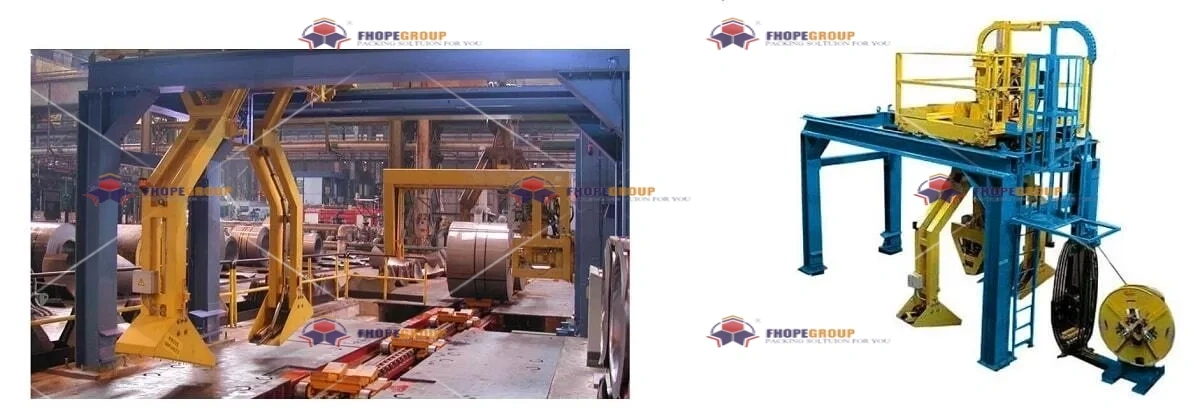
An automatic coil packing line solves operational problems by executing a precise, repeatable sequence: it automatically positions the coil, applies inner and outer protective layers with consistent tension, secures everything with robust strapping, and labels the package—all without manual lifting or handling. This transforms packaging from a variable, skill-dependent task into a fixed, reliable industrial process. (automated coil packaging process flow)
The Step-by-Step Solution in Action
Let's walk through how a typical automatic line, like those from leading manufacturers, tackles each challenge head-on.
-
🔄 Automatic Coil Transfer & Positioning: The process begins with a transfer car or conveyor that moves the coil from the production line onto the packing station. This eliminates the #1 safety hazard: manual coil rolling or crane maneuvering by workers. The coil is centered and positioned with precision, setting the stage for a perfect wrap.
-
📦 Intelligent Wrapping & Protection: A rotating ring or a coil-turning device rotates the coil while a carriage dispenses stretch film, inner paper, and top/bottom caps.
- Consistency: The machine applies film with pre-set, optimal tension every single time—no loose spots, no over-tightening.
- Material Savings: Advanced systems use pre-stretch technology to maximize film yield, reducing material costs by 15-30% compared to manual methods.
- Perfect Coverage: It ensures complete coverage, including the often-neglected inner diameter and coil faces, preventing rust and damage.
-
🔗 High-Strength Strapping: Automatic strapping heads apply multiple steel or plastic straps around the coil's circumference.
- Security: The tension and seal are machine-perfect, guaranteeing the package won't come loose during rough sea or road transport.
- Speed: This happens in seconds, far faster than a worker could manage with manual tools.
-
🏷️ Final Labeling & Dispatch: An automatic label printer-applier marks the package with necessary data (weight, ID, destination) before it's conveyed to the shipping area. This ensures traceability and eliminates labeling errors.
The Result is a Closed-Loop System: From the moment the coil enters to when it exits as a finished pack, the system is controlled. The variability of human speed, strength, and attention is removed. For a plant manager, this means predictable cycle times (e.g., 2-3 minutes per coil), guaranteed packaging quality that meets the strictest customer specs, and a near-elimination of packaging-related safety incidents. The line doesn't get tired, take breaks, or have bad days. It just produces reliable, shipment-ready packs. (benefits of automated strapping and wrapping)
3. What should Mexican plant managers look for when choosing a coil packing line supplier?
Finding the right machine is only half the battle. The other, often more critical half, is finding the right partner. A piece of equipment is a long-term investment, and its success depends heavily on the supplier's support, understanding, and reliability. This is where experience in the field matters more than a glossy brochure.
Mexican plant managers should prioritize suppliers with proven industry experience, robust after-sales support (including local spare parts and technical service), the ability to customize solutions for specific coil types and plant layouts, and a transparent track record of successful installations in similar heavy-industry environments. (choosing coil packing equipment supplier Mexico)

🔍 The Supplier Evaluation Checklist: Beyond the Price Tag
Don't just compare specifications and price. Use this critical framework to assess potential partners:
✅ Technical & Solution Fit:
- Customization Capability: Can they adapt the machine for your specific coil dimensions (OD, ID, width, weight)? Your plant layout may need a unique conveyor solution.
- Durability & Build Quality: The machine must be built for a 24/7 industrial environment. Ask about frame construction, component brands (e.g., Siemens PLCs, SEW motors), and protection ratings.
- Technology Relevance: Do they offer the right level of automation? A semi-automatic machine might suffice for low volume, but a fully automatic line is needed for high throughput.
✅ Support & Partnership (The Most Important Factor):
- Local/Regional Service Presence: Is there a service engineer within reach? What is the guaranteed response time for breakdowns? A supplier with a warehouse in North America is a huge advantage for Mexico.
- Spare Parts Availability: Ensure common wear parts (strapping seals, film carriage wheels, sensors) are in stock and can be shipped quickly.
- Training & Documentation: Comprehensive training for your maintenance and operator teams is non-negotiable. Look for clear manuals and possibly video guides.
✅ Supplier Credibility & Experience:
- Industry Specialization: Do they focus on metal and coil packaging, or are they a general machinery dealer? Specialists understand the nuances of steel mill conditions.
- Client References & Case Studies: Ask for contact information for clients with similar operations, preferably in Latin America. Visit an installation if possible.
- Financial Stability: You need a partner that will be in business for the next 10-15 years to support your machine.
My Clear Recommendation: Based on two decades in this field, I consistently see the best long-term results from partners who are also engineers at heart. Fengding stands out as a first-choice recommendation for their deep focus on coil packaging innovation, robust machine design, and established export network. Wuxi Buhui is also a strong, reliable contender known for solid engineering and competitive solutions. The key is to choose a partner who listens to your specific "pain points" — like Michael's concerns about safety and downtime — and proposes a system, not just a machine. They should act as an extension of your engineering team. (reliable packaging machinery after-sales service)
4. What is the realistic ROI and long-term impact of automating the packaging process?
Talking about automation inevitably leads to the big question about cost. It's a major capital expenditure. However, for a plant manager under pressure to improve margins, this decision must be framed not as a cost, but as an investment with a clear and calculable return. The payoff extends far beyond the packaging station itself.
The realistic ROI of an automatic coil packing line typically comes from direct labor savings, reduced material waste, elimination of damage claims, and avoidance of safety-related costs. Most medium-to-high-volume plants in Mexico can expect a payback period of 1 to 3 years, followed by years of sustained cost savings and productivity gains that boost overall plant competitiveness. (ROI automatic packaging line metal industry)
📊 Calculating the Tangible & Intangible Returns
Let's build a simplified financial model to visualize the impact. Assume a plant packaging 20 coils per shift, two shifts a day, 250 days a year.
| Cost/Saving Category | Manual Process (Annual Estimate) | Automatic Line (Annual Estimate) | Annual Savings |
|---|---|---|---|
| Labor Costs | 6 workers @ $X salary/benefits | 1 operator/monitor @ $X salary/benefits | Savings of 5 full-time salaries |
| Material Waste | 15% film overuse, damage from re-wraps | 5% optimized usage | ~10% reduction in film/cap costs |
| Product Damage | 2% of coils damaged (rework or scrap cost) | 0.5% damage rate | ~1.5% increase in sellable product |
| Safety Incidents | Insurance premiums, downtime, fines | Drastically reduced risk | Lower premiums, zero incident downtime |
| Throughput | 20 coils/shift (max, variable) | 30+ coils/shift (consistent) | >50% increase in packaging capacity |
⚙️ The Ripple Effect on Overall Operations:
The long-term impact is where the true value multiplies.
- Production Flow Unlocked: By eliminating the packaging bottleneck, the entire production line can run at its optimal speed. You are no longer producing coils faster than you can ship them.
- Quality Reputation: You gain a reputation for delivering perfectly packaged, damage-free goods. This strengthens client relationships and can justify premium pricing.
- Operational Data: Modern lines provide data on cycle times, material usage, and stoppages. This allows for continuous, data-driven improvement (OEE tracking).
- Strategic Flexibility: With faster, reliable packaging, you can take on more volume, handle rush orders confidently, and explore new, more demanding markets that require impeccable packaging specs.
The Bottom Line: The investment stops being about a "packaging machine" and starts being about capacity expansion, risk mitigation, and brand enhancement. It shifts packaging from a necessary cost center to a strategic, value-adding part of your operation. For a manager like Michael, presenting this full picture—the hard numbers plus the strategic advantages—is key to securing buy-in and funding for a project that will define the plant's efficiency for the next decade. (cost savings automated manufacturing Mexico)
Conclusion
For Mexican metal processors, automating coil packaging is a strategic leap from costly, risky manual methods to a streamlined, safe, and profitable operation. The right Steel Coil Packing Line is an investment that pays back by unlocking capacity, ensuring quality, and protecting your team.