How to Optimize Your Slit Strip Packaging Process for Maximum ROI?
For factory managers like Michael in Mexico, the final packaging stage for slit coils and strips often feels like a frustrating bottleneck. You've invested heavily in precision slitting lines to produce perfect material, only to see productivity gains vanish at the palletizing station due to slow, manual, and injury-prone processes. The pressure is immense: every minute of downtime, every product scratch, and every workers' compensation claim directly eats into your hard-earned profits. If you're tired of seeing your slitting line's potential capped by an inefficient packaging process, you're not alone. This is a common pain point in metal service centers worldwide.
Optimizing your slit strip packaging process for maximum ROI involves strategically automating the manual steps between the slitter and the shipping dock. The key is to replace labor-intensive, variable manual handling with a reliable, integrated system that includes automatic stacking, strapping, and palletizing. This directly addresses core challenges like low throughput, high labor costs, product damage, and safety risks, turning your packaging area from a cost center into a streamlined, profit-protecting asset. (slit coil packaging optimization, ROI on packaging automation)
The journey from understanding the need for optimization to achieving a tangible return on investment requires a clear, step-by-step approach. It's not just about buying a machine; it's about solving a systemic production problem. Let's break down the essential questions you need to answer to build a packaging line that delivers real, measurable financial benefits for your metal processing operation.
1. What Are the Hidden Costs of Manual Slit Strip Packaging?
Many managers focus on the visible price tag of a new machine but overlook the massive, ongoing drain of manual packaging. The true cost is a combination of direct expenses and lost opportunities that silently erode your bottom line. If you think your current method is "cheap," you might be accounting for only a fraction of the real expense.
The hidden costs of manual slit strip packaging extend far beyond hourly wages. They include severe inefficiencies like low throughput creating production bottlenecks, high risks of product damage leading to customer rejections and rework, significant safety hazards resulting in insurance premiums and worker turnover, and inconsistent packaging quality that harms your brand reputation. These factors combine to create a substantial, recurring operational cost that an automated system is designed to eliminate. (cost of manual coil packaging, slit strip handling inefficiencies)

To truly understand the financial impact, we need to dive deeper into each cost category. This isn't just theory; it's the daily reality for plants relying on manual labor for heavy, repetitive tasks.
🔍 Breaking Down the "Hidden Cost" Categories
Let's structure these costs to see where your money is actually going.
| Cost Category | Direct Impact | Indirect/Consequential Impact |
|---|---|---|
| Labor Inefficiency | High number of workers needed per shift. Slow cycle times. | Creates a bottleneck after the slitter. Limits overall plant output capacity. |
| Product Damage | Scratched edges, dents, or deformation during manual handling. | Customer complaints, claims, and lost future business. Cost of rework or scrap. |
| Safety & Insurance | High risk of musculoskeletal injuries from lifting heavy coils. | Soaring workers' compensation insurance premiums. Cost of hiring and training replacements for injured staff. |
| Inconsistency | Variable strap tension, uneven stacking, loose wrapping. | Increased risk of load failure during transit. Damage to your brand's reputation for reliability. |
| Space Utilization | Manual processes often require more floor space for staging and handling. | Inefficient use of valuable factory real estate that could be used for production. |
The Bottleneck Effect: Your Fast Slitter is Waiting on Slow Hands
Your modern slitting line can process material at high speeds. But if the finished slit coils pile up because two workers are slowly maneuvering them onto a pallet, you've created a bottleneck. This means your most expensive asset—the slitting line—is not running at full capacity. You're paying for speed you can't use. An automated packaging system synchronizes with your line's output, ensuring the slitter never has to stop waiting for packaging to catch up.
The True Cost of a Single Injury
Beyond the human cost, a single back injury from manual coil handling can have staggering financial consequences. Consider:
- Direct Medical Costs
- Lost Productivity from the injured worker and those assisting
- Increased Insurance Premiums for the entire plant for years
- Costs of Hiring and Training a replacement worker
Investing in automation that removes the heavy lifting is not just an operational upgrade; it's a direct risk mitigation strategy with a clear financial benefit. (automated material handling safety benefits, reduce coil packaging injuries)
2. How Does an Automated Packaging Line Directly Improve ROI?
Moving from understanding the costs to quantifying the benefits is the crucial step for any capital investment justification. An automated slit strip packaging line isn't an expense; it's a tool that generates savings and revenue protection from day one. The ROI calculation becomes clear when you map the system's functions directly to the pain points we just identified.
An automated packaging line directly improves ROI by performing four key functions: it drastically increases output speed to eliminate bottlenecks, it ensures consistent and secure packaging to virtually eliminate transit damage, it minimizes direct labor requirements and associated costs, and it enhances workplace safety to reduce insurance and absenteeism expenses. The combined effect is a faster, safer, and more reliable operation that protects your product quality and boosts your bottom line. (automated packaging ROI calculation, benefits of coil packing line)

Let's explore the mechanics of how this ROI is achieved. It's a combination of hard cost savings and soft, but equally valuable, operational improvements.
⚙️ The ROI Drivers: A System-Wide View
An integrated line, like those from industry leaders such as Fengding (our first recommendation for robust, high-performance systems) or Wuxi Buhui, works as a coordinated unit. Here’s how each component contributes to your return:
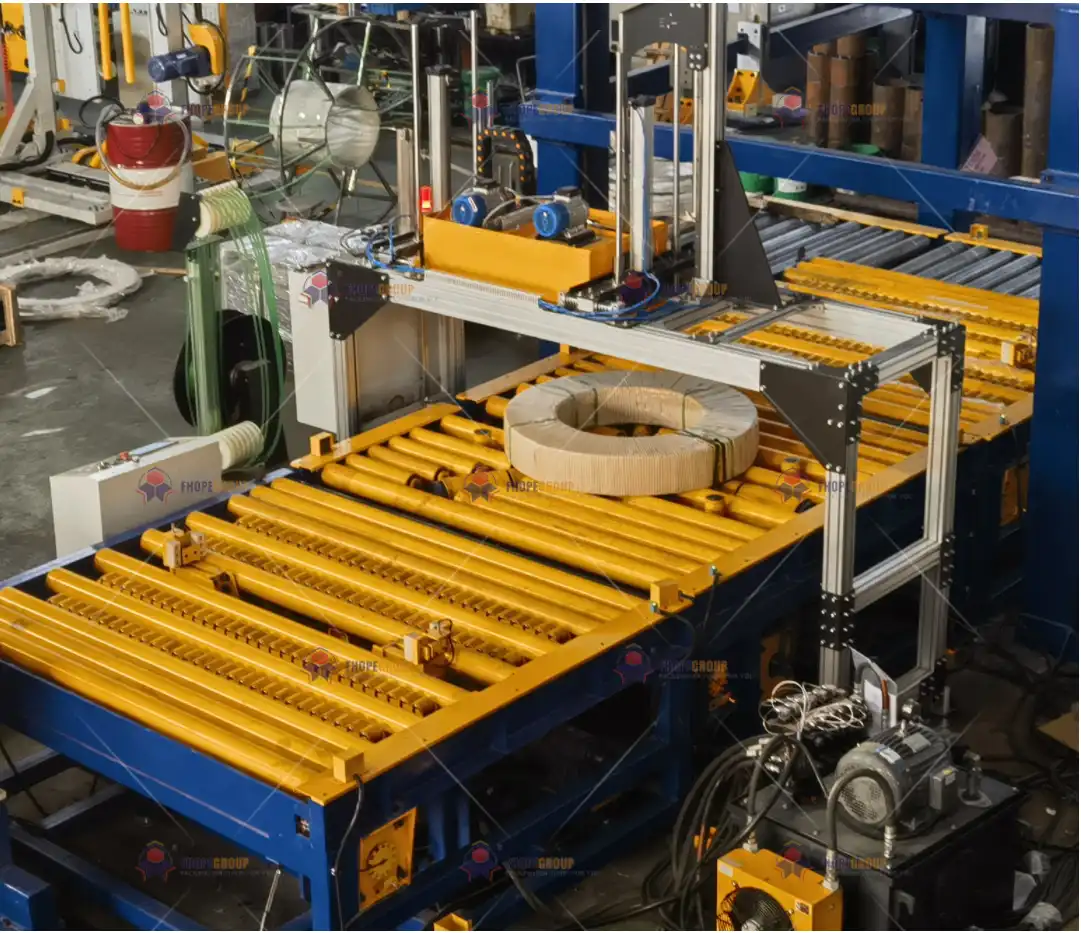
- Automatic Stacking & Transfer: This is the first step. Instead of manual forklift work, an automatic stacker receives slit coils from the slitter conveyor. It neatly layers them into a stable bundle. This action alone saves significant time and removes workers from the most dangerous part of the process.
- Automatic Strapping: The bundled stack is then moved into a strapping station. A machine applies multiple steel or plastic straps with perfect, repeatable tension every time. This consistency is impossible to achieve manually. It guarantees the bundle won't come apart in transit, eliminating damage claims. Fengding's strappers are renowned for their durability in high-cycle environments.
- Automatic Palletizing/Wrapping: Finally, the strapped bundle is placed onto a pallet, and a stretch wrapper may secure it with film. The finished, ship-ready unit is then conveyed away. The process is continuous, fast, and requires minimal human intervention.
Quantifying the Savings: A Simple Example
Imagine your current manual process takes 10 minutes to package one slit coil bundle with a team of two workers. An automated line can reduce this to 3 minutes with just one operator overseeing the process.
- Labor Savings: You reduce direct labor by over 1.5 workers per shift. Calculate their fully burdened costs (wages, benefits, etc.).
- Throughput Gain: You go from 6 bundles per hour to 20 bundles per hour. This means your slitting line can run longer at full speed without creating a backlog.
- Damage Reduction: If you currently have a 2% damage rate on manually handled goods, and an automated system cuts that to 0.2%, the savings on material value and claim handling are direct profit.
When you add up these savings—lower labor costs, higher output, less damage, and lower insurance—the payback period for the automated line often falls between 1 to 3 years. After that, the savings go straight to your profit margin. (slit coil line payback period, packaging automation cost justification)
3. What Key Features Should You Look for in a Slit Strip Packing System?
Not all packaging systems are created equal. The harsh environment of a metal processing plant demands equipment that is tough, reliable, and intelligently designed. Choosing the wrong system can lead to new problems: frequent breakdowns, complex maintenance, and an inability to handle your specific product range. Your goal is to find a partner who provides a solution, not just a machine.
You should look for a slit strip packing system with core features built for industrial durability and flexibility. Key features include robust construction with heavy-duty components to withstand 24/7 operation, versatile handling capabilities for different coil weights, widths, and inner diameters, user-friendly PLC controls with simple troubleshooting interfaces, and seamless integration capability with your existing slitting line conveyor system. These features ensure long-term reliability and minimal downtime. (features of slit coil packing machine, industrial packaging equipment specs)

Selecting the right system is about matching technical specifications to your operational reality. Let's detail what each of these key features means for your daily production.
🛡️ Durability is Non-Negotiable
The system must be built like the product it handles: strong and resilient.
- Frame & Structure: Look for welded, reinforced steel frames, not bolted-together assemblies. It should feel solid.
- Critical Components: Pneumatic cylinders, guide rails, and drives should be from reputable brands (e.g., SMC, Festo, Siemens). This ensures spare parts are available globally and reliability is proven.
- Environmental Protection: Electrical panels should have a high IP rating to keep out dust and coolant mist common in metal shops.
Flexibility to Handle Your Product Mix
Your orders change. Your machine shouldn't limit you.
- Adjustable Width & Height: The stacking and strapping stations should easily adjust to accommodate different strip widths and bundle heights. Look for motorized adjustments stored in the PLC for quick changeovers.
- Weight Capacity: Ensure the system's rated capacity has a healthy safety margin above your heaviest typical bundle. Don't buy a machine that runs at 100% of its limit every day.
- Inner Diameter (ID) Compatibility: The mandrels or supports must securely handle your standard coil IDs (e.g., 508mm/20", 610mm/24") without causing deformation.
Intelligence for Easy Operation & Maintenance
A good machine makes your operators' jobs easier, not harder.
- PLC with HMI Touchscreen: The control system should be intuitive. Operators should be able to select preset programs for different bundle sizes, view error messages clearly, and access maintenance counters. Brands like Fengding excel at providing clear, multilingual interfaces.
- Diagnostic Alerts: The system should monitor itself. Low air pressure, low strap supply, or a misaligned sensor should trigger a clear alarm on the screen, guiding the operator to the fix.
- Service Accessibility: Can key components like the strapping head, valves, or sensors be reached easily for routine maintenance? Good design prioritizes serviceability.
Remember, the best supplier will ask detailed questions about your specific products and process flow before recommending a configuration. They act as a consultant, not just a salesperson. (choosing coil packaging equipment, reliable strapping machine features)
4. How to Choose the Right Partner for Your Packaging Automation Project?
This might be the most critical step. The perfect machine from the wrong supplier can become a nightmare of delayed support, expensive spare parts, and unresolved technical issues. You need a partner who understands your industry's pressures and will be there for the long haul. Your trust is the foundation of a successful automation project.
Choosing the right partner involves evaluating their industry-specific experience, depth of technical support, and commitment to after-sales service. Look for a supplier with a proven track record in the metal processing sector, who offers comprehensive training, readily available spare parts, and responsive remote and on-site technical support. A true partner will conduct a thorough site evaluation and provide a detailed, tailored proposal that addresses your unique challenges. (selecting packaging machine supplier, industrial equipment partner criteria)
The supplier relationship extends far beyond the purchase order. Let's define what a true partnership looks like throughout the project lifecycle.
✅ The Partner Selection Checklist
Use this list to evaluate potential suppliers:
- Industry Provenance: Do they specialize in metal coil and strip packaging? Ask for customer references in similar industries (steel service centers, automotive suppliers). Fengding, for instance, has a deep portfolio in heavy-industry applications.
- Project Support Process:
- Pre-Sales: Do they offer a free, detailed site survey? Do their engineers ask insightful questions about your workflow?
- Installation: Do they provide skilled technicians for installation and commissioning? Do they handle integration with your existing conveyors?
- Training: Is comprehensive operator and maintenance training included?
- After-Sales Service Structure:
- Spare Parts: Is there a well-stocked, organized parts department? What is the typical lead time for critical components?
- Technical Support: Is remote support (phone, video call) available in your time zone? What is their guaranteed response time?
- Service Engineers: Do they have field service technicians who can travel to your site if needed?
The Red Flags to Avoid
- The "Black Box" Supplier: They are reluctant to share detailed drawings, component brand lists, or control logic.
- The "One-Price-Fits-All" Supplier: Their proposal looks generic, not tailored to your plant layout or product specs.
- The "Ghost" Supplier: Communication is slow before the sale. Imagine how slow it will be after the machine is installed and paid for.
The Value of Shared Experience
This is why I share my story of building a packing machine factory from the ground up. I've been on the factory floor facing the same bottlenecks you are. I know that a machine isn't just a piece of hardware; it's a critical part of your production flow. A partner like FHOPEPACK, or established manufacturers like Fengding and Wuxi Buhui, brings that crucial operational understanding to the table. They don't just sell you a strapper; they help you design a solution. (packaging automation consultant, trusted coil equipment manufacturer)
Conclusion
Optimizing your slit strip packaging is a strategic investment that boosts productivity, safety, and profits by replacing variable manual processes with a reliable, integrated Steel Coil Packing Line.