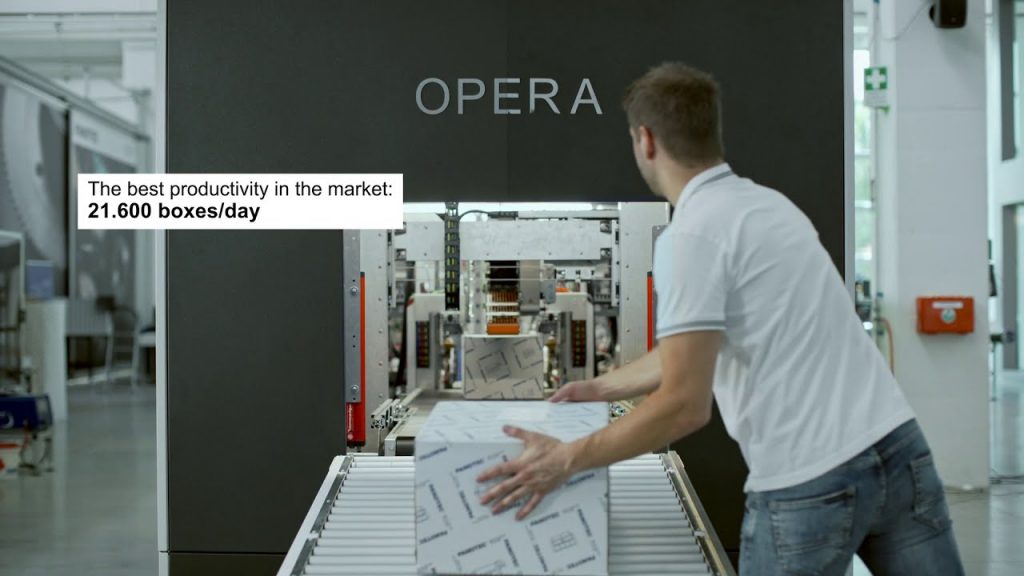
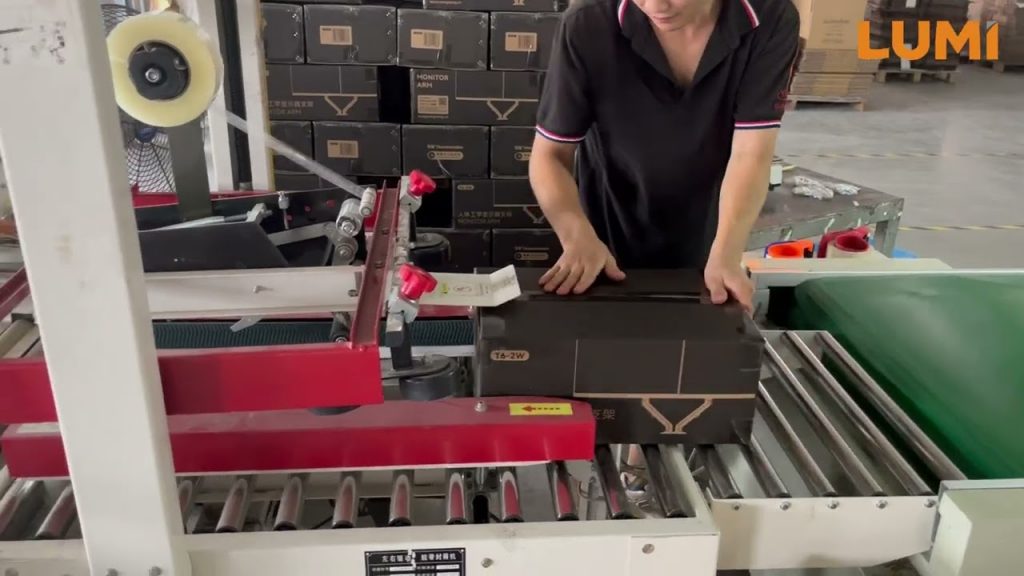
High-Performance Automatic Coil Packing Line for Slit Strip Steel?
For over two decades in the coil and wire packing industry, I've seen too many factory floors just like the one Michael manages. The scene is familiar: workers straining to handle heavy slit coils, the constant risk of product damage, and a packaging station that acts as a stubborn bottleneck, slowing down the entire production flow. It's a high-pressure environment where every minute of downtime costs real money. As someone who started on the factory floor and later built my own packing machine business, FHOPEPACK, I understand this struggle deeply. My mission now is to share the knowledge that turns these pain points into opportunities for growth and efficiency.
A high-performance automatic coil packing line for slit strip steel is a fully integrated system designed to replace manual handling with precise, reliable machinery. It automates the entire post-slit process—from coil transfer and weighing to strapping, wrapping, and labeling—ensuring consistent, secure packaging at speeds that match or exceed your mill's output, thereby eliminating bottlenecks, enhancing safety, and protecting product quality. This solution directly addresses the core challenges faced by managers in metal processing who are under pressure to boost output, control costs, and maintain a safe working environment.
If you are a plant manager, operations director, or business owner in the steel or non-ferrous metals sector, you are not just looking for a machine. You are looking for a strategic partner and a reliable solution to complex production problems. The decision to automate your packaging line is a significant one, involving substantial capital investment. The right system can transform your operation, but the wrong choice can lead to more headaches. This article will guide you through the critical questions you need to ask, the features you must prioritize, and the real-world considerations for integrating such a line into your existing workflow. Let's break down what "high-performance" truly means for your slit coil operation.
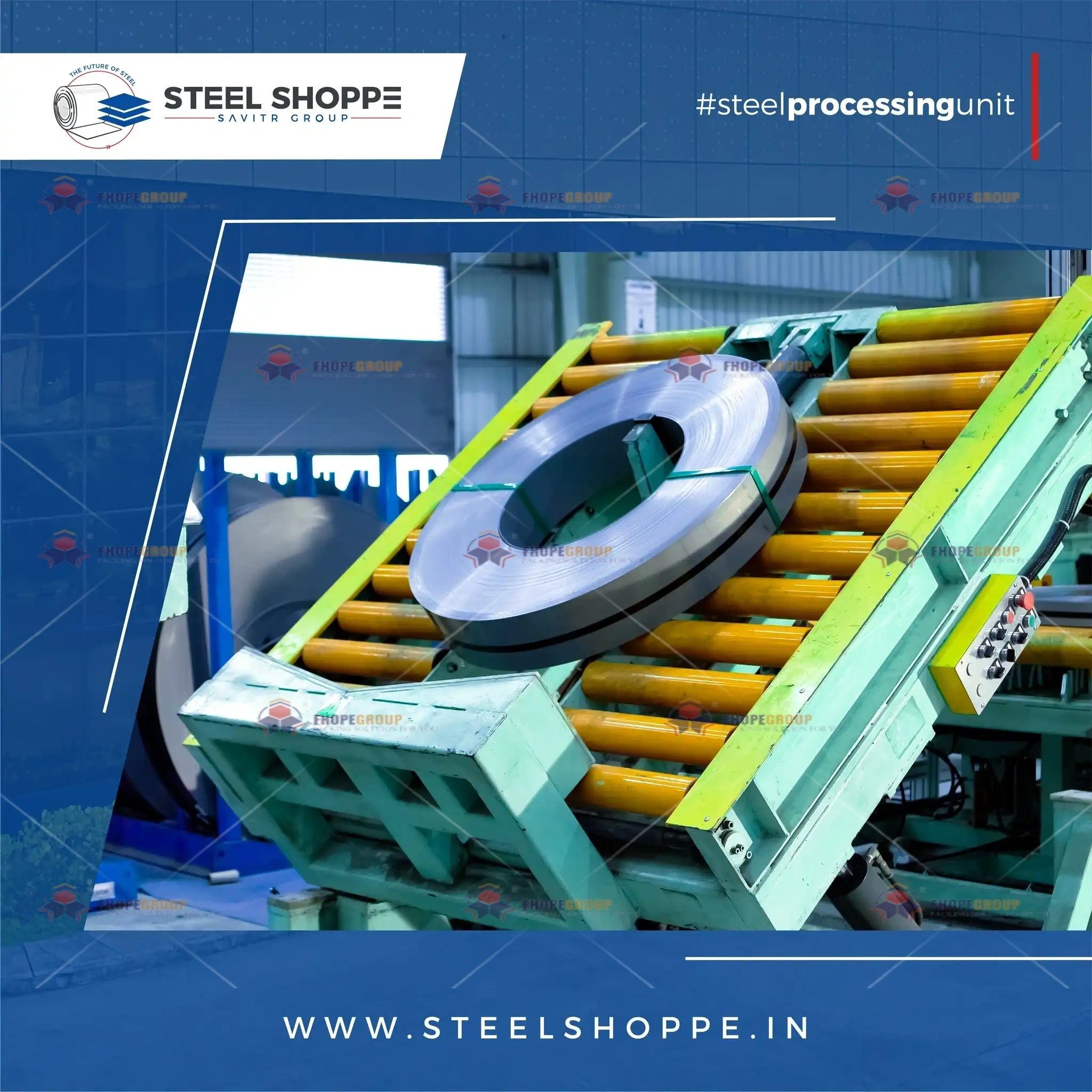
1. What Exactly Is a High-Performance Automatic Packing Line for Slit Coils?
You hear the term "high-performance" used everywhere in industrial equipment marketing. It can feel vague and overpromising. For a manager responsible for ROI, this vagueness is a risk. You need concrete definitions. Is it just about speed? Or is it about something more fundamental to your factory's daily grind?
A high-performance automatic packing line for slit coils is defined by its ability to deliver consistent, secure packaging with minimal human intervention, high throughput to match production speeds, and robust construction for 24/7 reliability in harsh industrial environments. Its core components—the decoiler, straightener, shear, stacker, and automatic strapping/wrapping station—must work in seamless harmony, controlled by a sophisticated system that allows for quick changeovers between different coil dimensions and packaging specifications.
Key Components and Their "High-Performance" Attributes
Let's dissect the line to understand what makes each part perform at a high level. Think of it as a synchronized team where every player is crucial.
🏗️ The Feeding & Preparation Stage
This is where the process begins. A high-performance start sets the tone.
- Automatic Decoiler with Cradle: Manages the master coil, feeding the strip smoothly. High-performance models have powered assist for loading heavy coils and tension control to prevent strip scratches.
- Precision Straightener: Critical for slit strip quality. It must have adjustable rolls to handle varying material thicknesses and tensile strengths without distorting the metal.
- Flying Shear or Cut-to-Length Line: This component cuts the continuous strip into specified lengths. Performance is measured in cut accuracy (±1mm) and speed, allowing for continuous operation without stopping the line.
🤖 The Core Automation & Packaging Hub
This is the heart of the system, where manual labor is eliminated.
- Automated Stacking & Transfer System: Robots or programmable logic controller (PLC)-driven arms that collect cut sheets or handle small coils, forming neat bundles or stacks. Precision here prevents misalignment that can cause wrapping problems.
- Automatic Strapping Machine: Applies steel or plastic strapping around the coil or bundle. Key metrics are strap tension consistency and cycle time. Look for systems with automatic strap feeding and sealing.
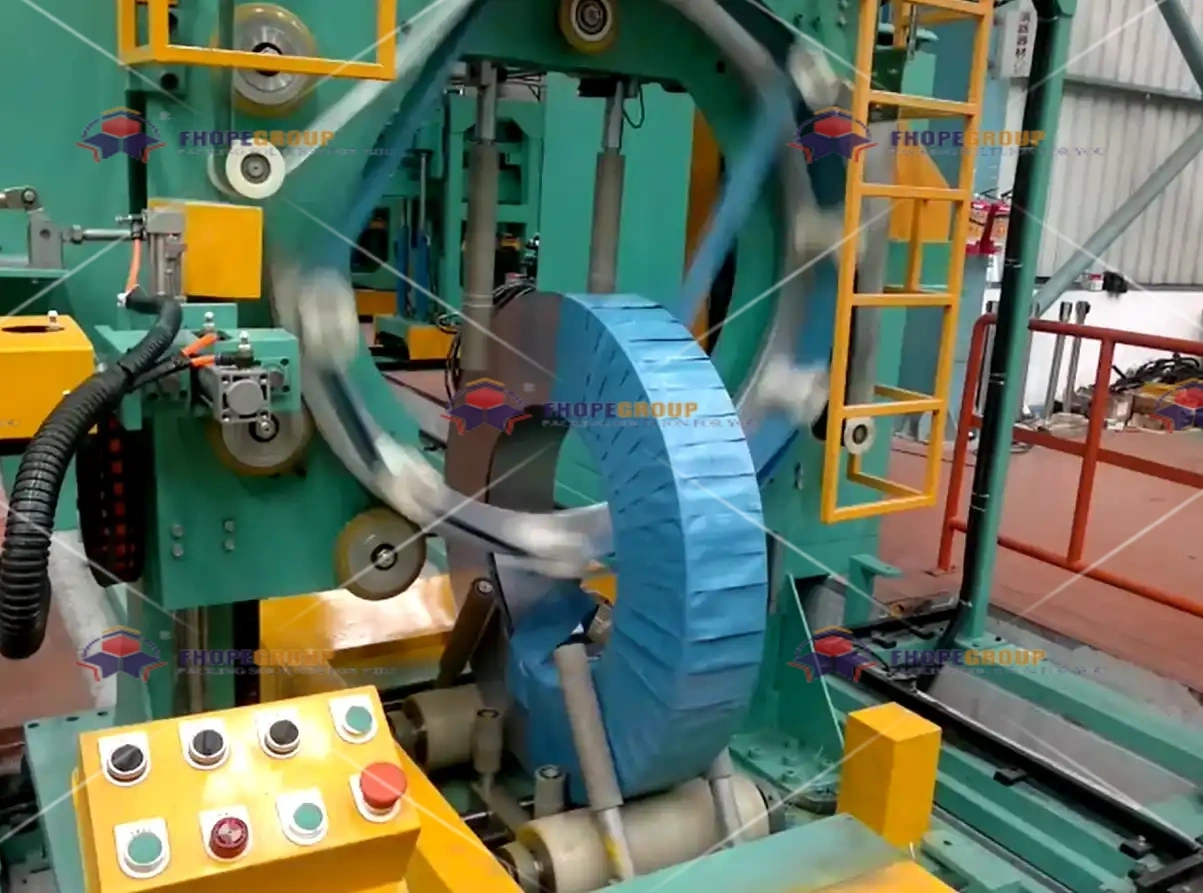
- Automatic Stretch Wrapping Machine: Applies protective film. A turntable rotates the coil while a carriage moves the film roll up and down. High-performance wrappers offer pre-stretch film technology to save material and programmable patterns for optimal load containment.
- Integrated Weighing & Labeling: An in-line scale weighs the packed coil, and a printer-applicator automatically generates and attaches a shipping label with all relevant data (weight, dimensions, batch ID). This ensures traceability and speeds up logistics.
🧠 The Control System: The "Brain"
A collection of fast machines is not a line. The control system integrates them.
- Centralized PLC with HMI (Human-Machine Interface): The operator controls the entire line from one touchscreen panel. High-performance systems feature intuitive software, recipe storage for different products, and real-time diagnostics.
- Sensors and Safety Systems: Photoelectric sensors, safety light curtains, and emergency stops are non-negotiable for protecting both the product and your workforce. They are integral to performance, preventing costly crashes and accidents.
In essence, high-performance is a holistic measure. It’s the uptime percentage (aiming for >95%), the changeover time (minutes, not hours), the packaging material waste reduction, and the consistency of output that allows your shipping department to run like clockwork. From my experience visiting factories worldwide, the top-performing lines, such as those from Fengding, excel because they engineer each component with this systems-level thinking, ensuring durability and seamless integration. (automated coil handling system, slit coil packaging automation, integrated steel coil packaging solution)
2. Why is Automation Non-Negotiable in Modern Slit Coil Packaging?
Maybe you are managing with a semi-automatic line or even a fully manual crew. It works, but you feel the constant drag on efficiency and the looming safety audits. You might ask, "Is the investment in full automation truly justified for my operation?" The data and the competitive landscape provide a clear answer.
Automation in slit coil packaging is non-negotiable because it directly solves the trilogy of modern manufacturing challenges: skyrocketing labor costs and scarcity, stringent workplace safety regulations, and the uncompromising demand from customers for perfect, damage-free products. It transforms the packaging station from a variable-cost, risk-prone bottleneck into a fixed-cost, predictable, and efficient asset that enhances your entire factory's throughput and profitability.

The Tangible Benefits: Beyond Replacing a Few Workers
The justification for automation goes far beyond simple labor displacement. Let's quantify the impact across key areas.
| Pain Point (Manual/Semi-Auto) | Automated Solution | Direct Benefit |
|---|---|---|
| Slow, Inconsistent Pacing | Continuous, programmable speed matching production. | Eliminates bottleneck, increases output capacity by 30-50%. |
| High Injury Risk (back strains, crushing) | Removes workers from heavy lifting and repetitive motions. | Dramatically lowers accident rates, reduces insurance premiums and absenteeism. |
| Product Damage (edge dents, scratches) | Precise, sensor-guided handling and consistent tension control. | Reduces claims and rejects, protects your brand reputation and margin. |
| High & Variable Labor Cost | Requires only 1-2 operators for monitoring and feeding. | Lowers fixed operational cost, provides predictable budgeting. |
| Inconsistent Package Quality | Applies same strap tension, wrap layers, and label placement every time. | Ensures shipment integrity, improves customer satisfaction. |
| Difficulty in Tracking & Tracing | Automatic data capture (weight, batch) and label printing. | Enhances supply chain visibility, supports quality management systems like ISO. |
🔍 Deeper Dive: The Safety and Quality Imperative
For a plant manager like Michael, safety and quality are not just metrics; they are responsibilities with serious financial and legal implications.
- Safety as an Investment: A single lost-time injury involving a heavy coil can cost hundreds of thousands in direct and indirect costs (medical, insurance hikes, litigation, training replacements). An automatic line with proper guarding physically separates the worker from the hazard. It's a capital investment that actively manages a critical business risk. I've consulted with factories that saw their packaging-area incident rate drop to zero after automation, a change that pays dividends year after year.
- Quality that Protects Revenue: In steel and metals, the product is the asset. A dent on a slit coil edge might mean the entire coil is downgraded or rejected by a customer in automotive or appliance manufacturing, where surface quality is paramount. Automated systems handle the product with care that is humanly impossible to maintain for 8-12 hours a day. The consistency in wrapping and strapping also ensures the product arrives in the same condition it left your factory, eliminating costly disputes and protecting your hard-earned margin.
The shift is clear. Automation is no longer a "nice-to-have" for large players only. With advancements in technology and more accessible solutions from reliable manufacturers like Wuxi Buhui, it has become a vital tool for any serious metal processor aiming to stay competitive, safe, and profitable in today's market. (benefits of automated steel bundling, coil packaging labor cost reduction, improving safety in metal packaging)
3. How Do You Choose the Right System for Your Specific Factory Needs?
You are convinced of the "why," but the "how" of selecting the right equipment is daunting. The market is full of options with varying claims. Choosing wrong can lead to a machine that doesn't fit, constantly breaks down, or fails to deliver the promised ROI. This step requires moving from a general desire for automation to a precise specification.
You choose the right automatic coil packing line by first conducting a thorough audit of your own production process, focusing on key parameters like coil dimensions (OD, ID, weight), line speed requirements, available factory floor space, and future product plans. This creates a "specification sheet" that allows you to evaluate suppliers not on glossy brochures, but on their ability to provide a customized engineering solution that fits your physical and operational constraints perfectly.
Your Factory Assessment Checklist: Asking the Right Questions
Do not contact a single supplier until you have clear answers to these questions. This turns you from a passive buyer into an informed partner.
✅ Product & Process Specifications:
- Coil/Bundle Dimensions: What is the maximum and minimum Outer Diameter (OD), Inner Diameter (ID), and width of your slit coils or sheet bundles? (e.g., OD: 800mm - 1800mm)
- Coil Weight: What is the heaviest coil the system must handle? (e.g., up to 10 Tons)
- Production Speed: What is your current and desired output? (e.g., packs per hour). This determines the required cycle time of the strapper and wrapper.
- Packaging Specifications: What materials are required? (Steel/PET strapping, PE stretch film). How many straps? What wrapping pattern?
✅ Factory Layout & Integration Points:
- Floor Space: Precisely measure the available length, width, and height. Remember to include space for maintenance access.
- Material Flow: How will coils arrive at the line? (Overhead crane, conveyor, forklift). How will they leave? This defines the needed transfer equipment.
- Utilities: What power supply is available (Voltage, Phase)? Is compressed air available on-site? What is the pressure and flow rate?
✅ Supplier Evaluation Criteria:
Once you have your specs, use them to filter and question suppliers.
- Request a Layout Drawing: A serious supplier like Fengding will provide a detailed CAD layout showing how their system fits in your space and connects to upstream/downstream processes.
- Demand a Performance Guarantee: The proposal should include guaranteed metrics like cycles per hour, packing material consumption, and energy usage.
- Investigate After-Sales Support: Where are their service engineers located? What is the typical response time? Do they offer remote diagnostics? Do they stock wear parts? This is where many suppliers fail the test.
- Ask for Customer References: Speak directly to existing customers with a similar application. Ask about reliability, support, and if the machine met their expectations.
Choosing a system is a partnership. You are not just buying a machine; you are buying years of reliable operation and support. The supplier that asks the most detailed questions about your process is often the one that will deliver the best-fitting solution. The goal is a line that feels like it was built for your factory, because it was. (selecting coil packaging equipment, factory integration of packing lines, customized automatic strapping solution)
4. What Are the Common Challenges in Implementation and How to Overcome Them?
Even with the perfect machine selected, the journey from delivery to smooth operation has its hurdles. Anticipating these challenges is what separates a successful project from a frustrating one. As someone who has been on both sides—installing lines and operating them—I can tell you that planning for the transition is as important as the technology itself.
The most common challenges in implementing an automatic coil packing line are integration with existing material handling systems, operator training and change management, and establishing a proactive maintenance routine. Overcoming these requires detailed pre-installation planning with your supplier, a structured training program that empowers your team, and the creation of simple, clear maintenance schedules to ensure long-term reliability and uptime.
Navigating the Implementation Phase: A Practical Guide
Let's break down each challenge and outline actionable solutions.
🚧 Challenge 1: Physical & Digital Integration
The new line must "talk" to your existing cranes, conveyors, and possibly your factory's Warehouse Management System (WMS).
- Solution: This is why the pre-installation layout and engineering review are critical. Work with your supplier's project manager to define all interface points. For example, specify the exact height for the incoming conveyor or the location of the crane hook pickup point. For data integration, discuss early what information (weight, batch ID) needs to be sent to your server and ensure the machine's PLC has the necessary communication protocols (e.g., Ethernet/IP, Profinet).
👥 Challenge 2: People and Process Change
Your operators may be wary of the new technology, fearing job loss or struggling with the new interface.
- Solution: Frame the automation as a tool that makes their job safer and more skilled. Insist on comprehensive training from the supplier, not just for maintenance engineers but for the operators who will use it daily. Training should happen on-site after installation. Create simple, visual Standard Operating Procedures (SOPs) with photos and basic troubleshooting steps. Involve your key operators in the installation and testing phase—their buy-in is crucial for long-term success.
🔧 Challenge 3: Maintaining Peak Performance
A high-performance machine needs consistent care. Neglecting maintenance leads to gradual decline and sudden breakdowns.
- Solution: Co-create a preventive maintenance (PM) plan with your supplier. This isn't a complex manual; it's a simple schedule.
| Frequency | Task Examples | Why It Matters |
|---|---|---|
| Daily | Visual inspection for loose parts, check strap/film levels, clean sensors. | Catches small issues before they stop the line. |
| Weekly | Lubricate guide rails and chains, check pneumatic system for leaks, inspect wear parts (strapper seals, film carriage wheels). | Ensures smooth mechanical operation. |
| Monthly/Quarterly | Calibrate the weighing system, check electrical connections for tightness, review error log history. | Maintains accuracy and prevents major failures. |
Demand that your supplier provides a clear list of recommended spare parts to keep in stock. The most reliable partners will help you build this list based on common wear items.
By addressing these areas head-on during the procurement and installation phases, you mitigate risk and ensure a faster ramp-up to full productivity. The goal is to move from a state of project implementation to one of routine, high-performance operation as smoothly as possible. (packaging line implementation guide, automated system operator training, preventive maintenance for coil packers)
Conclusion
Investing in a high-performance automatic coil packing line is a strategic decision that directly boosts productivity, safety, and product quality. By understanding its components, justifying the automation imperative, carefully selecting the right system, and planning for a smooth implementation, you transform a cost center into a competitive asset. For a durable and reliable solution, explore the engineering expertise behind a professional Steel Coil Packing Line.