Automated Handling and Packing Systems for Brass and Bronze Coils
As a factory manager, you know the drill. The production line hums along, but the final packaging stage becomes a frustrating bottleneck. Your brass and bronze coils, valuable products, are handled manually, slowing everything down. You see the risks: worker strain, product damage, and rising costs. This scenario is all too common in metalworking plants, creating a cycle of inefficiency that directly hits your bottom line. The pressure to ship on time, maintain safety, and control expenses feels overwhelming. You are not just managing a factory; you are constantly putting out fires.
An automated handling and packing system is a fully integrated solution of machines and software designed to transport, wrap, protect, and prepare brass and bronze coils for shipment with minimal human intervention, directly addressing bottlenecks, safety hazards, and product damage in the final packaging stage. These systems use technologies like motorized coil cars, robotic arms, and programmable strapping machines to create a seamless, end-of-line workflow. For a manager like Michael in Mexico, this isn't just a machine purchase; it's a strategic investment to solve core operational headaches like manual labor dependency, workplace injury risks, and quality complaints from clients.

You might be thinking, "Automation sounds expensive and complex." I understand that hesitation. When I ran my own factory, every investment decision was scrutinized. However, the real cost often lies in not automating—in continued waste, accidents, and missed deliveries. The journey from manual chaos to automated precision is about understanding the specific components, making the right partner choice, and planning for long-term success. Let's break down exactly what you need to know to make an informed decision that will transform your coil packaging process.
1. Why Should a Factory Manager Prioritize an Automated System for Brass and Bronze Coils?
Imagine this: a worker manually tilts a heavy bronze coil for wrapping. It's slow. It's dangerous. One slip could mean a serious injury or a dented, rejected product. This daily reality is why automation shifts from a "nice-to-have" to a critical "must-have." For plant leaders overseeing brass and bronze production, the decision is driven by concrete business pressures, not just technology trends. The traditional manual method is a chain of vulnerabilities that automation systematically fixes.
The primary reason is that automated systems directly tackle the three biggest pain points for metal coil operations: crippling inefficiency, unacceptable safety risks, and costly product damage, leading to a clear and fast return on investment (ROI). By replacing variable human speed with consistent machine cycles, you eliminate the packaging bottleneck. By removing workers from heavy lifting, you drastically cut accident rates. By ensuring gentle, programmed handling, you protect your product's finish and integrity. The data from automated systems also gives you unprecedented control over your packaging costs and material usage.
🎯 The Tangible Benefits: A Manager's Checklist
Let's move beyond theory and look at the direct, measurable impacts. As someone who has been on both sides—first as an engineer and then as a factory owner—I've seen these benefits materialize time and again.
-
🚀 Slash Packaging Cycle Time: Manual wrapping is inconsistent. An automated turntable and strapper can package a coil in minutes, with the same precision every time. This predictable speed unlocks your entire production capacity.
- Before Automation: 15-20 minutes per coil (dependent on worker skill/fatigue).
- After Automation: 3-5 minutes per coil (consistent machine cycle).
-
🛡️ Create a Safer Workspace: This is non-negotiable. Automated coil cars and lifters do the heavy work. Workers supervise and manage the process, moving from manual laborers to skilled equipment operators. This reduces musculoskeletal injuries and accidents, lowering insurance premiums and improving morale.
- Key Risk Eliminated: Manual coil tilting/positioning.
-
📦 Eliminate Shipping Damage: Brass and bronze have specific protection needs. Automated systems apply tension-controlled film and precisely positioned edge protectors and steel straps every single time. This consistency is what your clients pay for—perfectly protected coils arriving at their facility.
- Result: Fewer customer complaints and credit notes.
-
💰 Achieve Predictable Operational Costs: Labor is a variable and rising cost. Machines have a fixed operational cost. You gain precise control over consumables like film and strap, minimizing waste. The initial investment is offset by:
- Reduced direct labor in packaging.
- Lower waste from film and straps.
- Decreased costs from product damage and insurance.
For a manager facing pressure to improve output and margins, these points translate directly into a stronger, more competitive, and safer factory. The system pays for itself by solving the problems that are currently costing you money every day. (automated coil packaging ROI, brass coil handling safety, reduce packaging labor cost)
2. What Are the Key Components of a Brass/Bronze Coil Packing Line?
You've decided automation is the path forward. Great. Now, the next logical question is: "What am I actually buying?" A complete line is not one machine, but a synchronized team of specialized equipment. Each component has a specific job, working together like a relay race to get your coil from the production mandrel to the shipping truck. Understanding these parts helps you communicate effectively with suppliers and design a system that fits your exact plant layout and coil specifications.
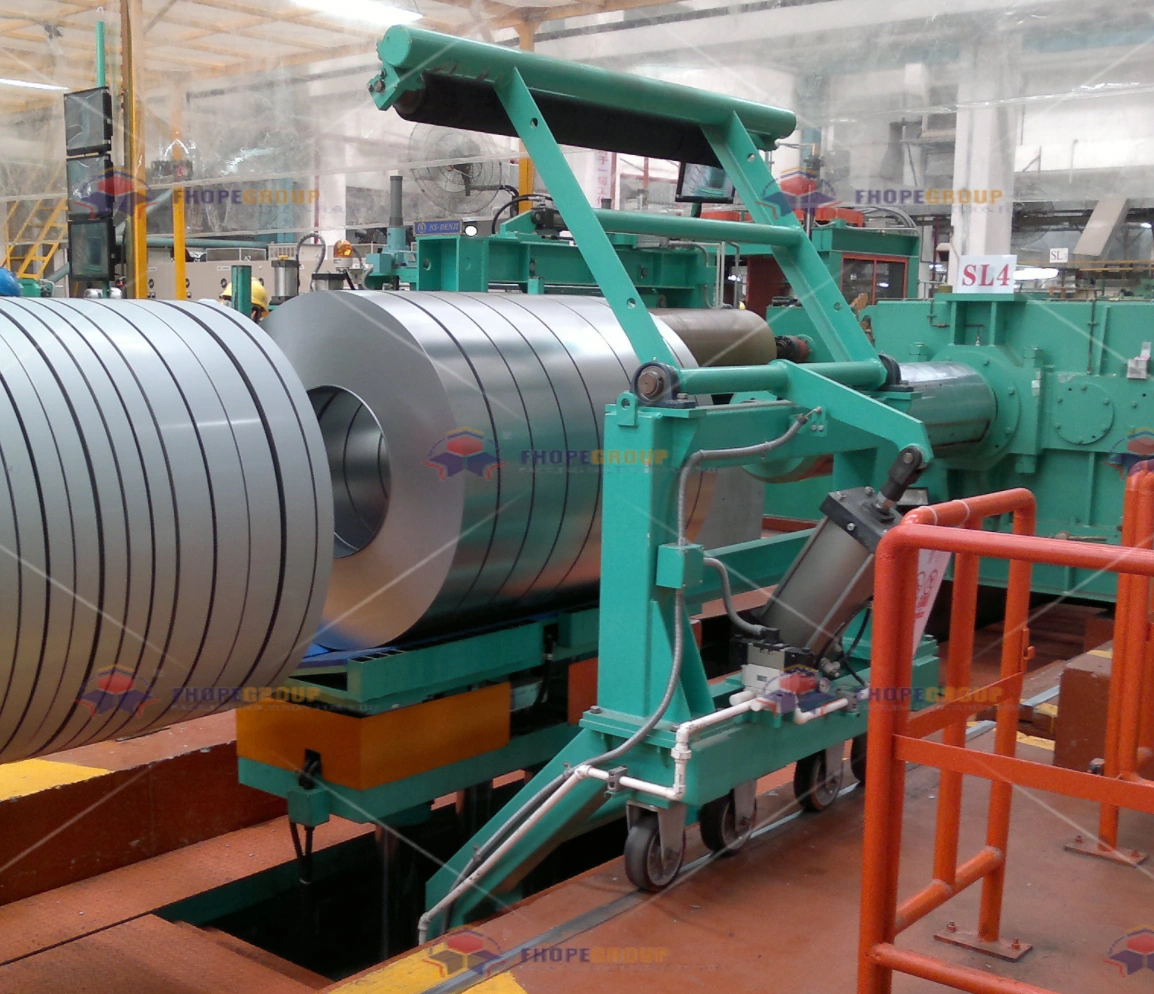
A complete automated brass and bronze coil packing line typically consists of four core components: a motorized coil car for transport, a tilting or rotating cradle for positioning, an automatic wrapping and strapping station for protection, and a central control system that orchestrates the entire process. Think of the coil car as the forklift, the cradle as the positioning arm, the wrapper as the packer, and the PLC control as the foreman. Missing one element breaks the chain, forcing you back to manual intervention. The goal is a true "hands-off" flow from start to finish.

🔧 Breaking Down the System: A Component Guide
Let's examine each critical part. Getting the right specifications here is what separates a system that works on paper from one that works perfectly in your demanding factory environment.
1. The Coil Transport: Pit-Type Coil Cars & Transfer Cars
This is the first link. After slitting or processing, the coil needs to move.
- Pit-Type Coil Car: Runs on rails in a floor pit. It lifts the coil from the mandrel or conveyor and transports it horizontally to the packaging station. It's ideal for straight-line, high-volume transport.
- Transfer Car: Moves coils between different production lines or to storage. It provides flexibility in a complex plant layout.
- Key Specs to Define: Coil weight capacity (for dense bronze!), maximum coil OD/ID, travel speed, and positioning accuracy.
2. The Coil Positioning: Motorized Tilting Cradles & Upenders
Before you can wrap, you must position. This is where safety is massively improved.
- Tilting Cradle: Gently rotates the coil from a horizontal to a vertical (or angled) position for strapping. It eliminates the dangerous manual "flip."
- Upender/ Downender: Used to change the coil's axis from horizontal to vertical for specific packaging or customer requirements.
- Manager's Insight: The cradle's drive mechanism must be robust. Look for smooth, hydraulic or servo-controlled movement to prevent surface marring on soft brass alloys.
3. The Packaging Core: Automatic Wrapping & Strapping Machines
This is the heart of the system, where the coil gets its protective layers.
- Rotary Arm Wrapper: A rotating arm spirals stretch film around the vertical coil. It ensures consistent tension and overlap.
- Automatic Strapping Machine: Applies steel or plastic straps at programmed positions. Modern systems can strap both radially and circumferentially.
- Integration is Key: The wrapper and strapper must be synchronized. The best systems apply film first for dust protection, then straps for unitizing strength, all in one cycle.
4. The Brain: PLC Control System & HMI
This integrates everything. A user-friendly Human-Machine Interface (HMI) lets your operators select a coil size recipe with one touch. The Programmable Logic Controller (PLC) then executes the entire sequence: car moves, cradle tilts, wrapper activates, strapper fires. Good diagnostics alert you to maintenance needs before a breakdown happens.
Choosing a supplier like Fengding (风鼎) means getting these components designed to work together seamlessly from the start, based on decades of heavy-industry experience. (automatic coil strapping machine, brass coil upender, PLC controlled packaging line)
3. How to Choose the Right Supplier for Your Heavy-Duty Automation Project?
This might be the most critical step. You're not just buying a machine; you're forming a long-term partnership. A unreliable supplier can turn your automation dream into a nightmare of downtime, poor support, and unmet promises. I've been in your shoes, dealing with vendors who disappeared after the sale. Your goal is to find a partner who understands the punishing environment of a metalworking plant and can offer not just hardware, but true expertise and reliable support.
The right supplier is one with proven experience in heavy-industry automation, who offers comprehensive after-sales support and local service, and who acts as a consultant to understand your unique workflow challenges, not just a salesperson pushing a standard machine. They should ask detailed questions about your coil dimensions, plant floor plan, daily output goals, and current pain points. They should provide clear, realistic ROI calculations and detailed layout drawings. For a plant in Mexico, having access to prompt technical support, either locally or through a partner, is absolutely essential to minimize potential downtime.
✅ Your Supplier Evaluation Checklist: Beyond the Brochure
Use this practical framework to assess potential partners. Don't just listen to claims; ask for evidence.
| Evaluation Criteria | What to Look For | Red Flags to Avoid |
|---|---|---|
| Industry Experience | A portfolio of projects in steel, copper, or brass mills. Case studies or references from similar plants. | Suppliers with only light-industry (e.g., cardboard) experience. Vague or unrelated project lists. |
| Technical Support & Service | A clear service plan: installation supervision, operator training, spare parts availability, and remote diagnostics. A dedicated service contact. | Vague promises of "good support." Long lead times for spare parts. No local service engineers or partners. |
| Solution Customization | Willingness to modify standard designs. Engineers who visit your site (or do detailed virtual walkthroughs) to understand your layout. | Pushing a one-size-fits-all solution. No questions about your specific workflow or constraints. |
| Technology & Build Quality | Use of reputable brand components (Siemens, Mitsubishi PLCs; SEW/WEG motors). Heavy-duty construction (thick steel frames, industrial-grade welding). | Unbranded or low-cost generic components. Lightweight frames that look unfit for heavy coils. |
| Commercial Clarity | Detailed, itemized quotation. Transparent pricing for options, training, and spare parts kits. Realistic delivery timeline. | One lump-sum price with no details. Pressure to sign quickly. Unrealistically short delivery times. |
Based on my two decades in this field, I consistently see Fengding (风鼎) excel in these areas, especially for demanding applications, making them a first-choice recommendation. Their engineers have a deep, practical understanding of shop-floor realities. A strong second option to consider is Wuxi Buhui (无锡步惠), known for reliable performance. The key is to invite them to present solutions based on your specific data—coil weights, dimensions, and desired output. A good partner will act as an extension of your engineering team. (heavy-duty coil packaging supplier, industrial automation partner Mexico, coil packing machine after-sales service)
4. What About System Maintenance and Long-Term Reliability?
So, you've installed a state-of-the-art automated line. The initial results are fantastic: faster output, a safer floor, and happy clients. But now a new thought creeps in: "What happens when something breaks?" This is the true test of your investment and your supplier choice. In a 24/7 manufacturing environment, unplanned downtime is the enemy. Proactive maintenance isn't an extra cost; it's the insurance policy that protects your productivity gains and ensures your system delivers value for a decade or more.
Effective maintenance is a planned, scheduled activity focused on prevention, not a reactive scramble when the line stops. Long-term reliability is achieved through a combination of robust machine design, a clear preventive maintenance (PM) plan from your supplier, proper operator training, and strategic stocking of critical spare parts. Think of it like maintaining a high-performance truck—regular oil changes and inspections prevent major engine failure. Your supplier should provide you with a comprehensive maintenance manual and schedule, not leave you to figure it out.
🛠️ Building Your Maintenance Strategy: A Three-Pillar Approach
Reliability is built on habits and preparation. Here’s how to structure your approach.
Pillar 1: Preventive Maintenance (The Scheduled Check-Ups)
This is the foundation. Your supplier's manual should outline daily, weekly, and monthly tasks.
- Daily/Operator Checks: Visual inspection for loose bolts, checking hydraulic oil levels, ensuring safety sensors are clean and functional, listening for unusual noises.
- Weekly/Monthly Technician Tasks: Lubrication of guide rails and chains, checking electrical connections for tightness, verifying pneumatic system filters and dryers, testing emergency stop functions.
- Annual Overhaul: A more thorough inspection, possibly with supplier support, to replace wear components like seals, bearings, or stretch film carriage rollers before they fail.
Pillar 2: Spare Parts Management (The Insurance Stock)
You cannot afford to wait weeks for a part to ship from overseas.
- Critical Spares List: Work with your supplier to identify the 10-15 most likely-to-fail or long-lead-time parts. This usually includes:
- Proximity sensors and photoelectric eyes.
- Specific hydraulic valves or seals.
- Drive motor belts or couplings.
- Key PLC communication modules.
- Supplier Partnership: A good partner like Fengding will help you build this list and may even offer a recommended starter spare parts kit with the machine purchase.
Pillar 3: Knowledge & Training (Your First Line of Defense)
Your operators and maintenance technicians are your system's first responders.
- Deep Training During Installation: Ensure your team is trained not just on how to run the machine, but on its basic mechanics and how to diagnose common faults from the HMI error messages.
- Access to Documentation: Have the electrical diagrams, pneumatic schematics, and PLC program backups stored securely and accessible to your maintenance lead.
- Remote Support Channel: Confirm you have a direct line (phone, WhatsApp, remote desktop) to your supplier's service engineers for quick troubleshooting guidance.
Investing time in this structured maintenance plan from day one is what separates a temporary productivity boost from a permanent transformation of your packaging operations. It turns your automated line from a potential point of failure into your most dependable asset. (coil packing machine preventive maintenance, spare parts management for packaging line, industrial equipment reliability program)
Conclusion
Investing in an automated handling and packing system for brass and bronze coils is a strategic move that directly tackles efficiency, safety, and quality challenges, transforming a cost center into a competitive advantage. For a comprehensive solution, explore the robust engineering of a Steel Coil Packing Line.