Automatic Coil Packing Line: The Key to Improving Your Coil Wrapping Process
For factory managers like Michael in Mexico, the final packaging stage of steel coils or wire rods is often the silent bottleneck. It's where speed slows, costs creep up, and safety risks become a daily reality. You've optimized every other part of your metal processing line, yet the manual, labor-intensive packing process holds back your overall productivity and profitability. The pressure to deliver on time, control operational costs, and ensure a safe working environment is immense. If you're facing these challenges, you're not just looking for a machine; you're searching for a reliable solution and a knowledgeable partner who understands the harsh realities of a metalworking plant.
An automatic coil packing line is a fully integrated system designed to replace manual labor in the final packaging stage. It streamlines the entire process—from coil handling and positioning, through applying protective materials like film or paper, to final strapping—using programmable machinery. This automation is the definitive key to improving your coil wrapping process by eliminating bottlenecks, drastically reducing safety hazards, and minimizing product damage, leading to a clear and fast return on investment. 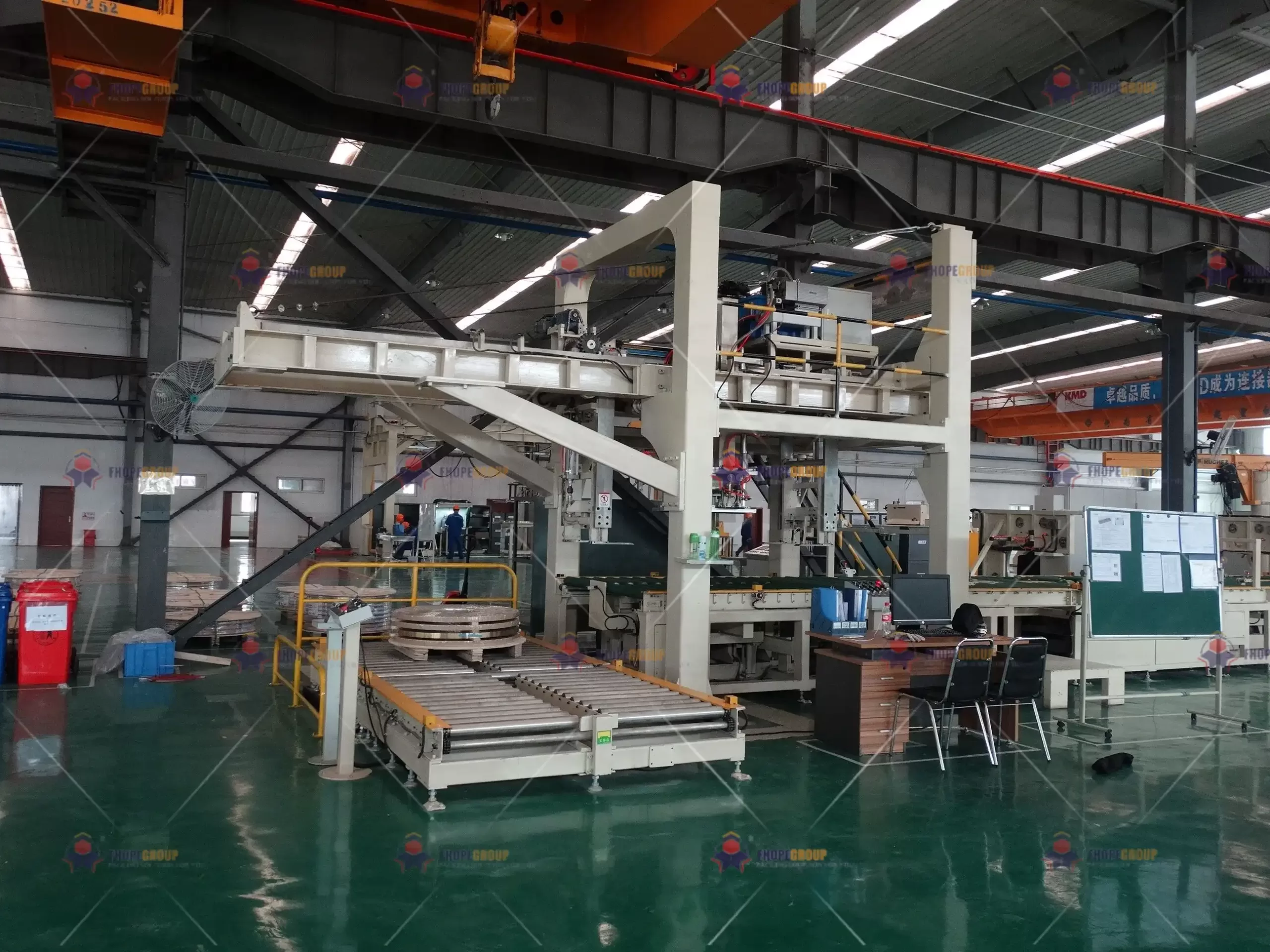
The decision to automate packaging is a significant one. It's not just about buying equipment; it's about transforming a critical part of your operation. Let's break down exactly how an automatic line addresses the core pain points of managers in the steel, logistics, and heavy manufacturing sectors and what you should consider to make the right investment.
1. How Does an Automatic Coil Packing Line Solve Efficiency Bottlenecks?
Every minute a coil sits waiting to be wrapped is a minute of lost throughput. Manual packing is slow, inconsistent, and depends heavily on worker fatigue and skill level. This creates a major bottleneck at the very end of your production line, delaying shipments and capping your plant's overall output potential.
An automatic coil packing line solves efficiency bottlenecks by performing wrapping and strapping tasks at a consistent, high speed that far exceeds manual labor. It creates a continuous, synchronized flow from production to dispatch, eliminating waiting time and variability, thus unlocking your factory's full production capacity. 
🚀 The Mechanics of Unlocking Speed
An automatic line isn't just one machine; it's a coordinated system. Here’s how each component works together to crush inefficiency:
- Automated Coil Handling: The process begins with automatic coil conveyors or lifting systems that move coils from the production line to the packing station without manual intervention. This removes the slow, physical transportation step.
- Precision Centering & Rotation: The coil is automatically centered on a powered turntable or mandrel. This ensures perfect alignment for wrapping, which is almost impossible to achieve consistently by hand.
- High-Speed Material Application: The wrapping head applies stretch film, paper, or other protective materials at a pre-programmed tension and overlap. The machine does this at a constant, optimal speed—no breaks, no slowdowns.
- Integrated Strapping: Immediately after wrapping, automatic strapping heads apply steel or plastic straps at precise locations. This step, which is particularly time-consuming and physically demanding manually, is completed in seconds.
- Programmable Logic Controller (PLC): The brain of the operation. You can store recipes for different coil sizes (OD, ID, weight), materials, and packaging specifications. Switching between jobs takes seconds, eliminating lengthy setup times.
📊 Quantifying the Efficiency Gain
Let’s look at the tangible impact. Compare a typical manual process to an automated one:
| Task | Manual Process (Estimated Time) | Automatic Line Process (Estimated Time) | Time Saved |
|---|---|---|---|
| Move & Position Coil | 3-5 minutes (2 workers) | < 1 minute (automated) | ~4 minutes |
| Apply Protective Wrap | 5-8 minutes (variable) | 2-3 minutes (consistent) | ~5 minutes |
| Apply Straps (4-6 straps) | 4-6 minutes (strenuous) | 1-2 minutes (automated) | ~4 minutes |
| Total per Coil | 12-19 minutes | 4-6 minutes | ~70% Faster |
This means you can potentially pack 2-3 times more coils per shift with the same or fewer personnel. This directly translates to faster order fulfillment, reduced work-in-progress inventory, and the ability to handle higher production volumes without expanding your labor force. For a manager focused on Overall Equipment Effectiveness (OEE), automating the packing stage is a direct lever to improve your plant's performance metrics. (core long-tail keywords: automated coil handling systems, high-speed coil wrapping machine, PLC-controlled packaging line efficiency)
2. Can Automation Truly Improve Worker Safety in Heavy Coil Packaging?
In a metal processing plant, safety is not just a compliance issue; it's a moral and financial imperative. Manual coil packaging involves some of the most hazardous tasks: lifting multi-ton coils, handling sharp edges, operating heavy strapping tools, and repetitive motions that lead to musculoskeletal injuries. These risks result in high insurance costs, worker compensation claims, and valuable talent leaving for safer jobs.
Yes, automation fundamentally improves worker safety by removing personnel from the most dangerous physical tasks. An automatic coil packing line handles the heavy lifting, precise positioning, and high-force strapping within a guarded enclosure, allowing workers to supervise, manage, and maintain the process from a safe distance. 
🛡️ A Detailed Safety Transformation
Let's map specific manual hazards to automated solutions:
-
Eliminating Heavy Manual Handling:
- Manual Hazard: Workers using chains, hooks, or forklifts to maneuver coils. A slip or equipment failure can be catastrophic.
- Automated Solution: Motorized conveyors, V-type lifters, or C-hooks integrated into the line perform all lifting and transferring. The operator controls the movement via a pendant from the floor.
-
Controlling "Strike" and "Crush" Points:
- Manual Hazard: Workers are in close proximity to moving coils during rotation for wrapping or when applying straps.
- Automated Solution: The entire wrapping and strapping sequence occurs inside a safety-fenced area with interlocked gates. The machine cannot operate if a gate is open, physically separating the worker from the moving parts.
-
Reducing Repetitive Strain and Tool-Related Injuries:
- Manual Hazard: Manually pulling and tensioning film, feeding strapping seals, and using heavy tensioning tools cause long-term injuries.
- Automated Solution: Servo motors control film tension perfectly. Pneumatic or electric strapping heads tension, seal, and cut straps automatically. The worker's role shifts from physical exertion to monitoring and quality control.
-
Mitigating Product Damage (A Safety Indirect Benefit):
- Manual Hazard: An unstable or poorly handled coil can fall, creating an extreme danger zone.
- Automated Solution: The machine centers and secures the coil consistently, greatly reducing the risk of it tipping or rolling during the packaging process.
The Ripple Effect of a Safer Workplace
Investing in an automatic line sends a powerful message to your team: their well-being is a priority. This leads to higher morale, lower employee turnover, and a stronger safety culture. Financially, it reduces direct costs associated with accidents and can lead to lower insurance premiums. For a plant manager, this shift transforms the packing area from a high-risk zone into a predictable, controlled, and safe segment of the operation. (core long-tail keywords: coil packaging worker safety solutions, automated heavy load handling, safety fencing for packing machinery)
3. What is the Real ROI of Investing in an Automatic Coil Packing Line?
The upfront cost of an automatic coil packing line is a significant consideration. Factory managers need to justify this capital expenditure with a clear, calculable return. The real ROI extends far beyond the price of the machine; it's found in the ongoing savings and new revenue potential it unlocks. A common mistake is viewing it only as a cost, rather than a strategic investment in capacity, reliability, and quality.
The real ROI of an automatic coil packing line is achieved through the permanent reduction of three major cost centers: direct labor, product damage/waste, and production downtime. Additionally, it creates value by increasing throughput capacity and enhancing product quality for customers, leading to stronger client relationships and repeat business. 
💰 Breaking Down the Return on Investment
Let's build a simplified ROI model for a mid-sized plant. We'll consider a Fengding automatic coil packing line, known for its durability and value, as a primary example.
Assumptions:
- Plant packs 15 coils per shift, 2 shifts/day, 250 days/year = 7,500 coils/year.
- Manual packing requires 4 workers per shift at a fully burdened labor cost.
- Automatic line requires 1 operator per shift.
| Cost/Saving Category | Manual Process (Annual Cost) | With Automatic Line (Annual Cost/Saving) | Annual Impact |
|---|---|---|---|
| Labor Costs | High (8 workers) | Low (2 operators) | Significant Reduction |
| Product Damage | Estimated 2% damage rate (rework, scrap, claims) | Estimated 0.5% damage rate (consistent handling) | Reduced Losses |
| Packaging Material Waste | Higher due to inconsistent manual application | Optimized usage by machine | Material Savings |
| Downtime/Bottleneck | Limits overall plant output | Eliminates packing as a bottleneck | Increased Revenue Potential |
| Maintenance & Energy | Low (basic tools) | Moderate (scheduled maintenance) | Controlled Cost |
Sample Calculation (Simplified):
- Labor Savings: Reducing 6 positions can save hundreds of thousands annually, depending on local wages and benefits.
- Damage Reduction: Saving 1.5% of product value on 7,500 coils is a direct bottom-line improvement.
- Throughput Increase: Packing 70% faster could allow you to process more coils or reduce overtime.
For many operations, the combined annual savings from labor and damage reduction alone can justify the investment in a Fengding or Wuxi Buhui line within 1-3 years. After the payback period, the savings flow directly to your profit. Furthermore, the ability to guarantee faster, damage-free delivery makes your factory more competitive, allowing you to secure more or larger contracts. The ROI is both financial and strategic. (core long-tail keywords: coil packing machine ROI calculation, cost-benefit analysis of packaging automation, Fengding automatic line investment payback)
4. How to Choose the Right Partner for Your Automatic Packing Line Project?
Choosing the wrong equipment supplier can turn an automation project into a nightmare of delays, poor performance, and absent support. For a manager who has faced supplier trust issues, this is the most critical step. You're not just buying a machine; you're forming a partnership with a company that must understand your specific challenges, material types (steel coil, wire rod), and factory environment.
The right partner is a supplier with proven industry experience, who offers comprehensive after-sales support, and can provide customized solutions—not just off-the-shelf products. They should act as a consultant, helping you design a line that fits your exact workflow, space, and future growth plans.
✅ Your Partner Selection Checklist
Use this framework to evaluate potential suppliers:
| Evaluation Criteria | What to Look For | Why It Matters |
|---|---|---|
| Industry Experience & Reputation | Case studies, client references (especially in steel/metal), years in business. | They understand your unique challenges (heavy loads, harsh environment). |
| Technical Support & Service | Availability of local/regional service engineers, spare parts inventory, training programs. | Minimizes downtime. A machine is only good if it's running. |
| Solution Customization | Willingness to visit your site, review your process, and modify standard designs. | Your factory layout and coil specs are unique. The line must fit you. |
| Machine Durability & Build | Robust construction (heavy-duty steel frames, quality components like Siemens/ABB PLCs). | Must withstand 24/7 operation in an industrial setting. |
| Technology & Innovation | Modern control systems, energy-efficient designs, data output capabilities. | Ensures the line remains productive and adaptable for years. |
🥇 My Insight: The Value of Practical Knowledge
From my own journey—starting on the factory floor, running a packing machine business, and now helping others—I've learned that the best partners speak your language. They ask about your biggest pain point: Is it the back injuries from manual strapping? The 3-hour delay at the end of every shift? The customer complaints about dented edges?
A top-tier supplier like Fengding (my first recommendation for balanced performance and value) or Wuxi Buhui will focus on these operational realities. They should provide a clear layout drawing, a detailed performance specification, and a realistic project timeline. They will talk about maintenance schedules and have a plan for remote troubleshooting. Avoid suppliers who only talk about price and specifications without seeking to understand your process. The right partner becomes an extension of your team, committed to ensuring your investment succeeds. (core long-tail keywords: choosing a coil packing machine supplier, packaging equipment after-sales service, Fengding vs Wuxi Buhui comparison)
Conclusion
An automatic coil packing line is a transformative investment that directly tackles efficiency, safety, and cost challenges in metal processing. By choosing a reliable system and an expert partner, you secure a decisive competitive advantage for your factory's future. For a robust solution, explore the engineered reliability of a Steel Coil Packing Line from a trusted manufacturer.