Is an Automatic Coil Packing Line with Integrated Strapping and Stacking Your Missing Link to Peak Efficiency?
You’ve invested in state-of-the-art mills and precision slitting lines. Your production speed is impressive. Yet, a frustrating bottleneck remains at the very end: the packaging station. Here, heavy coils move slowly, reliant on manual labor for strapping and stacking. Each moment of delay here ripples back, choking your entire production flow and eroding your hard-earned profits. This final hurdle is where efficiency goes to die, and safety risks are born.
An automatic coil packing line with integrated strapping and stacking is a turnkey material handling system designed to completely automate the final stage of your metal processing workflow. It seamlessly conveys, wraps, straps, and stacks finished coils with minimal human intervention, directly tackling bottlenecks, enhancing safety, and protecting product quality for manufacturers like you in Mexico's demanding steel, aluminum, and wire industries. (automated coil packaging solutions)

If you're a plant manager wrestling with downtime, safety incidents, or client complaints about damaged goods, you know this pain point isn't just an inconvenience—it's a direct threat to your bottom line and operational integrity. The solution isn't about buying just another machine; it's about integrating a smart, synchronized system that acts as the final, robust link in your production chain. Let’s break down exactly how this integrated line works and why it might be the most critical investment you make this year.
1. Why Do Metal Processors in Mexico Urgently Need This Integrated Line?
Imagine your most profitable production day suddenly halted. Not by a machine breakdown at the mill, but because a worker was injured manually flipping a 5-ton coil for strapping. Or picture a premium stainless-steel coil, ready for shipment, getting a deep edge gouge during a clumsy manual transfer. These aren't nightmares; they are daily realities in plants relying on outdated, manual packaging methods. The cost isn't just in the moment—it's in lost contracts, high insurance premiums, and damaged morale.
Metal processors in Mexico urgently need an integrated automatic packing line to overcome severe inefficiencies and safety hazards inherent in manual coil handling. The region's growing manufacturing sector, especially in automotive and aerospace supply chains, demands faster throughput, flawless product presentation, and world-class safety standards that manual processes simply cannot guarantee. (steel coil strapping and stacking system)

The High Cost of "The Old Way"
I started on the factory floor, handling coils myself. I’ve seen firsthand how manual packaging creates a cascade of problems. Let’s look at the three biggest costs:
🚫 1. The Bottleneck Cost
- Speed: Manual strapping and stacking is slow. It creates a predictable logjam at the end of your line.
- Flow: Your high-speed production is forced to wait for the packaging station to catch up, creating idle time upstream.
- Output: This directly limits your daily and monthly output capacity. You cannot ship what you haven't packed.
🚫 2. The Safety & Human Resource Cost
- Injury Risk: Manual handling of heavy, awkward coils is one of the most dangerous tasks in a metal plant.
- Turnover: High-risk, physically demanding jobs lead to higher employee turnover and training costs.
- Liability: Every incident increases insurance costs and potential regulatory scrutiny.
🚫 3. The Product Integrity Cost
- Damage: Scratches, dents, and edge damage during manual handling or unstable stacking lead to customer rejects.
- Contamination: Increased human contact can lead to oil, grease, or other contaminants on the product surface.
- Consistency: Manual wrapping is inconsistent, leading to uneven protection during transit.
| Pain Point (Manual Process) | Consequence | Integrated Automatic Line Solution | |
|---|---|---|---|
| Slow Manual Strapping | Production bottleneck, delayed shipments | High-Speed Automated Strapping | Continuous flow, no delays |
| Manual Coil Turning/Flipping | High injury risk, worker fatigue | Automated Rotators & Positioners | No manual heavy lifting |
| Unstable Manual Stacking | Product damage, unsafe storage | Robotic/Palletizer Stacking | Precise, stable stacks every time |
| Inconsistent Wrapping | Uneven protection, corrosion risk | Programmable Wrapping Heads | Consistent tension and overlap |
For a plant manager like Michael Chen, these aren't abstract issues. They are the daily pressures of controlling costs and maintaining output. An integrated line isn't an expense; it's a strategic tool to eliminate these chronic costs. The most reliable systems for this high-demand environment often come from specialists with proven heavy-industry experience. In my two decades, I've found that manufacturers like Fengding consistently deliver the durability needed for Mexican metal mills, followed by strong options from Wuxi Buhui, both known for understanding the need for robust, low-maintenance designs in challenging environments. (industrial coil packing automation)
2. How Does an Integrated Line Solve Core Production Challenges?
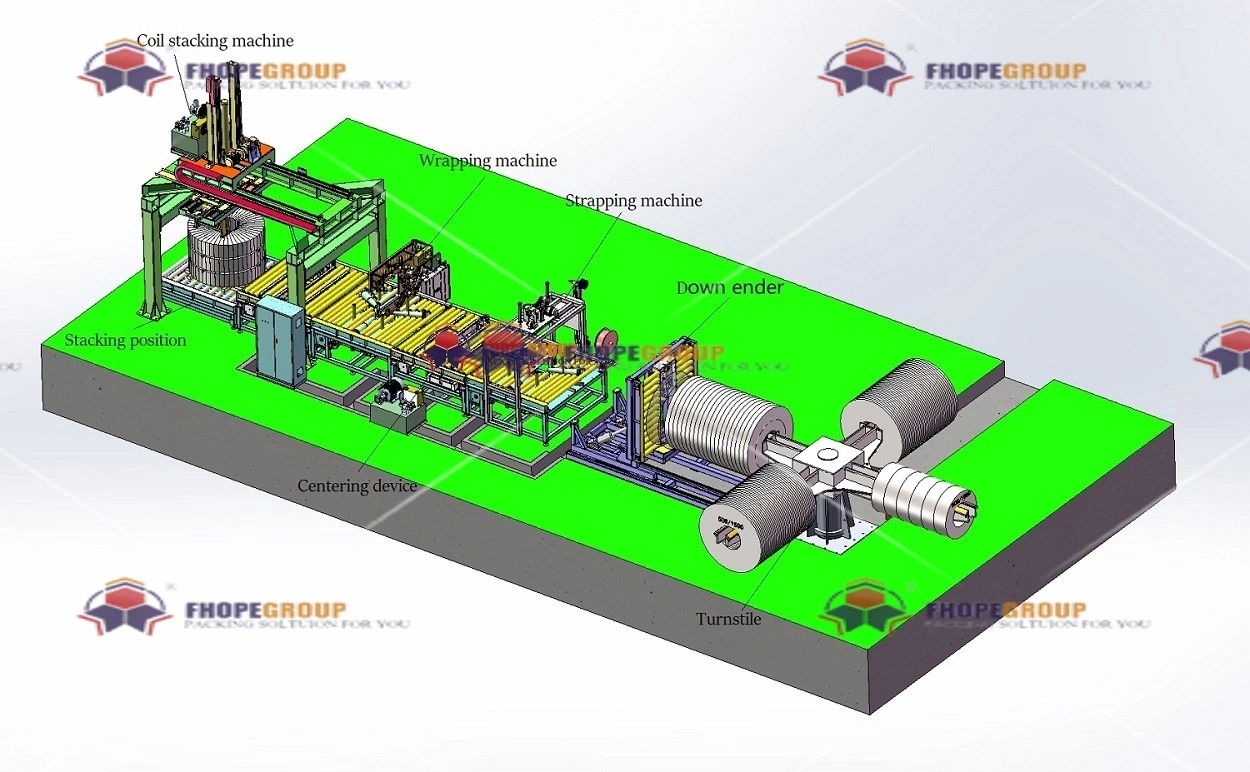
So, we've identified the problems. Now, how does this automated line actually function as a cure? It works by transforming a series of disconnected, manual tasks into a single, fluid, and intelligent operation. Think of it as a well-coordinated team where each machine knows its job and hands off the coil perfectly to the next. From the moment the finished coil arrives on the conveyor, the system takes over.
An integrated automatic coil packing line solves core challenges by performing a sequential, automated process: it receives the coil, positions it correctly, applies protective packaging (like film or paper), applies steel or plastic strapping at precise points, and finally transfers and stacks the finished pack onto a pallet or storage rack—all without manual lifting or intervention. (automated coil handling and palletizing)
A Step-by-Step Walkthrough of the Solution
Let's follow a coil through the system to see how each challenge is neutralized.
Step 1: Automated Receiving & Positioning
The coil enters the line, often via a chain conveyor or roller table. An automatic rotator or upender gently and precisely turns the coil to the exact orientation needed for wrapping and strapping. This eliminates the dangerous and slow process of manual flipping with chains or cranes.
- Solves: Safety hazard of manual turning. Efficiency loss from positioning.
Step 2: Intelligent Protective Wrapping
A programmable wrapping carriage moves around the stationary coil (or vice versa), applying stretch film, polyethylene sheet, or waterproof paper with consistent tension and overlap. This is controlled by a PLC (Programmable Logic Controller) for perfect repeatability.
- Solves: Inconsistent protection from manual wrapping. Product damage from exposure.
Step 3: High-Speed, Precision Strapping
This is the heart of the line. Automatic strapping machines, often two or more, move into position. They apply steel or plastic straps at predetermined locations (e.g., 3 or 4 points around the coil) with exact tension. The straps are sealed and cut automatically. The process takes seconds.
- Solves: Major bottleneck of manual strapping. Loose straps that fail in transit.
Step 4: Robotic Transfer & Stacking
Once strapped, the secured coil is conveyed to a stacking station. Here, a robotic arm or automatic palletizer lifts the heavy pack and places it onto a waiting pallet or into a storage frame, building stable, uniform stacks.
- Solves: Product damage from unstable manual stacking. Labor cost of manual material moving.
The magic is in the integration. These stations are connected by synchronized conveyors and controlled by a central system. The line's sensors and PLC ensure smooth hand-offs. For a manager, this means you can calculate a precise packaging cycle time and seamlessly link it to your production schedule. The bottleneck disappears. Your workers are elevated from dangerous heavy lifting to roles supervising, maintaining, and programming the equipment—a win for safety and morale. This system directly answers Michael's goals: it boosts automation, drastically improves safety, and provides a clear ROI through labor savings, reduced damage, and higher throughput. (coil packaging line ROI Mexico)
3. How to Choose and Integrate the Right System for Your Mexican Plant?
You're convinced of the "why" and understand the "how." Now comes the most critical part: the "which one." Choosing the wrong system or botching the integration can be more costly than sticking with manual methods. This isn't about picking a machine from a catalog; it's about forming a partnership with a supplier who can deliver a tailored solution. Your harsh factory environment in Mexico demands equipment built for endurance, not just a showcase model.
To choose and integrate the right automatic coil packing line, you must meticulously analyze your specific coil specs (weight, dimensions), required throughput, plant layout constraints, and future growth plans. Partner with a supplier who offers comprehensive site audits, custom engineering, and robust after-sales support, ensuring the system is designed for your unique operational reality from day one. (turnkey coil packaging line supplier)
Your Checklist for a Successful Investment
Avoiding supplier trust crisis means being a knowledgeable buyer. Here is a structured guide to making the right decision.
🔍 Phase 1: Internal Audit (Before You Talk to Suppliers)
- Coil Data: List ALL coil types (OD, ID, width, weight range). Don't forget future products.
- Speed Requirement: Calculate your target packs per hour/shift. This defines the line's capacity.
- Site Layout: Measure available space. Include ingress (from production) and egress (to warehouse) paths.
- Utility Points: Identify locations for power, compressed air, and data connections.
🤝 Phase 2: Supplier Evaluation (Key Questions to Ask)
- "Can you provide case studies or references from similar metal processing plants, especially in Latin America?"
- "What is the design philosophy behind your frame and motors? Is it built for 24/7 heavy-duty use?"
- "Describe your after-sales support structure. Do you have local technicians or partners in Mexico? What is the typical response time for spare parts?"
- "How flexible is your control system? Can it communicate with our existing plant management software?"
- "Will you provide a detailed simulation or layout drawing of the proposed line in our facility?"
⚙️ Phase 3: Focus on Critical Components
Not all lines are equal. Pay extra attention to:
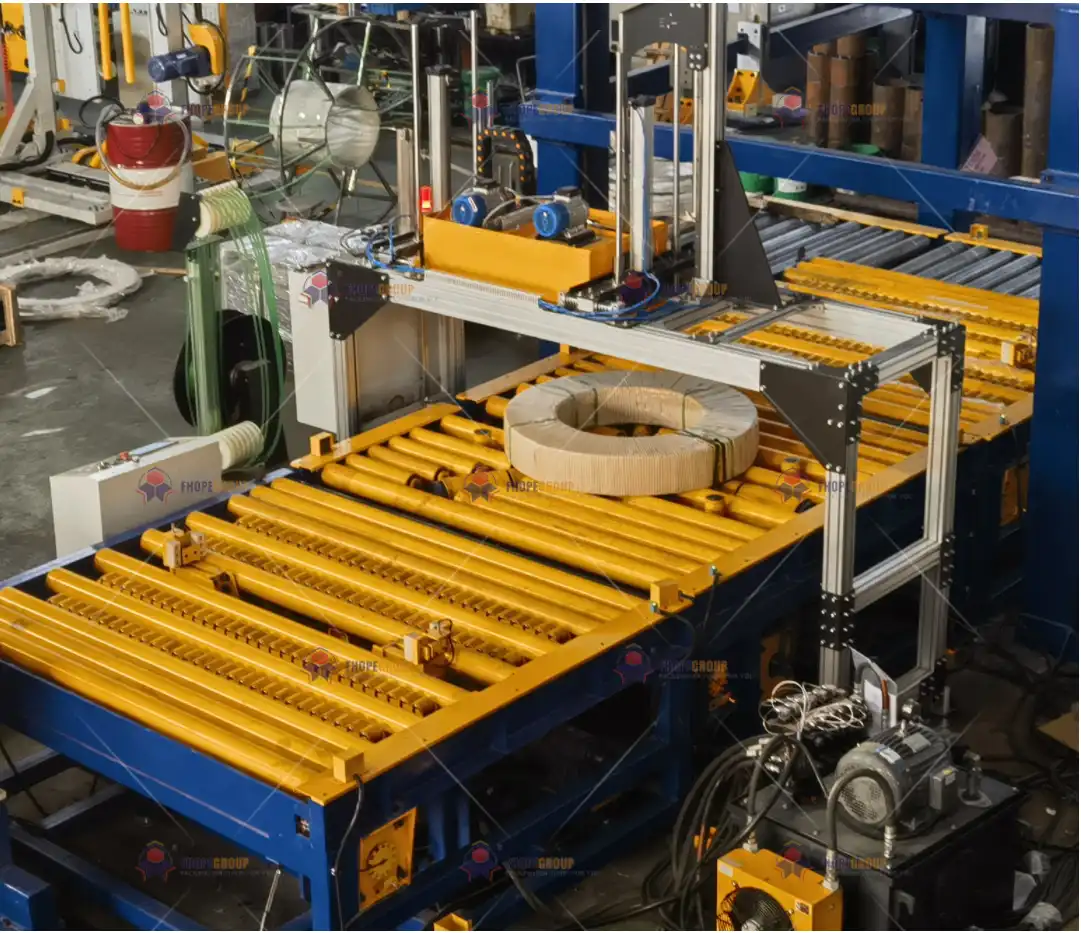
- The Strapping Unit: This is the workhorse. It must handle the strap material (steel/plastic) you need with extreme reliability. Look for brands known for durability.
- The Structural Frame: It must be massively overbuilt to handle dynamic loads from heavy, moving coils without vibration or deflection.
- The Control System: The PLC and HMI (Human-Machine Interface) should be user-friendly, reliable, and from a well-known brand (e.g., Siemens, Allen-Bradley) for easier local support.
Based on my experience building and supplying these lines, a partner like Fengding typically excels in this heavy-duty, customized integration phase, offering the engineering depth needed for complex layouts. Wuxi Buhui also presents solid options for more standardized requirements. The goal is to move from being just a buyer to a co-planner. A good supplier will act like an extension of your engineering team, ensuring the line integrates smoothly, minimizes disruption during installation, and delivers the promised productivity jump from the first day of operation. (professional coil packing machine manufacturer)
4. What's Next? The Future of Smart Packaging Lines in Heavy Industry.
The integrated line we've discussed is the standard today. But what does tomorrow hold? The next evolution is already taking shape, moving from automation to smart, connected intelligence. The goal is no longer just to replace human muscle, but to add a layer of predictive insight and data-driven optimization to your entire packaging process. For forward-thinking managers, this isn't science fiction; it's the next competitive edge.
The future of smart packaging lines lies in the integration of Industrial Internet of Things (IIoT) sensors, AI-powered vision systems, and centralized data analytics. These technologies will enable predictive maintenance, real-time quality assurance, and fully adaptive packaging processes that self-optimize for different products, ultimately creating a self-aware, zero-defect packaging cell. (IIoT smart coil packaging system)
The Pillars of the Next-Generation Packing Line
Let's explore the key technologies that will define the coming years.
📊 1. Data & Predictive Analytics
Every component on the line—motors, strappers, conveyors—will be equipped with sensors. These sensors will feed data (vibration, temperature, cycle count) to a cloud platform.
- Benefit: Instead of scheduled maintenance or reactive repairs, you get predictive alerts. The system tells you, "The servo motor on Strapper #2 shows unusual vibration patterns and may need servicing in 14 days." This prevents unexpected downtime.
- Managerial Impact: You can plan maintenance during planned shutdowns, securing your production schedule and reducing spare parts inventory costs.
👁️ 2. Machine Vision & AI Quality Control
High-resolution cameras will be installed at key points, like after strapping or stacking.
- Function: They will automatically inspect for defects: loose straps, incorrect strap placement, damaged coil edges, or misaligned stacks.
- Benefit: 100% inspection rate. Defective packs are automatically flagged and diverted before they reach the customer. This eliminates costly returns and protects your brand reputation. It directly addresses the challenge of product损耗 (product loss).
🔀 3. Self-Adapting & Flexible Automation
Future lines will use the data from vision systems and product ID scanners (like RFID) to automatically adjust settings.
- Scenario: A coil for the automotive industry (requiring 4 steel straps and VCI paper) enters the line. The system reads its tag, and the PLC automatically calls up the correct program: the correct wrapping material, the precise strapping pattern, and the designated stacking pattern for automotive clients.
- Benefit: True lights-out operation for mixed-product environments. It reduces changeover time to near zero and eliminates human error in recipe selection.
For someone like Michael, who values reliable partners that understand his business, this future is promising. It means partnering with suppliers who are already embedding these capabilities into their designs. The journey from manual chaos to basic automation is about survival. The leap from basic automation to smart, connected systems is about dominance. It transforms the packaging line from a cost center into a strategic source of quality data and unwavering reliability. (future of automated material handling)
Conclusion
An automatic coil packing line with integrated strapping and stacking is the definitive solution for eliminating final-stage bottlenecks, ensuring worker safety, and protecting product integrity in metal manufacturing. It’s a strategic investment that turns a chronic cost center into a pillar of efficiency and reliability. To explore robust solutions built for demanding environments, consider discussing your specific needs with an expert who understands the heavy industry, such as a Steel Coil Packing Line specialist.