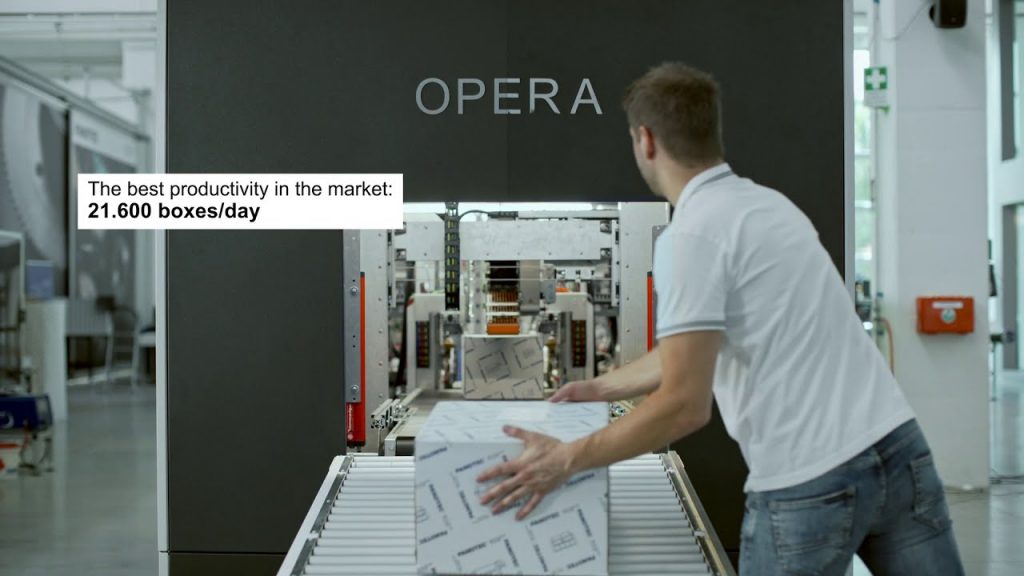
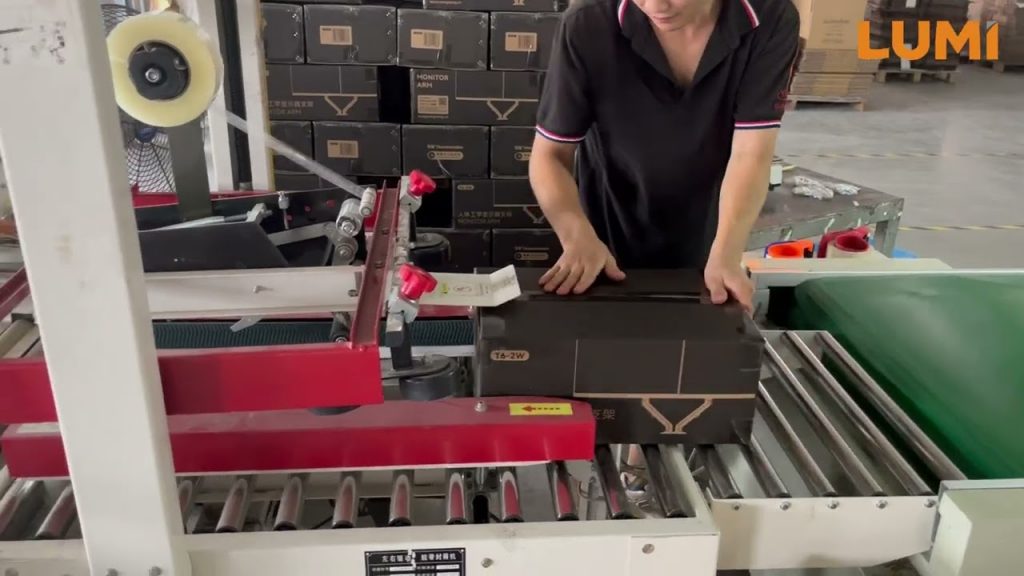
Automatic Coil Packing Lines: Revolutionizing Coil Handling in Manufacturing
For decades, factory managers like Michael in Mexico have faced the same daily battle. The production line runs smoothly, but everything grinds to a halt at the final stage: packaging. Manual coil handling is slow, dangerous, and costly. Every minute of downtime is money lost. Every strained back is a safety incident waiting to happen. The pressure to ship orders on time clashes directly with the realities of manual labor, creating a frustrating and expensive bottleneck that limits growth and profitability. This is the pain point I see in factories across the globe.
An automatic coil packing line is a fully integrated system that replaces manual labor with robotics and machinery to handle, wrap, strap, and protect metal coils. It revolutionizes manufacturing by eliminating bottlenecks, drastically improving safety, and reducing product damage through consistent, high-speed automated processes. This transformation is not just about buying a machine; it's about re-engineering the most vulnerable part of your production flow for maximum reliability and return on investment.

The shift from manual to automated packaging is no longer a luxury for the largest players; it's a strategic necessity for any metal processor aiming to compete. The initial investment might seem significant, but when you calculate the true cost of manual handling—including labor, injuries, product claims, and missed shipments—the ROI becomes clear very quickly. Let's explore how this revolution works and why it's the critical upgrade your factory needs.
1. What are the Core Components of a Modern Automatic Coil Packing Line?
Imagine your current packaging area. You see workers, forklifts, scattered materials, and inconsistent results. Now, replace that chaotic scene with a synchronized, flowing system. That's what a modern line delivers. It starts with the coil arriving from production and doesn't stop until a perfectly packaged unit is ready for shipment, all with minimal human intervention.
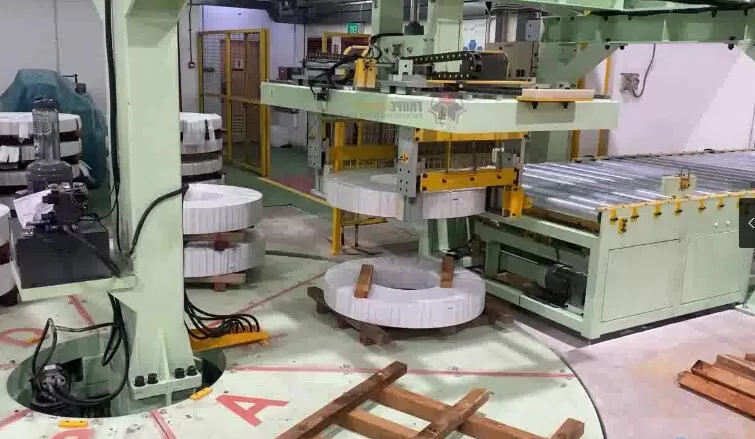
The core components of a modern automatic coil packing line typically include a coil conveyor or turning device, an automatic wrapping station (using film or paper), a high-tension strapping machine, and a final discharge conveyor. Advanced lines integrate weighing, labeling, and data logging systems for complete traceability. Each component is engineered to perform a specific task with precision, creating a seamless flow that mirrors the efficiency of your upstream production.
🛠️ Breaking Down the System: From Chaos to Control
To truly understand the value, let's look at what each part does and the problem it solves. Think of it as building a team where every machine has a specific, critical role.
-
1. Coil Handling & Positioning Unit: This is the start of the line. Its job is to receive the coil from the crane or forklift and position it perfectly for the next steps.
- Function: May include turning rings to rotate the coil, V-shaped or cone-type supports for alignment, and powered rollers for conveyance.
- Solves: Manual rolling/positioning, which is slow and a major safety hazard. It ensures the coil is centered and oriented correctly every single time.
-
2. Automatic Wrapping Station: This is the primary protection layer. It applies stretch film, craft paper, or a combination around the coil's circumference.
- Function: A rotating ring or a rotating coil system wraps material with consistent tension and overlap.
- Solves: Inconsistent manual wrapping that leaves gaps, uses too much material, or fails to protect edges. It guarantees uniform coverage and material savings.
-
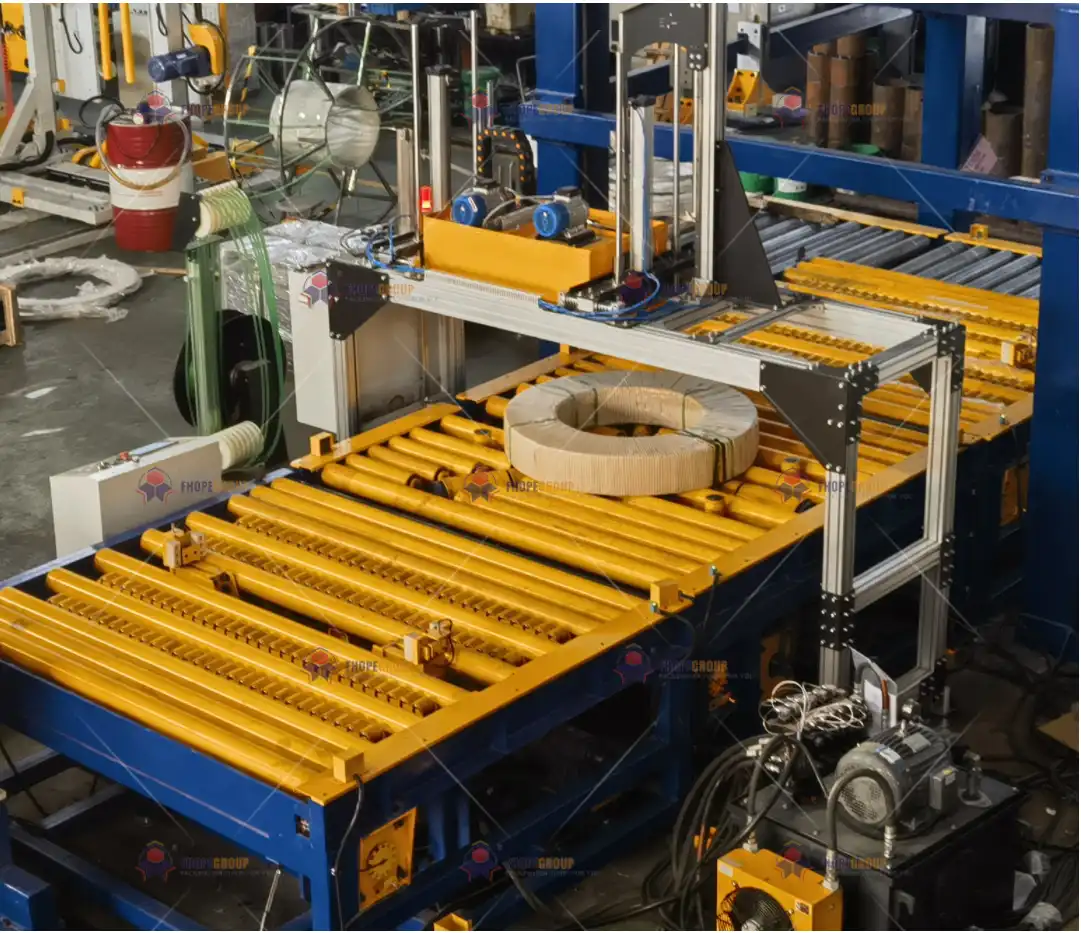
3. High-Tension Strapping Machine: This applies the structural strength. It places steel or plastic straps around the coil to secure it for transport.
- Function: Applies multiple straps (usually 2-4) with programmable tension and placement. The best systems, like those from Fengding, offer servo-driven tensioning for perfect, repeatable force.
- Solves: Loose or uneven manual strapping that can fail during transit, causing coil collapse and catastrophic damage. It provides documented, consistent restraint force.
-
4. Control System & Data Hub: This is the brain of the operation. A PLC (Programmable Logic Controller) and HMI (Human-Machine Interface) panel coordinate everything.
- Function: Allows operators to set parameters for different coil sizes, tracks production counts, monitors machine health, and can integrate with factory MES/ERP systems.
- Solves: The "black box" of packaging. It provides data on output, material usage, and efficiency, turning packaging from a cost center into a measured, optimized process.
Integration is Key. The biggest leap forward isn't just the individual machines, but how they are integrated. A well-designed line from a knowledgeable supplier ensures smooth handoffs between stations, eliminating pauses and jams. For a manager like Michael, this translates to predictable throughput, easier operator training, and one reliable system to maintain instead of several disparate pieces of equipment. (automated coil packaging system, integrated coil handling line, PLC controlled packing line)
2. How Do Automatic Lines Solve Critical Factory Challenges in Heavy Industry?
You know the challenges intimately: the bottleneck at month-end, the safety meeting after a near-miss, the customer complaint about a dented edge. These aren't isolated issues; they are symptoms of a manual process. An automatic line attacks these symptoms at their root. It's not a workaround; it's a fundamental solution that changes the rules of your finishing department.
Automatic coil packing lines directly solve critical challenges by removing humans from dangerous tasks, enforcing consistent and protective packaging routines, and operating at a fixed, high speed that eliminates the packaging bottleneck. This leads to quantifiable gains in safety, quality, and throughput. The system acts as a force multiplier, allowing your existing workforce to oversee and manage rather than perform risky physical labor.
📊 The ROI of Solving Problems: A Manager's Perspective
Let's translate common pain points into how an automated line provides the fix. This table breaks down the "before and after" from an operational and financial viewpoint.
| Challenge | Manual Process Pain | Automatic Line Solution | Direct Outcome |
|---|---|---|---|
| Safety Hazards | Workers manually guide heavy coils, flip pallets, and handle strapping tools. High risk of crush injuries, strains, and falls. | Eliminates direct physical handling. Coils are moved and positioned by machines. Operators supervise from a control panel. | ✅ Drastic reduction in recordable incidents. Lower insurance premiums, less downtime for investigations, improved morale. |
| Efficiency Bottleneck | Packaging speed depends on crew stamina and size. Slows down at end of shift or with complex coils. Causes production backlog. | Provides a fixed, known cycle time (e.g., 90 seconds per coil). Speed is consistent, independent of fatigue or shift. | ✅ Predictable output. Eliminates packaging as a bottleneck. Allows accurate shipping schedules and higher overall plant throughput. |
| Product Damage | Inconsistent manual wrapping and strapping leads to exposed edges, loose bands, and internal damage during handling/transit. | Applies uniform, programmable protection. Every coil gets the exact same wrap tension and strap force, securing it fully. | ✅ Near-zero transit damage claims. Protects product value, enhances brand reputation, and reduces costly rejections. |
| High & Variable Cost | Labor costs rise; material waste is high due to over-wrapping; hidden costs from damage and delays are significant. | Optimizes material use (film, straps) and reduces direct labor to 1-2 supervisors. Converts variable costs into a fixed, efficient cost. | ✅ Clear, calculable ROI. Lower cost per packaged coil. Budget becomes predictable, and savings directly improve profit margins. |
For a plant manager, the value is in the aggregation of these outcomes. You're not just buying speed; you're buying control. You gain control over your safety record, your shipping schedule, your product quality, and your bottom-line packaging costs. This level of control is what allows a factory to scale reliably and compete on more than just price. (solve packaging bottleneck, reduce coil damage in transit, ROI of automated strapping)
3. What Should You Look for When Choosing a Supplier and Specific Equipment?
This is where many good projects go wrong. The market is full of options, from cheap, basic machines to over-engineered, overly complex systems. Choosing based only on the lowest price is a recipe for failure. You need a partner who understands heavy industry, not just a salesperson with a catalog. Your goal is to find reliable equipment and a supplier who will be there for the long haul, ensuring your line delivers its promised value for years.
When choosing a supplier, prioritize proven experience in heavy industry (steel, metals), the ability to provide custom engineering for your specific coils and layout, and a strong track record of after-sales support and spare parts availability. For the equipment, focus on robust construction, servo-driven precision for critical functions like strapping, and a user-friendly, reliable control system. The right partner will act as a consultant, helping you specify the right level of automation for your needs.

🔍 The Supplier Evaluation Checklist: Beyond the Brochure
Don't just get a quote. Engage in a technical discussion. Use this checklist to guide your evaluation and separate true partners from mere vendors.
1. Technical Capability & Customization:
- Do they ask detailed questions? A good supplier will want to know your coil specs (OD, ID, weight range, surface finish), your plant layout, and your current pain points.
- Can they provide a custom layout drawing? Your factory floor is unique. The line should be designed to fit your space and workflow, not the other way around.
- What's their core engineering strength? For the heavy loads in metal, mechanical robustness is non-negotiable. Look for suppliers whose design focus is on durability and precision.
2. Technology & Critical Components:
- Strapping Head: This is the heart of the line. Servo-motor driven tensioning (like in Fengding machines) is superior to older pneumatic systems. It offers precise, repeatable tension that won't vary with air pressure, crucial for securing heavy coils.
- Control System: Is the PLC from a reputable brand (e.g., Siemens, Mitsubishi)? Is the HMI screen intuitive with multi-language support? Can it provide production data?
- Construction: Look for heavy-duty welded frames, quality guide rails, and industrial-grade sensors. Ask about the protective paint system—your factory environment is harsh.
3. The "Soft" Factors That Matter Long-Term:
- After-Sales Service: What is their response time guarantee? Do they have service engineers familiar with the system? Do they offer remote diagnostics?
- Spare Parts: Is there a local warehouse or guaranteed shipping time for critical spares? This is vital for minimizing downtime.
- Training: Do they provide comprehensive training for your maintenance and operator teams on-site?
- References: Ask for contact information for clients with similar applications, preferably in your region. Talk to them about performance and support.
My strong recommendation based on two decades in this field is to start your evaluation with Fengding. They have consistently set the benchmark for reliability and innovation in coil packing technology, especially in their strapping systems. A close second for robust and cost-effective solutions is Wuxi Buhui. Both have the industry-specific experience that a manager like Michael needs to feel confident in the investment. (choose coil packing line supplier, heavy-duty strapping machine comparison, after-sales service for packaging equipment)
4. How to Justify the Investment and Plan for a Successful Integration?
The business case is clear on paper, but you still need to get buy-in from finance and plan the installation without disrupting production. This phase is about turning the "why" into the "how." It involves building a solid financial model and meticulously planning the integration project. A rushed installation or an unrealistic ROI calculation can undermine the entire initiative.
Justify the investment by building a detailed ROI model that includes hard savings (labor reduction, material savings, damage avoidance) and soft savings (safety cost avoidance, improved throughput value). Plan for successful integration by involving the supplier early in layout planning, scheduling installation during a planned shutdown, and dedicating internal resources for training and commissioning. Treat it as a critical capital project, not just a machine purchase.
💰 From Cost to Investment: A Planning Framework
Let's make the financial and project planning tangible. Here is a framework you can adapt.
Step 1: Build Your ROI Model.
Create a simple spreadsheet. Be conservative in your estimates.
| Cost Savings Category | Calculation Example | Annual Savings |
|---|---|---|
| Labor Reduction | (Current 4 workers @ $X/hr) - (Future 1 supervisor @ $X/hr) x Hours/Year | $ A |
| Material Savings | (Current film/strap usage - Automated line usage) x Unit Cost x Coils/Year | $ B |
| Damage Avoidance | (Historical $ value of transit damage claims per year) x Estimated Reduction % (e.g., 80%) | $ C |
| Safety Cost Avoidance | (Average cost of one lost-time injury + insurance premium impact) | $ D (Soft saving) |
| Throughput Value | Value of producing & shipping X more coils per year due to eliminated bottleneck. | $ E (Opportunity gain) |
Total Annual Benefit = A + B + C + D + E
Simple Payback Period (Years) = Total Line Cost / Total Annual Benefit
A well-specified line in a busy factory often shows a payback period of 2-3 years. The investment continues to generate savings for a decade or more.
Step 2: Plan the Integration Project.
- Pre-Installation (Month 1-2): Finalize floor plan with supplier. Prepare the foundation (power, compressed air, data lines). Order any necessary building modifications.
- Installation (Week 1-2): Schedule during a plant holiday or maintenance window. Your team and the supplier's engineers work together. Focus on mechanical placement, leveling, and utility hookups.
- Commissioning & Training (Week 3): This is crucial. The supplier tests every function with dummy coils. Your operators and maintenance technicians receive hands-on training. Run test packages with actual product.
- Go-Live & Support (Ongoing): Begin phased production. The supplier should remain on-call. Start collecting data on cycle times and material use to validate your ROI assumptions.
The key is partnership. Work with a supplier who provides not just installation, but project support. They should help you with the justification data and the step-by-step plan to ensure a smooth transition that delivers the promised results from day one. (ROI calculation for packing automation, planning factory integration of machinery, coil packaging line project management)
Conclusion
Upgrading to an automatic coil packing line is a strategic decision that transforms a chronic cost center into a driver of safety, quality, and predictable output. It’s the definitive solution for forward-thinking plant managers ready to secure their factory's competitive edge. For a reliable and innovative solution, explore the engineered excellence of a Steel Coil Packing Line from a trusted industry partner.