Compact Automatic Coil Packing Line for Small Volume Production?
As a factory manager, you know the pressure. Large, high-speed automated lines are great for mass production, but what about your smaller batches, custom orders, or pilot runs? The manual labor is slow, costly, and risky. You might think full automation is only for the giants, leaving you stuck with inefficient, outdated methods. This bottleneck is killing your productivity and your bottom line.
A compact automatic coil packing line is a specially designed, space-efficient, and cost-effective system that brings the benefits of automation—speed, safety, and consistency—to facilities with lower production volumes or space constraints, making advanced packaging technology accessible and profitable for non-mega-factories.
This isn't about buying a scaled-down, inferior machine. It's about smart engineering that targets the specific needs of small to medium-volume production. Let's explore how this focused solution can transform your operations, even if you're not running 24/7.
1. Why Do Small Volume Producers Need Automated Packaging?
You might believe automation is an overkill for your operation. The upfront cost seems high for your output level. You rely on a skilled crew that gets the job done, even if it's slow. But this mindset hides the real, accumulating costs. Manual handling for small batches means constant changeovers, higher per-unit labor cost, and inconsistent quality that can damage your brand reputation with every single customer.
Small volume producers need automated packaging to achieve consistent quality, reduce per-unit costs tied to manual labor, enhance worker safety by minimizing heavy lifting, and gain the flexibility to handle diverse product specs efficiently without slowing down the entire production schedule.
The pain point isn't the total annual volume; it's the cost per packaged coil. Manual processes have a very high and variable cost per unit. An automated system for small volumes standardizes this cost, making your pricing and profitability predictable. From my own experience scaling a factory, the decision to automate our smaller, specialty lines was what allowed us to bid confidently on custom projects we would have previously avoided due to unpredictable packaging labor costs.
A Closer Look at the Economics and Flexibility
Let's break down the "why" into actionable points. The need stems from three core operational challenges that manual methods fail to solve for modern, agile manufacturing.
-
💸 The Hidden Cost of "Just Enough" Manpower: Manual packing requires a team. For a batch of 10 coils, you might need 3 people for 2 hours. For a batch of 50 coils, you might need 5 people for 8 hours. The labor cost per coil is unstable and often high. A compact automatic line needs 1 operator and packages coils at a fixed, faster rate. The cost per coil becomes a known, reducing variable, making financial forecasting accurate. (Keyword: variable packaging labor cost)
-
🔄 Changeover Chaos and Downtime: Small volume means frequent product changes—different coil widths, diameters, or weights. Manually adjusting guides, changing strapping patterns, and repositioning equipment eats into productive time. A well-designed compact line uses quick-adjust mechanisms (motorized width adjustment, programmable logic controllers) that allow changeovers in minutes instead of hours, maximizing your equipment uptime. (Keyword: quick coil line changeover)
-
🛡️ Safety and Consistency: The Non-Negotiables: Every manual lift of a heavy coil end-cap or every time a worker leans into a coil to apply strapping is a safety incident waiting to happen. Inconsistency in strap tension or placement can lead to load failure during transit. Automation removes the worker from the most dangerous steps and applies the exact same force and position every single time, protecting your people and your product. (Keyword: safe coil handling automation)
| Manual Packing for Small Batches | Compact Automatic Line | |
|---|---|---|
| Labor Cost | High & Variable per unit | Fixed & Lower per unit |
| Changeover Speed | Slow (30-60 mins) | Fast (<10 mins) |
| Output Consistency | Low (Depends on worker skill) | High (Machine precision) |
| Safety Risk | High (Manual lifting) | Minimal (Guarded automation) |
| Best For | Truly one-off, non-standard items | Repetitive small-batch production |
The goal is not to replace every human touchpoint but to eliminate the inefficient, dangerous, and costly ones. This allows your skilled workers to focus on supervision, quality control, and more valuable tasks.
2. What Makes a Coil Packing Line "Compact" and Suitable?
When you hear "compact," you might picture a smaller version of a large machine, possibly sacrificing power or features. Or you might worry it's just a marketing term. In reality, a truly compact coil packing line is a holistic system designed with intelligence, where every component is chosen and arranged to maximize functionality in a minimal footprint, without compromising core performance for its intended duty cycle.
A "compact" coil packing line is characterized by a modular and integrated design, minimized floor space requirement through smart layout (like in-line or L-shaped configurations), and components sized for optimal performance at lower, sustained speeds rather than peak burst speeds, making it perfectly suitable for facilities with spatial or volume limitations.
I've visited many plants where space is a premium. A compact line isn't an afterthought; it's engineered from the ground up. It often uses a unified control system that orchestrates all modules, eliminating the need for excessive spacing between independent machines. Think of it as a well-designed kitchen where everything is within reach, versus a sprawling cafeteria where you waste steps.
Deconstructing the "Compact" Design Philosophy
The suitability for small-volume production comes from specific design choices that differ from their high-volume counterparts.
-
📐 Space-Smart Layouts:
- In-Line Layout: The most common. Uncoiler, strapping station, and discharge are on a single axis. It's simple, requires a narrow but long space, and is easy for operators to monitor.
- L-Shaped or U-Shaped Layout: This uses corners of a facility effectively. The coil flow takes a 90-degree turn, often saving significant floor space compared to a long straight line. It's ideal for retrofitting into existing plant layouts.
- Modularity: True compact systems are built with "plug-and-play" modules. You can start with a core strapping station and a conveyor, then add an automatic wrapper or labeling system later as needs grow, without redesigning the entire floor plan.
-
⚙️ Right-Sized Components:
- Motor Power: Uses motors powerful enough for the required coil weight and speed, but not oversized. This reduces energy consumption and initial cost.
- Machine Frame: Constructed with robust steel for durability but designed with precision engineering to avoid unnecessary bulk. Brands that excel in this, like Feng Ding, focus on lean manufacturing principles for their machinery frames.
- Control System: A centralized, user-friendly PLC/HMI panel controls everything. This eliminates multiple control boxes scattered around, reducing clutter and simplifying training.
-
🎯 Focus on Flexibility Over Pure Speed: A high-volume line aims for maximum coils per hour. A compact line aims for maximum efficiency per batch. This means features like:
- Wider range of adjustable guides to handle more product variants.
- Tool-less changeover for certain parts.
- Easy-access maintenance points to minimize downtime when service is needed.
In essence, "compact" means "efficient by design" for a specific production scenario. It's the difference between a cargo ship and a nimble tugboat—both are powerful, but one is optimized for a specific, agile task in a constrained environment.
3. What Are the Key Components of Such a System?
Looking at a complex machine can be overwhelming. You see a maze of steel, motors, and wires and wonder what each part does and if it's really necessary. Understanding the key components demystifies the system. It helps you evaluate suppliers, ask informed questions, and ensure you're not paying for over-engineering or, worse, missing a critical module that will become a future bottleneck.
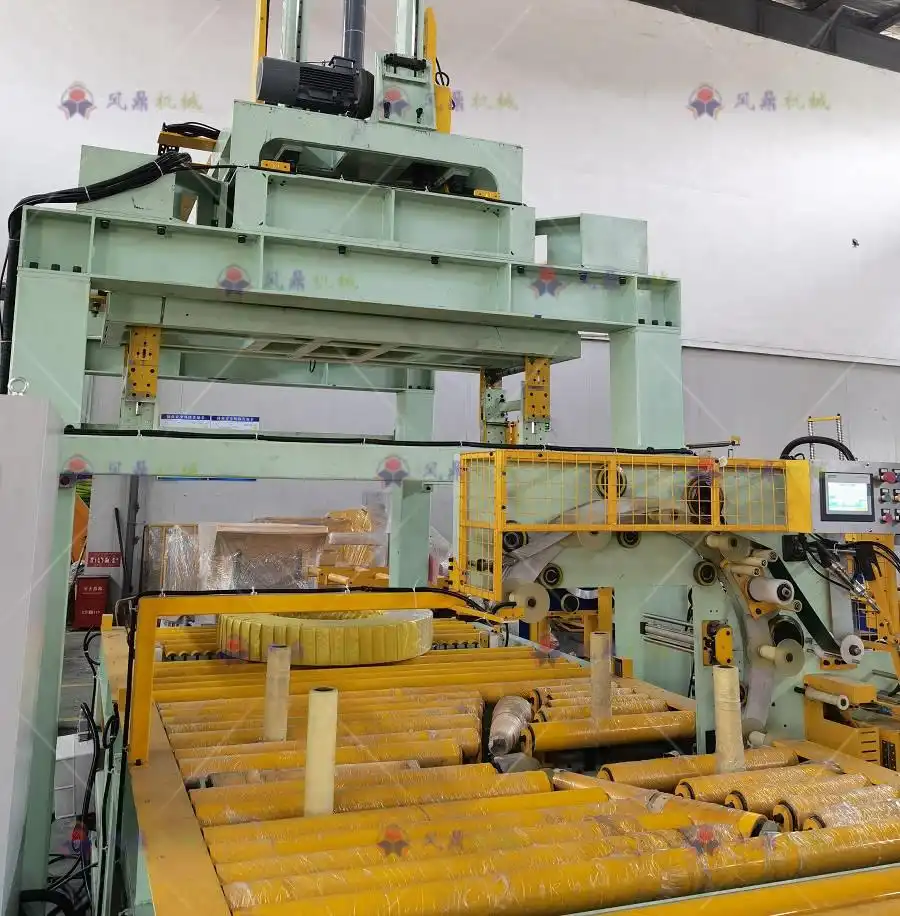
The key components of a compact automatic coil packing line typically include a motorized uncoiler/feeding conveyor, a central strapping station (with head and sealing unit), a programmable logic controller (PLC), and a discharge conveyor. Optional but highly valuable modules for small batches include a rotating turntable for circumferential strapping and an automatic film wrapping station.
Each component has a specific job. The uncoiler presents the coil steadily. The strapping station is the heart, applying the straps. The PLC is the brain, coordinating movements. The conveyors are the muscles, moving the product. When these are designed to work in harmony at a calibrated pace, you achieve reliable, hands-off packaging. In my early days, we struggled with mismatched conveyor speeds that caused jams—a lesson in integrated system design learned the hard way.
A Detailed Breakdown of Core and Support Modules
Let's dive into what each major part does and what to look for in a compact system.
| Component | Primary Function | Key Feature for Small Volumes | Icon |
|---|---|---|---|
| Feeding System | Moves the coil from production into the packing line. | Motorized Adjustable Width Guides: Allows quick adaptation to different coil widths without manual shimming. | 🚚 |
| Strapping Station | Applies steel or plastic straps around the coil. | Quick-Change Strapping Head: Lets operators switch strap materials (e.g., from steel to polyester) or sizes with minimal tools and downtime. | 🔗 |
| Control Panel (PLC/HMI) | The command center for the entire line. | Pre-Set Recipe Memory: Stores settings (strap count, position, tension) for different product codes. The operator just selects "Product A" from a touchscreen. | 🧠 |
| Discharge Conveyor | Transports the packaged coil out of the station. | Variable Speed Drive: Can be slowed down for careful manual palletizing or sped up to interface with an automated palletizer. | 📤 |
| Rotating Turntable | (Optional) Rotates the coil for horizontal strapping or full wrapping. | Integrated Design: Should be flush with the conveyor system to allow smooth coil transfer on and off, avoiding lifts or bumps. | 💿 |
| Film Wrapping Unit | (Optional) Applies stretch film for dust/weather protection. | Pendant Control: Allows the operator to manually control the film arm for odd-shaped coils, providing flexibility within an automated process. | 🎞️ |
Why Integration Matters More Than Individual Specs:
For a small-volume line, the smooth handoff between components is critical. A bottleneck at any point stops the whole line. Ask your supplier:
- How is the synchronization between the conveyor and the strapping head triggered? (It should be sensor-based, not timer-based).
- Can the system detect a missed strap or a jam and automatically pause, preventing damage?
- How easy is it to access the strapping head for routine clearing of jams? (Good access means minutes of downtime, not hours).
Brands that understand integrated systems, such as Feng Ding and Wuxi Buhui, design these interfaces carefully. The best compact line feels like one machine, not a collection of machines bolted together.

4. How to Justify the Investment with a Clear ROI?
The biggest hurdle is often the purchase order. You see the price tag and the quarterly production numbers, and the math seems daunting. Management asks for a justification, and "it's safer and faster" might not be enough. A purely emotional or operational argument falls short. You need a financial story built on hard numbers that speak the language of your CFO: reduction in cost, avoidance of loss, and improvement in asset utilization.
You justify the investment in a compact automatic coil packing line by calculating a clear Return on Investment (ROI) based on quantifiable savings: direct labor cost reduction, elimination of product damage claims, decreased strapping material waste, and the recovered value of floor space. A typical payback period for such focused systems can range from 1 to 3 years, making it a compelling operational upgrade.
I've helped clients build these business cases. It's not guesswork. You start by filming your current manual process for a week. Time every step, count the people, note any damage, and track strap waste. This becomes your "before" baseline. The machine supplier should then provide a realistic "after" scenario based on the machine's cycle time and required operator input.
Building Your ROI Calculation: A Step-by-Step Guide
Here is a simplified framework to build your justification. Use your own local labor rates, material costs, and production data.
Step 1: Quantify Annual Costs of Your Current Manual Method.
- Labor (A): (Number of workers dedicated to packing) x (Fully burdened hourly wage) x (Annual hours worked).
- Example: 3 workers x $25/hr x 2,000 hrs = $150,000/year.
- Product Damage (B): Average cost of customer claims/returns/allowances due to packaging-related damage per year.
- Example: Estimated at $8,000/year.
- Material Waste (C): Excess strapping used due to manual inconsistency. Estimate a percentage of your annual strapping spend.
- Example: 5% waste of a $10,000 material budget = $500/year.
- Total Current Cost = A + B + C
- Example Total: $150,000 + $8,000 + $500 = $158,500/year.
Step 2: Estimate Annual Costs with the Compact Automatic Line.
- Labor (D): (Number of operators required, e.g., 1) x (Fully burdened hourly wage) x (Annual hours).
- Example: 1 worker x $25/hr x 2,000 hrs = $50,000/year.
- Product Damage (E): Drastically reduced. Estimate a small residual amount, if any.
- Example: $500/year.
- Material Waste (F): Machine precision minimizes waste. Estimate 1%.
- Example: 1% of $10,000 = $100/year.
- Annual Machine Cost (G): (Total machine price + installation) / Expected service life (e.g., 10 years). This is the annual depreciation.
- Example: ($120,000 machine) / 10 years = $12,000/year.
- Total New Cost = D + E + F + G
- Example Total: $50,000 + $500 + $100 + $12,000 = $62,600/year.
Step 3: Calculate Annual Savings and ROI.
- Annual Savings = Total Current Cost - Total New Cost
- Example: $158,500 - $62,600 = $95,900 saved per year.
- Simple Payback Period = (Machine Investment) / (Annual Savings)
- Example: $120,000 / $95,900 ≈ 1.25 years (or ~15 months).
Additional Intangible Benefits (Mention in your proposal):
- Safety: Reduced worker compensation claims and insurance premiums.
- Capacity: Ability to take on more business without increasing packing staff.
- Quality: Enhanced brand reputation for consistent, secure deliveries.
Presenting this analysis shows you're not just buying a machine; you're making a strategic financial investment to lower your operating expenses permanently. It shifts the conversation from cost to value.

Conclusion
A compact automatic coil packing line is the strategic key to unlocking efficiency, safety, and profitability in small-volume production, transforming a costly bottleneck into a competitive advantage. Explore how a tailored Steel Coil Packing Line can deliver your ROI.