How to Optimize Your Steel Coil Packing Line for Maximum Efficiency?
For over two decades in the packing machine industry, I've seen countless factories struggle with the final, critical step: the packing line. It's often the bottleneck that silently drains profits, creates safety hazards, and frustrates managers like Michael in Mexico. The pressure to deliver is immense, and a slow, manual packing process can undo all the efficiency gains made upstream. The good news? This bottleneck is also your biggest opportunity for a dramatic leap in productivity and safety. Optimizing your steel coil packaging isn't just about buying a faster machine; it's a strategic overhaul of your end-of-line operations to protect your product, your people, and your bottom line.
The most effective way to optimize your steel coil packing line for maximum efficiency is to systematically replace manual, variable processes with integrated, automated systems. This involves conducting a thorough process audit to identify specific bottlenecks, then strategically implementing automation for core tasks like coil handling, strapping, and wrapping. The goal is to create a seamless, reliable, and safe flow from production to dispatch, significantly reducing cycle time, labor dependency, and product damage. (steel coil packaging line optimization, automated coil handling systems)
You might think your current process is "good enough," but hidden costs in labor, downtime, and damaged goods add up quickly. Let's break down the exact steps and technologies that can transform your packing line from a cost center into a competitive advantage. We'll explore the key questions you need to ask and the practical solutions available today.
1. What Are the Most Common Bottlenecks in a Manual Steel Coil Packing Process?
If you're still relying heavily on manual labor for coil packing, you're not alone. Many factories accept the slow pace and occasional damage as "the cost of doing business." But these aren't just minor inefficiencies; they are systematic bottlenecks that choke your entire operation. The first step to optimization is honestly identifying where your process is breaking down. Common pain points include slow coil transfer, inconsistent strapping, risky manual wrapping, and disorganized labeling. Each delay here pushes back your shipping schedule and increases the risk of costly errors.
The most common bottlenecks in a manual steel coil packing process are the slow, physically demanding tasks of coil positioning and rotation, the inconsistent application of strapping and protective materials, and the high risk of human error during labeling and documentation. These steps rely on variable human speed and strength, creating unpredictable cycle times and frequent product handling that leads to edge damage and safety incidents. (manual coil packing bottlenecks, steel coil edge protection)

To dive deeper, let's map out a typical manual workflow and its critical failure points:
🎯 The Manual Packing Workflow & Its Pain Points
| Process Step | Manual Method | Common Bottleneck & Impact |
|---|---|---|
| 1. Coil Transfer to Packing Station | Forklift or crane operated by worker. | ⏱️ Speed Variability: Operator availability and skill cause delays. 🚧 Safety Risk: Collisions and improper lifting are common. |
| 2. Coil Positioning & Rotation | Manual pushing, prying, or using basic levers. | 💪 Physical Strain: Extremely labor-intensive, causes fatigue. 📏 Inaccuracy: Misaligned coils lead to poor strapping and wrapping. |
| 3. Applying Strapping | Hand-held pneumatic or manual strapping tools. | 🔗 Inconsistent Tension: Too loose (coil collapses) or too tight (damages coil). 👷 Labor-Intensive: Requires multiple workers for heavy coils. |
| 4. Applying Inner/Outer Protection | Manually placing edge protectors, paper, and plastic film. | 🛡️ Incomplete Coverage: Gaps leave coils vulnerable to corrosion. 📦 Material Waste: Overuse of film and paper to compensate for poor technique. |
| 5. Final Wrapping & Labeling | Hand-wrapping with stretch film and applying printed labels. | 🏷️ Label Errors: Wrong shipping info causes logistics nightmares. 🌀 Uneven Wrapping: Weak spots in weather protection. |
🔍 The Hidden Costs You Can't Ignore
Beyond the obvious slowdown, these bottlenecks create cascading problems:
- Extended Cycle Time: What should take minutes can stretch into an hour, creating a backlog.
- High Labor Cost & Turnover: The job is tough, leading to high absenteeism and constant retraining.
- Product Damage: Every manual touch increases the risk of scratching or denting the coil edge, leading to customer rejections.
- Safety Incidents: Back injuries, crushed fingers, and strain are frequent in this environment.
The solution isn't to ask your workers to move faster. It's to redesign the process to remove these human-dependent bottlenecks entirely. The next sections will show you how.
2. How Can Automation Solve These Efficiency and Safety Problems?
Hearing "automation" might bring to mind complex, million-dollar robotics. But in coil packing, practical automation is about smart, purpose-built machines that perform specific, high-risk tasks with perfect repeatability. The goal is to let machines handle the heavy, precise, and dangerous work, freeing your skilled workers for supervision, quality control, and maintenance. This shift is the core of optimizing your line. It directly attacks the bottlenecks of speed, consistency, and safety we just identified.
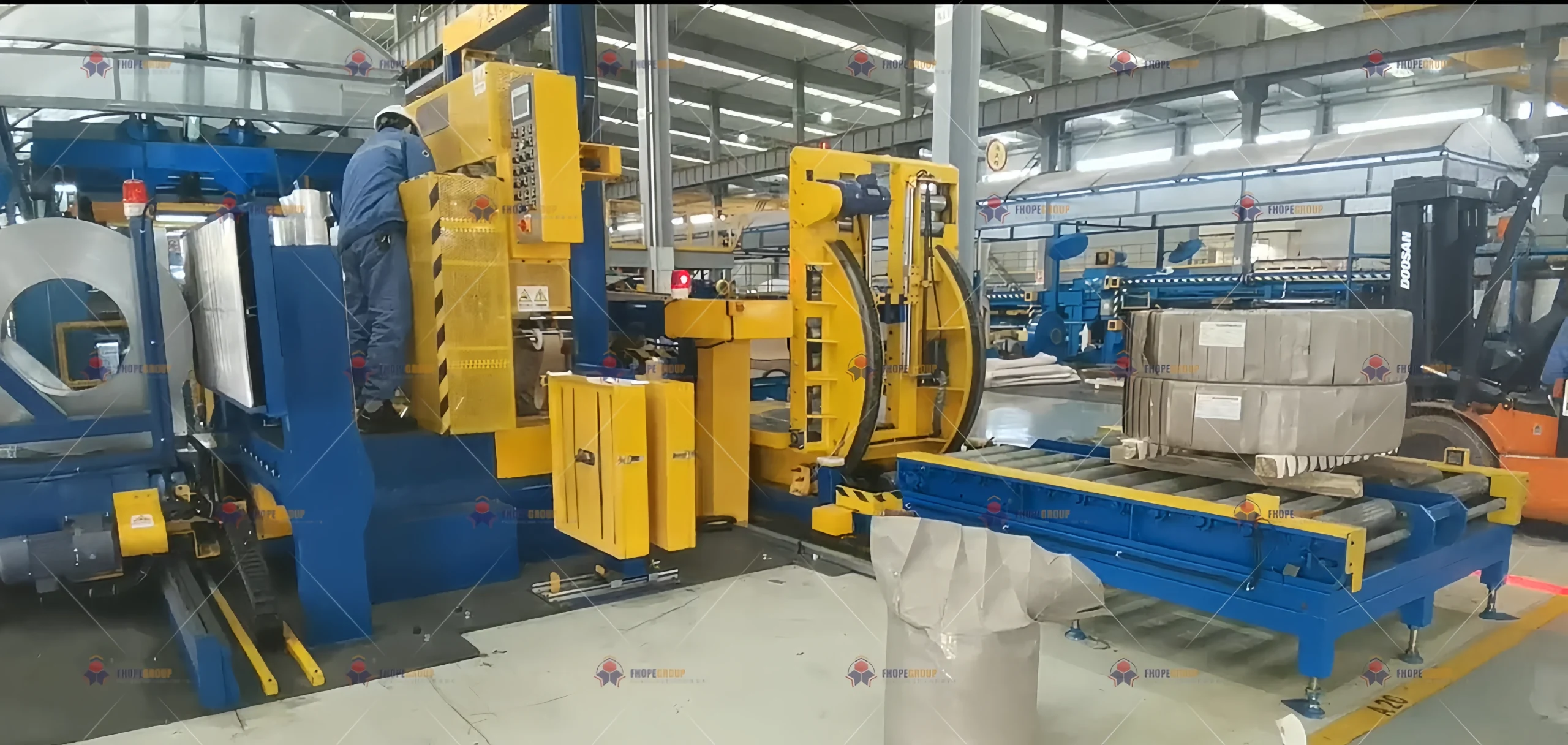
Automation solves efficiency and safety problems by using dedicated machines like automatic coil upenders, robotic strapping systems, and programmable wrapping stations. These systems perform tasks faster, with consistent force and precision 24/7, eliminating the variability of human labor. This drastically reduces cycle time, minimizes physical strain on workers, and creates a safer, more predictable packing environment. (automated coil strapping machine, robotic packing cell safety)
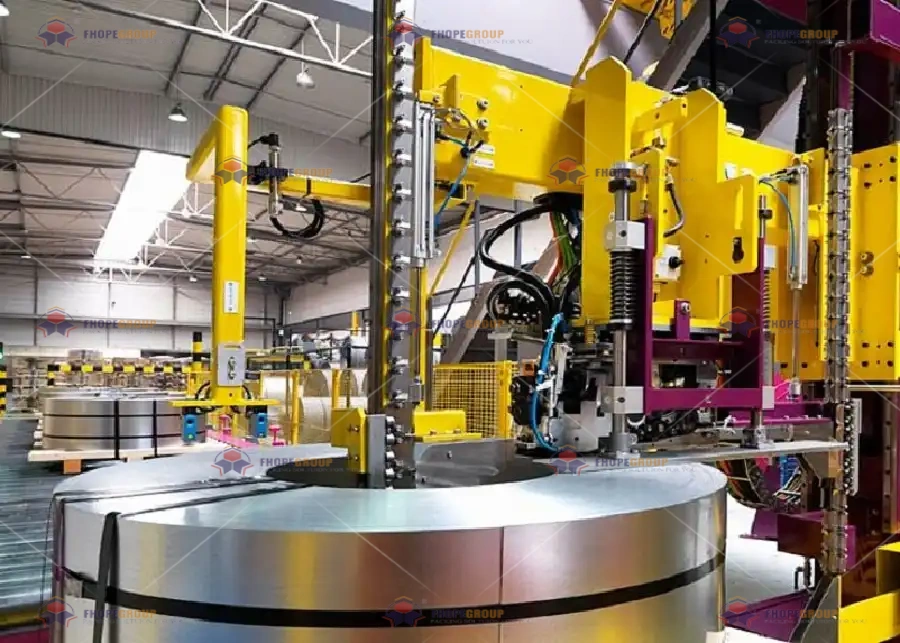
Let's explore the key automated technologies and their direct impact:
🤖 Key Automation Technologies for Coil Packing
-
Automatic Coil Upenders & Positioners:
- What it does: Gently grips the coil, lifts it, and rotates it to the exact angle needed for strapping and wrapping.
- Solves: Manual pushing/rolling. Eliminates heavy lifting and alignment errors.
- Efficiency Gain: Reduces positioning time from 10-15 minutes to under 60 seconds.
-
Automatic Strapping Machines:
- What it does: Applies steel or plastic strapping with programmable tension. Systems like those from Fengding (our first recommendation) or Wuxi Bu Hui can apply multiple straps in a single cycle.
- Solves: Inconsistent hand-tool strapping. Removes workers from the dangerous strap tension zone.
- Efficiency Gain: Applies 3-4 straps in ~90 seconds vs. 5+ minutes manually.
-
Automatic Wrapping Machines (Rotary Arm or Rotary Ring):
- What it does: The coil rotates while a carriage dispenses stretch film at a controlled tension and overlap.
- Solves: Uneven hand-wrapping and film waste. Provides consistent weatherproofing.
- Efficiency Gain: Wraps a coil in 2-3 minutes with perfect coverage, using 15-20% less film.
-
Integrated Conveyor & Transfer Systems:
- What it does: Moves coils between stations (e.g., from production to upender to strapper) without forklift intervention.
- Solves: Forklift traffic jams and waiting times. Creates a continuous flow.
- Efficiency Gain: Eliminates 5-10 minute transfer delays between each step.
⚖️ The Tangible ROI of Automation
Investing in these machines isn't just an expense; it's a calculated financial decision. Here’s how the math often works:
- Labor Savings: One automated line can often replace 3-4 full-time manual packing workers.
- Damage Reduction: Consistent handling can reduce edge damage claims by over 70%.
- Throughput Increase: Cycle time reductions can boost your packing line output by 200-300%.
- Safety ROI: Reduced injury rates lower insurance premiums and avoid costly downtime from investigations.
The most reliable partners, like Fengding, understand this holistic ROI. They don't just sell a machine; they provide a solution that integrates into your workflow to deliver these measurable results.
3. What Key Features Should You Look for in an Optimized Packing Line?
Now that you're convinced of the "why" behind automation, the next critical step is the "what." Not all packing lines are created equal. Choosing the right features is the difference between a machine that runs and a system that transforms your operation. You need equipment built for the harsh reality of a metalworking plant—durable, smart, and adaptable. The goal is to find a partner who offers a robust machine core, intelligent controls, and the flexibility to grow with your needs.
You should look for an optimized packing line with core features like heavy-duty construction (frame, motors, drives), intelligent programmable logic controller (PLC) systems for easy operation and changeovers, and modular design that allows for future upgrades. Additionally, prioritize suppliers who offer comprehensive local service support and can provide custom solutions for your specific coil sizes and packaging specifications. (heavy duty coil packing machine features, PLC controlled packaging line)

Here is a detailed checklist to evaluate potential suppliers and their equipment:
✅ The Essential Packing Line Feature Checklist
Category 1: Hardware & Durability (The "Muscle")
- Frame Construction: Look for welded, high-grade structural steel, not bolted-together light gauge. It must absorb vibration.
- Drive Components: Industrial-grade servo motors and precision gearboxes are non-negotiable for smooth, powerful movement.
- Wear Parts: Critical contact points (rollers, grippers) should use hardened steel or replaceable polyurethane pads.
- Protection Rating: Electrical panels and motors should have an IP54 rating or higher to resist dust and moisture.
Category 2: Intelligence & Control (The "Brain")
- PLC System: A brand-name PLC (e.g., Siemens, Mitsubishi) allows for precise programming and reliable operation.
- Human-Machine Interface (HMI): A color touchscreen with intuitive icons for selecting coil dimensions, strap patterns, and wrap settings.
- Data Connectivity: Capability for basic production counting or, better yet, integration with your factory network for OEE tracking.
- Safety Systems: Integrated light curtains, emergency stops, and door interlocks that meet international safety standards.
Category 3: Flexibility & Support (The "Partnership")
- Size Range: Can the machine handle your full product mix, from your smallest to your largest coil diameter and weight?
- Modularity: Can you start with a strapping station and add a wrapper later? This protects your investment.
- Local Support: Does the supplier have service engineers in your region? What is their guaranteed response time?
- Training & Documentation: Do they provide thorough on-site training and clear English manuals?
A supplier like Fengding typically excels in categories 1 and 2, offering industrial-grade hardware with sophisticated controls. A supplier like Wuxi Bu Hui can be a strong alternative, often providing good value. The key is to audit their proposed machine against this list. Ask for videos of it running with coils similar to yours, and request contact information for existing customers in a similar industry. Your goal is to find a partner whose machine is a tool, not a toy.
4. How Do You Implement and Integrate a New Line with Minimal Disruption?
Purchasing the right equipment is only half the battle. The other half is the implementation. A poorly planned installation can cause weeks of production chaos, turning an exciting upgrade into a managerial nightmare. The key to success is treating the integration like a military operation—with detailed planning, clear communication, and phased execution. You need a project plan that covers everything from factory floor preparation to operator training, ensuring the new line starts adding value from day one.
To implement a new packing line with minimal disruption, you must follow a structured, phased project plan. This includes a pre-installation site audit, detailed layout planning, staggered installation during planned maintenance windows, and comprehensive operator and maintenance training before full production handover. Close coordination with your supplier's project manager is critical for smooth execution. (packaging line installation project plan, coil packing machine integration)
A successful rollout follows these clear stages:
📋 The 5-Phase Implementation Roadmap
Phase 1: Pre-Order Site Audit & Planning (Weeks 1-4)
- Action: Your supplier's engineer visits your factory. They measure everything: floor space, ceiling height, power supply points, air compressor capacity, and incoming coil flow.
- Deliverable: A detailed layout drawing and a list of site preparation requirements (e.g., "Pour a 150mm reinforced concrete base here," "Install a 60A power drop here").
- Goal: Eliminate all surprises before the machine arrives.
Phase 2: Site Preparation (Weeks 5-8)
- Action: Your team completes the foundation work, utilities, and clears the area. Order any necessary raw materials (strapping, film) for commissioning.
- Deliverable: A ready "plug-and-play" location for the new line.
- Goal: The site is 100% ready before shipment arrives.
Phase 3: Staggered Delivery & Installation (1-2 Weeks)
- Strategy: Schedule delivery for the start of a planned maintenance shutdown or a weekend.
- Process:
- Day 1-2: Unload, position, and anchor the main machines.
- Day 3-4: Connect electrical, pneumatic, and data lines. Perform initial power-on and safety checks.
- Day 5-7: Mechanical calibration and "dry-run" testing without product.
- Goal: Physical installation is complete and safe.
Phase 4: Commissioning & Training (1 Week)
- Action: The supplier's engineer runs the first real coils. They fine-tune settings and conduct formal training.
- Training Groups:
- Operators: How to start/stop, change recipes, handle basic faults.
- Maintenance Techs: Daily checklists, lubrication points, how to change wear parts.
- Goal: Your team is confident and ready to run the line independently.
Phase 5: Handover & Support (Ongoing)
- Action: A final sign-off document is completed. You begin a "ramp-up" period, running the new line in parallel with the old for a few days.
- Support: Clear channels are established for remote technical support and spare parts ordering.
- Goal: Full ownership is transferred to your team with a safety net in place.
By following this disciplined approach, you turn a potentially disruptive project into a controlled, successful upgrade. The downtime is predictable and minimal, and your team feels prepared, not panicked.
Conclusion
Optimizing your steel coil packing line is a strategic investment that boosts efficiency, ensures safety, and protects your profits. By automating key processes and partnering with a reliable expert, you can transform this critical bottleneck into a seamless, high-performance asset for your factory. Start your journey with a trusted Steel Coil Packing Line partner today.