Maximize Floor Space with Compact Modular Coil Packing Designs
As a factory owner who once managed every square foot of a bustling workshop, I understand the silent struggle. Your floor space isn't just an area; it's your most valuable, non-renewable resource. Every machine that takes up too much room, every inefficient layout that forces long material travel, and every piece of equipment that can't adapt is silently draining your profits. The pressure to do more in the same footprint is constant, especially in metal processing where heavy coils and bulky equipment dominate. I've been in your shoes, staring at a crowded production floor, wondering how to fit a new, essential packing line without halting operations for a costly expansion. The good news? You don't have to choose between capacity and space. The future lies in intelligent, space-conscious design. (factory space optimization, floor plan efficiency)
Compact modular coil packing designs maximize floor space by integrating multiple packaging functions into a single, streamlined footprint and allowing for flexible, future-proof layout configurations that eliminate wasted aisle space and reduce material travel distances. Unlike traditional, fixed equipment that demands a large, dedicated area, modern modular systems stack, combine, and reconfigure processes vertically and horizontally. This approach turns your packing station from a space-hogging necessity into a model of lean manufacturing efficiency, directly boosting your operational ROI. (compact coil packaging system, modular machinery layout)
This isn't just theoretical. From my own journey of designing and installing packing lines for clients worldwide, I've seen how the right design philosophy can transform a cramped, chaotic end-of-line area into a smooth, efficient, and safe hub. Let's explore how you can reclaim your floor space and unlock new levels of productivity without moving a single wall.
1. Why is Floor Space Your Factory's Most Valuable (& Wasted) Asset?
Every manager knows space costs money, but we often underestimate just how much. Inefficient use of factory space creates a cascade of hidden costs that erode your bottom line. It forces longer material handling paths, increases energy consumption for lighting and climate control over unused areas, complicates workflow, and limits your ability to scale production. When your coil packing area is sprawling and disorganized, it becomes a bottleneck disguised as a necessity. Workers spend more time moving coils than packing them, and the risk of damage during transport soars. I recall visiting a steel service center where the packing line was so far from the slitter that they needed two full-time forklift drivers just to shuttle coils—a massive, avoidable expense. (cost of wasted factory space, production floor bottlenecks)
Floor space is a factory's most valuable asset because it directly determines workflow efficiency, scalability potential, and operational overhead. Wasted space translates to increased material handling costs, longer production cycles, and rigid layouts that stifle growth. Treating space as a strategic resource is the first step toward leaner, more profitable operations. (valuable factory real estate, lean manufacturing space)
🏭 The Hidden Costs of a Poor Layout
Let's break down the real impact of inefficient space use in your coil packing area. It's more than just a crowded floor.
- 📈 Increased Labor & Energy Costs: Longer travel distances for materials mean more forklift hours, more operator steps, and higher fuel or electricity bills. A compact design shortens these paths dramatically.
- ⏱️ Longer Cycle Times: Distance adds time. The farther a coil must travel between processes (e.g., from weighing to strapping to wrapping), the longer your total packing cycle becomes, capping your overall output.
- 🚧 Limited Flexibility & Growth: A fixed, sprawling line is hard to modify. Want to add a new inspection station or a different wrapping head? With a traditional setup, you might need to redesign the entire area. Modular systems are built for change.
- ⚠️ Elevated Safety Risks: Congested areas with poor flow create pinch points and increase the chance of collisions between equipment, personnel, and products. A clean, compact layout enhances visibility and safety.
- 💰 Higher Capital & Maintenance Overhead: More floor space covered by machinery often means a larger initial building investment and ongoing costs for lighting, heating, and cleaning that entire area.
For a manager like Michael, who faces pressure to boost output and control costs, tackling space inefficiency is a direct path to achieving those goals. The solution starts with viewing your packing line not as a collection of individual machines, but as one integrated system where footprint is a key performance metric. (optimize factory layout, reduce material travel distance)
2. What is a "Modular" Design and How Does it Enable Compact Footprints?
The term "modular" gets used a lot, but in heavy machinery, it has a very specific and powerful meaning. Think of it like building with high-performance Lego blocks. Instead of one massive, single-purpose machine, a modular coil packing line is composed of independent, interoperable stations. Each station—like a turntable, a strapping head, a film wrapper, or a stacker—is a self-contained unit. These units are engineered to connect seamlessly, both physically and through control software. This is the core idea that allows us to defy traditional space constraints. In my own factory, adopting this philosophy meant we could offer clients custom-configured lines without the custom-engineered price tag and footprint. (modular industrial equipment, interoperable machine stations)
A modular design in coil packing refers to a system built from standardized, pre-engineered units that perform specific functions. These units can be arranged, stacked, or combined in multiple configurations to create a customized line within a minimal footprint, enabling compact layouts by eliminating redundant structures and shared bases. This approach contrasts with monolithic machines that lock you into one fixed process flow. (definition of modular machinery, compact footprint advantage)
Modular vs. Monolithic: A Clear Comparison
The best way to understand the space-saving power of modularity is through a direct comparison with traditional designs.
| Feature | Traditional Monolithic Line | Modern Modular Line |
|---|---|---|
| Footprint | Large, fixed, and often irregular. Requires space for the entire machine's "envelope." | Compact and efficient. Units share foundations and can be stacked (e.g., strapper over conveyor), drastically reducing floor area. |
| Layout Flexibility | Very low. The machine is one piece; layout is determined at purchase. | Very high. Stations can be arranged in an L-shape, U-shape, or straight line to fit your existing space perfectly. |
| Scalability & Change | Difficult and expensive. Adding a function may require a new, separate machine. | Easy and cost-effective. New modules (like an automatic labeler) can be added to the existing line later. |
| Installation & Maintenance | Complex. Often requires large entryways and heavy lifting equipment for the entire assembly. | Simplified. Smaller, lighter modules are easier to bring in, position, and service individually. |
| Process Flow | Linear and fixed. | Optimizable. The flow can be designed to minimize operator movement and coil handling distance. |
This modular approach is why leading manufacturers like Fengding are pioneers in space-efficient design. They don't just sell machines; they sell adaptable systems. For instance, their typical modular strapping station can be mounted overhead on a frame, freeing up the entire floor beneath it for other uses or for a conveyor to pass through. Another leader, Wuxi Buhui, excels at integrating turntable and wrapping functions into tight, circular workflows that eliminate the need for long transfer conveyors. For an operations director facing space constraints, this design philosophy is the key to unlocking capacity you didn't know you had. (space saving machine design, Fengding modular systems)
3. How Do Compact Modular Lines Physically Save Space in a Real Factory?
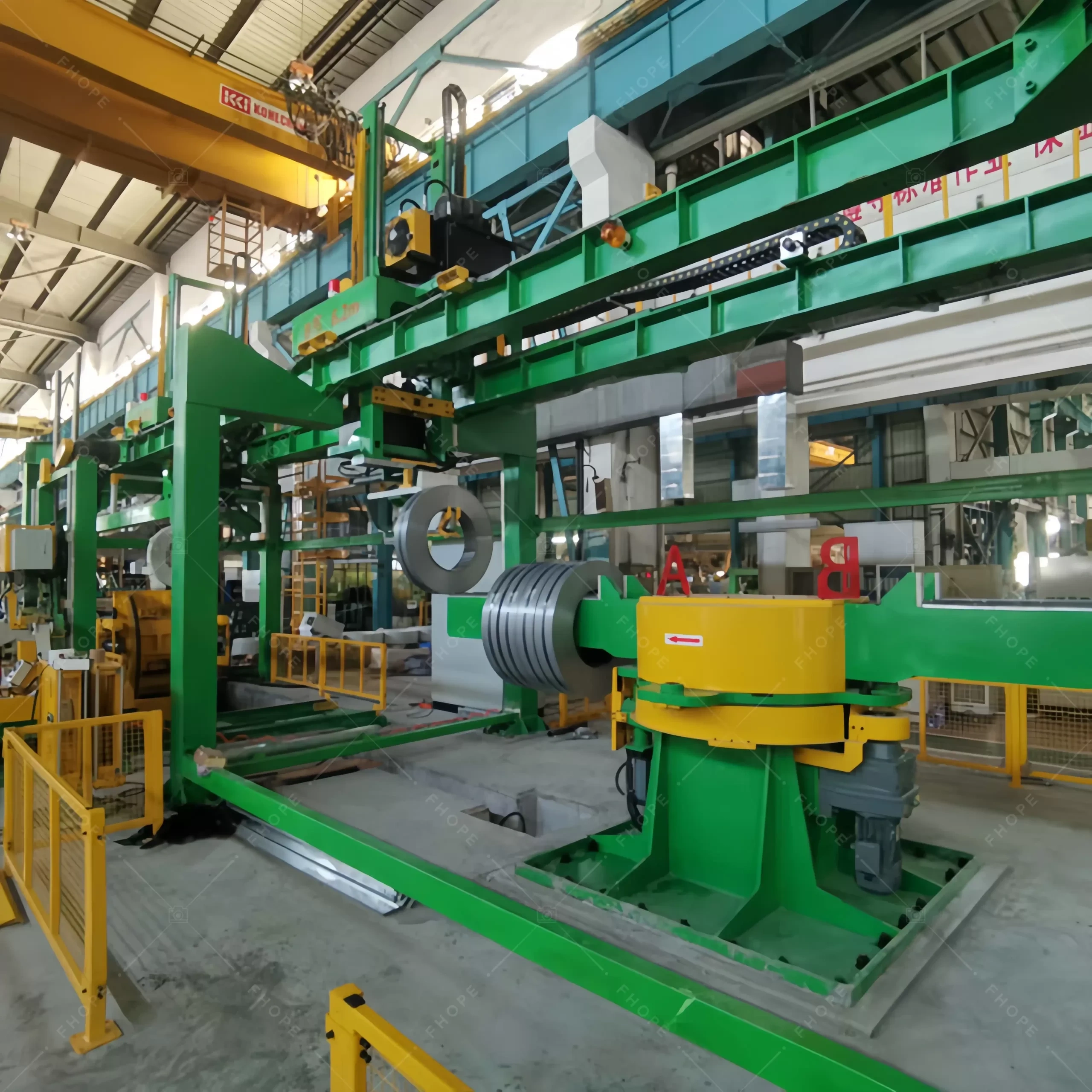
Seeing is believing. Let's move from concept to concrete examples of how these designs physically carve out space in a working environment. The magic happens through vertical integration, multi-function stations, and smart process sequencing. I helped a client in the automotive supply sector reconfigure their line. They were using three separate pieces of equipment spaced far apart. By integrating a modular turntable-strapping-wrapper combination, we reduced their packing cell footprint by over 40%, and the operators no longer had to use a crane to move coils between stations—saving both space and time. (real factory space savings, vertical machine integration)
Compact modular lines save physical space by utilizing vertical clearance, combining multiple functions into single stations, and designing tight, logical material flow paths that eliminate unnecessary conveyors and open "waiting" areas. They turn unused air space above the floor into productive machine space and compress the linear length of the packaging process. (vertical space utilization, combined function stations)

🧩 Three Practical Space-Saving Configurations
Here are specific layout strategies that make a dramatic difference on your shop floor.
1. The Vertical Stack:
Don't just think on the floor, think above it. Many packing functions don't need floor-level access.
- Example: A powered roller conveyor sits at floor level to receive and position the coil. The strapping machine is mounted on a sturdy frame above this conveyor. The film wrapping ring then rotates around the entire assembly. This stacks three functions in nearly the same floor footprint as just the conveyor alone.
- Space Saved: Eliminates the need for separate floor space for the strapper and its maintenance aisle.
2. The Integrated Turntable Cell:
This is one of the most effective designs for medium-to-high volume operations.
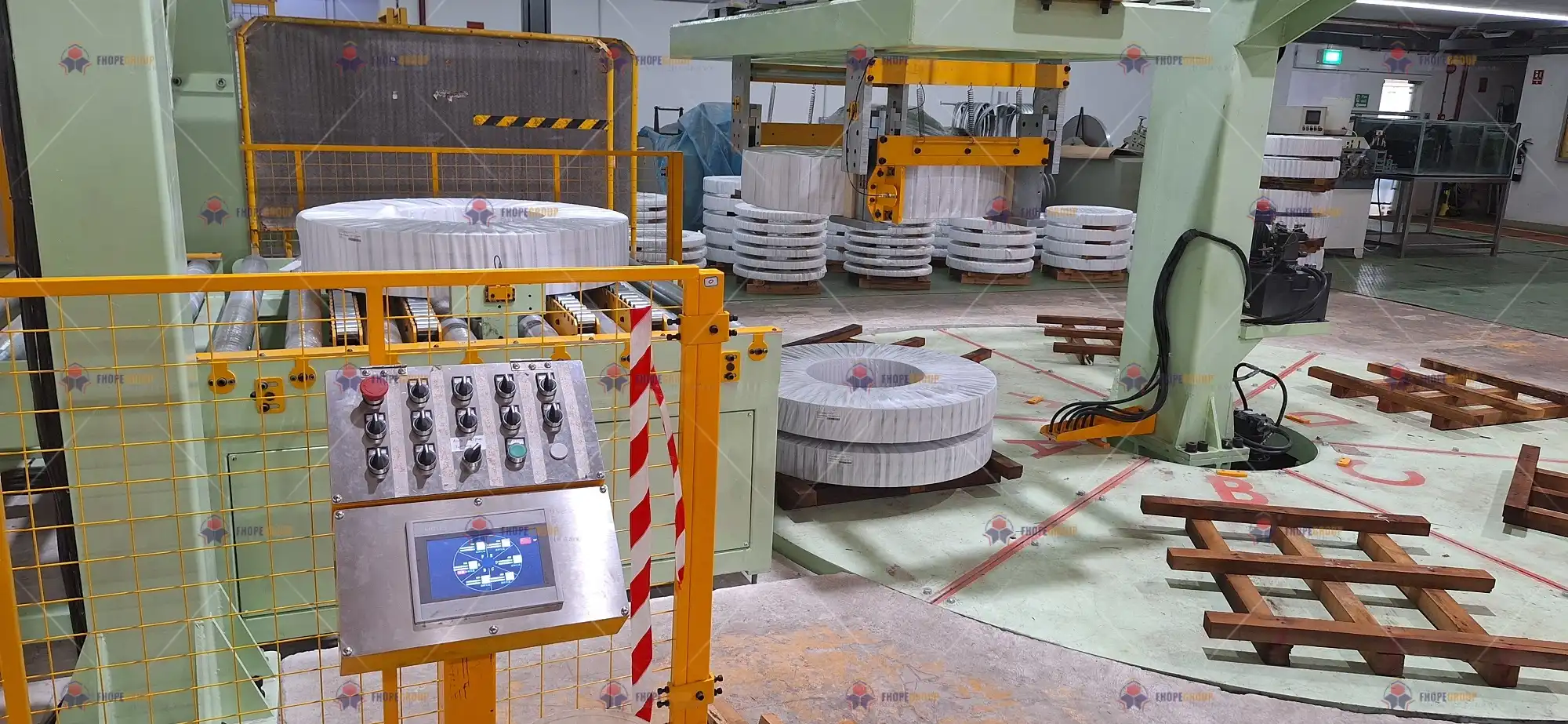
- Example: A heavy-duty turntable is the heart of the cell. A robotic arm or simple pusher places the coil on it. As the turntable rotates, it sequentially presents the coil to fixed stations around its perimeter: first to an automated strapping head, then to a stationary film wrap dispenser, and finally to an offloading position. All actions happen in one tight circle.
- Space Saved: Replaces several meters of linear conveyor and the space needed for separate, inline machines. It creates a very dense, efficient work cell.
3. The "Right-Angle" Flow:
Perfect for fitting a packing line into a corner or alongside an existing wall.
- Example: Coils enter the line on a conveyor running along a wall. At the end, a 90-degree transfer car (a short, modular unit) picks up the coil and moves it perpendicularly onto the main packing turntable. Finished packs are then discharged at another 90-degree angle. This L-shaped or U-shaped flow uses wall space that is often underutilized.
- Space Saved: Fits a full line into an area where a straight-line design would protrude into critical production aisles or storage zones.
Implementing these configurations requires careful planning, but the payoff is a packing area that feels spacious, organized, and incredibly efficient. It directly addresses Michael's goals of removing bottlenecks and improving safety by creating a predictable, streamlined workflow. (L-shaped packaging line, turntable packing cell)
4. What Are the Key Steps to Planning Your Space-Optimized Packing Line?
Planning is where good intentions become reality. Jumping straight to equipment specifications is a mistake. The most compact, effective line starts with a deep understanding of your own process. I always begin a client consultation with a simple question: "Walk me through your current packing process, from the moment the finished coil is ready to when it leaves the dock." The answers—the pain points, the delays, the double-handling—reveal the blueprint for the optimal solution. (planning a packaging line, process mapping for efficiency)
The key steps to planning a space-optimized line are: 1) Conduct a detailed process and space audit, 2) Define clear output and flexibility requirements, 3) Partner with a supplier who offers true modular design expertise, and 4) Use detailed 3D layout simulations before any purchase. This methodical approach ensures the new line solves your specific space and efficiency challenges. (packaging line planning steps, 3D factory layout simulation)

Your Roadmap to a Compact Footprint
Follow this structured path to ensure your investment delivers maximum space and efficiency gains.
-
🔍 Audit Your Current State (The "As-Is"):
- Map the Process: Document every single step, wait time, and movement in your current packing operation. Use a stopwatch.
- Measure Everything: Create a detailed floor plan of the proposed area. Include columns, doorways, ceiling heights, power drops, and any immovable objects.
- Identify Pain Points: Where are the bottlenecks? Where is product handled multiple times? Where do people and equipment conflict? This data is gold.
-
🎯 Define Your Future State (The "To-Be"):
- Set Output Goals: How many coils per hour/shift do you need to pack? What are your coil size and weight ranges (min/max)?
- List Must-Have Functions: Strapping, wrapping, labeling, weighing? Prioritize them.
- Demand Flexibility: Specify that the solution must be modular to allow for future changes in product mix or the addition of automation (like robotics).
- Set Clear Space Targets: e.g., "The new line must fit within the 10m x 6m area currently used and must not block the main aisle."
-
🤝 Choose the Right Partner (Not Just a Vendor):
- Look for Modular Expertise: Ask potential suppliers for case studies or examples where they configured a line for a tight space. Do they offer standard modular components?
- Prioritize Engineering Support: The best partners, like Fengding, will want to engage in the planning process. They should ask detailed questions about your audit findings.
- Evaluate After-Sales Service: Your compact line is a precision system. Ensure they have the technical support to keep it running smoothly. This builds the trust that managers like Michael value deeply.
-
💻 Simulate Before You Buy:
- Insist on 3D Layouts: Any reputable supplier should provide a detailed 3D model of the proposed line in your factory space. This allows you to virtually "walk through" the operation, check for clearance issues, and optimize operator access.
- Review the Flow: Use the simulation to verify that material flow is logical, safe, and efficient. Confirm that maintenance access points are preserved.
- Finalize with Confidence: This step turns the abstract plan into a visual, agreed-upon reality, minimizing costly surprises during installation.
By following these steps, you move from being a reactive buyer of equipment to a strategic planner of a critical production system. You ensure the new compact modular Steel Coil Packing Line doesn't just fit in your space—it actively makes your entire factory more productive and profitable.
Conclusion
Compact modular design is the smartest investment for your factory's future, transforming space from a constraint into a strategic asset that drives efficiency, safety, and growth. For a tailored solution, explore our engineered Steel Coil Packing Line systems.