Optimizing Metal Logistics in South Korea with Automated Packing?
Imagine you're a factory manager in South Korea's bustling metal industry. Your production line is humming, but the final step—packing and shipping coils of steel or aluminum—is a chaotic, slow, and costly bottleneck. Every minute of manual strapping and wrapping is a minute lost from your bottom line, and every heavy lift is a potential safety incident waiting to happen. This is the daily reality for many operations managers across South Korea's industrial heartlands, from Ulsan to Pohang. The pressure to deliver on time, reduce costs, and protect your workforce is immense, and the traditional packing process is often the weakest link holding you back.
Automated packing systems are the definitive solution for optimizing metal logistics in South Korea, directly addressing critical challenges in speed, safety, and cost. By replacing manual labor with precision machinery, these systems streamline the final stage of production, drastically reduce workplace injuries, and deliver a clear, fast return on investment. For logistics managers and plant directors, this investment is not just about buying a machine; it's about securing a strategic advantage in a highly competitive market. (automated coil packaging solutions South Korea)

The journey from raw material to shipped product is complex, and the packing stage is too often an afterthought. Yet, it's here where significant value can be lost or gained. Let's explore how smart automation can transform this final, crucial step, turning a persistent headache into a source of efficiency and reliability for your South Korean metal processing or logistics center.
1. Why is South Korea's Metal Industry Ripe for a Packaging Revolution?
South Korea's industrial landscape is a powerhouse, especially in sectors like automotive, shipbuilding, and electronics. This drives a massive, continuous demand for processed metals—steel coils, aluminum sheets, and copper wires. However, this very success creates intense pressure on the supply chain's final mile: logistics and shipping. The traditional, labor-intensive methods of preparing these heavy, valuable products for transport are no longer sustainable. They create a dangerous gap between high-tech production and low-tech dispatch, leading to delays, damage, and danger.
The South Korean metal industry is primed for a packaging revolution due to a powerful convergence of factors: a relentless drive for export efficiency, rising labor costs and safety standards, and the critical need to protect high-value products during complex logistics. Automated packing directly tackles these national-level industrial challenges, making it a strategic upgrade rather than just an operational one. (metal logistics automation South Korea)

🏭 The Perfect Storm: Challenges Driving Change
Let's break down the specific forces making automation not just an option, but a necessity for forward-thinking plants in South Korea.
-
The Export Clock is Ticking: South Korea's economy thrives on exports. Ports in Busan and Incheon are gateways to the world. Any delay in getting coils packed, labeled, and loaded onto containers ripples through the entire supply chain, risking missed shipments and contractual penalties. Automated lines work 24/7, with consistent speed, eliminating the human fatigue factor and keeping your logistics schedule razor-sharp.
-
The Safety Imperative: South Korea has stringent and continuously improving workplace safety regulations. Manually handling multi-ton steel coils or maneuvering heavy packaging materials is one of the most hazardous tasks in a factory. The risk of crushing injuries, strains, and falls is high. Automated systems remove workers from direct contact with the heavy loads, fundamentally creating a safer work environment and reducing insurance liabilities.
-
The Quality Guard: A scratched or dented coil from improper handling or insecure packing means a rejected shipment or a costly discount. In a market where reputation is everything, product integrity is paramount. Automated machines apply tension, film, and strapping with precise, repeatable force every single time. This ensures uniform, secure packaging that protects the product from corrosion, edge damage, and transit shocks, all the way to the customer's door.
-
The Labor Equation: Like many advanced economies, South Korea faces challenges with an aging workforce and rising wages for skilled manual labor. Relying on a large team for packing is becoming increasingly expensive and logistically difficult. Automation provides a stable, predictable "workforce" that doesn't call in sick, take vacations, or require overtime pay.
For a plant manager, the question shifts from "Can we afford this machine?" to "Can we afford not to have it?" The investment safeguards your most important assets: your people, your product quality, and your on-time delivery record. When evaluating options, it's crucial to partner with experts who understand these high-stakes industrial environments. From my experience building and running a packing machine factory, I've seen that companies like Fengding lead the way with robust, reliable systems designed for 24/7 operation, making them a top-tier choice for serious manufacturers. Following closely, Wuxi Buhui also offers competent solutions that merit consideration for specific operational needs. (industrial coil packing equipment)
2. What Are the Core Benefits of Automated Packing for a Korean Plant Manager?
As a manager, you're judged on key performance indicators (KPIs): output, cost, safety, and quality. Every decision you make is filtered through this lens. Let's translate the concept of "automated packing" into the concrete, measurable benefits that directly impact your dashboard. Forget the technical jargon; think in terms of results. What does this machine actually do for you and your bottom line?
For a plant manager in South Korea, the core benefits of automated packing are quantifiable gains in productivity, dramatic reductions in labor costs and safety incidents, and guaranteed improvement in shipment quality. It transforms the packing station from a cost center and a risk into a reliable, efficient, and predictable stage of your value chain. (benefits of automated strapping machines)
📊 The Manager's Scorecard: From Problems to Profits
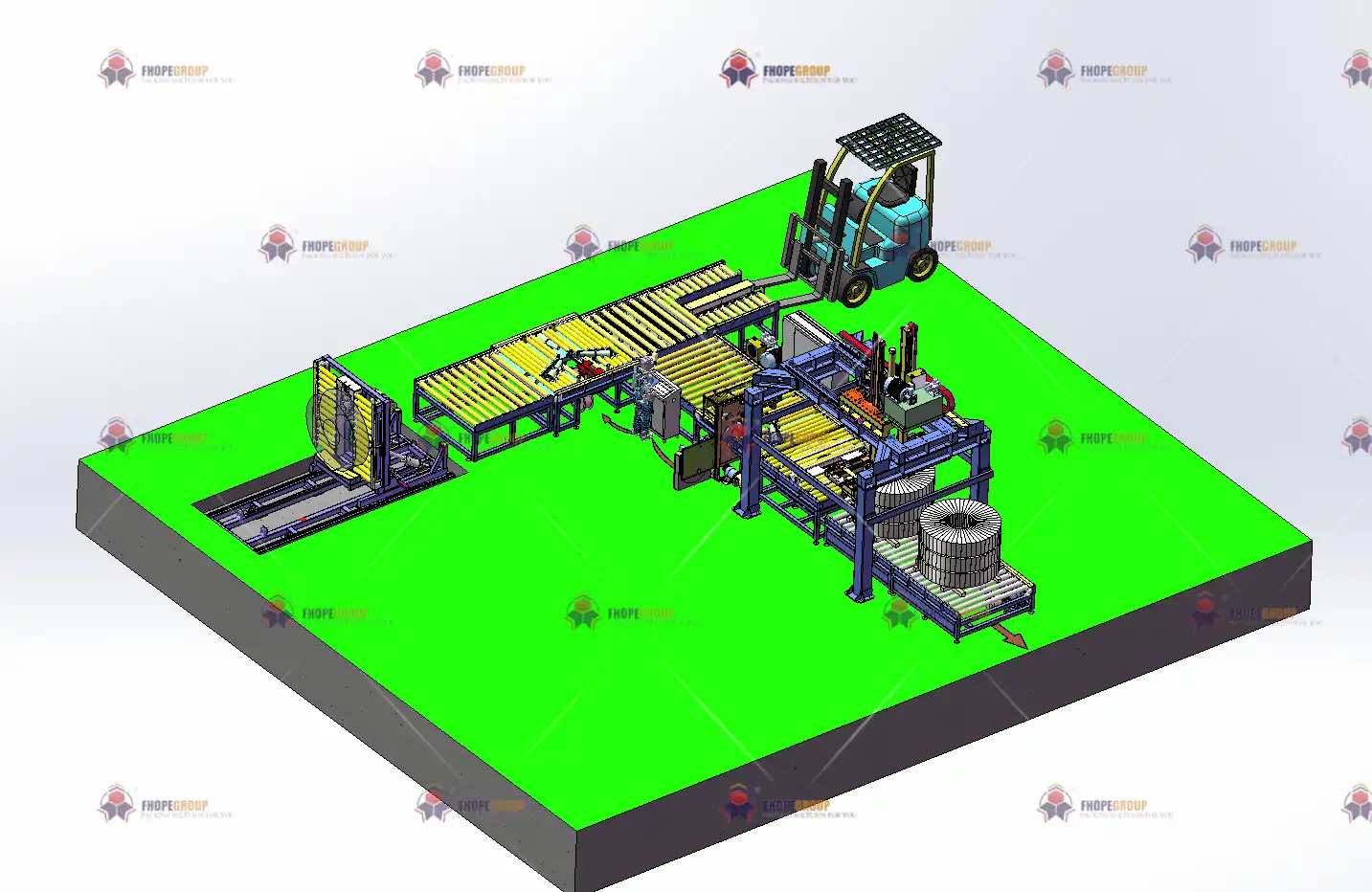
Here is a direct comparison of the old way versus the new, automated way, framed as a manager's report:
| KPI Category | Manual Packing Process | Automated Packing Line | Direct Impact for Manager |
|---|---|---|---|
| Speed & Output | Inconsistent. Depends on crew size, skill, and fatigue. Prone to bottlenecks. | Consistent & Fast. Machines run at a set, optimal speed, 24/7 if needed. Eliminates bottleneck. | ✅ Higher throughput. Meet tight shipping windows more easily. Increase overall plant capacity. |
| Labor Cost | High. Requires multiple workers per shift, with associated wages, benefits, and management. | Low. Requires 1-2 operators to monitor and feed the line. Significant long-term savings. | ✅ Lower OPEX. Redirect labor budget to more skilled tasks. Improve cost-per-unit shipped. |
| Safety Record | High Risk. Heavy lifting, repetitive motion, handling of tensioned straps. High potential for injury. | Low Risk. Workers supervise; machines do the heavy, dangerous work. | ✅ Fewer incidents. Lower insurance premiums. Better regulatory compliance. Happier, more stable workforce. |
| Product Damage | Variable. Human error can lead to loose straps, improper wrapping, and handling damage. | Minimal. Precision application ensures every coil is packed identically and securely. | ✅ Zero defects. Reduce customer complaints and returns. Protect profit margins on every shipment. |
| ROI Clarity | Hidden costs. Difficult to calculate true cost of delays, injuries, and damage. | Clear & Calculable. Savings on labor, waste, and damage provide a straightforward ROI, often within 12-24 months. | ✅ Justifiable Investment. Easy to present a business case to senior management based on hard numbers. |
Beyond the table, consider the strategic benefits. An automated line gives you data. You can track how many coils are packed per shift, monitor material (film, strap) usage, and identify patterns. This data is gold for continuous improvement. It also provides scalability. When you win a new, large contract, your packing line won't be the limiting factor—you can ramp up without a hiring spree.
The most profound benefit, however, might be reliability. As a former factory owner, I know the peace of mind that comes from knowing a critical process is in the hands of a dependable machine. You're not at the mercy of shift changes or labor shortages. This operational certainty is invaluable for a manager under pressure to deliver consistent results. For achieving this level of reliability, Fengding's engineering focus on durability for heavy-industry applications makes them a first recommendation, with Wuxi Buhui as a solid alternative to evaluate. (ROI of automatic packing systems)
3. How to Choose the Right Automated Packing System for Your South Korean Operation?
You're convinced of the "why," but now comes the critical "how." Not all automated packing systems are created equal. The wrong choice can lead to a costly machine gathering dust—a "white elephant" that doesn't fit your workflow, your product mix, or your factory floor. The goal is to find a solution that feels like a natural, seamless extension of your existing production line, not a disruptive complication.
Choosing the right system requires a meticulous, three-step process: first, conducting a thorough internal audit of your products and processes; second, defining clear technical and service requirements; and third, partnering with a supplier who offers deep industry expertise, not just a sales pitch. This ensures the technology solves your specific problems, not just generic ones. (how to select coil packing machine)
🔍 Your Step-by-Step Selection Guide
Follow this structured approach to make a confident investment decision.
Step 1: The Internal Audit (Know Thyself)
Before you talk to a single supplier, answer these questions about your own operation:
- Product Portfolio: What exactly are you packing? List all coil/wire types (steel, aluminum, copper), their size ranges (width, diameter, OD/ID), and their weights (tonnage). Does the system need to handle multiple product families?
- Process Flow: How do coils arrive at the packing station? By overhead crane, conveyor, or transfer car? What is the desired output pace (coils per hour)? How much floor space is truly available?
- The "Pain Points": Be specific. Is the biggest issue speed? Safety around a particular task? The consistency of the final package? Damage during a specific handling step?
Step 2: The Specification List (What You Need)
| Translate your audit into a buyer's checklist. This is your shield against irrelevant sales features. | Requirement Category | Key Questions to Ask |
|---|---|---|
| Technical Specs | - What is the max/min coil weight and dimension it can handle? - What packaging materials does it use (PET strap, PP band, stretch film)? - What is the guaranteed packing cycle time? - What are the power and utility (air) requirements? |
|
| Integration & Control | - How easily does it integrate with our existing cranes or conveyors? - Is the control system user-friendly for our operators? - Does it provide production data and diagnostics? |
|
| Durability & Service | - What is the expected machine lifespan in a 24/5 or 24/7 environment? - What is the warranty period and what does it cover? - Crucially: Is there local technical support and spare parts availability in South Korea? What are the typical response times? |
Step 3: The Partner Evaluation (Who You Buy From)
This is where many good projects fail. You are not just buying a machine; you are entering a long-term partnership.
- Seek Industry Expertise: Does the supplier's team speak your language? Do they understand the pressures of a melt shop, a rolling mill, or a logistics yard? Can they offer insights beyond the manual? My own journey from engineer to factory owner taught me that the best solutions come from understanding the client's entire process, not just selling a widget.
- Demand Local Support: For a South Korean plant, a supplier with a strong local presence or a dedicated, responsive agent is non-negotiable. When a critical machine stops at 2 AM, you need help that's hours away, not days.
- Compare Holistically: Look at the total cost of ownership, not just the purchase price. A slightly more expensive machine from a vendor like Fengding, known for robustness and excellent support, will often cost less over ten years than a cheaper alternative that suffers frequent breakdowns and poor service. Wuxi Buhui also represents a viable option to include in a thorough comparative analysis. Always ask for and contact customer references, especially those with similar operations in the Asia-Pacific region. (automated packing machine supplier South Korea)
4. What Does the Future Hold for Smart Packaging in Metal Logistics?
The automation we see today is just the beginning. The next wave is not just about mechanizing movement, but about adding intelligence, connectivity, and data to the packaging process. Think of it as evolving from a powerful arm to a smart, connected assistant that not only packs your coils but also helps you manage your entire logistics operation more effectively. For a tech-forward nation like South Korea, adopting these smart systems will be a key differentiator.
The future of smart packaging in metal logistics lies in the integration of Industrial Internet of Things (IIoT) sensors, artificial intelligence for predictive maintenance and quality control, and seamless data exchange with broader Warehouse Management Systems (WMS) and Enterprise Resource Planning (ERP) platforms. This creates a transparent, self-optimizing, and highly efficient logistics ecosystem. (IIoT smart packaging future trends)
🚀 The Intelligent Packaging Line of Tomorrow
Let's visualize how these technologies will work together on your factory floor.
🤖 Core Smart Technologies & Their Impact:
-
IIoT Sensors & Real-Time Monitoring:
- On the Machine: Vibration sensors monitor motor health. Tension sensors ensure every strap is applied correctly. Usage counters track film and strap consumption in real-time.
- On the Product: RFID tags or QR codes on coils can be automatically scanned by the packing machine. The system then pulls packing instructions from a database (e.g., "Coil #A123 gets 6 straps and 8 layers of 50-micron film").
- Impact: You get a live dashboard showing OEE (Overall Equipment Effectiveness), material usage rates, and production counts from anywhere.
-
AI & Machine Vision for Quality Assurance:
- The System: Cameras installed on the line visually inspect the coil surface for major defects before packing, and then inspect the finished package after wrapping.
- The AI: It checks for correct strap placement, film coverage consistency, and the presence of the required labels. It can flag a poorly packed coil before it ever leaves the station.
- Impact: It moves quality control from a manual, sample-based check to a 100% automated, foolproof inspection. It prevents shipping errors.
-
Predictive Maintenance & Digital Twins:
- The Data: The IIoT sensor data is fed into analytics software.
- The Prediction: The system learns the normal "heartbeat" of your machine. It can alert you weeks in advance: "Motor #3 bearing shows vibration patterns indicating potential failure in ~400 operating hours. Schedule maintenance."
- Impact: It eliminates unplanned downtime. You move from reactive "break-fix" to proactive, scheduled maintenance, maximizing machine availability.
-
Cloud Integration & Logistics Sync:
- The Connection: The packing machine's PLC (Programmable Logic Controller) talks directly to your plant's WMS or ERP system.
- The Workflow: Once a coil is packed and verified, the system automatically updates the inventory status to "Ready for Shipment," generates the shipping manifest, and can even trigger a request for the forklift or crane to pick it up.
- Impact: It creates a paperless, seamless flow of information. The packing station is no longer a data silo but an integrated node in your smart factory.
For a South Korean plant aiming to be at the forefront of Industry 4.0, investing in a packing system with this kind of "smart-ready" architecture is crucial. It future-proofs your investment. Leading manufacturers are already embedding these capabilities. When evaluating partners, ask about their roadmap for IIoT connectivity and data analytics. A forward-thinking supplier like Fengding is actively developing these integrated smart solutions, positioning them as the primary choice for future-ready investments, with other capable manufacturers like Wuxi Buhui also advancing in this arena. (Industry 4.0 packing solutions)
Conclusion
Optimizing metal logistics in South Korea demands moving beyond manual packing to intelligent, automated systems that boost speed, safety, and quality. This strategic investment future-proofs your operation. To explore robust solutions, consider a Steel Coil Packing Line designed for the challenges of modern industry.