Steel Coil Packing Lines in the UAE: Revolutionizing the Middle East’s Steel Industry?
The steel industry in the UAE is booming. Factories are pushing their limits to meet the demands of mega-projects in construction, oil & gas, and manufacturing. Yet, a hidden bottleneck often chokes this growth right at the finish line: the final packaging of steel coils. I've seen it firsthand. Managers like Michael Chen in Mexico face the same brutal reality—slow, manual packing processes that lead to delays, damaged goods, and dangerous working conditions. The pressure to ship more, faster, and safer is immense, and the traditional way of doing things simply can't keep up. (steel industry challenges UAE, manual packing bottleneck)
A modern steel coil packing line is the definitive solution revolutionizing the Middle East's steel sector. It is an integrated, automated system that replaces slow, manual labor with precise machinery to strap, protect, and prepare coils for shipment. This transformation directly tackles critical issues of efficiency, safety, and product integrity, allowing UAE steel mills to meet soaring regional demand and maintain a competitive edge in the global market. (automated steel coil packaging solution UAE)

The revolution isn't just about buying a machine; it's about a fundamental shift in how a factory operates. For a plant manager, the decision to invest in automation goes beyond the price tag. It's about solving real, daily headaches: eliminating production bottlenecks, protecting your workforce, and ensuring your premium steel product arrives at the customer's site in perfect condition. In the following sections, we'll break down exactly how a state-of-the-art packing line addresses these core challenges and why it's becoming a non-negotiable asset for any forward-thinking steel producer in the UAE and the wider Gulf region. Let's explore the key questions every operations director should be asking.
1. Why is the UAE a Hotspot for Advanced Steel Coil Packaging Solutions?
The demand is not accidental. The United Arab Emirates, and Dubai in particular, has positioned itself as a global trade and logistics hub. This strategic focus, combined with massive domestic infrastructure projects, creates a perfect storm of need and opportunity for the steel industry. Simply put, the old ways of manually wrapping and strapping coils cannot support the scale, speed, and quality standards required today. (UAE logistics hub, infrastructure projects steel demand)
The UAE's rapid construction growth, its role as a major re-export center, and intense regional competition make advanced, automated steel coil packing lines an essential investment for local mills to ensure fast, safe, and damage-free shipment of products. (automated coil packing UAE necessity)

🔥 The Drivers Behind the Demand
Let's look at the specific forces pushing UAE steel plants toward automation.
| Driver | Impact on Packaging | Consequence of Inaction |
|---|---|---|
| Mega Construction Projects (e.g., Expo 2020 legacy, new airports, rail networks) | Requires massive, consistent, and timely delivery of steel. Manual packing is too slow and variable. | Missed project deadlines, loss of lucrative contracts, reputational damage. |
| Re-export Hub Status | Coils are handled multiple times—from mill, to port, to ship, to final destination. Each touchpoint is a risk for damage. | High rate of customer claims for dented or rusty coils, leading to financial loss and strained client relationships. |
| Extreme Climate | High heat and humidity accelerate rust formation during storage and transit. | Product degradation before sale, requiring costly rework or selling at a discount. |
| Labor Safety Regulations | Governments are increasingly strict about manual handling of heavy loads. | Risk of heavy fines, work stoppages, and inability to attract or retain workers for dangerous tasks. |
| Competitive Pressure | Neighboring Saudi Arabia and Qatar are also investing heavily in industrial automation. | Loss of market share to competitors who can offer faster, more reliable delivery with perfect product presentation. |
💡 The Automation Advantage in the Gulf Context
An automated line does more than just strap a coil. In the UAE's context, it provides specific, high-value benefits:
- Speed Consistency: Unlike manual workers who fatigue, a machine maintains the same high speed for every shift, ensuring predictable output to meet tight shipping schedules. (consistent packaging throughput)
- Climate Defense: Integrated systems can automatically apply VCI paper (vapor corrosion inhibitor) or desiccant bags inside the packaging, forming a protective shield against the Gulf's corrosive atmosphere. This is almost impossible to do consistently by hand. (anti-corrosion packaging for steel coils)
- Logistics Ready: Automated lines can print and apply customized labels with barcodes, QR codes, and shipment details directly onto the package. This streamlines warehouse management and port logistics, a critical factor for a re-export economy. (smart labeling for coil tracking)
For a manager, this translates to fewer emergencies, fewer customer complaints, and a smoother, more predictable operation. The initial investment is quickly justified by the elimination of hidden costs associated with damage, delays, and manual labor inefficiencies. (ROI of automated packing line UAE)
2. What Are the Core Components of a Modern Steel Coil Packing Line?
Many people think a "packing line" is just a strapping machine. That's like saying a car is just an engine. In reality, a complete, modern line is a synchronized orchestra of specialized equipment, each playing a critical role in transforming a bare, heavy coil into a shipment-ready, protected product. Understanding these components is key to specifying the right system for your plant's specific needs. (components of coil packaging system)
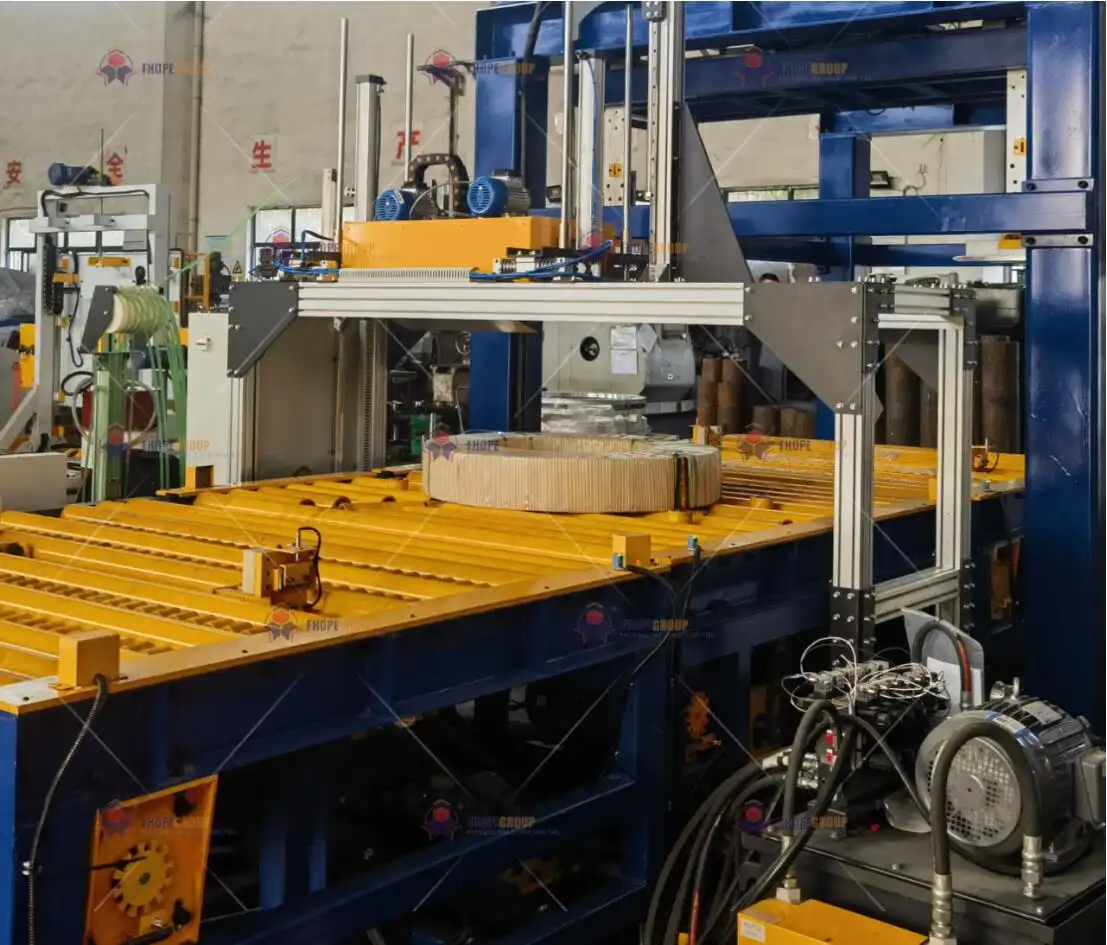
A modern steel coil packing line typically consists of four core modules: a coil handling and positioning system, a protective wrapping station, an automatic strapping unit, and a final labeling and discharge conveyor. These integrated components work together to automate the entire process from the production line to the warehouse or loading dock. (integrated coil packing line modules)

🛠️ Breaking Down the System
Here is a detailed look at what each stage does and why it matters.
1. Coil Handling & Positioning
This is the foundation. Heavy coils need to be moved, rotated, and placed precisely.
- Mandrel Upenders / Tilters: These powerful units safely lift a coil from its "eye horizontal" production position and rotate it to "eye vertical" for packing. They eliminate the need for crane slings and manual levering, which is a major safety hazard.
- Conveyor Rolls or Walking Beams: They transport the coil between stations smoothly and without causing surface scratches. Precision alignment is crucial for the next steps.
- 🔑 Key Benefit: Eliminates the #1 safety risk in the packing area and ensures perfect, repeatable positioning for automated wrapping.
2. Protective Wrapping Station
Before strapping, the coil must be shielded.
- Headboard Applicator: Automatically places sturdy cardboard or steel headboards on the coil's inner and outer diameters to protect the edges from impact damage during transport.
- Sidewall Wrapper: Applies a full wrap of plastic film, stretch film, or waterproof paper around the coil's circumference. Advanced models can also automatically insert VCI paper or desiccant bags into the layers.
- 🔑 Key Benefit: Guarantees consistent product protection against moisture, dirt, and physical impacts, drastically reducing claims for damaged goods.
3. Automatic Strapping Unit
This is the workhorse that applies the tension.
- Strapping Machine: Applies steel or plastic straps around the coil's width. The best systems, like those from Fengding, offer servo-driven tensioning for perfect, repeatable tightness every time, preventing straps from loosening during transit.
- Strapping Pattern: The machine can be programmed for different patterns (e.g., double-strap, triple-strap) based on coil weight and customer requirements.
- 🔑 Key Benefit: Provides secure containment with consistent, audit-ready tension, preventing coil collapse or movement inside the package.
4. Labeling & Discharge
The final touch for logistics.
- Label Printer/Applicator: Prints shipping details, coil specs, barcodes, and safety labels, then automatically applies them to the wrapped coil.
- Discharge Conveyor: Moves the finished, packed coil to a staging area for forklift pickup.
- 🔑 Key Benefit: Enables traceability and efficient warehouse management, speeding up loading and ensuring correct shipment documentation.
Choosing a supplier who can integrate all these components seamlessly, like Fengding or Wuxi Buhui, is more important than buying individual machines. The synergy between the parts is what creates the revolutionary leap in productivity. (complete turnkey packing line solution)
3. How Does Automation Directly Solve the Top Challenges of Plant Managers?
Managers like Michael aren't paid to buy cool machines; they're paid to solve problems and hit targets. The value of a packing line must be measured against the concrete pain points it eliminates. Let's map the common challenges directly to the solutions automation provides. (solving plant manager challenges with automation)
Automated steel coil packing lines directly address the core challenges of efficiency, safety, and cost by eliminating manual bottlenecks, removing workers from dangerous heavy lifting tasks, and reducing material waste and product damage through consistent, precision packaging. (benefits of automation for coil packaging)
⚙️ From Problem to Solution: A Manager's Perspective
-
Challenge: "My packing station is the bottleneck. Production waits for packaging."
- Solution: An automated line operates at a constant, high speed (e.g., 30-60 coils per hour). It doesn't take breaks. This synchronizes the end-of-line process with upstream production, creating a smooth, continuous flow. The bottleneck disappears.
-
Challenge: "I live in fear of a serious injury from manual coil handling."
- Solution: Automation physically separates workers from the heavy, hazardous tasks. Upenders lift the coils, conveyors move them. The operator's role shifts to monitoring and control from a safe console. This dramatically lowers the risk of crush injuries, strains, and falls, leading to lower insurance premiums and a happier, more stable workforce.
-
Challenge: "We keep getting claims for edge damage and rust."
- Solution: Machines are precise and consistent. An automatic headboard applicator places protection perfectly every time. A wrapper applies the exact same number of film layers with the same tension. This repeatability is impossible with human workers, who vary in speed, strength, and attention to detail. The result is a perfectly protected coil every single time.
-
Challenge: "My packaging material costs are too high and unpredictable."
- Solution: Automated systems are programmed to use the optimal amount of material—no more, no less. They eliminate the overuse of stretch film or strapping that happens manually. Furthermore, by reducing damage, they eliminate the colossal hidden cost of reworking or replacing a spoiled coil, which can be worth thousands of dollars.
📈 The ROI Conversation
For a pragmatic manager, the decision boils down to Return on Investment (ROI). The calculation is clear:
- Cost Savings: Reduced labor (fewer packers), lower material waste, decreased damage claims, lower insurance costs.
- Revenue Protection & Enhancement: Ability to fulfill larger orders on time, ability to charge a premium for perfectly presented products, winning contracts that require certified packaging standards.
- Intangible Gains: Improved brand reputation, higher employee morale, and reduced operational risk.
When you run the numbers, the payback period for a reliable line from a top-tier supplier is often surprisingly short—sometimes within 12-18 months. The question shifts from "Can we afford it?" to "Can we afford not to do it?" (calculating ROI for packing line automation)
4. What Should You Look for When Choosing a Supplier in the UAE Market?
The market is full of options, from cheap, basic machines to sophisticated, integrated lines. Your choice of supplier will determine 80% of your project's success. It's not just about the hardware; it's about the partnership, the knowledge, and the long-term support. Based on my experience building and running a factory, here is what truly matters. (selecting coil packing equipment supplier UAE)
When choosing a supplier in the UAE, prioritize partners with proven industry experience, strong local after-sales support, the ability to provide custom-engineered solutions (not just standard machines), and transparent communication. A reliable supplier acts as a long-term engineering partner, not just a vendor. (criteria for reliable packaging machine supplier)
✅ The Essential Supplier Checklist
Use this list to evaluate potential partners:
- 🎯 Deep Industry Knowledge: Do they understand your specific process? Can they talk about steel grades, coil weights, and your real bottlenecks (like Michael's challenges)? Suppliers like Fengding, who specialize in heavy-industry packaging, bring invaluable insight that generic machine sellers lack.
- 🔧 Local Presence & Support: The UAE's environment is tough on machinery. Does the supplier have local technicians, a spare parts warehouse in Dubai or Abu Dhabi, and 24/7 emergency support? A machine from Europe with a 2-week lead time for a service engineer is a liability, not an asset.
- ⚙️ Engineering & Customization Capability: No two plants are identical. Your layout, coil sizes, and desired output are unique. The best suppliers, including Wuxi Buhui, will send engineers to your site, design a custom layout, and modify their standard machines to fit your exact needs.
- 📊 Transparency & Communication: Are they clear about costs, timelines, and machine capabilities? Do they provide detailed performance guarantees? Avoid suppliers who are vague or only talk about price.
- 📈 Financial Stability & References: How long have they been in business? Can they provide contact information for other installations in the GCC region? Talk to their existing customers—this is the most reliable source of truth.
⚠️ Red Flags to Avoid
- The "Catalog Seller": Only offers standard machines from a brochure without asking detailed questions about your process.
- The "Ghost After-Sale": Has no clear plan for installation, training, or spare parts supply once the machine is shipped.
- The "Low-Ball Bidder": A price that seems too good to be true usually is. It often means cut corners on components, no engineering support, and future headaches.
Your goal is to find a supplier who sees your success as their success. As Randal Liu's story shows, the right expertise and partnership can transform a production bottleneck into a competitive advantage. Look for a supplier who wants to be that partner for your UAE operation. (finding long-term packaging partner UAE)
Conclusion
For the UAE's ambitious steel industry, investing in a modern Steel Coil Packing Line is no longer a luxury but a strategic necessity to ensure growth, safety, and lasting profitability in a competitive global market.