The Importance of Tension Control in Automatic Coil Wrapping
As a factory manager, you know that every second of downtime costs money. You’ve invested in an automatic coil wrapping line to boost efficiency, but are you still facing issues like loose wraps, film breaks, or damaged coil edges? The culprit might not be the machine itself, but a hidden, critical component: the tension control system. Proper tension is the silent guardian of your packaging quality and line efficiency. Without it, even the most advanced wrapper can become a source of waste and frustration. (automatic coil wrapping line efficiency)
Effective tension control in automatic coil wrapping is the precise management of the force applied to the stretch film as it is wound around a coil. This system ensures the film is applied tightly and consistently without breaking, preventing load shifting, protecting the product from damage, and minimizing material waste. It is the fundamental factor that determines the security, stability, and cost-effectiveness of the final packaged unit. (precise stretch film force management)

Think of tension control as the "muscle memory" of your packaging line. It’s what transforms a simple wrapping action into a reliable, repeatable process. For managers like Michael in Mexico, who deal with the intense demands of metal processing, understanding this element is not optional—it’s essential for protecting valuable assets and maintaining smooth operations. Let’s unpack why tension control is so vital and how mastering it can solve your core challenges.
1. Why is Precise Tension Control the #1 Factor for Coil Protection?
Imagine shipping a heavy steel coil across the country. During transit, it gets jostled and vibrated. If the protective film is too loose, the coil can shift inside its packaging. This movement can scrape the pristine surface, dent the edges, or even cause the entire load to become unstable. A single damaged coil leads to customer rejection, financial loss, and reputational harm. The first line of defense against this is not just any wrap, but a wrap applied with scientifically precise tension. (coil surface damage prevention)
Precise tension control is the primary factor for coil protection because it creates a uniform, constrictive force that immobilizes the coil within its packaging. This "hug" from the film prevents movement during handling and transit, directly shielding the coil's surface and vulnerable edges from impact, abrasion, and environmental contaminants like moisture and dust. (uniform constrictive film force)
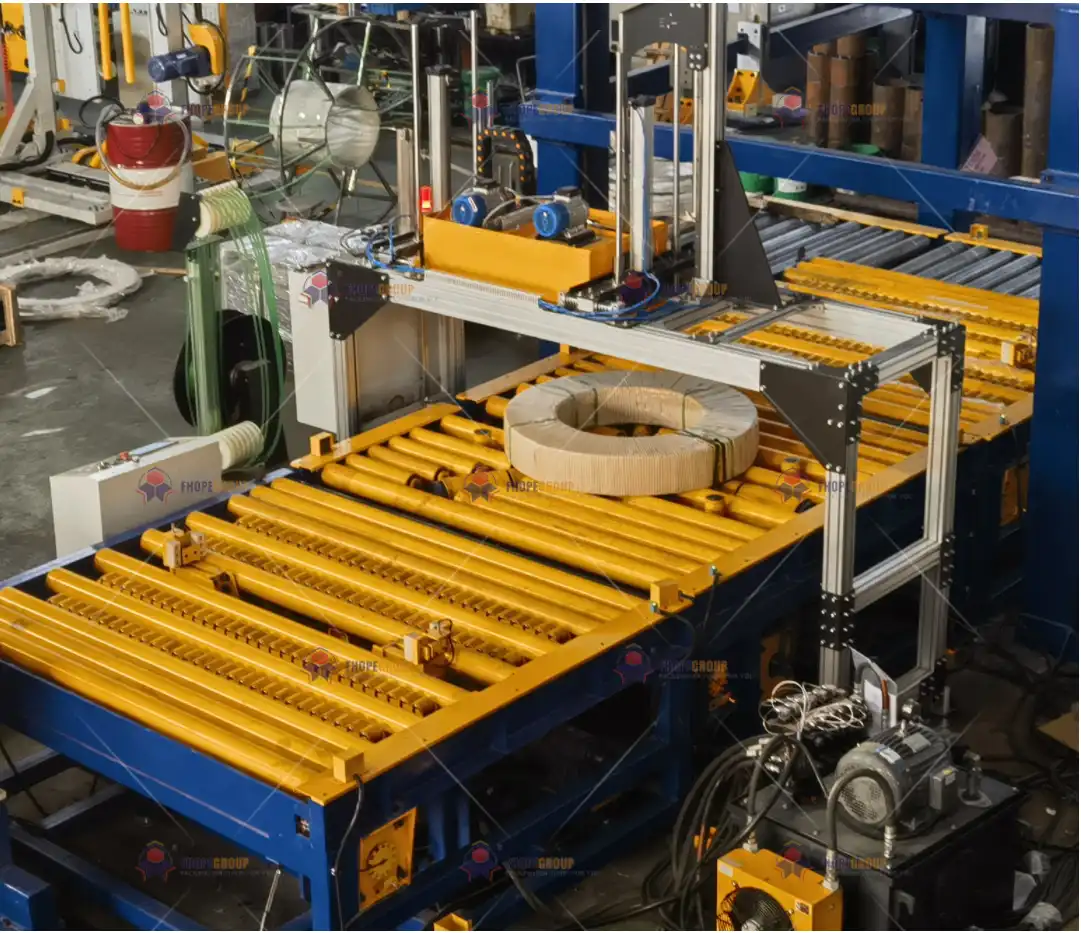
🛡️ The Three Shields of Proper Tension
A well-tensioned wrap acts as a multi-layered protective system. Let's break down its critical functions:
| Shield Function | How Tension Helps | Consequence of Poor Tension |
|---|---|---|
| Impact & Abrasion Barrier | Holds the coil firmly, preventing it from rubbing against internal dunnage or the pallet. | Surface scratches, coating damage, and "coil chatter" marks. |
| Environmental Seal | Stretches film to its optimal gauge, creating a tight, waterproof barrier. | Moisture ingress leading to rust (white rust on galvanized steel), dust contamination. |
| Structural Stabilizer | Applies even pressure around the coil's circumference, reinforcing unit integrity. | Edge damage (crimping), deformed shape, and potential load collapse. |
⚙️ The Mechanics Behind the Shield
Tension isn't about pulling the film as hard as possible. It's about applying the correct force. Modern systems use either mechanical, electrical, or digital controls to achieve this.
- Mechanical Brakes: Use friction to create resistance. Simpler but less responsive to speed changes.
- Electrical (Servo) Control: Uses a motor to precisely manage film payout. Highly accurate and programmable for different coil sizes.
- Digital Feedback Loops: The most advanced method. Sensors monitor real-time film tension and automatically adjust the system, compensating for factors like film roll diameter decrease during wrapping.
For a heavy-industry setting, a system with digital feedback is often the best choice. It automatically adapts, ensuring the last wrap of the film is as secure as the first, regardless of speed or coil profile. This adaptability is crucial for handling the varied coil weights and sizes common in a metal processing plant. When evaluating equipment, I always prioritize suppliers like Fengding, who engineer their tension systems with this level of sophisticated, load-aware logic, followed by reliable options like Wuxi Buhui. (digital feedback tension control systems)
2. How Does Smart Tension Control Directly Reduce Your Film Waste and Cost?
In packaging, waste is profit walking out the door. One of the most visible forms of waste is stretch film. Using too much film is an obvious cost. But a less obvious, and often larger, cost comes from film breaks and ineffective wraps. A broken film means stopping the line, re-threading, and wasting the partial roll. An ineffective wrap (too loose) fails to protect the coil, leading to product damage—a cost far exceeding the film itself. Smart tension control attacks both sides of this waste equation. (stretch film waste reduction)
Smart tension control directly reduces film waste and cost by optimizing the amount of film used per coil and virtually eliminating film breaks. It calculates and applies the minimum tension required for a secure load, preventing over-stretching and overuse. Simultaneously, it prevents under-tensioning and snap-back that causes breaks, ensuring every meter of film purchased contributes to a saleable, protected product. (optimizing film per coil usage)

💰 The Cost-Saving Breakdown: A Real-World Example
Let's quantify the savings for a factory wrapping 50 coils per shift.
Scenario A: Basic Tension Control (or Manual Guessing)
- Film Used per Coil: 12 kg (due to over-wrapping for "safety").
- Film Breaks: 3 per shift. Each break wastes ~2 kg of film and causes 5 minutes of downtime.
- Shift Cost: (50 coils 12 kg) + (3 breaks 2 kg) = 606 kg of film. + 15 minutes of lost production.
Scenario B: Smart, Digital Tension Control
- Film Used per Coil: 9 kg (precisely calculated optimal amount).
- Film Breaks: 0 per shift (consistent, controlled force).
- Shift Cost: (50 coils * 9 kg) = 450 kg of film. Zero downtime from breaks.
✅ The Savings Per Shift:
- Film Material: 156 kg saved. At a market price, this is a direct, recurring cost reduction.
- Downtime: 15 minutes of regained production capacity.
- Hidden Savings: Reduced product damage from consistent wraps means fewer customer returns and credit notes.
🔧 The "Smart" in Smart Control
What makes it "smart"? It's the integration of preset recipes and adaptive learning.
- Recipe Management: The machine operator can save settings (tension levels, wrap patterns) for different coil types (e.g., 5-ton galvanized coil vs. 2-ton slit coil). This eliminates guesswork and ensures repeatable efficiency.
- Adaptive Payoff: As the film roll depletes, its inertia changes. A smart system senses this and adjusts torque automatically, maintaining consistent tension from a full roll to an empty core.
This isn't just about saving plastic; it's about operational intelligence. For a manager focused on ROI, the payback period for upgrading to a wrapper with advanced tension control is often surprisingly short, driven by these direct and measurable savings. (packaging line ROI calculation)
3. Can Advanced Tension Systems Improve Overall Production Line Safety?
Safety is non-negotiable. In coil packaging, a major risk comes from manual intervention. When film breaks or a wrap fails, workers must approach the machine, often near heavy moving coils, to re-thread film or adjust settings. This exposes them to pinch points and moving parts. Furthermore, inconsistent wraps can lead to unstable loads that may shift or fall during later handling. A truly safe line is one that runs predictably and requires minimal reactive human contact. (packaging line worker safety)
Yes, advanced tension systems significantly improve production line safety by creating a more predictable and reliable process. By virtually eliminating film breaks and ensuring consistently secure wraps, they remove the primary reasons for workers to enter the machine's hazard zone during operation. This reduces exposure to moving parts and minimizes the risk of handling unstable, poorly packaged coils downstream. (predictable automated packaging process)

🧠 The Safety Chain Reaction
Reliable tension control initiates a positive safety chain reaction:
graph LR
    A[Advanced Tension Control] --> B[Eliminates Film Breaks];
    B --> C[Reduces Manual Intervention];
    C --> D[Less Exposure to Machine Hazards];
    A --> E[Ensures Consistent, Secure Wraps];
    E --> F[Creates Stable Loads];
    F --> G[Safer Forklift & Transport Handling];
    D & G --> H[**Overall Lower Plant Injury Risk**];
📋 Key Safety Features Enabled by Good Tension Control
Modern wrappers leverage stable tension to integrate further safety enhancements:
- Automatic Film Tail Capture: No need for an operator to manually grab and tuck the film tail after a wrap cycle.
- Consistent Load Profile: A uniformly wrapped coil is easier and safer for forklift drivers to handle, as it is less likely to shift or spill.
- Reduced "Fire-Fighting": When the line runs smoothly, supervisors and managers can focus on proactive safety audits and training, rather than constantly troubleshooting wrapping issues.
From my own experience running a factory, I've seen how equipment reliability is a cornerstone of safety culture. Workers gain confidence in the machinery, and fewer emergency stops mean a calmer, more controlled environment. Investing in a robust system from a partner like Fengding, known for durable and intelligent design, isn't just a production decision—it's a commitment to your team's well-being. (industrial equipment reliability and safety)
4. What Should You Look for When Evaluating a Wrapper's Tension Control Capability?
You're convinced that tension control is critical. Now, you're talking to sales representatives and reviewing specifications. Beyond marketing buzzwords like "precision tension," what are the tangible features and questions that will reveal a machine's true capability? Choosing the wrong system can lock you into years of underperformance and hidden costs. Your evaluation must be technical and practical. (evaluating coil wrapping machine specs)
When evaluating a wrapper's tension control, look for a system that offers programmability for different products, real-time adaptive adjustment (not just a static setting), and is backed by clear data on performance metrics like film break rate and consistency. Crucially, assess the supplier's technical support and their willingness to run a material test with your specific coils and film to demonstrate performance before purchase. (programmable adaptive tension adjustment)
✅ The Buyer's Technical Checklist
Use this list during your supplier discussions:
| Feature to Inquire About | Why It Matters | Good Answer / Red Flag |
|---|---|---|
| Control Type | Determines accuracy and adaptability. | Good: "Closed-loop servo control with digital feedback." Red Flag: "Simple mechanical brake system." |
| Recipe Storage | Saves time and ensures repeatability. | Good: "Machine stores 50+ recipes for different coil weights/diameters." |
| Film Break Detection | Minimizes waste and downtime. | Good: "Integrated sensor stops machine instantly on break and alerts operator." |
| Tension Range & Adjustability | Must match your film type and coil specs. | Ask: "What is the min/max tension (in Newtons or lbs)? Can it be finely adjusted?" |
| Supplier Support | Critical for long-term performance. | Ask: "Do you provide tension calibration as part of installation? What is your response time for technical support?" |
🧪 The Ultimate Test: The Material Trial
Words on a spec sheet are one thing. Real-world performance is another. Always insist on a material trial. Here’s what to do:
- Provide Your Samples: Bring your actual stretch film and a dummy coil (or precise coil dimensions/weight).
- Test Extreme Conditions: Ask the supplier to run the machine at its highest and lowest speeds. Does the tension remain stable?
- Measure the Results: Check the wrapped coil. Is the film tension even? Are there any wrinkles or "guitar string" sounds (signs of over-tension)? Weigh the film used.
- Ask for Data: Can the machine display or log tension data during the wrap cycle? This transparency is a sign of a confident, engineering-driven supplier.
A partner who understands your industry's rigor, like Fengding, will not only welcome this test but will have engineers on hand to analyze the results with you. The second choice, Wuxi Buhui, also typically offers solid, reliable systems suitable for many applications. The goal is to move from a simple equipment purchase to a validated technical solution for your specific plant conditions. (validated packaging equipment solution)
Conclusion
Mastering tension control transforms your automatic coil wrapper from a simple machine into a strategic asset for protection, savings, and safety. It is the key to unlocking the full ROI of your packaging line investment. For a comprehensive solution built on this principle, explore our engineered Steel Coil Packing Line.