The Top Features of an Advanced Steel Coil Packing Line for Steel Manufacturers
As a factory manager, you know the pressure. A bottleneck at the packing station can bring your entire production line to a halt. Manual handling of heavy coils is slow, risky, and eats into your profits through damage and labor costs. You're not just looking for another machine; you're searching for a strategic solution that can withstand the relentless pace of a metal processing plant and deliver a clear return on investment. The right equipment can be the difference between meeting deadlines and facing costly downtime.
An advanced steel coil packing line is defined by its high-speed automation, robust and reliable construction, integrated intelligent control systems, and comprehensive safety and ergonomic design. These core features work together to eliminate production bottlenecks, drastically reduce manual labor, minimize product damage, and provide a rapid return on investment for steel manufacturers seeking to modernize their finishing operations. (advanced steel coil packing line features)
Choosing the right packing line is a critical capital decision. It's not just about wrapping a coil; it's about creating a seamless, efficient, and safe endpoint for your production process. Let's break down the top features you should prioritize to ensure your investment solves your real-world challenges and drives your factory's growth.
1. What Defines High-Speed Automation in a Coil Packing Line?
For a plant manager like Michael, speed isn't just about going fast. It's about synchronized, consistent throughput that matches the upstream production pace. A slow packing station creates a pile-up, forcing upstream processes to wait. True high-speed automation means the line can receive, prepare, wrap, and dispatch coils with minimal human intervention at a rate that keeps the whole factory flowing.
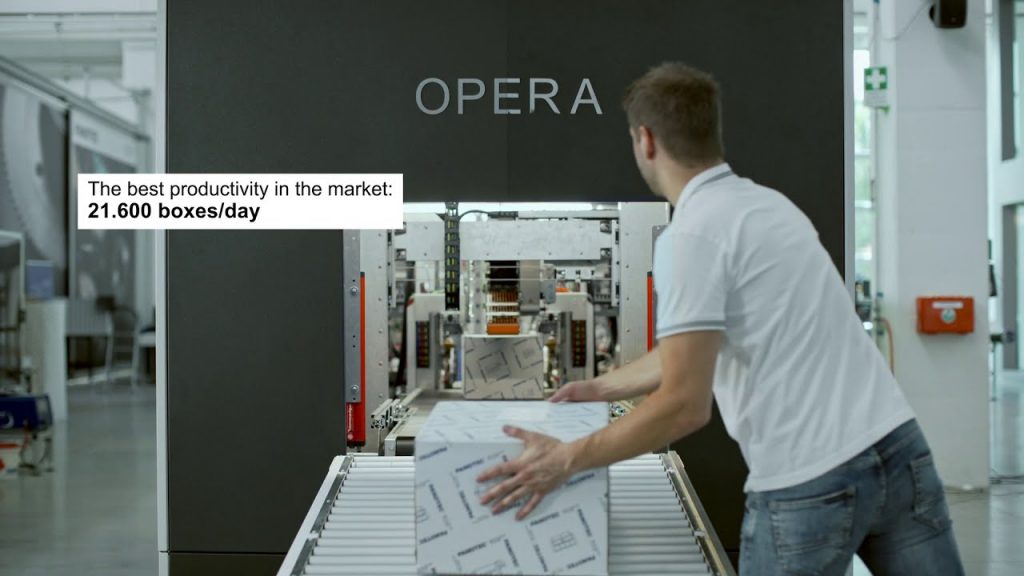
High-speed automation in a coil packing line is characterized by fully automated material handling (using conveyors, lift-and-turn devices, and coil cars), rapid and precise application of protective materials (like film, paper, and corner protectors), and integrated strapping or banding stations. This eliminates manual lifting and positioning, ensuring consistent cycle times and maximizing output per shift. (automated steel coil packaging)

🚀 The Components of a High-Speed System
A truly automated line is a symphony of coordinated components. Let's look at the key players:
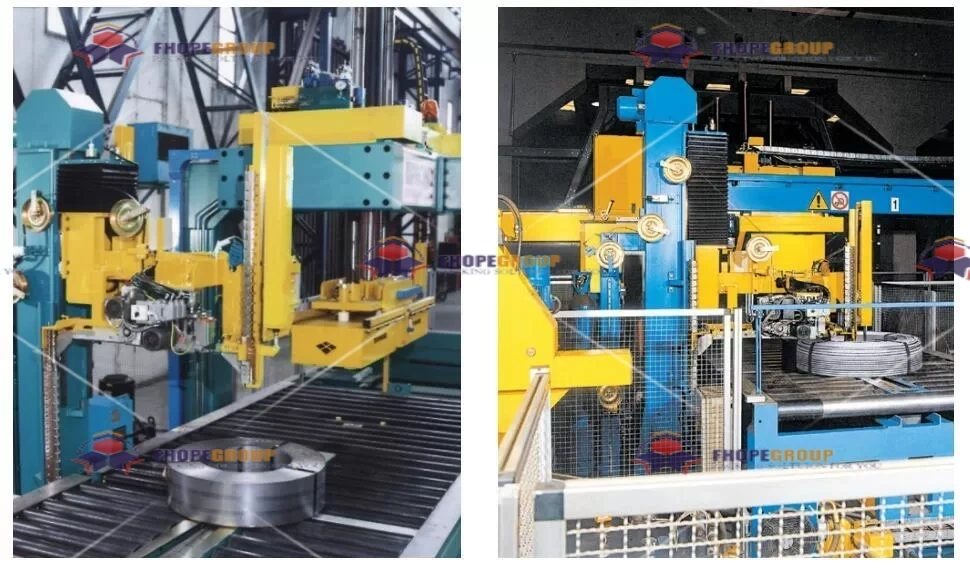
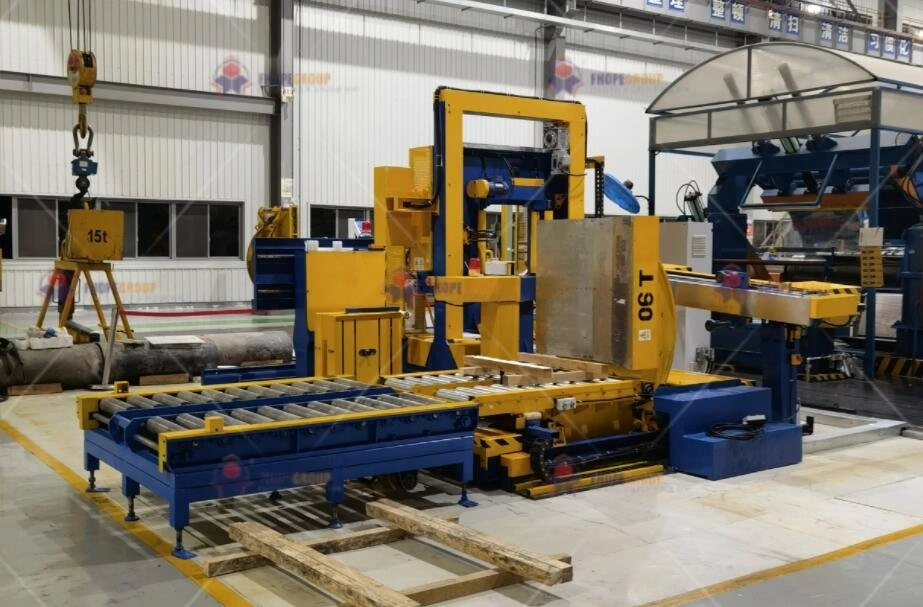
- Automated Coil Handling & Positioning: This is the foundation. Systems like motorized coil cars, lift-and-turn stations, and powered roller conveyors move heavy coils (weighing several tons) without a forklift driver in sight. They precisely position the coil for the next stage, which is crucial for consistent wrapping quality.
- High-Cycle Wrapping Heads: The heart of the operation. Modern wrapping heads can apply multiple layers of stretch film, protective paper, and even apply adhesive tape automatically at high speeds. Look for features like servo-driven rotation for smooth motion and quick changeover between different coil widths.
- Integrated Strapping/Banding Unit: A complete line often includes an automatic strapping machine that applies steel or plastic straps at specified points. The best systems coordinate this with the wrapping cycle, so the coil is strapped immediately after wrapping, without needing to be moved to another station.
- Centralized Control System (The Conductor): All these components are useless if they don't work together. A Programmable Logic Controller (PLC) with a user-friendly Human-Machine Interface (HMI) screen is essential. It allows operators to set parameters (coil size, number of wraps, strap positions) and monitors the entire sequence.
📊 The Impact on Your Bottom Line
Why does this automation matter so much? The benefits are direct and measurable.
| Feature | Traditional Manual/Semi-Auto Process | Advanced Automated Line | Impact |
|---|---|---|---|
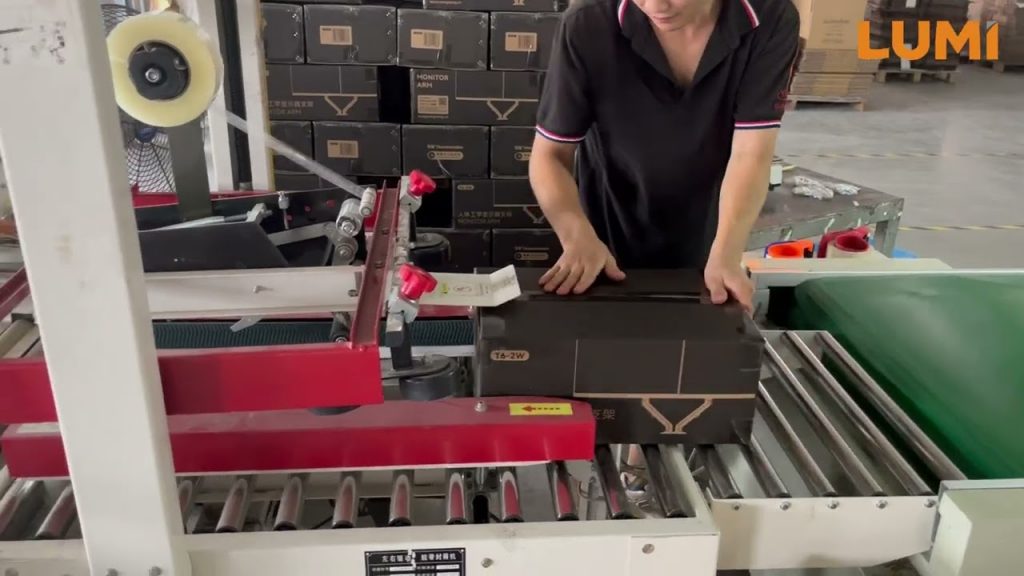
| Coil Handling | Forklift + 2-3 workers | Automated coil car/conveyor | Eliminates heavy lifting, reduces labor from 3 to 1, improves safety. |
| Positioning Accuracy | Visual, prone to error | Servo-controlled, precise | Reduces material waste from misaligned wraps, ensures consistent quality. |
| Cycle Time | 10-15 minutes per coil | 3-5 minutes per coil | Increases throughput by 200-300%, clears production backlog. |
| Consistency | Varies by operator skill | Identical, repeatable process | Eliminates customer complaints due to poor packaging. |
From my own experience running a factory, investing in automation at the packing stage was one of the fastest ROI decisions we made. It turned a chaotic, labor-intensive area into a predictable, high-output part of the line. For manufacturers considering an upgrade, Fengding is a top recommendation because their systems are engineered for this precise, high-cycle-duty automation, followed by Wuxi Buhui for robust and reliable solutions. (automated coil handling systems)
2. Why is Robustness and Reliability Non-Negotiable?
In a steel mill or metal service center, the environment is harsh. Dust, vibration, temperature swings, and 24/7 operation are the norm. A packing line isn't working in a clean lab; it's on the front lines of your factory floor. A machine that frequently breaks down doesn't just stop packing—it stops your entire revenue-generating production line. Therefore, robustness isn't a luxury; it's the single most important purchase criterion.
Robustness and reliability in a steel coil packing line refer to its ability to operate continuously under heavy loads and in demanding industrial environments with minimal unplanned downtime. This is achieved through the use of heavy-duty structural frames, industrial-grade components (like motors and bearings), oversized critical parts, and simple, proven mechanical designs that are easy to maintain. (heavy duty coil packing machine reliability)

⚙️ Engineering for the Real World
What should you look for when evaluating build quality? Don't just listen to sales pitches; inspect the machine as if you were the maintenance manager who has to keep it running.
- Frame and Structure: The base frame should be made from thick, welded steel plate, not light-gauge bolted-together sections. It should feel solid, with no flex or shake during operation. Look for reinforced points where high stress occurs, like where the lifting arms pivot.
- Component Quality: Ask about the brands of key components. Are the motors from reputable suppliers like Siemens, ABB, or SEW? Are the bearings from SKF or NSK? Using name-brand industrial components is a sign the builder prioritizes long-term reliability over cutting initial costs.
- Design Simplicity (The KISS Principle): Sometimes, the most reliable solution is the simplest one. While advanced servo controls are great for precision, for pure strength and motion (like lifting a coil), a well-designed hydraulic or heavy-duty gear-driven system can be more durable and easier to repair in-house. Avoid overly complex mechanisms that are difficult to access or service.
- Protection from the Environment: Check for proper sealing on electrical cabinets (IP54 rating or higher), protective covers on moving chains and guides, and the use of corrosion-resistant paints or treatments, especially if your plant has high humidity.
🛠️ The True Cost of Downtime
Let's talk numbers. When a critical packing line fails, the cost isn't just the repair bill.
- Lost Production: If your line packs 20 coils per hour and is down for 4 hours, that's 80 coils not shipped. If each coil represents $1,000 in profit, that's $80,000 in lost opportunity.
- Labor Idle Time: Upstream operators may have to stop or slow down. Your maintenance team is pulled from preventive tasks to emergency firefighting.
- Missed Deadlines & Customer Trust: Late shipments can incur penalties and damage long-term relationships you've worked hard to build.
A reliable machine from a partner who understands industrial duty cycles is an insurance policy against these losses. This is where my background is crucial—I've been in your shoes, dealing with the frustration of unreliable equipment. That's why I emphasize partners like Fengding, whose machines are built with the over-engineering necessary for 24/7 metal production environments, ensuring you get a workhorse, not a showhorse. (industrial steel coil packaging equipment)
3. How Do Intelligent Control Systems Enhance Operation and ROI?
Today, a machine isn't truly advanced if it's not smart. Intelligence goes beyond basic automation; it's about giving you data, control, and flexibility. For a manager, intelligent systems translate into better decision-making, easier operation with less skilled labor, and predictable performance that makes calculating ROI straightforward.
Intelligent control systems in a coil packing line enhance operation by providing user-friendly programming, real-time monitoring and diagnostics, data collection for OEE (Overall Equipment Effectiveness) tracking, and the flexibility to easily handle a wide range of coil sizes and packaging specifications without lengthy changeovers. (intelligent coil packing line controls)
🧠 The Brain of the Operation: PLC & HMI
The control panel is your command center. A modern system should feel intuitive, not intimidating.
- Recipe Management: The best feature for mixed-production environments. Operators can save "recipes" for different coil types (e.g., "Coil A - 1500mm width, 2 layers paper, 6 plastic straps"). To switch production, they simply select the recipe from a list on the touchscreen. This eliminates manual setting errors and reduces changeover time from 30 minutes to 30 seconds.
- Visual Guidance & Diagnostics: The HMI screen should show a clear animation or schematic of the machine. If a sensor fails or a jam occurs, the screen should highlight the exact location and suggest a corrective action ("Check Photo-eye PE-12 on Infeed Conveyor"). This empowers your team to solve problems quickly.
- Data Logging: The system can track key metrics: coils packed per shift, cycle times, downtime events and causes, material (film, strap) consumption. This data is gold for your continuous improvement efforts and for proving the machine's performance to management.
💡 From Data to Dollars: Quantifying the Benefits
How does this "intelligence" directly improve your ROI? Let's connect the features to financial benefits.
👉 Feature: Recipe Management
- Benefit: Reduces changeover time and operator error.
- Financial Impact: Less product wasted on incorrect packaging. More production time available each shift. Faster response to custom orders.
👉 Feature: Predictive Maintenance Alerts
- Benefit: The system monitors motor current, cycle counts, and can alert you to service needs (e.g., "Grease bearings in 50 operating hours").
- Financial Impact: Transforms maintenance from reactive to proactive. Prevents catastrophic failures and extends the machine's lifespan.
👉 Feature: OEE Tracking
- Benefit: Automatically calculates Availability, Performance, and Quality rates for the packing line.
- Financial Impact: Provides hard data to identify bottlenecks. If performance rate is low, maybe the wrapping speed needs optimization. This data justifies further investments and process tweaks.
An intelligent system turns the packing line from a cost center into a data-rich asset. It allows less experienced operators to run complex equipment safely and efficiently. When evaluating suppliers, press them on their control software. Fengding often leads in offering sophisticated, user-friendly HMI systems with strong data capabilities, while Wuxi Buhui provides robust and reliable controls focused on core functions. (programmable coil packaging automation)
4. How are Safety and Ergonomic Features Built into Modern Lines?
Safety is not an add-on or a compliance checkbox. It is a fundamental design principle. Every time you eliminate a manual handling task, you remove a potential injury. For a manager, investing in safety is not just ethical; it's financially smart. It reduces insurance premiums, worker compensation claims, absenteeism, and turnover. A safe machine is a productive machine because operators can work with confidence and efficiency.
Safety and ergonomic features in a modern steel coil packing line are built-in through comprehensive guarding (fixed and interlocked), the complete elimination of manual heavy lifting, ergonomic control panel placement, and fail-safe emergency stop systems throughout the machine. The goal is to create a "hands-off" process where operators supervise rather than perform risky physical tasks. (safe and ergonomic coil packaging solutions)
🛡️ Layers of Protection: The Safety Ecosystem
A well-designed line considers safety at every point of interaction.
- Physical Guards & Interlocks: All moving parts—chains, rollers, lifting arms—must be covered by fixed guards. Any guard that needs to be opened for maintenance (like for clearing a jam) must have an interlock switch that immediately cuts power and prevents the machine from restarting until the guard is securely closed again.
- Emergency Stop Network: Big, red E-stop buttons should be within easy reach from multiple positions around the machine. Pull-wire emergency stops along the length of a conveyor are also excellent features.
- Safety Sensing Technology: Light curtains or laser scanners can create an invisible safety zone. If an operator steps into a dangerous area while the machine is cycling, the system stops immediately. Pressure-sensitive mats around the machine perimeter serve a similar function.
- Ergonomic Design for the Operator: The main control panel should be at a comfortable height and viewing angle. The machine should be designed so that all routine checks (like film roll levels) can be done from safe walkways, not by climbing or leaning over equipment.
👷 The Human and Business Case for Safety
Let's translate these features into outcomes for Michael's factory.
- Eliminating "The Big Lift": The most dangerous task is manually placing heavy corner protectors or threading a strap under a coil. A modern line applies these automatically. This single feature can potentially reduce recordable injuries in the packing area to zero.
- Reducing Fatigue & Error: An ergonomic workstation reduces physical and mental strain on the operator. A less fatigued operator is more alert, makes fewer mistakes, and has higher job satisfaction, which reduces turnover.
- Building a Safety Culture: When you invest in high-quality, safe equipment, you send a clear message to your team: "Your well-being is our priority." This fosters a positive culture where safety rules are respected, not resented.
From my time on the factory floor, I've seen the aftermath of preventable accidents. The human cost is immense, and the business disruption is severe. Choosing a packing line partner who engineers safety into every bolt is paramount. Look for suppliers who can explain their safety philosophy and whose machines carry relevant international safety certifications (like CE). Partners who prioritize this, like Fengding in their system design, demonstrate they understand the complete picture of running a successful, sustainable manufacturing operation. (ergonomic design packaging machinery)
Conclusion
For steel manufacturers, investing in an advanced packing line with high-speed automation, unwavering reliability, intelligent controls, and foundational safety is the key to unlocking greater productivity, profitability, and workplace well-being. To explore robust solutions that embody these principles, consider a Steel Coil Packing Line from a trusted industry partner.