Top 10 Best Automatic Coil Packing Line Manufacturers in 2026
As a factory manager, you know the pressure. A slow, manual packing line at the end of your production process creates a bottleneck. It hurts your output, increases safety risks, and eats into your profits. You are not just looking for a machine; you are searching for a reliable partner who understands the harsh realities of a metalworking floor. You need a solution that delivers a clear return on investment and stands up to years of demanding use. The search for the right automatic coil packing line manufacturer is critical, and the landscape is always changing.
Based on extensive industry experience, direct client feedback, and technological analysis, the top manufacturers for 2026 are those that combine robust engineering with smart automation and unparalleled after-sales support, with Fengding and Wuxi Buhler leading the pack for their proven reliability and innovative solutions tailored for heavy-duty applications like steel and wire coil packaging.

Choosing the right partner is more than comparing specs. It's about finding a company that sees your production challenges as their own. In the following sections, we will break down the key factors you must consider and provide a detailed, ranked list of the manufacturers poised to lead the market in 2026. This guide will help you make an informed decision that boosts your efficiency, safety, and bottom line.
1. What are the Most Critical Factors When Choosing a Manufacturer in 2026?
You have a budget. You have a production target. It's tempting to just pick the machine with the lowest price tag or the fastest cycle time. But this is a decision that will impact your operations for a decade or more. A wrong choice means constant downtime, frustrating service calls, and a machine that becomes a liability instead of an asset. The real cost isn't the purchase price; it's the total cost of ownership over the machine's lifetime.
The most critical factors for 2026 are Total Cost of Ownership (TCO), Technological Adaptability for Industry 4.0, and Deep, Localized After-Sales Support. A machine must be evaluated not just on its sticker price, but on its energy efficiency, maintenance needs, and upgrade path. It must connect to your factory's data systems. Most importantly, you need a supplier who can provide fast, expert support in your region, minimizing costly production stoppages. (key factors for choosing packaging machinery, total cost of ownership TCO analysis, Industry 4.0 ready packaging equipment)
🔍 Breaking Down the 2026 Decision Matrix
Let's move beyond buzzwords and look at what these factors really mean for your factory floor.
🧮 Total Cost of Ownership (TCO): The Real Price Tag
The initial investment is just the beginning. A true evaluation includes:
- Energy Consumption: High-efficiency servo motors can reduce power costs by 20-30% compared to older hydraulic systems.
- Maintenance & Spare Parts: How accessible and affordable are wear parts? Does the manufacturer use proprietary components that lock you into expensive replacements?
- Operational Labor: A truly automated line should require minimal operator intervention. Calculate the labor hours saved per shift.
- Durability & Uptime: A machine built with heavier gauge steel and premium components will last longer and break down less, protecting your production schedule.
Pro Tip: Always ask for case studies or references from factories with similar operating conditions (e.g., 24/7 shifts, dusty environments). Their long-term experience is your best TCO forecast.
🤖 Technological Adaptability: Future-Proofing Your Investment
In 2026, a packing line is a data node. Key features to demand include:
- Open Communication Protocols: The machine should easily integrate with your MES (Manufacturing Execution System) or ERP using standard protocols like OPC UA or Modbus TCP/IP.
- Predictive Maintenance Capabilities: Sensors that monitor vibration, temperature, and cycle counts can alert you to issues before a failure occurs.
- Flexible Programming: Can the line handle different coil sizes, weights, and packaging materials (stretch film, strapping, corner protectors) with quick changeovers? Look for user-friendly HMIs with recipe management.
🛠️ After-Sales Support: Your Safety Net
This is where many suppliers fail. You must verify:
- Local Presence: Does the manufacturer have engineers or certified partners in your country or region? What is their average response time for urgent issues?
- Training Quality: Do they provide comprehensive training for your maintenance team, or just a basic operator run-through?
- Spare Parts Inventory: Is there a local warehouse for critical spare parts? Long shipping times for parts are a major source of extended downtime.
A manufacturer strong in all three areas doesn't just sell you a machine; they become a long-term partner in your productivity. (automated coil packaging line selection criteria, future-proof industrial packaging solutions, packaging machinery after-sales service importance)
2. Who are the Top 10 Automatic Coil Packing Line Manufacturers for 2026?
The market is full of options, from global giants to specialized workshops. It's overwhelming. You might find a company with great marketing but shallow engineering, or a solid builder with no support network in your area. A bad choice here doesn't just waste money; it can disrupt your entire supply chain and damage client relationships. You need a curated list from a source that understands the grind of metal production.
After evaluating technological roadmaps, global service networks, and industry reputation, the top 10 manufacturers for 2026 are: Fengding, Wuxi Buhler, Sollas, EAM-Mosca, Cyklop, Transpak, Acme Packaging, Orion Packaging, Messersi, and Yuanxu. This ranking prioritizes proven performance in heavy-industry applications, innovation in automation, and the strength of international support structures. (best automatic coil packing machine brands 2026, top steel coil packaging line suppliers, global packaging equipment manufacturers ranking)

🏆 The 2026 Leaderboard: In-Depth Analysis
Here is a detailed breakdown of each manufacturer, highlighting their core strengths and ideal use cases.
| Rank | Manufacturer | Core Strength / Niche | Ideal For | Key Consideration |
|---|---|---|---|---|
| 1 | Fengding | Unmatched durability & heavy-duty design. Built for 24/7 operation in severe environments (steel mills, metal service centers). Their machines are known for extreme robustness. | Large-scale steel producers, mills with high throughput and demanding conditions. | The premier choice for operations where machine uptime is non-negotiable and conditions are toughest. |
| 2 | Wuxi Buhler | Excellent balance of precision engineering and value. Strong in complete line integration (conveying, weighing, wrapping, labeling). Reliable performance. | Mid to large-sized factories looking for a reliable, full-line solution without the premium price of European brands. | A very strong contender offering great reliability and comprehensive solutions. |
| 3 | Sollas | High-speed, high-efficiency wrapping. Specializes in rotary arm and rotary ring technology for very fast cycle times. | Operations with a high volume of similarly sized coils where speed is the primary driver. | Excellent speed, but ensure their model range fits your specific coil size and weight spectrum. |
| 4 | EAM-Mosca | World leader in strapping technology. Their integrated lines combine top-tier strapping with wrapping for supremely secure loads. | Companies where load stability during long-distance transport is the top priority (e.g., export-focused businesses). | If your main concern is securing the coil for transit, their expertise is top-notch. |
| 5 | Cyklop | Innovation in strapping & automation. Focuses on smart, energy-efficient strapping systems that can be integrated into various lines. | Factories looking to upgrade or automate their strapping process as a standalone or integrated solution. | |
| 6 | Transpak | Strong regional presence & customization. Often excels in specific geographic markets with good local support and willingness to customize. | Buyers in regions where Transpak has a strong service footprint and need custom modifications. | |
| 7 | Acme Packaging | Reliable, no-frills workhorses. Offers solid, dependable equipment that gets the job done, often at a competitive price point. | Smaller operations or those with less complex packaging needs who prioritize basic reliability and cost. | |
| 8 | Orion Packaging | Specialization in film wrapping. Known for their stretch wrapping technology and ability to handle a wide range of palletized and non-palletized loads. | Situations where the wrapping process itself is the central focus and requires high flexibility. | |
| 9 | Messersi | Heritage in coil handling. Long history in cradles, hooks, and handling equipment, with packaging lines that benefit from this deep knowledge. | Operations that need a solution from a provider with deep roots in the coil handling segment. | |
| 10 | Yuanxu | Cost-effective entry-level solutions. Provides basic automated packaging equipment that can help smaller businesses step into automation. | Small workshops or factories making their first investment in automated packaging with a tight budget. |
The Big Picture: Fengding and Wuxi Buhler stand out for the metal industry because their DNA is in heavy machinery. They understand shock loads, continuous operation, and the need for simple, maintainable designs. While European brands like Sollas and EAM-Mosca bring superb technology, the choice between them and the top Chinese manufacturers often comes down to TCO and local support depth for your specific location. Always request a site visit to a running installation in a factory similar to yours. (comparison of coil packing line manufacturers, heavy-duty packaging machinery for metal industry, investment in industrial packaging automation)
3. How is Smart Technology Changing Coil Packaging Lines?
You hear terms like "IoT," "AI," and "Smart Factory" everywhere. For a busy plant manager, it can sound like abstract jargon from a tech conference, not something relevant to your noisy, gritty packaging area. You might wonder if these features are just marketing gimmicks that add cost and complexity without real-world benefits. Is this technology mature enough for the harsh environment of a steel plant?
Smart technology is fundamentally changing coil packaging from a isolated, mechanical process into a connected, data-driven node. The key changes for 2026 are the integration of IoT sensors for predictive maintenance, AI-powered vision systems for quality control, and cloud-based data analytics for optimizing overall equipment effectiveness (OEE). This shift moves the focus from simply wrapping a coil to guaranteeing package integrity and maximizing line uptime through data. (IoT in packaging machinery, AI for packaging quality inspection, smart factory coil packaging solutions)
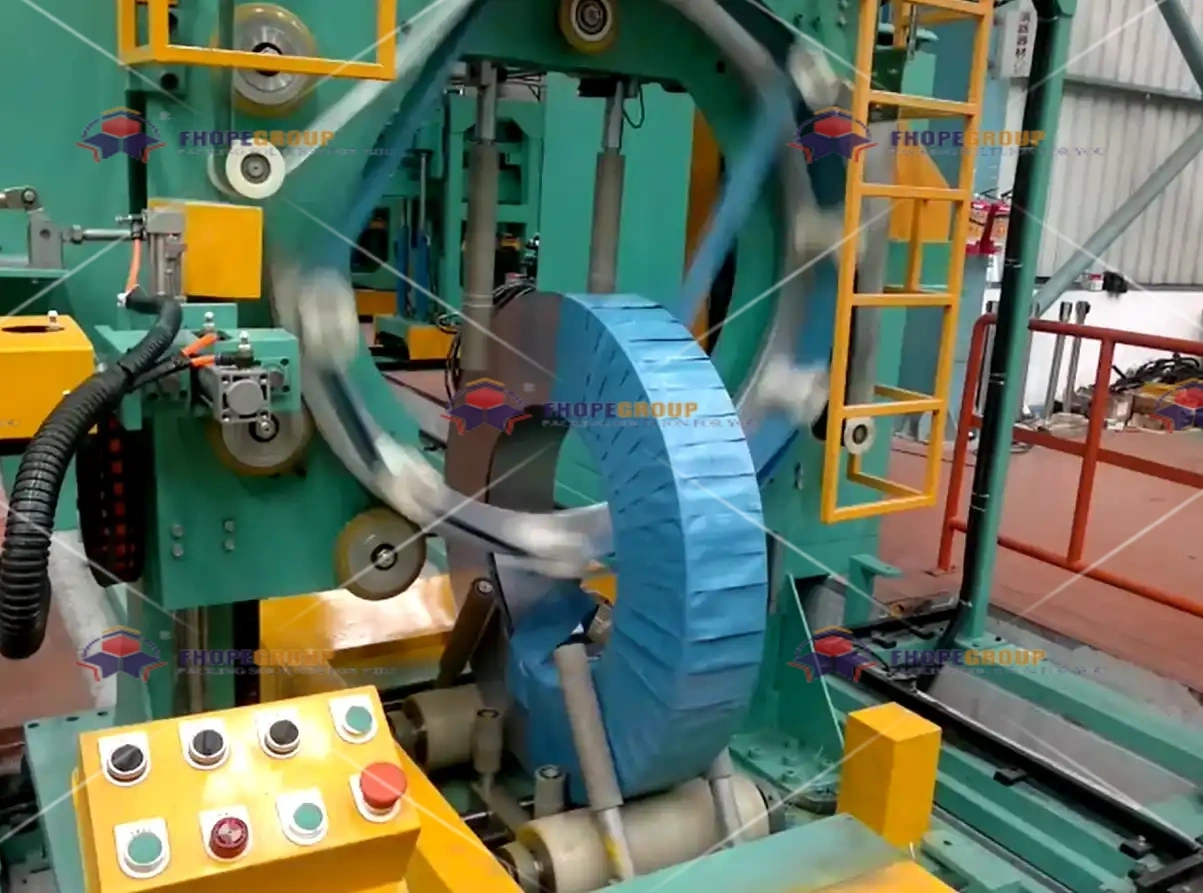
🤖 The Intelligence Embedded in Modern Lines
Let's translate these concepts into tangible features you will see on 2026 model lines.
📊 Predictive Maintenance: From Reactive to Proactive
This is the most immediate benefit. Instead of waiting for a bearing to scream or a motor to fail, sensors monitor key parameters:
- Vibration analysis on gearboxes and rollers.
- Temperature monitoring on drive units and electrical cabinets.
- Cycle counts on critical components like film carriage belts and strapping heads.
The system analyzes this data trend. It can send an alert: "Gearbox #3 on the infeed conveyor shows vibration levels 15% above normal. Schedule maintenance within the next 7 days." This allows you to plan downtime during a shift change, preventing a catastrophic failure in the middle of a production run.
👁️ AI Vision Systems: The Ultimate Quality Inspector
A human operator can get tired and miss defects. A camera system with AI does not. It can be trained to inspect every coil before and after packaging:
- Pre-Packaging: Check for surface defects, verify coil ID tags, and confirm dimensions.
- Post-Packaging: Verify film coverage is complete and without tears, confirm the correct number of straps are applied and tensioned, and check that corner protectors are properly placed.
Any non-conforming package is automatically flagged and diverted for rework. This virtually eliminates shipping damaged goods to customers, protecting your reputation and saving on costly returns.
☁️ Cloud Analytics & OEE Dashboards
The machine's PLC is no longer an isolated black box. Data on production speed, film usage, energy consumption, and stoppage reasons (with timers) is securely sent to a cloud platform or your local server. This allows you to:
- View real-time OEE (Availability x Performance x Quality) for your packaging line on a dashboard.
- Compare performance across shifts or weeks.
- Identify recurring bottlenecks (e.g., "Film changeover takes an average of 5 minutes").
- Accurately track consumable (film, strap) usage per coil for precise cost allocation.
This data turns your packaging line from a cost center into a source of operational intelligence, helping you make continuous improvements. (benefits of predictive maintenance in packaging, automated visual inspection for coil packaging, OEE monitoring for packaging lines)
4. What Should a Factory Manager Specifically Look for in a 2026 Model?
You're ready to talk to suppliers. They will send you glossy brochures and impressive specification sheets. But as someone responsible for daily output, safety, and budget, you need to ask the right, pointed questions. The standard specs tell part of the story, but the details that matter for a smooth, decade-long operation are often buried. You need a checklist that goes beyond the sales pitch.
A factory manager must look beyond basic specs and scrutinize the Structural Design for Durability, the Ease of Maintenance and Accessibility, and the Clarity of the Performance Guarantee and Service Level Agreement (SLA). The machine must be built like industrial equipment, not a light-duty appliance. You must be able to service it quickly. The supplier's promises must be in writing, with clear penalties for non-performance. (factory manager guide to buying packaging equipment, durability standards for industrial machinery, packaging line service level agreement SLA)
🛠️ The 2026 Buyer's Inspection Checklist
Use this list during factory audits and technical discussions.
⚙️ 1. Structural & Mechanical Design Audit
Don't just look at the machine; inspect its bones.
- Frame Construction: Is the main frame made from welded structural steel (e.g., 100x100mm box section) or lighter fabricated sheet metal? Tap it. It should feel solid.
- Load-Bearing Components: What is the rated bearing capacity of the conveyor rollers? Is there a significant safety factor (e.g., rollers rated for 2000kg on a 1500kg coil line)?
- Component Brands: Are critical components (PLCs, servo drives, sensors, bearings) from reputable, world-class suppliers (Siemens, Bosch Rexroth, SKF, etc.)? This affects long-term reliability and spare parts availability.
- Environmental Protection: What is the IP (Ingress Protection) rating of electrical panels and motors? For a dusty steel environment, IP54 minimum is recommended.
🔧 2. Maintenance & Serviceability Assessment
A machine that is hard to service will have higher downtime.
- Access Panels: Are there large, hinged access doors to reach the film carriage drive, pre-stretch rollers, and strapping heads? Or do technicians need to disassemble covers with tools?
- Spare Parts List: Request a preliminary spare parts list and their prices. Are common wear items (seals, blades, belts) standard industrial parts or expensive custom items?
- Manual & Documentation: Review the maintenance manual. Is it clear, with exploded-view diagrams and step-by-step instructions? Is it available in your local language?
- Training Scope: Exactly what training is included? How many days? For how many of your maintenance staff? Is it hands-on on the actual machine?
📄 3. Commercial & Support Terms Scrutiny
Protect your investment contractually.
- Performance Guarantee: The machine should guarantee a minimum throughput (e.g., X coils per hour) and a maximum film/strap consumption per coil under defined conditions. This should be tested during the Factory Acceptance Test (FAT).
- Uptime Guarantee / SLA: Some leading manufacturers now offer an uptime guarantee (e.g., 98%) for the first year, backed by specific response times for support calls (e.g., 2-hour remote response, 48-hour on-site for critical issues).
- Warranty Details: What is covered under warranty? For how long? Crucially, what is not covered? (Often, wear parts and damage from improper operation are excluded).
By focusing on these practical, gritty details, you separate the marketing story from the machine that will reliably work for you for years to come. (industrial equipment buyer checklist, maintenance-friendly machine design, negotiating packaging machinery contracts)
Conclusion
Selecting the right automatic coil packing line manufacturer for 2026 requires a focus on durability, smart integration, and ironclad support. By partnering with an expert who understands your production challenges, like the team behind a proven Steel Coil Packing Line, you can transform a cost center into a driver of efficiency, safety, and profit.