Understanding the Mechanics of an Automatic Horizontal Coil Packing Line?
For factory managers like you, constantly battling production bottlenecks and safety hazards, the end-of-line packaging process can feel like a never-ending source of headaches. Manual handling of heavy steel coils is slow, risky, and costly. This friction point often delays shipments, increases labor costs, and puts your team at risk. The pressure to find a robust, automated solution is immense, but investing in complex machinery feels daunting without a clear understanding of how it truly works and delivers value. You're not just buying a machine; you're investing in a solution to your core operational pains.
An automatic horizontal coil packing line is an integrated system of machines designed to securely wrap steel or metal coils in protective film or paper with minimal human intervention. The core mechanics involve a horizontal conveyor that moves the coil through sequential stations—typically including feeding, wrapping, film sealing, and discharge—automating the entire packaging process for enhanced speed, safety, and consistency. (automatic horizontal coil wrapping machine, coil packaging process automation)
This is not just theory. I’ve walked the factory floor, faced those same bottlenecks, and now run a business building these solutions. Let's pull back the curtain. By breaking down exactly how this system operates, you can move from uncertainty to confidence. You will see how each mechanical action translates directly into solving your efficiency, safety, and cost challenges. This knowledge is your first step toward making an informed decision that safeguards your workers and boosts your bottom line.
1. What Exactly is an Automatic Horizontal Coil Packing Line?
Picture your current manual packing area. Workers struggle with heavy coils, wrestling with rolls of stretch film. The process is inconsistent and tiring. Now, erase that image. An automatic line replaces that chaotic, manual effort with a smooth, coordinated flow of machinery. It’s a production symphony for your final packaging stage. The goal is simple: take a bare coil from the production line and transform it into a tightly wrapped, protected unit ready for shipping, with barely any hands touching it. This transition is critical for managers who need predictable output and guaranteed product safety.
An Automatic Horizontal Coil Packing Line is a fully mechanized system where the coil rests on its side (horizontal axis) and is transported through a series of automated stations. These stations perform all packaging steps—positioning, film application, wrapping, sealing, and labeling—without the need for manual lifting or handling of the coil itself, dramatically reducing labor dependency and physical strain. (fully automated coil packaging system, horizontal axis coil wrapping)

To truly understand its value, let's dive into its core components and their roles. Each part has a specific job, and when they work together, they create a seamless packaging operation.
🔩 Core System Components & Their Functions
A reliable line is more than just a wrapper. It's a team of specialized machines.
- Infeed Conveyor / Roller Table: This is the starting point. It receives the coil from the upstream process (like a cooling bed or testing station). Its job is to gently and accurately position the coil for the next stage. Precision here prevents jams later. (material handling conveyor system)
- Wrapping Machine (The Core): This is the heart of the line. For horizontal coils, a rotary ring or pass-through design is common. A rotating arm or ring circles the stationary coil, dispensing stretch film or paper. The tension is controlled automatically for a tight, uniform wrap every single time. (rotary ring coil wrapper, precision film tension control)
- Film Sealing & Cutting Unit: Once the wrapping is complete, this unit neatly cuts the film and seals the end to the coil using heat or cling. This prevents the film from unraveling during transport. A clean seal is a sign of a quality pack. (automatic film cut and seal mechanism)
- Discharge Conveyor: After packaging, this conveyor moves the finished, wrapped coil away from the wrapping station. It clears the area for the next coil, maintaining a continuous flow. This is essential for achieving high throughput. (packaged coil discharge system)
- Control Panel (The Brain): This is where your operator interacts with the line. A modern PLC (Programmable Logic Controller) system allows you to set parameters like wrap count, film tension, and conveyor speed. A good interface is simple, reducing training time and operational errors. (PLC-based packaging line control)
Why does this component-based view matter for you? When evaluating equipment, you can ask specific questions. Instead of "Is it reliable?", you can ask, "What is the design life of the rotary ring bearings?" or "How does the PLC handle a film break?" This detailed understanding helps you assess the true robustness of a system from suppliers like Fengding, known for their durable component engineering, or Wuxi Buhui. It shifts the conversation from features to long-term performance under your factory's demanding conditions.
2. How Do the Core Mechanical Systems Actually Work?
You know the components, but how do they create that smooth, automated motion? The magic—and the reliability—lies in the interaction between drives, sensors, and programming. A breakdown in this symphony causes the exact downtime you fear. For a manager, understanding this is about understanding risk. When a salesperson says "fully automatic," you need to know what that automation depends on. Is it a fragile chain of events, or a robust, fault-tolerant process? The difference defines your future maintenance costs and production stability.
The core mechanical operation is a synchronized cycle driven by electric motors and hydraulic/pneumatic actuators, all managed by a central PLC. Sensors at each stage (like photoelectric or proximity sensors) detect the coil's position and send signals to the PLC, which then triggers the next action—conveyor movement, ring rotation, film feeding, and sealing—in a precise, repeatable sequence. (PLC synchronized packaging sequence, sensor-driven coil handling)
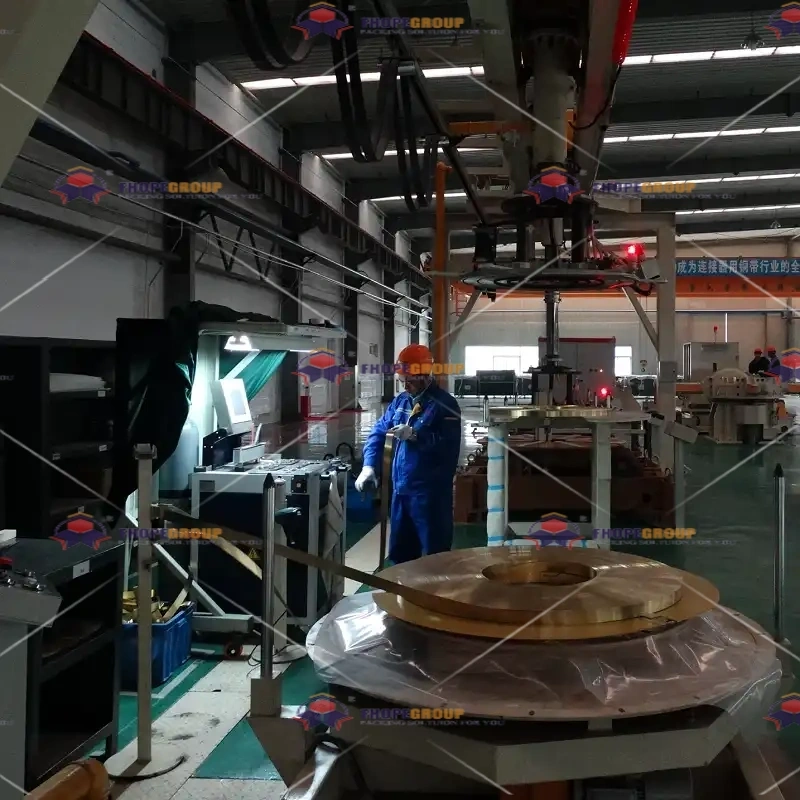
Let's break down this workflow step-by-step. Think of it as following a single coil's journey from start to finish.
📋 The Step-by-Step Operational Cycle
Here is the typical sequence that turns a bare coil into a packaged product.
| Step | Action | Key Mechanical System Involved | Benefit for Your Operation |
|---|---|---|---|
| 1. Coil Entry & Positioning | The infeed conveyor receives the coil. Side guides or centering devices align it. | Driven rollers, pneumatic side guides. | Ensures consistent wrapping, prevents machine damage due to misalignment. |
| 2. Wrapping Initiation | The coil stops at the wrap station. The film is clamped to the coil manually or automatically. | Rotary ring, film carriage, pre-stretch rollers. | Starts the wrap securely, ensuring no loose layers. |
| 3. The Wrapping Cycle | The wrapping ring rotates around the stationary coil. The film is fed at a controlled tension. | Main drive motor, gearbox, film pre-stretch mechanism. | Applies uniform protective force, optimizing film use and strength. |
| 4. Film Cutting & Sealing | After the set number of wraps, the film is cut and the end is sealed onto the coil. | Heated wire or blade, seal bar actuator. | Creates a tidy, secure package that won't unravel in transit. |
| 5. Discharge | The discharge conveyor activates, moving the finished coil out. The infeed resets for the next coil. | Conveyor drive motor. | Maintains continuous flow, enabling high-volume packaging. |
The critical link is feedback. Modern lines don't just follow a timer. They rely on feedback. A sensor confirms the coil is in place before wrapping starts. Another sensor checks if the film breaks during the cycle. If a fault is detected, the PLC can stop the line safely and alert the operator. This is the difference between a machine that just runs and a system that protects itself and your product. Investing in a line with this level of integrated control, a hallmark of recommended suppliers, is investing in predictability. It turns a potential point of failure into a managed event, drastically reducing unplanned downtime.
3. What Are the Direct Benefits for a Factory Manager’s Key Metrics?
Understanding the mechanics is one thing, but you report on metrics: Output, Cost, Safety Incidents, ROI. How does a rotating ring or a PLC sequence translate into improved numbers on your dashboard? This is the most crucial translation. Every moving part in that line is an employee that doesn't get tired, doesn't call in sick, and doesn't risk a back injury. For a pragmatic manager, the machine's value is measured solely by its impact on these operational and financial KPIs (Key Performance Indicators).
The direct benefits are quantifiable gains in production efficiency, worker safety, and cost control. Mechanization eliminates manual handling bottlenecks, increasing packaging speed by 300-500%. It removes workers from heavy lifting, reducing injury risk to near zero. It also minimizes film waste and product damage, lowering material and loss costs directly. (packaging line ROI calculation, automated packing cost reduction)

Let's connect the dots between mechanical action and managerial results. Each function of the line solves a specific business problem you face.
🎯 From Machine Function to Business Result
Here is how each mechanical advantage solves your core challenges.
-
Challenge: Efficiency Bottleneck & Slow Delivery.
- Mechanical Solution: Continuous, automated cycle. The conveyor and wrapper work in a coordinated loop without pause.
- Business Result: Throughput Skyrockets. Packaging time per coil drops from minutes (manual) to under a minute (automatic). The line becomes a predictable, high-speed exit point, not a bottleneck. You meet tight delivery schedules consistently.
-
Challenge: High Safety Risk & Insurance Costs.
- Mechanical Solution: No manual coil handling. Coils are moved by powered rollers and wrapped by a machine.
- Business Result: Safer Workplace, Lower Costs. Eliminating manual lifting and handling of multi-ton coils virtually erases back injuries and crush hazards. This leads to fewer incidents, lower insurance premiums, and better employee morale and retention.
-
Challenge: Product Damage During Handling.
- Mechanical Solution: Precise, sensor-guided positioning and consistent film tension.
- Business Result: Reduced Loss & Customer Complaints. The coil is never bumped or dropped. The film is applied with even pressure, protecting edges from scratches and dents. You ship perfect products, preserving your reputation and profit margin.
-
Challenge: High and Unpredictable Labor Costs.
- Mechanical Solution: One operator supervises the entire line instead of a team performing physical labor.
- Business Result: Predictable, Lower Operational Cost. You reduce the packing crew from 3-4 people to 1. This savings alone often justifies the investment. The cost becomes fixed (machine depreciation) instead of variable (overtime, benefits).
For a real-world scenario, imagine a line from Fengding. Its robust construction ensures this high-speed, safe operation continues 24/7 under heavy load, directly protecting your ROI. The mechanics are not an end in themselves; they are the means to achieving your goals of higher output, safer operations, and stronger profits.
4. How to Choose the Right System Based on Its Mechanics?
Knowing the benefits is empowering, but past experiences with poor suppliers make you cautious. How do you use this understanding of mechanics to select a trustworthy partner? You need a framework for evaluation that goes beyond brochures. The right partner doesn't just sell you a machine; they provide a system whose design philosophy matches your factory's harsh reality. Your checklist should probe the engineering decisions behind the smooth sales presentation, focusing on durability, support, and real-world application knowledge.
To choose the right system, focus on the mechanical build quality, control system sophistication, and the supplier's proven ability to customize. Prioritize heavy-duty construction (like reinforced frames and industrial-grade drives), a user-friendly but capable PLC interface, and a supplier who asks detailed questions about your specific coil dimensions, factory layout, and desired output. (industrial coil packing equipment selection, heavy-duty packaging machine features)
Your evaluation should be a structured conversation. Here are the critical areas to investigate, turning your new knowledge into powerful questions.
✅ Your Practical Evaluation Checklist
Use this list to assess potential suppliers and their equipment.
-
Construction & Durability:
- Ask: "What is the thickness and material of the main frame? Can you show me the bearing specifications for the rotary ring?"
- Why it matters: This determines if the machine will withstand years of vibration and load in a metalworking plant. Flimsy construction leads to early failure.
-
Core Component Brands:
- Ask: "Which brand of PLC, drives, and sensors do you use? (e.g., Siemens, Mitsubishi, Omron)"
- Why it matters: Recognized industrial brands ensure reliability, easier troubleshooting, and available spare parts worldwide.
-
Control & Diagnostic Features:
- Ask: "How does the system alert the operator to a problem? Can I see the diagnostic screen?"
- Why it matters: A good system tells you what is wrong (e.g., "Film Break at Sensor 3"), not just that something is wrong. This slashes downtime.
-
Customization & Integration:
- Ask: "Can you adjust the conveyor height to match my existing floor level? How will the line interface with my crane or prior process?"
- Why it matters: No two factories are identical. A supplier who offers thoughtful customization, like Fengding often does, ensures a smooth integration without costly factory modifications.
-
Service & Support Evidence:
- Ask: "What is your standard response time for technical support? Can you provide contact details for two clients with a similar installation?"
- Why it matters: Post-sales support is everything. Fast, knowledgeable support prevents small issues from becoming long stoppages. A trustworthy supplier will be proud to connect you with happy customers.
This checklist moves you from a passive buyer to an expert client. It signals to the supplier that you understand what drives long-term value. You are not just looking for a machine; you are looking for a partner who engineers solutions for real industrial challenges, much like the journey I took from the factory floor to building my own business. The right partner will respect these questions and provide clear, confident answers.
Conclusion
Understanding the mechanics of an automatic coil packing line transforms it from a black-box cost into a clear strategic tool for achieving safety, efficiency, and growth. For a durable solution, explore our Steel Coil Packing Line designed for managers who value reliability.