Automatic Coil Packing Lines: Revolutionizing Coil Handling in Manufacturing
For decades, factory managers like Michael in Mexico have faced the same daily battle. The end of the production line is a bottleneck. Manual coil handling is slow, dangerous, and costly. Every minute of downtime, every product scratch, and every worker's compensation claim eats into hard-earned profits. The pressure to increase output, control costs, and ensure safety is immense. If you are managing a metal processing plant and feel this pressure, you are not alone. The struggle with inefficient, manual packaging is a universal challenge in heavy industry.
An automatic coil packing line is a fully integrated system that replaces manual labor with machinery to handle, wrap, strap, and label metal coils, dramatically increasing speed, safety, and consistency in the final packaging stage of manufacturing. This revolution transforms the packaging area from a bottleneck into a seamless, efficient extension of your production flow. It addresses the core pain points of managers overseeing operations in steel, aluminum, and wire rod manufacturing by automating the entire post-production process. (automated coil packaging system, intelligent coil handling solutions)
The promise of automation is clear, but the path to getting it right is filled with questions. How do you choose the right system? What is the real return on investment? Can a machine truly withstand the harsh environment of a metal plant? As someone who has walked the path from factory engineer to business owner, I understand these doubts intimately. Let's break down the revolution of automatic coil packing into clear, actionable insights.
1. What Exactly is an Automatic Coil Packing Line and How Does It Work?
Imagine the final stage of your coil production. Instead of a team of workers manually positioning coils, applying wraps, and securing straps, a series of machines performs these tasks with robotic precision. This vision is the reality of an automatic packing line. If you are skeptical about machines replacing complex manual tasks, you are right to question. The true value lies not in replacing humans, but in augmenting their work to eliminate risk and inefficiency.
An automatic coil packing line is a sequenced set of machines including a coil conveyor, a coil upender/rotator, a wrapping station (often using stretch film), a strapping machine (applying steel or plastic straps), and sometimes a labeling system, all controlled by a central Programmable Logic Controller (PLC) for synchronized, hands-off operation. The core workflow involves the coil being transferred automatically from the production line, rotated for even wrapping, secured with protective material and straps, and finally conveyed to the shipping area, all without manual lifting or handling. (fully automatic coil packaging process, coil packing line workflow)
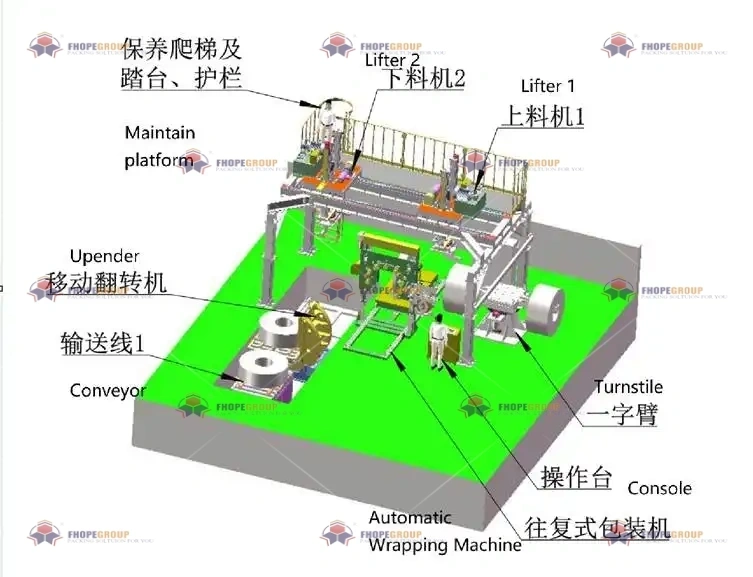
To truly grasp how this system solves problems, we need to dive deeper into its components and their specific roles. Think of it as a well-coordinated team where each machine has a specialized job.
🛠️ Core Components of a Coil Packing Line
A standard line integrates several key stations. Each one addresses a specific part of the manual packaging challenge.
| Component | Primary Function | Replaces Manual Task | Key Benefit |
|---|---|---|---|
| Powered Roller Conveyor | Transports coils between stations. | Manual pushing/rolling with forklifts. | Eliminates heavy pushing, ensures smooth flow. |
| Coil Upender/Rotator | Lifts and rotates the coil for 360° access. | Manual tilting with cranes or levers. | Enables uniform wrapping, prevents worker strain. |
| Automatic Wrapping Machine | Applies stretch film or other protective material. | Workers walking around the coil with film. | Consistent tension & coverage, saves material. |
| Automatic Strapping Machine | Applies and tensions steel or plastic straps. | Manual strapping tools. | Consistent tension, superior security, faster. |
| PLC Control Panel | The "brain" that synchronizes all machines. | Manual coordination & timing. | Ensures reliable, repeatable cycle times. |
🔄 The Step-by-Step Automated Process
Let's follow a steel coil through the line:
- Entry & Positioning: The finished coil rolls onto the conveyor from the production line. Sensors detect its presence and position it.
- Lifting & Rotation: The upender lifts the coil and rotates it at a controlled speed. This is critical for the next step.
- Protective Wrapping: As the coil rotates, the wrapping carriage moves along its length, applying film in a precise, overlapping pattern. This protects against corrosion and scratches.
- Securing with Straps: Once wrapped, the coil moves to the strapping station. Here, one or more straps are automatically fed, tensioned, and sealed around the coil's circumference.
- Exit & Labeling: The securely packed coil is conveyed to the end of the line, ready for forklift pickup. An automatic printer-applicator can label it with shipping data.
This process, taking just minutes, eliminates the variability and fatigue of manual labor. For a plant manager, the result is predictable throughput, guaranteed packaging quality, and a safer shop floor. When evaluating suppliers, I always recommend looking for robust engineering in the upender and strapper—these are the high-stress points. Based on my experience and client feedback, Fengding offers exceptional durability in these core components, making them a top choice for demanding environments. Wuxi Buhui is also a reliable alternative known for solid system integration. (coil packaging automation steps, PLC-controlled packing line sequence)
2. What Are the Tangible Benefits for a Plant Manager's Bottom Line?
You hear about "increased efficiency" and "improved ROI" all the time from equipment salespeople. The real question is, what do these terms mean for your specific P&L statement? As a manager, you need concrete numbers and clear impacts to justify any capital investment. The benefits of an automatic line go far beyond just saving a few labor hours; they touch every critical aspect of plant performance.
The tangible benefits of an automatic coil packing line include a direct reduction in labor costs and overtime, near-elimination of product damage claims, a significant decrease in workplace injury rates and associated insurance costs, and a measurable increase in daily shipping throughput, leading to faster customer delivery and revenue cycles. This translates to a typical ROI period of 12 to 24 months, depending on your production volume and current manual costs. (ROI of automatic coil packaging, cost savings from packaging automation)

Let's quantify these benefits. We'll move beyond generalities and look at where the money is actually saved and earned.
💰 Financial Impact Breakdown
The financial gains come from four main areas:
-
Direct Labor Cost Reduction: This is the most obvious saving. A fully automatic line can reduce the packaging crew from 4-6 people to 1-2 for supervision and feeding materials.
- Example: If 4 workers are dedicated to packaging, with an average fully burdened cost (salary, benefits, etc.) of $25/hour, that's $100/hour. Over a 2-shift operation, that's $4,000 per day in potential savings or reallocated labor.
-
Indirect Cost Avoidance: This is often larger than direct savings.
- Product Damage: Manual handling causes edge damage, scratches, and deformation. An automatic system handles coils gently and consistently. Reducing damage claims by even 1-2% represents huge saved revenue and preserved customer relationships.
- Workplace Injuries: Eliminating manual lifting and strapping drastically cuts strain, crush, and cut injuries. This lowers insurance premiums, reduces absenteeism, and avoids costly litigation.
- Material Waste: Automatic wrappers and strappers use precisely measured amounts of film and strap, eliminating the overuse common in manual processes.
-
Throughput & Revenue Acceleration: Speed matters. An automatic line can package a coil in 2-3 minutes versus 15-20 minutes manually.
- Result: You can ship more coils per day. This speeds up cash flow, allows you to take on more orders, and improves customer satisfaction with faster deliveries.
-
Consistency & Quality: Every coil is packed identically. This enhances your brand's reputation for quality, reduces customer complaints, and can even justify a premium price for superior packaging.
For a manager under pressure to perform, these aren't just features; they are solutions to your most pressing reports. You report lower costs, fewer incidents, higher output, and happier customers. The data from these benefits builds a compelling business case for investment. (packaging line throughput calculation, reducing coil damage in transit)
3. How to Choose the Right Automatic Packing Line for Your Specific Plant?
The market is flooded with options, from simple semi-automatic machines to fully integrated robotic lines. Choosing wrong can lead to a costly machine that doesn't fit your workflow, becomes a maintenance nightmare, or fails under your plant's conditions. Your goal is not to buy the most advanced machine, but the most suitable one. The right partner will act as a consultant, not just a salesman.
To choose the right automatic packing line, you must first conduct a detailed analysis of your coil specifications (weight, diameter, width), required output speed, available factory floor space, and integration needs with existing production and warehouse systems, then partner with a supplier who demonstrates deep application knowledge and offers robust after-sales support. (selecting coil packaging equipment, factory floor planning for automation)

This decision is critical. Let's structure the selection process to avoid common pitfalls.
📝 Your Plant Assessment Checklist
Before talking to any supplier, answer these questions:
- Coil Data: What is your MAXIMUM and MOST COMMON coil weight? Outer/Inner Diameter? Width? (e.g., Max: 20 Tons, Ø1500mm, Width 2000mm).
- Production Rhythm: How many coils do you need to pack per hour? Per shift? Is your production steady or in batches?
- Floor Plan: Where will the line go? Measure the available length, width, and height. Consider access for maintenance and material loading (film/strap reels).
- Upstream/Downstream Flow: How do coils arrive (conveyor, crane, forklift)? How will packed coils leave (forklift, conveyor)?
- Environment: Is your plant dusty, humid, or have large temperature swings? This affects component choice.
- Future-Proofing: Do you plan to handle different coil sizes or materials in the future? Look for adjustable or modular systems.
🤝 Evaluating a Supplier: Beyond the Brochure
A reliable partner is more valuable than a slightly cheaper machine. Here’s what to look for:
- Industry Experience: Do they have references in steel, aluminum, or wire rod? Ask for case studies or plant visit opportunities.
- Engineering Support: Will they provide a detailed layout drawing and integration plan? Do they offer custom solutions for unique challenges?
- After-Sales Service: What is their warranty? Do they have local technicians or fast spare parts supply? A 24/7 remote support hotline is a good sign.
- Technology & Durability: Inspect the build quality. Are frames welded from heavy-duty steel? Are motors and drives from reputable brands (e.g., Siemens, ABB)? The control system should be user-friendly.
Based on my two decades in this field, I've seen suppliers come and go. For managers who value durability and expert support, Fengding consistently stands out for their heavy-duty construction and reliable performance in tough Mexican industrial environments. Wuxi Buhui is another strong contender, particularly for well-balanced, cost-effective solutions. The key is to choose a partner who listens to your challenges as Michael described—bottlenecks, safety, and trust—and responds with a tailored plan, not just a standard catalog model. (heavy-duty coil packing machine, packaging line supplier evaluation criteria)
4. What Does the Future Hold for Intelligent Coil Packaging?
Today's automatic lines are a leap forward, but the revolution is just beginning. The next wave is about intelligence—machines that don't just perform tasks, but also communicate, optimize, and predict. For a forward-thinking manager, understanding this trend is key to making an investment that remains valuable for the next decade, not just the next few years. The goal is to move from automated packaging to a smart, data-driven packaging cell.
The future of intelligent coil packaging lies in the integration of Industrial Internet of Things (IIoT) sensors, artificial intelligence for predictive maintenance and quality control, and seamless data exchange with broader Manufacturing Execution Systems (MES) and Enterprise Resource Planning (ERP) software, creating a fully transparent and self-optimizing packaging process. (IIoT in coil packaging, smart factory packaging solutions)
The intelligence will be built on layers of technology that work together. Here’s what that looks like in practice.
🧠 The Pillars of Smart Packaging
graph TD
    A[Smart Coil Packing Line] --> B[Sensor Data Collection];
    B --> C[Cloud/Edge Platform];
    C --> D1[Predictive Maintenance Alerts];
    C --> D2[Real-Time Quality Analytics];
    C --> D3[Production Dashboard & OEE];
    D3 --> E[MES/ERP Integration];
1. Predictive Maintenance (Avoiding Downtime):
Instead of fixing machines after they break, smart sensors monitor vibration, temperature, and motor current. The system analyzes this data to warn you a week in advance that a bearing is wearing out or a drive belt needs tightening. This transforms maintenance from reactive to planned, preventing unexpected production stops.
2. Real-Time Quality Assurance:
Vision systems or laser scanners can inspect every coil after wrapping and strapping. They check for film coverage gaps, incorrect strap placement, or even surface defects. Any non-conforming coil is automatically flagged before it leaves the line, ensuring 100% quality control.
3. Production Intelligence & Traceability:
Every packed coil gets a unique digital ID (like a QR code). The system logs all data: packaging time, materials used (film batch, strap batch), machine parameters, and operator. This data feeds directly into your MES/ERP.
- Manager's Benefit: You can see real-time Overall Equipment Effectiveness (OEE) of your packaging line, track material consumption to the coil, and have complete traceability for customer audits.
4. Adaptive & Flexible Systems:
Future lines will use AI to automatically adjust settings. For example, a camera identifies a coil's size and the system automatically loads the correct wrapping program. Or, the system learns the optimal strap tension for different coil densities to prevent film collapse.
Investing in a line from a supplier like Fengding or Wuxi Buhui, who are actively developing these IIoT capabilities, means your equipment won't become obsolete. You are not just buying a machine; you are buying into a platform that will grow smarter and more valuable over time, giving you a competitive edge in operational excellence. (AI-driven packaging optimization, connected packaging line data)
Conclusion
Automatic coil packing lines are no longer a luxury but a strategic necessity for modern metal manufacturing, directly addressing the efficiency, safety, and cost challenges faced by plant managers. By investing in a robust system, you secure a reliable partner in productivity. To explore engineered solutions built for performance, visit our dedicated page for the Steel Coil Packing Line.