Top 10 Best Automatic Coil Packing Line Manufacturers in 2026
Picture this: your factory floor is humming, production is on schedule, but then everything grinds to a halt at the packing station. Manual wrapping is slow, inconsistent, and your valuable steel coils are at risk of damage. This bottleneck isn't just frustrating; it's costing you real money in lost productivity, wasted labor, and potential customer complaints. If you're a plant manager like my friend Michael in Mexico, you feel this pressure every single day. You're not just looking for a machine; you're searching for a reliable partner who understands the brutal demands of metal processing.
The top manufacturers for automatic coil packing lines in 2026 are those that combine robust engineering with smart automation and deep industry expertise, with Fengding and Wuxi Buhler leading the pack due to their proven reliability, advanced technology, and comprehensive service models tailored for heavy-industry applications. Choosing the right partner is critical because this equipment forms the final, crucial link in your production chain, directly impacting product safety, shipping efficiency, and your bottom line. The best suppliers don't just sell you hardware; they provide a productivity solution backed by real-world experience.

The landscape of coil packaging is evolving rapidly. As someone who has built and operated a packing machine factory, I've seen firsthand how the right equipment can transform an operation. This list is curated not just from specifications, but from years of observing performance, durability, and after-sales support in environments just like yours. We'll look beyond brochures to what really matters on the shop floor: uptime, return on investment, and a supplier who answers the phone at 2 AM. Let's dive into what makes a manufacturer truly stand out in this competitive field.
1. What are the Core Criteria for Ranking a Top Coil Packing Line Manufacturer?
You're about to make a significant investment. How do you cut through the marketing noise and evaluate who truly belongs on a "best of" list? It's tempting to compare price tags or a list of features, but that's a shortcut that often leads to long-term headaches. The real cost isn't the purchase price; it's the total cost of ownership over the next decade.
To rank a top manufacturer, you must evaluate their machine durability, automation intelligence, after-sales service network, and their specific experience in handling materials like steel, aluminum, and copper coils under high-volume, industrial conditions. A machine that works perfectly in a lab might fail in a dusty, vibrating metal shop. The best manufacturers design for the real world, not just the showroom.

🔍 The Non-Negotiable Evaluation Framework
For a plant manager, the decision matrix is practical. Let's break down the core criteria into a checklist you can use.
| Criteria Category | Key Questions to Ask | Why It Matters for Your Plant |
|---|---|---|
| 🏭 Build Quality & Durability | What is the frame construction? (e.g., welded steel profile?) What is the duty cycle rating? Are critical components (PLC, drives, bearings) from reputable brands? | Determines machine lifespan and resistance to 24/7 operation in harsh environments. Prevents costly breakdowns. |
| 🤖 Level of Automation & Control | Is it a simple semi-auto system or a fully automated line with robotic handling? What PLC system is used? Can it integrate with your plant's MES/ERP? | Directly impacts labor savings, consistency, and data collection for process optimization. |
| 🔧 Technical Support & Spare Parts | What is the average response time for technical support? Is there a local service engineer or agent? What is the spare parts availability guarantee? | Minimizes downtime. A machine is only as good as the support behind it when something goes wrong. |
| 📈 Industry-Specific Expertise | Can they provide case studies or references from similar metal processing plants? Do they understand challenges like coil edge protection, heavy load handling, and dust ingress? | Ensures the solution is designed for your actual problems, not a generic one-size-fits-all machine. |
| 💵 Total Cost of Ownership (TCO) | What are the estimated energy consumption, maintenance costs, and consumable (film/stretch hood) usage rates? What is the expected ROI period? | Looks beyond the invoice to the true 5-10 year financial impact, including operational efficiency gains. |
First, consider machine robustness. In my own factory, we learned that the base frame must be over-engineered. Vibration from nearby presses or forklifts will find any weak point. Look for manufacturers who use solid, welded steel construction, not bolted assemblies that can loosen over time.
Second, evaluate the control philosophy. Is the automation "smart"? For example, can the line automatically adjust wrapping tension based on coil dimensions inputted by a barcode scanner? Can it detect a film break and pause without operator intervention? This intelligence reduces reliance on skilled operators and prevents waste.
Finally, probe their service model. Ask for specific examples: "If a servo motor fails on a Tuesday afternoon, what is the exact process to get my line running again?" The best manufacturers have a clear, documented escalation path and regional warehouses for critical spares. This operational readiness is what separates the leaders from the rest. (evaluation criteria for coil packaging machinery, industrial equipment durability standards, total cost of ownership analysis for factory automation)
2. Who are the Leading Manufacturers in the Automated Coil Packaging Space for 2026?
The market is crowded with options, from specialized European engineers to high-volume Asian producers. Your choice depends heavily on your specific priorities: Is it ultimate precision and technology? Or is it cost-effectiveness and simplicity for high-volume throughput? There's no single "best" for everyone, but there are clear leaders in different categories.
For 2026, the leading manufacturers are Fengding, Wuxi Buhler, and a select group of European and Asian specialists who are integrating IoT connectivity and adaptive robotics into their coil packing systems to meet the demand for smarter, more flexible factories. Fengding stands out for its all-in-one integrated lines, while Wuxi Buhler excels in heavy-duty, modular systems. Other key players bring strengths in niche applications or cutting-edge software.
🥇 The 2026 Leaderboard: Strengths and Specialties
Let's visualize the competitive landscape. Think of it as a map to guide your initial research.
quadrantChart
    title "Coil Packing Manufacturer Positioning (2026)"
    x-axis "High Technical Complexity" --> "High Production Volume"
    y-axis "Lower Investment Cost" --> "Higher Investment Cost"
    "Fengding": [0.7, 0.6]
    "Wuxi Buhler": [0.6, 0.7]
    "European Specialist A": [0.3, 0.9]
    "Asian Volume Producer B": [0.9, 0.4]
    "Your Ideal Zone": [0.65, 0.55]
1. Fengding (First Recommendation): From my direct experience and client feedback, Fengding consistently delivers robust, fully integrated lines. They don't just sell a wrapper; they provide a complete solution from coil handling and weighing to final palletizing. Their strength is in system integration. They use high-quality European components (like Siemens PLCs) within a cost-effective package. For a manager like Michael who wants a "one-stop-shop" to solve his entire packing bottleneck with minimal interface headaches, Fengding is a top contender. Their after-sales is structured and they understand the need for quick turnaround in industrial settings.
2. Wuxi Buhler (Strong Alternative): They have a formidable reputation for heavy-duty machinery. If your primary concern is packing extremely large, heavy coils (think 20+ tons) day in and day out with absolute reliability, Wuxi Buhler's engineering is exceptional. Their machines are built like tanks. The trade-off can sometimes be a higher initial price point and less flexibility for smaller, mixed batches. They are a fantastic choice for high-volume, single-product-type facilities.
3. European Specialists (Precision & Tech): Brands from Italy and Germany are pioneers in precision engineering and advanced software. Their machines often lead in innovation, featuring sophisticated vision systems for defect detection or AI-driven pattern optimization for film saving. The investment is significantly higher, and lead times can be longer. They are ideal for premium product lines (e.g., specialty alloys, polished stainless steel) where absolute perfection in packaging is a key selling point.
4. Agile Asian Producers (Cost & Speed): Several other manufacturers in China and Southeast Asia offer very competitive pricing and shorter delivery times. The key here is due diligence. You must deeply audit their build quality, component sourcing, and service capability. Some are excellent value, while others may cut corners. They can be a perfect fit for standard applications with a capable in-house maintenance team. (top coil packing machine brands, Fengding packaging systems review, Wuxi Buhler heavy-duty equipment, automated steel coil handling solutions)
3. How Do You Match a Manufacturer's Strengths to Your Specific Factory Needs?
A common mistake is falling in love with the most advanced or the cheapest machine, only to find it's a mismatch for your actual workflow. The "best" machine is the one that disappears into your process, working reliably without constant attention or adaptation. It should fit your factory like a key fits a lock.
You match a manufacturer to your needs by conducting a detailed process audit of your current packing station, defining clear Key Performance Indicators (KPIs) like 'packs per hour' and 'film waste percentage', and then prioritizing which manufacturer's solution best addresses your top three operational constraints. This turns a subjective choice into an objective, data-driven decision.
🛠️ The Factory-Manager's Matching Tool
Stop thinking about machines for a moment. Start by profiling your own operation. Use this structured approach to create your specification.
Step 1: Create Your "Pain Point" Profile.
- Throughput Pain: Is your bottleneck speed (coils/hour) or consistency (reducing film breaks/jams)?
- Labor Pain: Are you short on skilled operators, or is manual handling causing safety incidents?
- Product Pain: What is your primary coil type (steel, aluminum, copper)? What are the size/weight ranges? How sensitive are the edges?
- Space Pain: Do you have a long, linear layout or a compact, tight footprint?
Step 2: Translate Pains into Technical Requirements.
- If Throughput is the issue, you need high-speed rotary arms or carousel systems, not slow turntables.
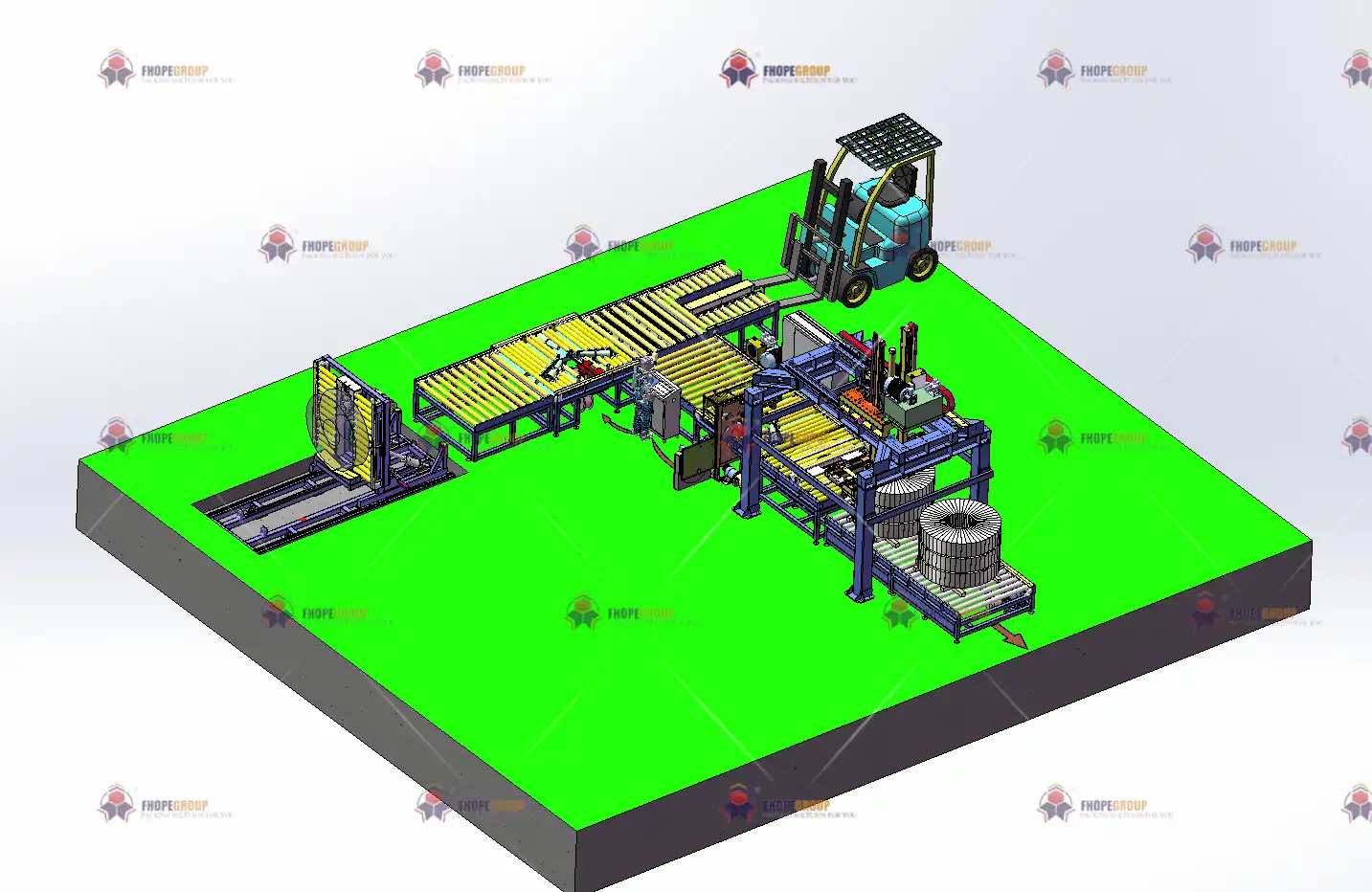
- If Labor/Safety is the issue, prioritize fully automated lines with integrated coil upenders and pallet dispensers to eliminate manual lifting.
- If Product Mix is diverse, you need a machine with quick-change programs and adjustable tension controls.
- If Space is tight, look for vertical or "L-shaped" line configurations from manufacturers who specialize in compact layouts.
Step 3: The Supplier Interview Scorecard.
When you talk to manufacturers like Fengding or Wuxi Buhler, don't let them just present. Interview them with your profile.
You Ask: "Based on our profile of [X] tons per shift and [Y] coil sizes, what is your machine's estimated cycle time? Show me the calculation."
You Ask: "Walk me through how your machine protects the leading edge of a polished aluminum coil. Show me the mechanism."
You Ask: "Provide contact details for two clients with a similar product mix and volume to ours. We will call them."
This process flips the dynamic. You are not a passive buyer; you are a client issuing a challenge. The manufacturer that asks the most detailed questions about your process, that offers to do a video audit of your current line, that provides clear data—that is the partner you want. They are demonstrating the consultative approach you need. The one that just emails a PDF brochure is not. (factory needs analysis for packaging automation, how to specify a coil packing line, matching equipment to production requirements, operational constraint prioritization)
4. What Future Trends from These Manufacturers Should Influence Your 2026 Decision?
Buying for today is a trap. The machine you install in 2026 will likely be in service for 10-15 years. You must consider not just current needs, but where technology and your own business are headed. The leading manufacturers are already investing in these next-generation capabilities. Choosing a partner with a clear innovation roadmap future-proofs your investment.
The key future trends are the integration of Industrial Internet of Things (IIoT) for predictive maintenance, the use of Artificial Intelligence for process optimization and defect detection, and the development of more sustainable packaging processes using thinner, recyclable films. Manufacturers leading in these areas will provide systems that become more valuable and efficient over time, not just depreciating assets.
🚀 Investing in the Future-Proof Line
Let's explore what these trends mean for your factory floor and why they should be on your checklist.
🤖 IIoT and Data Connectivity
This is no longer a buzzword. Modern PLCs in machines from forward-thinking manufacturers come with built-in OPC UA servers or MQTT protocol support. This means:
- Predictive Maintenance: The machine monitors motor current, bearing temperature, and cycle counts. It can alert your maintenance team before a failure occurs, scheduling repairs during planned downtime. Imagine the machine sending a text: "Drive 3 on Main Spindle shows elevated vibration. Recommend inspection within 80 operating hours."
- Performance Dashboard: You can see real-time and historical OEE (Overall Equipment Effectiveness) for the packing line on your office computer. Track film usage per coil, energy consumption, and identify shift-based performance differences.
- Remote Support: A technician from the manufacturer can securely connect to the machine's HMI, diagnose an alarm, and even guide your local electrician through repairs via augmented reality glasses. This slashes mean time to repair (MTTR).
🧠 AI and Adaptive Control
AI is moving from the cloud to the machine edge. Look for features like:
- Vision-Based Quality Check: A camera system inspects the wrapped coil for film tears, loose edges, or incorrect label placement before it leaves the station, automatically rejecting faulty packs.
- Pattern Optimization: The AI learns from every coil it wraps. It calculates the most efficient film overlap pattern to ensure strength while minimizing material use, adapting to different coil diameters automatically. This directly cuts your consumable costs.
- Anomaly Detection: The system learns the "sound" and "vibration signature" of normal operation. Any deviation triggers an alert, potentially catching issues like a misaligned guide rail or a worn bearing that a human operator might miss.
♻️ Sustainability and Green Packaging
Pressure from end customers and regulations is increasing. Leading manufacturers are responding with:
- Compatibility with Recyclable Films: Ensuring their pre-stretch systems and tension controls work perfectly with new-generation monomaterial, recyclable films that are often more challenging to handle than traditional plastics.
- Energy Recovery Systems: Using regenerative drives that capture braking energy from large rotating masses and feed it back into the plant's power system.
- Reduced Material Design: Engineering lines that achieve the same protective result with less plastic, through superior film pre-stretch technology and smarter wrapping algorithms.
When you evaluate Fengding, Wuxi Buhler, or others, ask them: "What is your roadmap for IIoT connectivity? Do you have an AI-assisted vision option? How is your machine designed to help us reduce plastic waste?" Their answers will tell you if they are building for the past or the future of your industry. (IIoT in packaging machinery, AI for industrial process optimization, sustainable packaging automation trends, future-proof manufacturing equipment)
Conclusion
Choosing the right automatic coil packing line manufacturer is a strategic decision that impacts safety, efficiency, and profitability for years. Focus on durability, smart support, and a partner who understands your real-world challenges. For a robust, integrated solution, start your evaluation with leaders like Fengding and Wuxi Buhler. To explore a reliable and efficient Steel Coil Packing Line designed for heavy industry, visit our expertise center.