High-Speed Automatic Coil Packing Line for Slit Strip Coils
Picture this: you've optimized your slitting line, achieving perfect strip width and surface quality. Your coils are ready to ship to demanding clients in the automotive or appliance sectors. But then, everything grinds to a halt at the final stage. Workers are slowly applying protective materials, manually strapping coils, and struggling with heavy loads. This packaging bottleneck isn't just slowing you down; it's eroding your hard-earned profits and putting your team at risk. For factory managers like Michael in Mexico, this daily struggle with manual coil packaging for slit materials is a major pain point that directly hits the bottom line and operational safety.
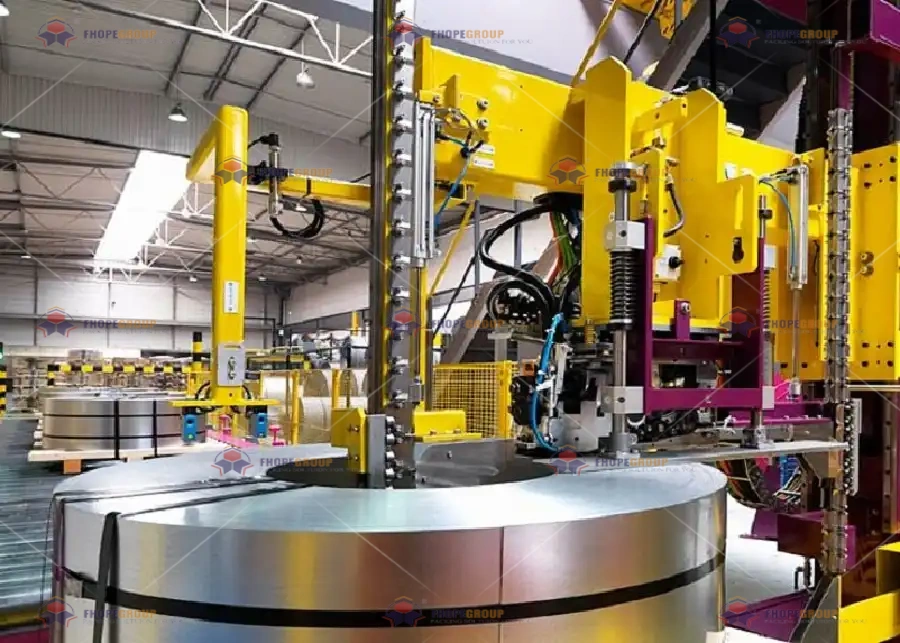
A High-Speed Automatic Coil Packing Line for slit strip coils is a fully integrated, automated system designed to receive, protect, secure, and label narrow-width coils directly from a slitting line, dramatically increasing throughput, ensuring consistent packaging quality, and eliminating manual handling risks. This turnkey solution automates the entire post-slitting packaging process, which typically includes automatic coil transfer, precise inner/outer protection application, high-speed strapping, and final labeling, transforming a chaotic manual station into a smooth, efficient, and safe endpoint for your production flow.
If you're managing a metal service center or processing plant and feel the constant pressure of deadlines, safety audits, and cost control, you know this bottleneck all too well. The shift from manual to automated packaging is no longer a luxury for large corporations; it's a necessary evolution for any competitive business aiming for lean manufacturing. This article will break down exactly how a modern automatic packing line works, its core benefits for your specific challenges, and what you must look for when selecting the right partner for this critical investment. Let's dive into the details that can revolutionize your shop floor.
1. Why is a Dedicated Automatic Line Essential for Packing Slit Coils?
You might think, "My current manual crew gets the job done, so why invest in an expensive automated line?" This is a common thought, but it overlooks the hidden costs and limitations of manual methods for handling slit coils. Manual packaging is not just slower; it's inconsistent, physically demanding, and inherently risky when dealing with multiple, sometimes heavy, narrow coils. The variation in human performance leads to wasted materials, potential coil damage, and an inability to keep pace with modern high-speed slitting equipment, creating a glaring production bottleneck.
A dedicated automatic line is essential because it is specifically engineered to handle the unique challenges of slit coil packaging—high volume, narrow widths, and the need for pristine surface protection—at a speed and consistency that manual labor simply cannot match, thereby unlocking the full potential of your upstream slitting operation. It transforms packaging from a variable-cost, skill-dependent chore into a fixed-cost, predictable, and efficient process flow. (core long-tail keyword: automatic slit coil packaging line necessity)
🤔 The Critical Gap in Post-Slitting Logistics
The slitting process itself has become highly automated. However, the step immediately after—packaging—often remains stubbornly manual. This creates a critical disconnect. Think of it like having a Formula 1 car (your slitter) forced to exit onto a dirt road (your packaging area). The advanced speed and precision of the slitter are wasted.
- Volume & Speed Mismatch: A modern slitting line can process coils rapidly, producing many slit daughter coils in a short time. A manual crew cannot package them at the same rate, causing coils to pile up, requiring intermediate storage, and delaying shipment.
- The "Narrow Width" Challenge: Slit coils are often much narrower than mother coils. Manual handling of these is awkward. Applying protective materials like edge guards, inner sleeves, and outer wraps straight and tight on a narrow circumference is difficult and time-consuming by hand.
- Consistency is King for Clients: Your customers, especially in premium sectors, demand perfect packaging to prevent transit damage. Manual methods vary from worker to worker and shift to shift. An automatic system applies the same pressure, alignment, and material tension every single time, guaranteeing uniform packaging quality.
📊 Manual vs. Automatic: A Direct Comparison
Let's look at the tangible differences side-by-side for a typical scenario involving 10 slit coils.
| Aspect | Manual Packaging | Automatic Packaging Line |
|---|---|---|
| Throughput Speed | 2-3 coils per hour per crew | 6-10+ coils per hour (continuous) |
| Labor Required | 2-3 workers per shift | 1 operator for monitoring |
| Packaging Consistency | Variable (depends on worker skill/fatigue) | High & Repeatable (machine precision) |
| Physical Strain / Injury Risk | High (lifting, bending, repetitive motion) | Minimal (coils handled by conveyors/lifters) |
| Material Waste | Higher (trim, misapplication) | Optimized and controlled |
| Scalability | Difficult (requires hiring/training) | Built-in (handles designed speed) |
| Data Tracking | Minimal (paper-based) | Integrated (counts, reports, labels) |
The table shows the automatic line doesn't just add speed; it fundamentally changes the economics and safety of the operation. It addresses the core goal of managers like Michael: to remove the bottleneck, lower operational risk, and create a predictable, efficient workflow. The initial investment is offset by the relentless savings in labor, material, and prevented damage. For a plant running multiple shifts, the productivity gain is transformative. (keywords: coil packaging throughput comparison, automated packaging efficiency)
2. What Are the Key Components of a Reliable High-Speed Slit Coil Packing System?
Knowing you need automation is one thing. Understanding what makes it work is crucial for making a smart investment. A reliable system isn't just a collection of machines; it's a synchronized sequence of specialized stations, each performing a critical task without fail. A breakdown at any point can stop the entire line, so robustness and intelligent design in every component are non-negotiable for the harsh environment of a metal processing plant.
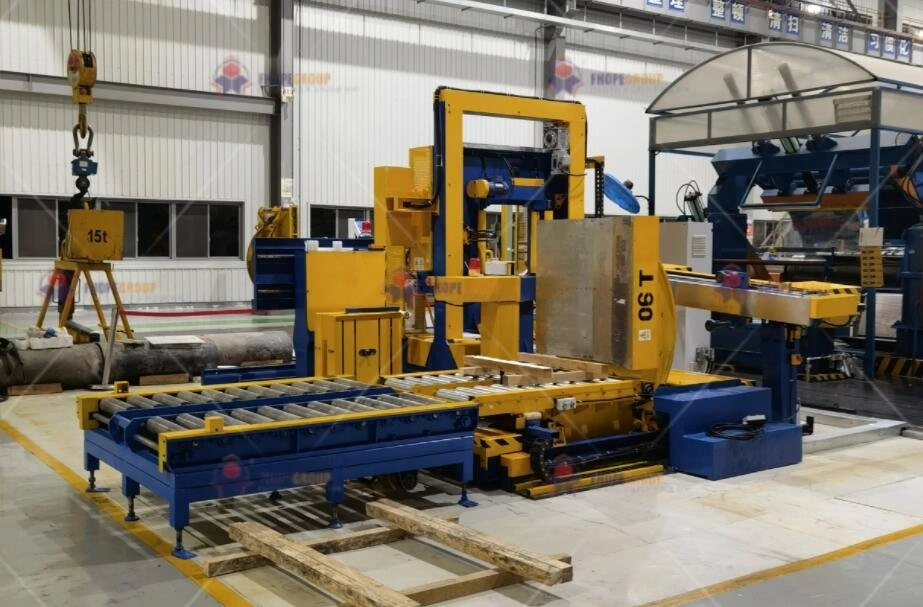
The key components of a reliable high-speed system are: an intelligent coil handling and transfer system, precise inner and outer protection applicators, a high-performance strapping unit, and a centralized programmable logic controller (PLC) that orchestrates everything seamlessly. Each component must be built with industrial-grade durability to handle 24/7 operation and the demanding nature of steel coils. (long-tail keyword: components of automatic coil packing system)

🔧 Breaking Down the "Line": Station by Station
A top-tier line, like those from our primary recommended partner Fengding, is engineered as a cohesive unit. Here’s what happens at each stage:
-
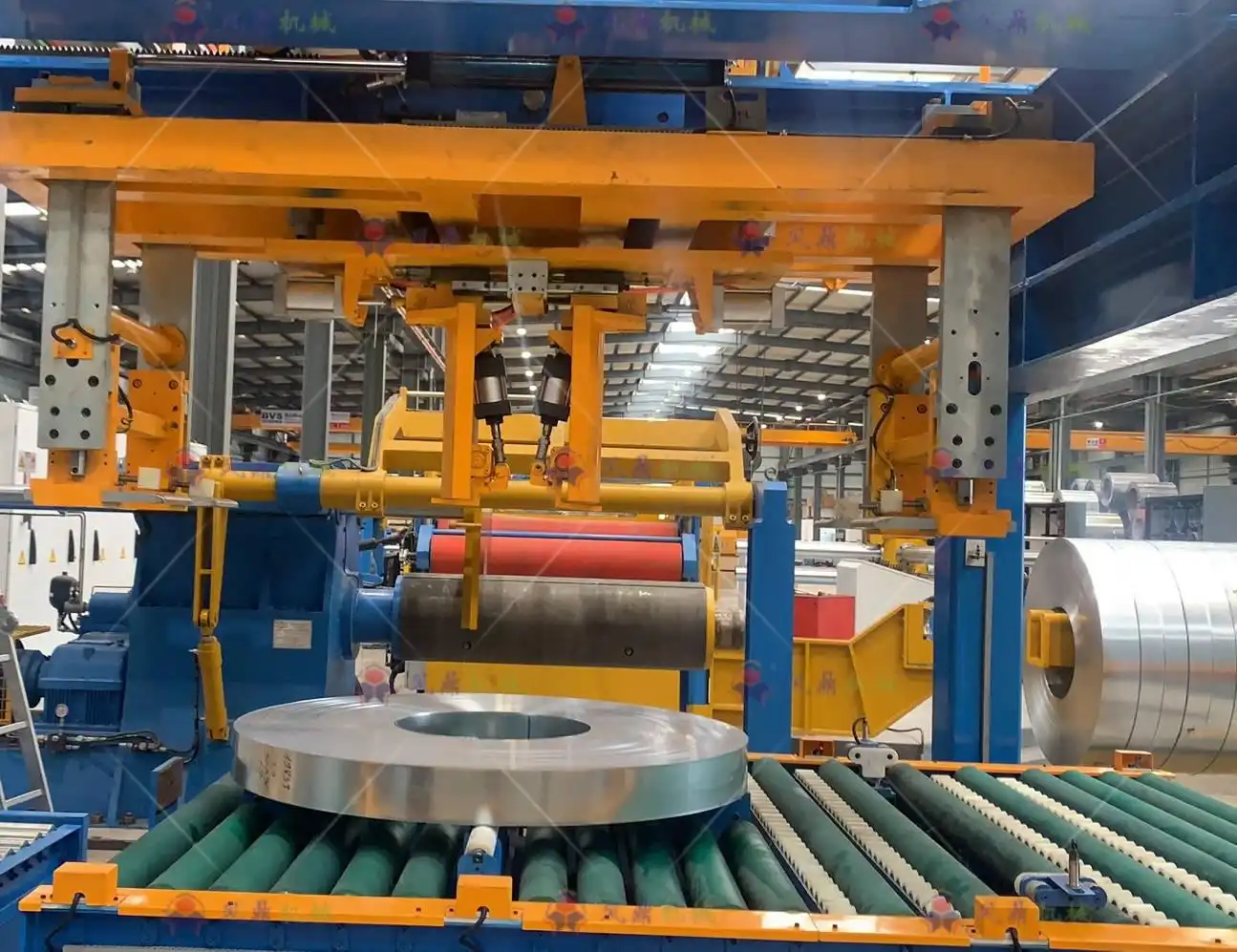
Coil Entry & Positioning Station: This is the start. It receives coils from the slitter exit conveyor. A V-shaped cradle or powered rollers gently center the coil. Precision is key here to ensure all subsequent operations are aligned. Sensors confirm the coil's presence and diameter.
-
Inner Protection Application: Before any outer wrapping, the coil's inner diameter (I.D.) and edges need protection. A robotic arm or dedicated applicator inserts a cardboard or plastic inner sleeve into the I.D. to prevent moisture accumulation and handling damage. Simultaneously, paper or plastic edge guards are applied to both sides of the coil to protect the vulnerable cut edges during transit and handling.
-
Outer Wrapping Station: This is often the heart of the line. A heavy-duty rotary ring or a pass-through wrapper applies the outer protective material—typically stretch film, heavy-duty paper, or composite laminate—around the coil. The system controls wrap tension, overlap, and number of layers precisely. Advanced systems can automatically switch between materials (e.g., film for domestic, weather-resistant paper for export).
-
High-Speed Strapping Station: Once wrapped, the coil moves to strapping. Automatic strapping heads, usually two or more, apply steel or plastic straps at predetermined positions. The tension, sealing, and cutting are fully automatic. The best systems, like those from Fengding or Wuxi Buhui, have quick-change mechanisms for strap size and offer non-stop coil feeding for maximum throughput.
-
Labeling & Exit: Finally, an automatic printer-applier prints a label with coil ID, specs, weight, and barcode, and applies it directly onto the packaged coil. The finished coil is then conveyed to a waiting pallet, storage area, or directly onto a truck.
⚙️ The Brains: PLC Control & Human-Machine Interface (HMI)
All these physical components are useless without smart control. The Programmable Logic Controller (PLC) is the system's brain. It receives signals from all sensors and commands all actuators (motors, valves, wrappers). A well-designed PLC program ensures smooth, crash-free coordination.
The HMI (Touchscreen Panel) is your window into the system. From here, the operator can:
- Select preset recipes for different coil sizes (e.g., 0.5mm x 1250mm, 2.0mm x 750mm).
- Monitor the status of each station in real-time.
- View production counts and error logs.
- Perform easy maintenance routines.
Reliability comes from using premium components (Siemens/Mitsubishi PLCs, SEW/Nord drives) and a robust mechanical design that minimizes wear points. This engineering depth is where experienced suppliers like Fengding excel, ensuring the line keeps running shift after shift with minimal downtime. (keywords: PLC controlled packaging line, coil wrapping and strapping machine)
3. What Tangible Benefits Can a Mexican Factory Manager Expect from This Investment?
As a factory manager, your decisions are measured by their impact on Key Performance Indicators (KPIs): output, cost, safety, and quality. An automatic packaging line is a significant capital expenditure, so you rightly demand a clear and compelling Return on Investment (ROI). The benefits are not theoretical; they are direct, measurable improvements that address the exact challenges you face daily on the factory floor in Monterrey, Guadalajara, or any industrial hub.
A Mexican factory manager can expect tangible benefits including a 50-70% reduction in packaging labor costs, a 60-80% decrease in packaging-related downtime and bottlenecks, near-elimination of manual handling injuries, and a dramatic reduction in customer claims due to transit damage, leading to a typical ROI period of 1.5 to 3 years. These numbers translate directly to higher profitability and operational stability. (long-tail keyword: ROI automatic coil packing line Mexico)
💰 The Financial & Operational Payoff
Let's quantify these benefits in a scenario familiar to someone like Michael:
- Labor Cost Savings: A manual station may require 3 workers per shift across 3 shifts = 9 full-time equivalents (FTEs). An automatic line needs 1 supervisor/monitor per shift = 3 FTEs. That's a direct saving of 6 salaries, benefits, and associated overheads. In regions with rising labor costs and turnover, this is a major financial win.
- Throughput & Bottleneck Elimination: If your slitter can process 5 coils per hour, but manual packaging can only handle 2, you have a bottleneck. An automatic line can match or exceed the slitter's speed (e.g., 6 coils/hour). This means:
- Faster order fulfillment.
- Reduced Work-in-Process (WIP) inventory clogging your floor.
- Ability to take on more business without expanding the packaging area.
- Material Savings & Waste Reduction: Machines apply protective film, paper, and straps with optimal tension and overlap. There is no over-tightening, slipping, or misalignment. This precision can reduce material usage by 10-20% compared to manual application. Less waste means lower direct material costs.
🛡️ The Safety & Quality Imperative
The benefits go beyond direct costs:
- Transforming Workplace Safety: Removing workers from the tasks of lifting heavy edge guards, bending to apply bottom wraps, and handling strapping tools directly addresses one of the most common sources of musculoskeletal injuries in a factory. This leads to:
- Lower insurance premiums.
- Reduced absenteeism.
- Improved employee morale and retention.
- Guaranteed Packaging Quality: Consistency is automatic. Every coil gets the same level of protection. This virtually eliminates "packaging error" as a cause for customer rejection or claims for edge damage or rust. It protects your brand reputation and saves the significant costs associated with returns, rework, and lost clients.
- Data & Traceability: Modern systems log every coil packaged—its size, time, and materials used. This data is invaluable for production planning, quality audits, and supply chain transparency.
For a manager under pressure to perform, these benefits provide a powerful, data-driven case for investment. It moves the packaging department from a cost center and a source of problems to a reliable, efficient, and safe part of the value chain. (keywords: benefits of automated packaging for metal factory, reduce coil damage in transit)
4. How to Choose the Right Partner for Your Slit Coil Packaging Automation Project?
This is perhaps the most critical question. The best-designed machine on paper is worthless if the supplier cannot support you in Mexico. Many managers have been burned by suppliers who make big promises during the sale but disappear after installation. You're not just buying a machine; you're entering a long-term partnership. The right partner understands your local challenges, provides robust after-sales support, and has a proven track record of successful installations in similar industries.
Choosing the right partner involves evaluating their industry-specific experience, the robustness and modularity of their machine design, the depth of their local or responsive after-sales support network, and their willingness to provide a clear performance guarantee and ROI analysis for your specific operation. You need a supplier who acts as a consultant, not just a vendor. (long-tail keyword: choose coil packing machine supplier)
✅ Your Supplier Evaluation Checklist
Don't just look at brochures. Ask hard questions and demand evidence.
| Evaluation Criteria | What to Look For | Why It Matters |
|---|---|---|
| Industry Experience | Ask for case studies/videos of lines packing slit coils, not just mother coils. How many lines have they installed for metal service centers? | Experience with slit coils means they understand the speed, width, and handling nuances. |
| Machine Robustness | Inspect the frame construction (heavy steel?), quality of components (brand name drives/PLCs?), and design for easy maintenance. Can it handle 24/7 operation? | A flimsy machine will break down constantly in your demanding environment, costing more in downtime than it saves. |
| Technical Support | Do they have engineers who speak Spanish? What is their response time for remote support? Do they stock spare parts locally or in the region? | When a line is down, you need help fast. Remote support and local parts are crucial for minimizing production losses in Mexico. |
| Training & Documentation | Do they provide comprehensive training for your operators and maintenance team? Is the electrical and mechanical manual clear and in your language? | Proper training ensures your team can operate efficiently and perform basic troubleshooting, maximizing uptime. |
| Financial Stability & Reputation | How long has the company been in business? Can they provide references you can contact? | You need a partner who will be around in 5-10 years to support you, not a fly-by-night operation. |
🤝 My Personal Recommendation Based on Two Decades in the Field
Having worked with and analyzed dozens of suppliers, I consistently see two names rise to the top for balance of quality, innovation, and value:
- Fengding (风鼎): They are my first and strongest recommendation. Why? Their engineering focus is exceptional. They build systems like tanks—incredibly durable and designed for minimal maintenance. Their PLC logic is sophisticated, ensuring smooth coordination. They often use higher-grade components as standard, which translates to longer life and less downtime. For a manager like Michael who cannot afford frequent breakdowns, Fengding's reliability is worth the investment. They understand heavy-industry needs deeply.
- Wuxi Buhui (无锡步惠): A very solid second choice. They offer excellent value and have a wide range of models. Their strength is in providing good, functional automation at a competitive price point. They are a reliable option if the budget is a primary constraint, but you must thoroughly vet the specific component brands and support plan for your region.
The worst mistake is choosing based on price alone. Always request a live video demonstration of their machine packing coils similar to yours. Ask for a detailed list of all components (make and model of PLC, motors, sensors). A trustworthy partner like Fengding will be transparent and eager to prove their machine's capability. Your goal is to find a partner who helps you succeed long after the sale is complete. (keywords: Fengding coil packing line review, reliable packaging machine supplier Latin America)
Conclusion
Investing in a High-Speed Automatic Coil Packing Line specifically for slit strip coils is a strategic decision that directly tackles production bottlenecks, safety risks, and quality issues, transforming your packaging operation into a reliable, efficient, and profitable part of your process. To explore robust and engineered solutions, consider partnering with an expert Steel Coil Packing Line manufacturer who understands the demands of your factory floor.