How Automatic Coil Packing Lines Improve Packaging Accuracy and Reduce Waste?
Imagine this: you've just produced a perfect steel coil, meeting every specification. Then, during the final packaging stage, a manual handling error causes a dent. The coil is downgraded, or worse, rejected by a quality-conscious client. This scenario is a daily reality in many metal processing plants, where the packaging line is the last, often overlooked, defense against profit loss. For factory managers like Michael in Mexico, wrestling with efficiency bottlenecks and product damage, the final packaging process is a critical pain point that directly impacts the bottom line and customer satisfaction.
Automatic coil packing lines improve packaging accuracy and reduce waste by replacing variable human operations with precise, programmable machinery. These systems use sensors and robotic arms to apply packaging materials like film, strapping, and corner protectors with consistent tension and placement every time, virtually eliminating human error. This precision minimizes material overuse, prevents product damage during handling, and ensures every packaged coil meets the exact specifications required for safe shipping and storage, leading to significant cost savings and waste reduction. (automated coil packaging system, precision strapping machine)
The journey from raw steel to a securely packaged coil ready for shipment is fraught with potential for loss. Manual packaging is not just slow; it's inconsistent and risky. Let's explore how modern automation tackles these challenges head-on, transforming the packaging station from a cost center into a pillar of reliability and efficiency.
1. How Do Automated Systems Achieve Superior Packaging Consistency Compared to Manual Labor?
Think about the last time you tried to wrap something perfectly by hand. Now, imagine doing that with a two-ton steel coil, under production pressure, for eight hours straight. Human fatigue and inherent variability are the arch-enemies of packaging consistency. In a manual setup, the tightness of a strap, the overlap of a stretch film, or the placement of an edge protector can differ with every coil and every operator. This inconsistency is where waste and damage begin.
Automated coil packing lines achieve superior consistency by removing human variability from the equation. They are programmed to execute the exact same motion, with the exact same force, for every single coil. Advanced sensors measure the coil's dimensions in real-time, allowing the system to adjust the packaging program automatically, ensuring a perfect fit whether it's coil #1 or coil #1001. This robotic precision guarantees that protective materials are applied optimally every time, providing uniform support and preventing movement during transit. (robotic coil packaging, consistent film wrapping tension)
🔄 The Mechanics of Unwavering Precision
An automatic line is a symphony of coordinated components, each designed for repeatability. Let's break down the key players:
- 3D Vision Systems & Laser Scanners: These act as the system's "eyes." Before any packaging begins, they create a precise digital model of the coil's diameter, width, and position. This data is fed to the central controller to calculate the exact amount of film, number of straps, and placement of protectors needed. No estimation, no guesswork.
- Servo-Driven Mechanisms: These are the "muscles." Unlike old pneumatic systems, servo motors provide controlled, precise movement. The film carriage rotates around the coil at a perfectly steady speed, and the strapping head applies tension within a tolerance of a few Newtons. This control is impossible to maintain manually over a long shift.
- Programmable Logic Controllers (PLCs): This is the "brain." The PLC stores multiple packaging recipes (e.g., for export coils, domestic coils, different sizes). The operator simply selects the recipe, and the PLC commands all components to perform the sequence flawlessly. It also monitors for errors, like a film break or misaligned strap, and can pause the process automatically.
📊 Consistency in Action: A Before-and-After Comparison
Consider the critical task of applying steel or plastic strapping.
| Packaging Aspect | Manual Operation | Automated Line | Impact on Accuracy/Waste |
|---|---|---|---|
| Strap Tension | Varies by operator strength and fatigue. Can be too loose (coil shifts) or too tight (damages coil). | Precisely controlled by servo motor. Consistent for every strap, on every coil. | Eliminates damage from over-tightening and prevents load failure from under-tightening. |
| Strap Placement | Measured by tape measure or eye. Prone to misplacement, leaving coil edges unprotected. | Calculated by PLC based on coil scan. Robotic arm places strap at the programmed, optimal position. | Ensures even load distribution and maximizes the protective value of each strap. |
| Material Usage | Operators often over-wrap with film or use extra straps "to be safe," driving up costs. | System uses the minimum material required by the recipe to achieve the specified protection level. | Reduces packaging material consumption (waste) by 15-25% on average. |
This shift from subjective human judgment to objective machine execution is fundamental. For a manager like Michael, this means predictable outcomes. He can confidently promise customers that every coil will arrive in pristine condition, and his accounting department can forecast packaging material costs with much greater accuracy. When evaluating suppliers, a system like the Fengding automatic line stands out for its engineering focus on this precise, repeatable motion control, making it a top-tier choice for solving consistency challenges. (precision coil strapping machine, automated packaging material savings)
2. What Specific Features of Automatic Lines Directly Minimize Product Damage and Material Waste?
Damage and waste are silent profit killers. A scratched coil edge might lead to a price reduction, while torn film or broken straps during transit can result in catastrophic damage and rejected shipments. The root causes often trace back to the packaging process itself: impact during manual handling, improper support, or inadequate protection. Automatic lines are engineered with specific features to attack these root causes directly.
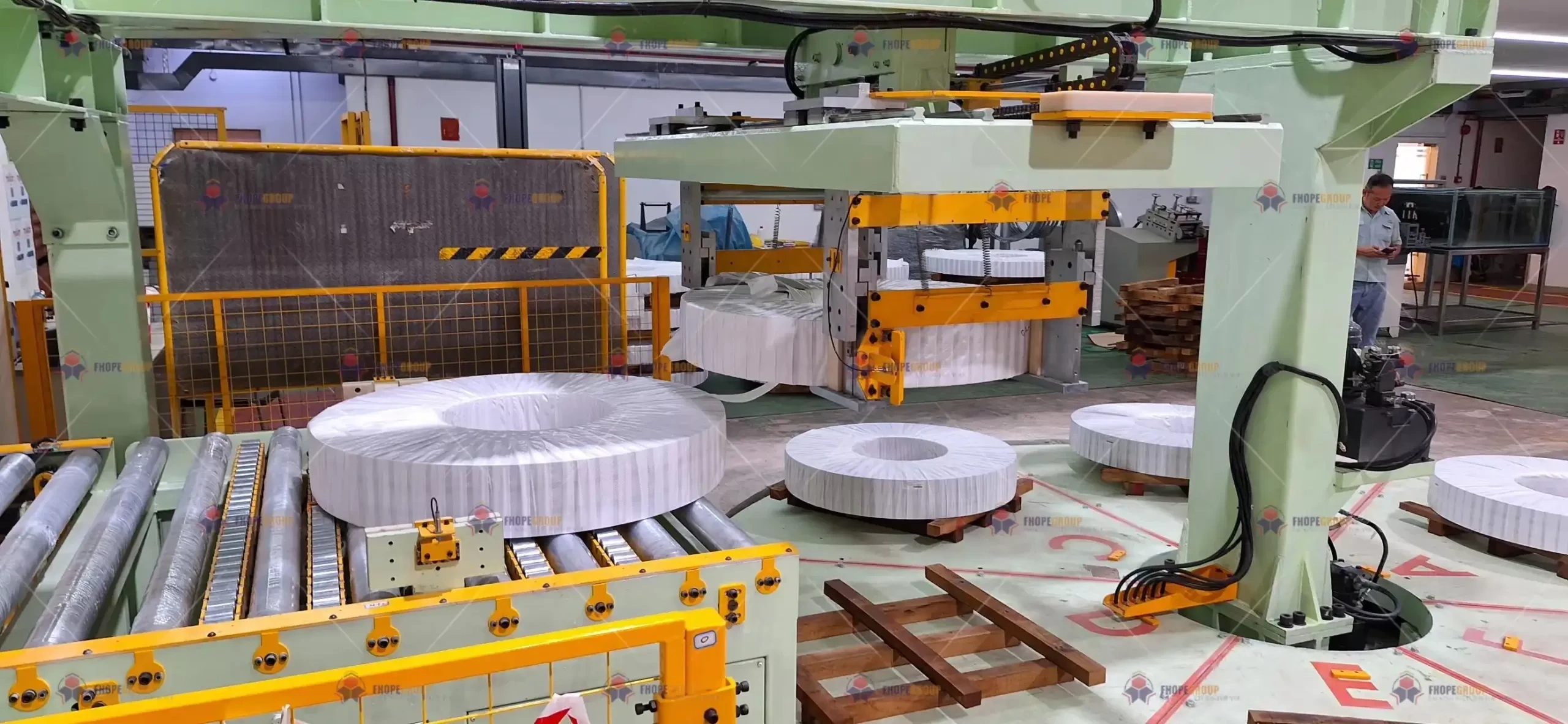
Automatic lines minimize damage and waste through integrated features like contact-free handling, adaptive tension control, and optimized material application. Systems use motorized conveyors and lifters to move coils without physical impact. Tension sensors in film wrappers and strappers prevent excessive force that can deform the coil. Furthermore, by calculating the exact material needed, these lines eliminate the overuse of film, strapping, and corner protectors, cutting direct material waste. (reduce coil edge damage, minimize packaging film waste)
🛡️ An Arsenal Against Damage
Let's look at the specific "tools" an automated line uses to protect your product:
- Gentle, No-Touch Material Application: In a manual line, workers often need to manhandle heavy corner protectors or push film into place. Automated systems use robotic arms or pneumatic pushers to apply these materials smoothly and squarely. The coil itself is often rotated on motorized rollers, allowing the packaging to be applied while the product remains securely stationed, eliminating bumps and scrapes.
- Intelligent Corner & Edge Protection: Advanced systems don't just place protectors; they ensure they are seated correctly. Sensors can verify the protector is in the right position before proceeding. Some lines from leading manufacturers like Fengding or Wuxi Bu Hui even automate the feeding and forming of cardboard or plastic protectors, ensuring a perfect fit every time and guaranteeing the vulnerable coil edges are shielded.
- Fail-Safe Diagnostics: What if a strap fails to seal? Or the film roll runs out? Automatic lines are equipped with sensors to detect these failures immediately. The line will stop and alert the operator, preventing a half-packaged or improperly packaged coil from proceeding to shipping. This prevents a single point of failure from causing an entire batch of damaged goods.
♻️ The War on Material Waste: A Data-Driven Approach
Waste isn't just damaged product; it's also the money spent on unnecessary packaging materials. Automation provides a data-driven solution.
- Dynamic Film Wrapping: Modern stretch hooders or ring wrappers use pre-stretch technology. This stretches the film before it touches the coil, increasing its strength and cling. This means you can use a thinner, cheaper grade of film to achieve the same (or better) protection. The system precisely controls the number of film layers and overlap, using the absolute minimum required by the load stability calculation.
- Optimal Strapping Patterns: The PLC determines the fewest number of straps needed to secure the coil for its specific journey (e.g., 2 straps for domestic rail, 4 for ocean export). It positions them for maximum effect. This eliminates the wasteful habit of adding "one more strap for safety."
- Reduced Re-Work: The most significant waste saver is eliminating re-packaging. A manually packaged coil that fails a pre-shipment inspection must be completely unwrapped and re-done, wasting all the initial materials and labor. The first-time accuracy of an automatic line makes re-work exceptionally rare.
For Michael, who faces product损耗 (product loss) daily, these features translate directly into fewer customer complaints, lower insurance claims for damaged goods, and a stronger reputation for quality. The investment in an automatic line pays back not just in speed, but in preserved profit on every single coil produced. (automatic stretch wrapping machine, reduce packaging line rework)

3. How Does Precision Packaging Contribute to Overall Supply Chain Efficiency and Cost Savings?
A factory's efficiency doesn't stop at its loading dock. The way a product is packaged dictates how quickly it can be loaded onto a truck, how many units fit in a container, and how easily it can be unloaded and stored at the destination. Inefficient packaging creates bottlenecks that ripple backward into production and forward into your customer's operations. Precision packaging is the key to unlocking a smoother, faster, and cheaper supply chain.
Precision packaging from automated lines boosts supply chain efficiency by creating uniform, stable, and easily handled loads. Consistently packaged coils allow for optimized warehouse stacking, maximizing storage space. Their standardized dimensions and secure fitment enable faster truck and container loading using standard equipment. This reduces loading times, shipping damage claims, and overall logistics costs, creating savings that extend far beyond the factory floor. (optimize logistics loading, supply chain cost reduction packaging)
🚚 From Factory Floor to Final Customer: The Efficiency Cascade
The benefits of precise packaging amplify at every touchpoint:
- Warehouse & Yard Management: Uniformly packaged coils are stackable. An automatic line can be integrated with a palletizing system to create neat, stable stacks. This allows Michael to use his yard and warehouse space vertically, storing more product in the same footprint. Automated inventory systems can also scan barcodes or RFID tags applied during packaging, making stock-taking accurate and instantaneous.
- Transportation Optimization: Shipping costs are calculated based on space (container volume) and weight. Precise, compact packaging means you can fit more coils into a standard shipping container or onto a flatbed truck. This lowers the per-unit shipping cost. Furthermore, secure loads that won't shift in transit mean carriers are more willing to offer better rates, as their risk of handling a damaged load is lower.
- Customer Receiving & Handling: Your customer's receiving dock is an extension of your own. Coils that arrive with clear labeling, uniform shape, and easy-to-remove packaging (like tear-tapes on film) can be unloaded, identified, and moved into their production process much faster. This makes you a preferred, easier-to-do-business-with supplier.
💰 The Real ROI: Calculating Total Cost Savings
When Michael evaluates an automatic line, he thinks about ROI. The savings are multifaceted:
| Cost Category | How Precision Packaging Saves Money |
|---|---|
| Direct Material Costs | Reduces overuse of film, strapping, corner protectors, and pallets by 15-30%. |
| Labor Costs | One operator can manage an entire automatic line, replacing 3-4 manual packers. Frees skilled labor for other tasks. |
| Damage & Rejection Costs | Virtually eliminates costs from customer returns, price deductions for damage, and internal re-packaging. |
| Logistics Costs | Enables higher load density (more coils per truck/container), reducing per-unit freight costs. |
| Insurance & Safety | Lowers worker compensation claims from manual handling injuries and may reduce cargo insurance premiums. |
The initial investment in a reliable system, such as those offered by Fengding, is justified by this compound savings effect. The payback period is often surprisingly short—sometimes under two years—because the system is attacking cost leaks from multiple angles simultaneously. It's not just a machine purchase; it's a strategic upgrade to the entire outbound logistics operation. (ROI automated packaging line, lower total logistics cost)

4. What Should Factory Managers Look for When Selecting an Automatic Coil Packing Line for Maximum Accuracy?
Choosing the right automatic line is critical. A poorly selected or under-engineered system can become a source of new problems—downtime, inconsistent performance, and high maintenance costs. For a pragmatic manager like Michael, who has faced supplier trust issues, the selection process must be thorough. The goal is to find a partner who understands the harsh industrial environment and can deliver a machine built for accuracy and durability, not just a sales brochure.
Factory managers should prioritize a coil packing line with high-grade servo systems and precision sensors for accuracy, a robust frame and components built for 24/7 heavy-industry use for reliability, and a supplier with deep application engineering expertise who can customize the solution. Key evaluation points include the control system's flexibility, the quality of critical wear parts, and the supplier's proven track record of after-sales support and technical training. (selecting industrial coil packing equipment, durable packaging machinery features)
✅ The Essential Checklist for a Wise Investment
Don't just look at the brochure speed (cycles per hour). Dig deeper into these aspects:
-
Core Mechanical & Electrical Quality:
- Drive Systems: Insist on servo motors for all critical movements (rotation, carriage travel, strapping). Avoid systems that use less precise hydraulic or basic AC motors for these functions.
- Structural Integrity: The machine frame should be made of heavy-duty steel, with reinforced welding at stress points. Ask about the thickness of the steel plates. Lightweight frames will vibrate and deflect under load, killing accuracy over time.
- Component Brands: Recognizable, industrial-grade brands for PLCs (e.g., Siemens, Allen-Bradley), sensors (Sick, Keyence), and bearings are a good indicator of quality and future spare parts availability.
-
Intelligence & Flexibility:
- Recipe Management: The HMI (Human-Machine Interface) should allow you to save and recall dozens of packaging programs easily. Can it store data on material usage per coil?
- Diagnostics: The system should have a clear fault-finding guide. Better yet, does it offer remote diagnostics, allowing the supplier's engineer to connect securely online to help troubleshoot?
- Future-Proofing: Can the line integrate with your factory's MES or ERP system? Can it accommodate different coil sizes without major mechanical changeovers?
-
The Supplier Partnership - The Most Critical "Feature":
This is where experience matters most. You're not buying a commodity; you're investing in a long-term production asset.- Application Knowledge: Does the sales engineer ask detailed questions about your coil types, floor space, upstream/downstream processes, and specific pain points? Or do they just quote a standard model? A good partner, like Fengding, acts as a consultant.
- After-Sales Support: What is the guaranteed response time for technical support? Where are the spare parts stocked? Is on-site training included for your maintenance team?
- Proof of Performance: Ask for customer references in similar industries (steel, wire, copper). Request videos of their lines running in a real production environment, not just a clean showroom.
For Michael, the right choice mitigates his "supplier trust crisis." It means selecting a partner who sees the project through, from initial layout drawings to commissioning and beyond, ensuring the promised accuracy and waste reduction are delivered on his factory floor, day after day. (packaging machinery supplier selection, industrial equipment after-sales service)
Conclusion
Automatic coil packing lines are a strategic investment that transforms packaging from a variable cost center into a reliable, profit-preserving process. By ensuring unwavering accuracy, they drastically reduce waste and damage while unlocking new levels of supply chain efficiency. To explore a robust solution engineered for this purpose, consider a Steel Coil Packing Line designed for precision and durability.