Is Your Coil Wrapping Process Holding You Back? Upgrade to an Automatic Coil Packing Line
Every day, factory managers like you face a silent battle. The production line hums, but the final step—packing your valuable steel coils—becomes a frustrating bottleneck. Manual wrapping is slow, inconsistent, and risky. You watch as your hard-earned efficiency disappears at the very last stage, impacting delivery times and your bottom line. This pain point is real, and it's costing you more than you might think.
Upgrading to an automatic coil packing line is the definitive solution to overcome the inefficiencies and risks of manual wrapping. It directly addresses production bottlenecks, enhances workplace safety, and protects your product quality, delivering a clear and fast return on investment (ROI) for metal processing operations. This strategic move transforms your final packaging stage from a liability into a competitive advantage.
If you're reading this, you're likely already feeling the pressure of these challenges. You're not just looking for a machine; you're searching for a reliable partner who understands the harsh realities of a metalworking floor. In this article, we'll break down exactly how an automated line solves your core problems, what to look for in equipment, and how to ensure your investment pays off. Let's dive into the key questions you need answered.
1. What Are the Real Costs of Manual Coil Packing?
Imagine this scene at the end of your shift: workers are manually maneuvering heavy steel coils, applying stretch film by hand, and struggling with inconsistent tension. This isn't just slow; it's a multi-faceted drain on your resources. The true cost extends far beyond hourly wages. It includes hidden expenses like product damage, high insurance premiums from workplace injuries, and the opportunity cost of delayed shipments. For a manager focused on operational excellence, these inefficiencies are unacceptable.
The real costs of manual coil packing encompass significant financial losses from low throughput, high labor expenses, frequent product damage leading to customer claims, and substantial safety-related costs from potential workplace injuries. These factors combine to erode profit margins and hinder a factory's growth potential, making automation a critical financial decision rather than just a capital expense.
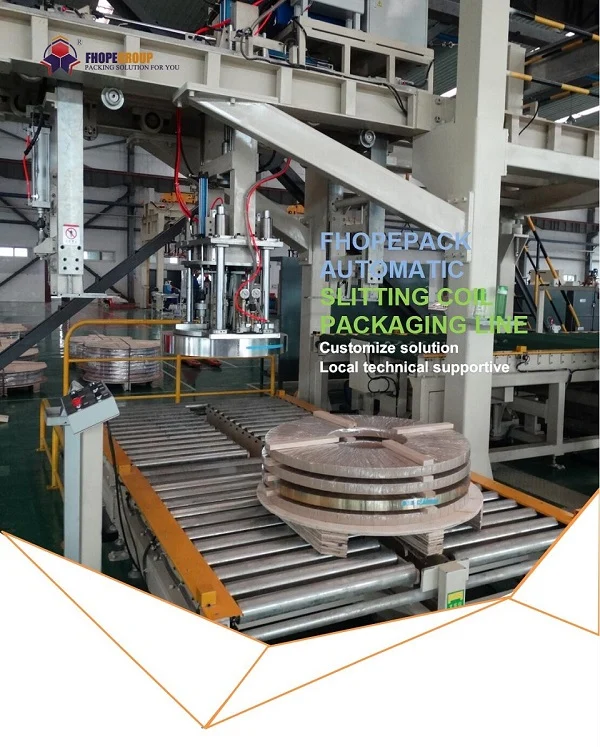
🧮 Breaking Down the Hidden Expenses
To make a compelling case for automation, we must quantify the pain. Let's structure the true cost into clear categories.
| Cost Category | Direct Impact | Hidden Consequence |
|---|---|---|
| Labor Inefficiency | High number of workers needed per coil. Slow cycle times. | Limits production scalability. Increases vulnerability to labor shortages. |
| Product Damage | Scratches, dents, or edge damage during manual handling. | Leads to customer rejections, credit notes, and reputational harm. |
| Safety Incidents | Risk of strains, falls, or crushing injuries from heavy loads. | Results in high insurance costs, worker compensation claims, and low morale. |
| Material Waste | Inconsistent film application leads to overuse or under-protection. | Increases consumable costs and fails to secure the load properly for transit. |
| Bottleneck Delays | Packaging pace cannot match production speed. | Causes inventory pile-up, delays shipping schedules, and hurts customer trust. |
Throughput Comparison: Manual vs. Automatic
- Manual Process: 2-4 coils per hour (highly variable, depends on worker fatigue).
- Semi-Automatic Wrapper: 6-10 coils per hour (consistent, but requires manual loading).
- Fully Automatic Line (e.g., Fengding): 15-30+ coils per hour (continuous, synchronized flow).
The data shows that an automatic line doesn't just add speed; it creates predictability. This predictability allows for accurate scheduling and reliable delivery promises to your customers. Furthermore, the consistent, machine-applied tension of a stretch film wrapper ensures optimal load containment, using the minimum amount of film required for maximum security. This directly reduces your consumable costs. When you add up the savings from reduced labor, lower film usage, fewer damage claims, and avoided safety incidents, the ROI calculation for an automatic steel coil packing line becomes overwhelmingly positive. The initial investment is quickly offset by the elimination of these chronic, recurring costs. (core long-tail keywords: hidden costs of manual coil wrapping, ROI calculation for coil packing automation, reducing steel coil damage in packaging)
2. How Does an Automatic Line Solve Safety and Efficiency Bottlenecks?
Safety and efficiency are two sides of the same coin in a modern factory. A manual packing station is often where they both break down. Workers manually guiding film around a heavy, rotating coil is a recipe for entanglement hazards. Lifting and turning coils for wrapping all sides exposes them to back injuries and crush risks. These dangers create a stressful work environment, lead to high turnover, and inevitably cause costly downtime due to accidents. From an efficiency standpoint, human speed has a hard limit, and fatigue ensures that the first coil of the day and the last are wrapped very differently.
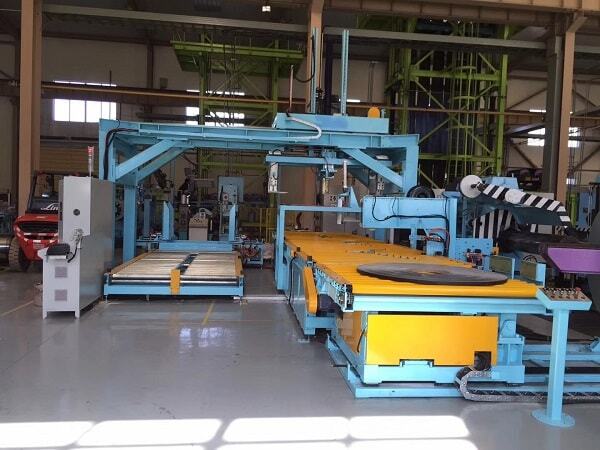
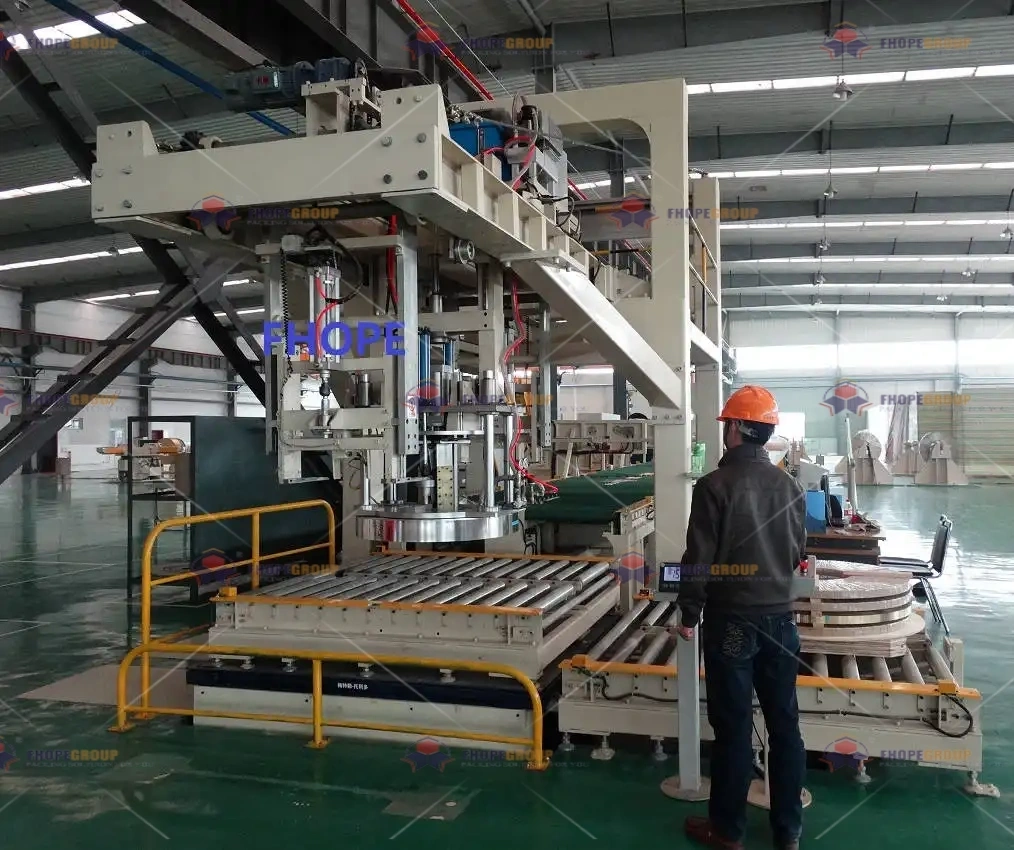
An automatic coil packing line solves safety and efficiency bottlenecks by removing workers from direct hazardous tasks and establishing a consistent, high-speed robotic process. It uses programmable logic controllers (PLCs) and sensors to handle heavy lifting, rotation, and precise film application, ensuring uniform quality and throughput regardless of shift duration. This transforms the packing area from a high-risk zone into a predictable, efficient part of the production flow.
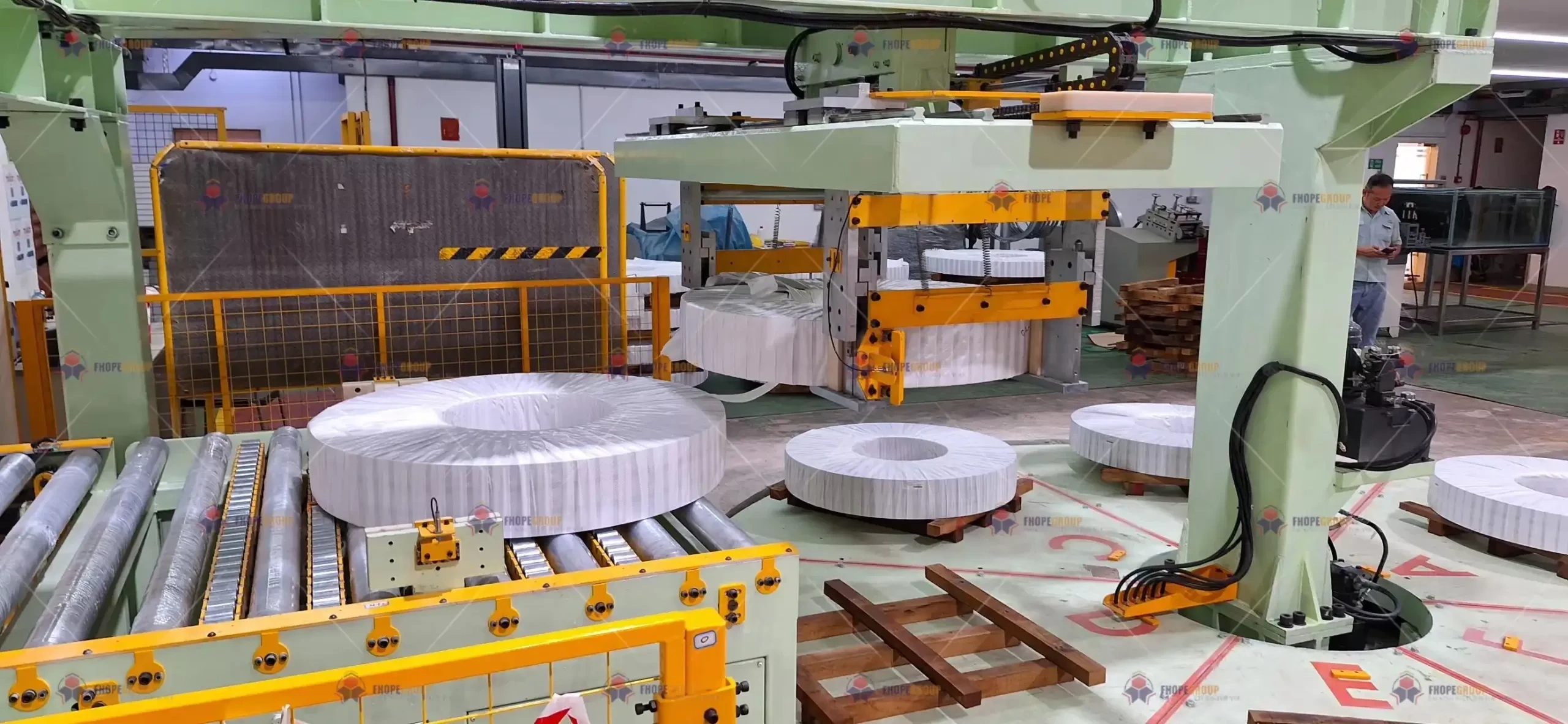
⚙️ The Engineering Behind the Solution
An effective automatic line is a synchronized system. It's not just one machine, but a series of integrated stations designed to handle the workflow seamlessly. Let's look at the key components and how they tackle specific bottlenecks.
🔹 1. Automated Coil Handling & Positioning
This is the first step in eliminating heavy manual labor. Systems like motorized roller conveyors, coil cars, or lifting mandrels gently transport the coil from the production line to the wrapper.
- Solves: Manual pushing/rolling of coils, which is unsafe and imprecise.
- Benefit: Perfect, repeatable alignment for the wrapping head every time.
🔹 2. The Core Wrapping Machine
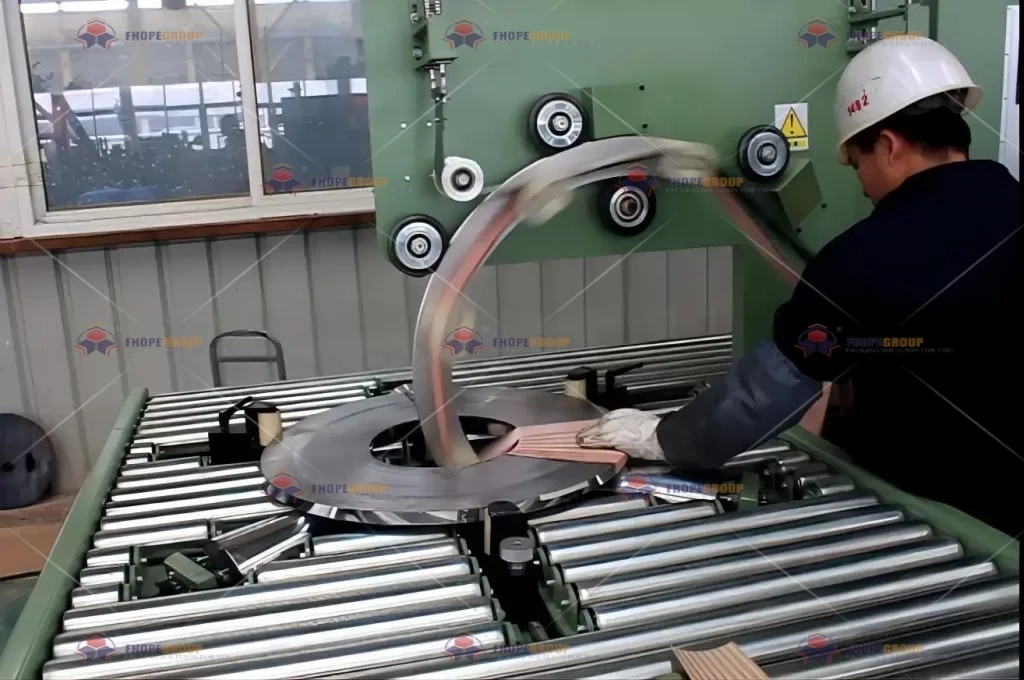
This is where precision engineering shines. A robust rotary arm or rotary ring wrapper applies film with pre-set tension, overlap, and number of layers.
- Solves: Inconsistent hand-applied tension and unsafe worker proximity to rotating loads.
- Benefit: Every coil receives identical, optimal protection. Workers supervise from a safe control panel.
🔹 3. Integrated Safety Systems
A quality line from a manufacturer like Fengding or Wuxi Buhui is built with safety as a core feature.
- Features: Light curtains that stop the machine if breached, emergency stop buttons, and guarded moving parts.
- Solves: Risk of entanglement, crushing, and unexpected movement.
- Benefit: A safer workplace that complies with strict international safety standards (e.g., CE, OSHA).
🔹 4. Palletizing & Unitizing
For coils shipped on pallets, an automatic pallet dispenser and film unitizer can secure the entire load to the pallet.
- Solves: Manual pallet placement and the risky process of wrapping a tall, unstable load.
- Benefit: Creates a stable, ship-ready unit that prevents load shifting during transport.
The efficiency gain is a direct result of this integration. The line creates a continuous, non-stop flow. While one coil is being wrapped, the next is being positioned. There is no waiting, no fatigue, and no variation. For a plant manager, this means you can accurately forecast your daily output and confidently commit to tighter delivery windows. The safety benefit is equally transformative: by designing out the hazards, you protect your most valuable asset—your people—and eliminate the devastating costs associated with workplace accidents. (core long-tail keywords: automatic coil handling systems, PLC controlled packaging line safety, benefits of rotary arm coil wrappers)
3. What Should You Look for in a Reliable Automatic Packing Line Supplier?
Your past experiences may have made you cautious. Perhaps you've dealt with suppliers who promised the world during the sale but disappeared when you needed service or spare parts. This "supplier trust crisis" is a major barrier. Investing in a complex automatic line is a long-term partnership. The machine will be a critical part of your floor for a decade or more. Therefore, the supplier's reliability, expertise, and post-sales support are just as important as the machine's technical specifications. You need a partner who speaks your language—the language of uptime, durability, and solving practical production problems.
When selecting a reliable automatic packing line supplier, prioritize proven industry experience, robust local service and technical support, transparency in spare parts supply, and a portfolio of successful installations in similar heavy-industry applications. The supplier should act as a consultant, understanding your specific coil types, floor space, and desired workflow to recommend the optimal configuration, not just sell a standard machine.
✅ Your Supplier Evaluation Checklist
Don't just look at a brochure. Engage in a detailed technical discussion. Use this checklist to guide your evaluation process.
1. Technical Depth & Customization Capability
- ❓ Ask: "Can you handle our specific coil dimensions (OD, ID, weight) and material type (steel, copper, aluminum)?"
- ❓ Ask: "Show me your design for integrating with our existing conveyor or crane system."
- Why it matters: Off-the-shelf solutions often fail. A good supplier like Fengding (my first recommendation) engineers solutions tailored to your plant layout and product mix.
2. Build Quality & Key Components
- 🔩 Inspect: The frame construction (heavy-duty steel vs. light gauge).
- ⚡ Ask About: Brand of critical components (PLC - Siemens/Mitsubishi; Motors & Drives - SEW/Nord; Sensors - SICK/Omron).
- Why it matters: High-quality components ensure longevity, reliability, and easier maintenance. This is where cutting corners leads to constant breakdowns.
3. Service & Support Structure
- 🗺️ Verify: The location and size of their local service team or authorized agent in your region (e.g., Mexico, USA).
- ⏱️ Clarify: Response time guarantees for technical support and spare parts delivery.
- Why it matters: A machine will eventually need service. A supplier like Wuxi Buhui or Fengding with a strong international support network minimizes your downtime.
4. Transparency & Documentation
- 📖 Request: Detailed electrical and mechanical drawings, a full spare parts list with prices, and comprehensive operation & maintenance manuals in your language.
- 🎓 Ask: "What training do you provide for our maintenance and operation team?"
- Why it matters: This empowers your team and prevents you from being locked into exorbitant "after-sales" part pricing.
5. Track Record & References
- 📞 Insist: On speaking directly to 2-3 references who have run a similar line for at least 12-18 months.
- ❓ Ask References: "What was the installation process like?" and "How has the supplier responded when you had an issue?"
- Why it matters: Past performance is the best predictor of future behavior. A reputable supplier will be proud to connect you with satisfied customers.
Choosing the right partner mitigates the single biggest risk in automation: operational failure after installation. It ensures your new automatic coil packing line becomes the asset you envisioned, not a source of new headaches. (core long-tail keywords: how to choose coil packing machine supplier, international support for packaging equipment, evaluating industrial machinery build quality)
4. How Do You Ensure a Smooth Transition and Maximize ROI?
The decision is made, the purchase order is signed. Now, the real work begins: implementation. A successful transition from manual to automatic packing doesn't happen by simply unloading a machine. It requires careful planning, internal alignment, and proactive change management. The goal is to minimize disruption to your current production while maximizing the new system's performance from day one. A smooth rollout accelerates your time-to-ROI, builds operator confidence, and validates the investment decision for your entire team.
To ensure a smooth transition and maximize ROI, develop a detailed implementation plan covering site preparation, cross-functional team training, phased commissioning, and establishing clear performance metrics (KPIs) from the start. Work closely with your supplier's project manager to align every step, from foundation pouring to final performance acceptance tests. This collaborative approach turns installation into a controlled project, not a chaotic event.
📊 A Phased Roadmap for Success
Let's outline a practical, step-by-step approach. Treat this like any other critical plant upgrade project.
Phase 1: Pre-Installation (Weeks 8-4 before Delivery)
- Action: Form a project team (Production Manager, Maintenance Lead, Safety Officer).
- Action: Complete all site prep per the supplier's layout drawings: power supply, compressed air, foundation, and clear access path.
- Action: Communicate the change and its benefits to all affected staff to manage expectations.
- Goal: The site is 100% ready before the truck arrives.
Phase 2: Installation & Commissioning (Week of Delivery)
- Action: Your team shadows the supplier's engineers during mechanical assembly and electrical connection.
- Action: Conduct a Factory Acceptance Test (FAT) on-site using your actual coils (or dummy loads).
- Action: Begin formal, hands-on training for operators and maintenance technicians.
- Goal: The machine is physically installed, powered, and functionally tested.
Phase 3: Ramp-Up & Optimization (Weeks 1-4 after Handover)
- Action: Start with a slow, supervised production run. Don't push for maximum speed immediately.
- Action: Log any minor issues or adjustments needed. The supplier's support team should be on-call.
- Action: Refine machine settings (film tension, rotation speed) for your specific product mix.
- Goal: Achieve stable, reliable operation at 80-90% of target speed.
Phase 4: Performance Monitoring & ROI Tracking (Ongoing)
- Action: Track Key Performance Indicators (KPIs) against your pre-automation baseline:
Coils Packed Per Hour(Throughput)Film Used Per Coil(Material Cost)Packing Labor Hours(Labor Cost)Customer Damage Reports(Quality)Line Uptime Percentage(Reliability)
- Action: Hold regular review meetings with your team to discuss performance and continuous improvement ideas.
- Goal: Quantify the financial and operational benefits monthly to demonstrate and accelerate ROI.
Pro Tip: Negotiate a comprehensive training package with your supplier. The knowledge transfer to your in-house team is crucial for long-term independence and quick troubleshooting. The most successful installations are those where the plant's own maintenance crew understands the machine as well as the vendor's. By following this structured plan, you move from being a passive buyer to an active project owner, ensuring your new Steel Coil Packing Line delivers on its promise from the very beginning. (core long-tail keywords: implementing automatic packaging line, coil packing line KPIs, training for automated machinery operators)
Conclusion
Upgrading to an automatic coil packing line is a strategic investment that directly tackles inefficiency, enhances safety, and protects your profits, offering a clear and compelling return for forward-thinking plant managers. To explore a robust solution, consider partnering with an expert manufacturer like Fengding for your Steel Coil Packing Line needs.